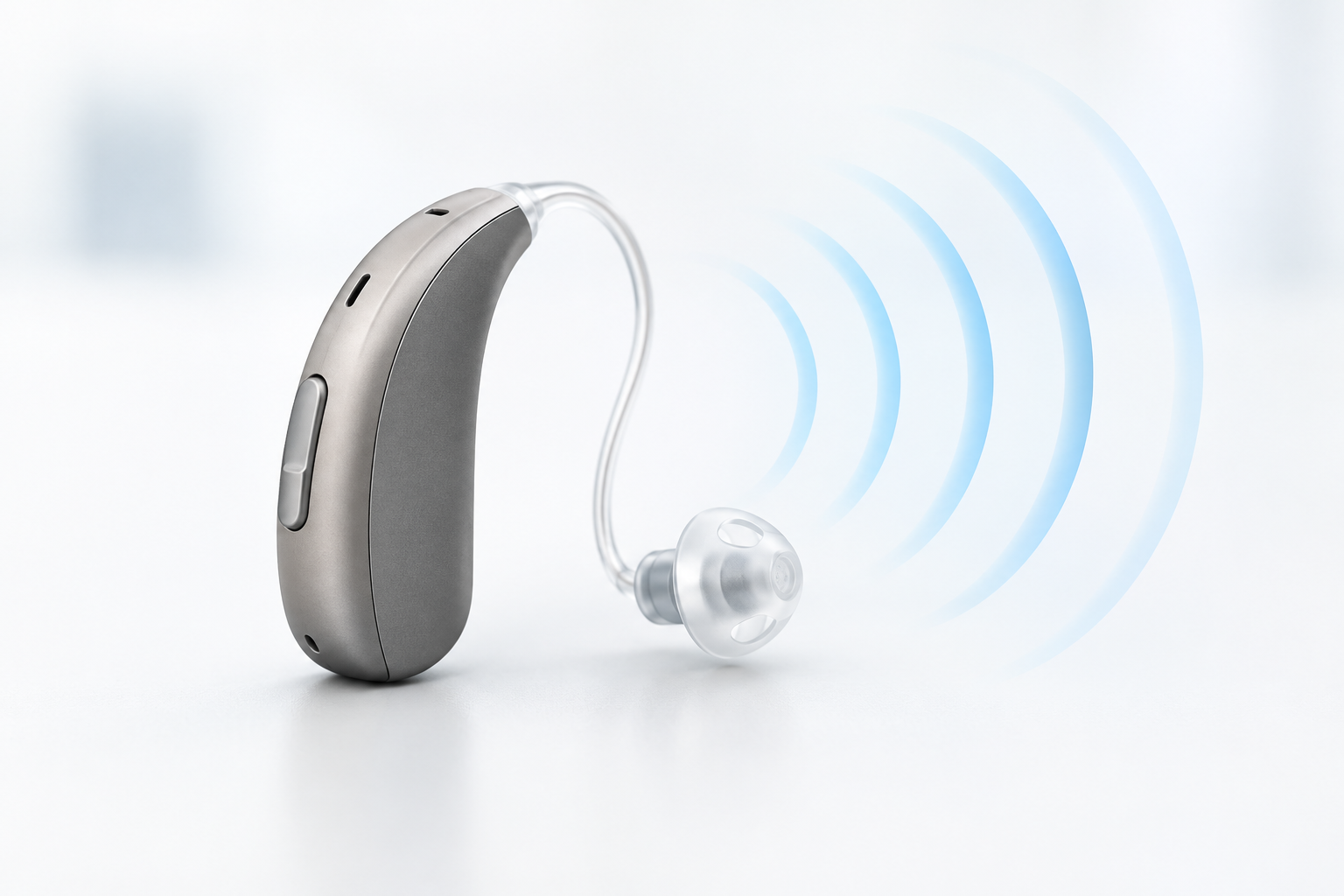
Hearing aids help many people with tinnitus, especially when the ringing comes with hearing loss. Most hearing aid users with tinnitus report at least some relief, and roughly one in five report major relief. They do not cure tinnitus. They make it quieter, less intrusive and easier for your brain to ignore.
Last updated: October 29, 2026
Do hearing aids actually help with tinnitus?
Yes, for the right person. If you have measurable hearing loss and bothersome tinnitus, a properly fitted hearing aid is one of the most practical first steps you can take. The American Academy of Otolaryngology–Head and Neck Surgery (AAO-HNS) clinical practice guideline on tinnitus recommends a hearing aid evaluation for people with persistent, bothersome tinnitus and documented hearing loss. That puts hearing aids among a small group of approaches the guideline actively supports, alongside cognitive behavioral therapy.
The honest framing is relief, not removal. Most people who get a hearing aid for ringing in the ears still hear their tinnitus at times, particularly in quiet rooms or after taking the devices out at night. What changes is how much of your attention the sound grabs and how much it bothers you. For many people, that shift is the difference between tinnitus running the day and tinnitus fading into the background.
If your hearing tests as normal, a standard hearing aid has little to amplify and is unlikely to help much. That is a separate situation covered later in this guide.
Why tinnitus and hearing loss show up together
Tinnitus is the perception of sound, such as ringing, hissing, buzzing or whooshing, that has no outside source. It is common. A 2022 meta-analysis in JAMA Neurology estimated that about 14% of adults worldwide experience tinnitus, and about 2% have a severe form.
The large majority of people with tinnitus also have some degree of hearing loss, often high-frequency loss from aging or noise exposure. Many don’t realize it because the loss is mild or affects pitches they rarely think about, like birdsong, the “s” and “f” sounds in speech, or a microwave beep.
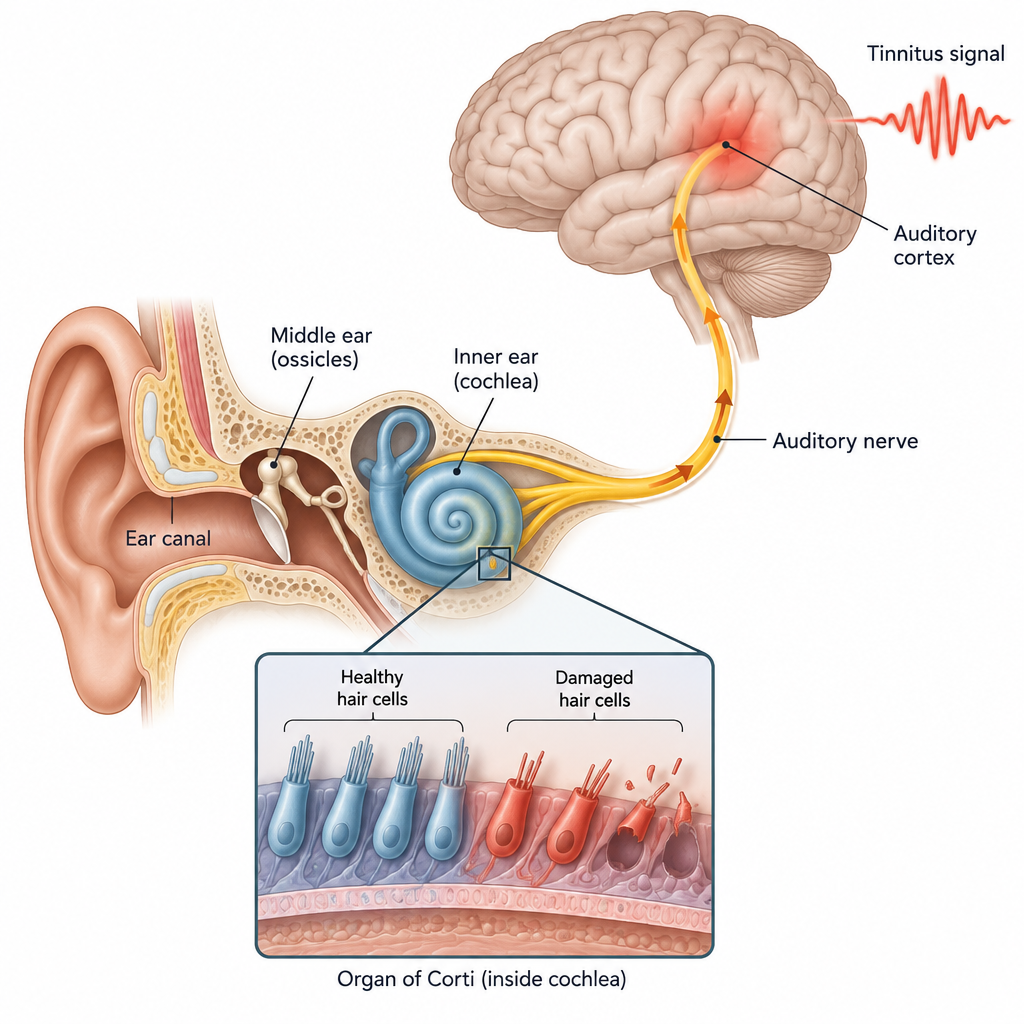
The leading explanation for the link sits in the brain rather than the ear. When damaged hair cells in the inner ear stop sending normal signals for certain frequencies, the auditory system doesn’t simply go quiet. Neurons in the auditory pathway turn up their sensitivity to compensate, a process researchers often call increased central gain. That extra “volume” can produce activity the brain interprets as sound. In plain terms, the brain fills in the gap where input used to be.
This is why tinnitus pitch often matches the region of hearing loss. Someone with a dip around 4,000 Hz from years of loud concerts or power tools frequently hears a tone in that same range. It also explains why quiet makes tinnitus louder. With less outside sound coming in, the internal signal has less competition.
Ludwig van Beethoven described exactly this pattern in an 1801 letter, complaining that his ears buzzed day and night as his hearing declined. Anyone who has asked whether Beethoven was deaf will find that tinnitus was part of his story from the early years of his hearing loss.
How hearing aids reduce ringing in the ears
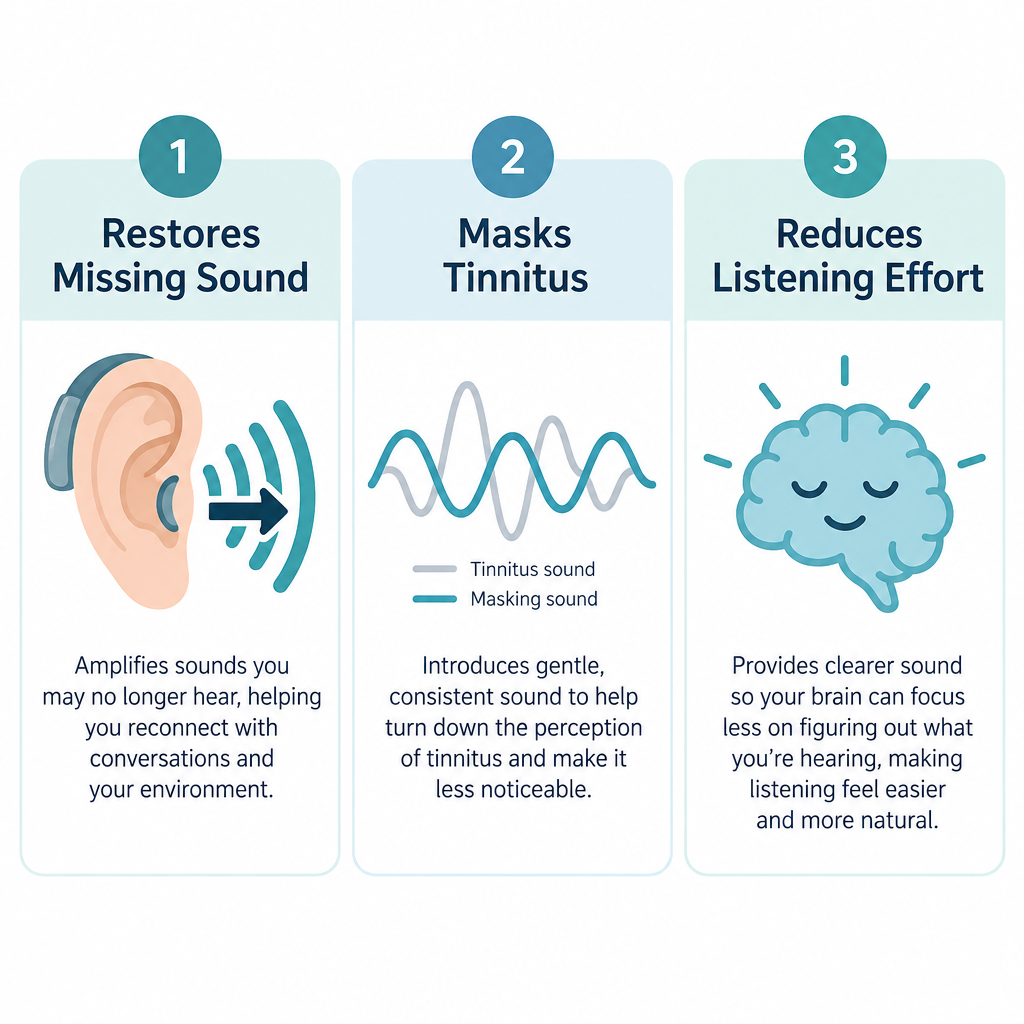
Hearing aids work on tinnitus through several overlapping mechanisms. None is magic on its own, but together they explain why so many users report feeling better.
They restore the missing sound
Amplifying the frequencies you’ve lost gives your auditory system real input again. With more normal signal arriving, the brain has less reason to keep its internal gain cranked up. Over weeks and months, many people notice their tinnitus becoming less prominent even when they aren’t actively listening for it.
This works best when the hearing aid can reach the frequencies involved. Many modern hearing aids deliver useful amplification up to roughly 8,000 to 10,000 Hz. If your loss and tinnitus sit above what the device can amplify, this particular benefit shrinks.
They mask the tinnitus with everyday sound
When you can hear the hum of a refrigerator, traffic outside or the rustle of your own clothes, those sounds partially cover the tinnitus. Audiologists generally aim for partial masking rather than full masking. You should still faintly hear your tinnitus underneath the background sound. Complete masking can bring short-term relief, but partial masking appears to better support habituation, the gradual process in which your brain learns to treat the tinnitus as unimportant.
They reduce listening effort and stress
Straining to follow conversation is tiring. People with untreated hearing loss often end the day exhausted and tense, and stress reliably makes tinnitus more noticeable. Hearing speech clearly lowers that effort. It also redirects your attention outward, toward voices and the world around you, and away from the sound inside your head.
This attentional effect matters more than many people expect. Tinnitus distress is driven heavily by how much focus the sound commands and the emotional reaction it triggers. Hearing aids give your attention somewhere better to go.
Many include built-in sound generators
Most prescription hearing aids from major manufacturers, and some over-the-counter models, include a tinnitus program that plays a gentle sound through the hearing aid itself. Options typically include white, pink or brown noise, ocean-like sounds, or tonal patterns. You or your audiologist can set the volume, and many apps let you switch sounds during the day. Some people use the generator only in quiet settings, such as reading or working alone, and rely on regular amplification the rest of the time.
What the research says
Evidence for hearing aids and tinnitus is encouraging but not airtight. Large surveys show high rates of self-reported relief. Formal clinical trials are fewer and smaller, which is common in tinnitus research.
| Source | What it found |
|---|---|
| MarkeTrak VIII survey (Kochkin, Tyler & Born, 2011) | About 60% of hearing aid users with tinnitus reported some relief; about 22% reported major relief |
| AAO-HNS Clinical Practice Guideline: Tinnitus (2014) | Recommends hearing aid evaluation for persistent, bothersome tinnitus with hearing loss |
| Same guideline | Recommends cognitive behavioral therapy; recommends against routine medications and dietary supplements for tinnitus |
| Cochrane review of sound therapy (Sereda et al., 2018) | No clear difference between hearing aids, sound generators and combination devices; overall evidence quality rated low |
| JAMA Neurology meta-analysis (Jarach et al., 2022) | Tinnitus affects about 14% of adults; about 2% have severe tinnitus |
Two things stand out. First, a majority of users report benefit, which is a strong signal even from survey data. Second, the Cochrane finding suggests the specific delivery method matters less than getting appropriate sound therapy at all. That’s useful when choosing a device: a hearing aid with a solid tinnitus program is valuable, but the fitting and consistent daily use matter at least as much as the brand.
Manufacturers also publish their own studies. Oticon, for instance, reports that users of its hearing aids with Tinnitus SoundSupport experienced a significantly reduced impact of tinnitus. Company-funded research is worth reading, but weigh it below independent trials.
Tinnitus features by hearing aid brand
Every major manufacturer offers a tinnitus feature, though each takes a slightly different approach. The table below covers the main prescription brands and how their tinnitus tools work. Feature availability varies by model and technology tier, so confirm the specific device with your provider.
| Brand | Tinnitus feature | How it works | App control |
|---|---|---|---|
| Oticon | Tinnitus SoundSupport | Broadband noise and nature sounds, including ocean-like options | Oticon Companion app |
| Phonak | Tinnitus Balance | Broadband noise generator; can also stream relaxing audio | myPhonak app |
| Signia | Notch Therapy, plus noise and ocean sounds | Notch Therapy reduces amplification at the tinnitus pitch for tonal tinnitus | Signia app |
| ReSound | Tinnitus Sound Generator | Built-in noise and nature sounds; pairs with the free ReSound Relief app | ReSound Smart 3D and ReSound Relief |
| Widex | Zen | Fractal “Zen” tones and noise designed to be calm and non-repetitive | Widex Moment app |
| Starkey | Multiflex Tinnitus | Customizable noise stimulus shaped to your hearing profile | My Starkey app |
Signia’s Notch Therapy deserves a separate mention because it works differently. Instead of adding a sound, it slightly reduces amplification in a narrow band centered on your tinnitus pitch. The idea is to calm overactive neurons in that region over time. It is intended for tonal tinnitus with a clear, identifiable pitch, so it isn’t the right fit for hissing or broadband tinnitus.
Widex Zen tones are another distinctive option. The fractal tones play in a chime-like, non-repeating pattern, which some people find more relaxing than static noise. Others prefer plain noise. Trying both during a fitting is the only way to know.
Hearing tip
Try each tinnitus sound for at least a few days before deciding. A sound that seems annoying in the clinic often feels different at home in a quiet room.
Prescription, OTC or earbuds: which route makes sense
Since the FDA’s over-the-counter hearing aid rule took effect on October 17, 2022, adults 18 and older with perceived mild to moderate hearing loss can buy hearing aids without a prescription or exam. That opened new, cheaper routes. For tinnitus specifically, though, the right path depends on how much your tinnitus bothers you and how complex your hearing is.
| Route | Typical price range (pair) | Tinnitus programs | Professional fitting |
|---|---|---|---|
| Prescription, independent clinic | Roughly $2,000 to $7,000, often bundled with follow-up care | Standard on most current models | Yes, with ongoing adjustments |
| Prescription, warehouse club | Roughly $1,500 to $2,500 | Varies by model | Yes, in-store hearing test and fitting |
| OTC hearing aids | Roughly $200 to $1,500 for most models | Some models include one; many don’t | Self-fit, sometimes with remote support |
| Earbuds with a hearing aid feature (e.g., AirPods Pro 2 and 3) | About $249 | No built-in tinnitus generator | Self-fit using a hearing test in the app |
Prices vary widely by region, technology level and what’s included, so treat these as broad ranges rather than quotes.
When prescription aids are the better choice
Go prescription if your tinnitus is moderate or severe, if it affects your sleep or mood, or if your hearing loss is more than mild. You get a full hearing test, a verified fitting, a professionally tuned tinnitus program and someone to adjust it as your needs change. Tinnitus support often needs several visits to get right, and that follow-up is what bundled clinic pricing pays for.
Warehouse clubs are a reasonable middle ground. If you’re weighing hearing aids at Costco, ask specifically whether the model you’re offered includes a tinnitus sound generator and whether staff will adjust it, since this varies.
When OTC can work
OTC devices can suit mild hearing loss with mild, occasional tinnitus. Check the product listing for a named tinnitus feature rather than assuming one exists. The FDA requires OTC labels to list warning signs that call for a medical evaluation first, and tinnitus or hearing loss in only one ear is one of them.
Where earbuds fit
Apple’s FDA-authorized hearing aid feature on AirPods Pro 2 and AirPods Pro 3 provides amplification for perceived mild to moderate loss. It doesn’t include a tinnitus generator, but the amplification itself can bring the restoring and masking benefits described above. You can pair it with the iPhone’s Background Sounds feature, covered below, for quiet moments.
How to choose a hearing aid for tinnitus
Start with a hearing test from an audiologist. Knowing the shape of your hearing loss and the pitch and loudness of your tinnitus drives every decision that follows. Then use this checklist when comparing devices:
- A built-in tinnitus sound generator with several sound options and independent volume control.
- App control so you can switch sounds and adjust tinnitus volume on your phone without a clinic visit.
- Bluetooth streaming for music, podcasts or relief sounds sent directly to your ears.
- Wide frequency range, especially if your loss and tinnitus sit in the high pitches.
- Rechargeable batteries, which make all-day wear easier. Most current rechargeable models are rated for a full day of use, though heavy streaming shortens it.
- Receiver-in-canal (RIC) style with open fitting where your hearing allows it. Open fittings let natural sound in and reduce the plugged feeling that can make tinnitus stand out.
- A trial period long enough to judge tinnitus benefit. Ask for at least 30 days.
- Follow-up visits included, since tinnitus programs often need adjusting after a few weeks of real-world use.
Ask the provider directly how they set up tinnitus programs and whether they offer tinnitus counseling. Hearing aid providers vary a lot here. Some fit the devices and switch the tinnitus program on at a default setting. Others tune it carefully and teach you how to use it. You want the second kind.
Getting the fitting right
A great hearing aid fitted poorly will disappoint you. Three details make the biggest difference for tinnitus.
Verified amplification. Ask for real ear measurement, a test that uses a tiny microphone in your ear canal to confirm the hearing aid delivers the amplification your hearing loss actually needs. Without it, many fittings under-amplify the high frequencies, which are exactly the frequencies most linked to tinnitus.
Avoiding occlusion. When an earpiece fully blocks the ear canal, outside sound drops and your own body sounds get louder. Both can make tinnitus more noticeable. Open or vented domes avoid this for many people with mild to moderate loss.
Full-time wear. Hearing aids help tinnitus most when you wear them during all your waking hours. The brain adapts to consistent input, and wearing devices only for social events limits that adaptation. Put them in when you get up and take them out at bedtime.
Setting up a tinnitus program with your provider
- Describe your tinnitus: pitch, loudness, one or both ears, steady or pulsing.
- Ask for real ear measurement to verify the amplification.
- Try two or three relief sounds in the clinic.
- Set the tinnitus volume just below your tinnitus level.
- Confirm you can adjust it in the brand’s app.
- Book a follow-up for two to four weeks later.
What to expect in the first eight weeks
Most people expect hearing aids to bring immediate relief. Some get it. Many experience a more gradual curve, and knowing that ahead of time keeps you from giving up too early.
Days 1 to 7. Everything sounds loud, sharp or tinny. Your own voice may sound strange. Some people notice their tinnitus less right away because the world is suddenly full of sound. Others notice no change yet. Both are normal.
Weeks 2 to 4. Your brain starts adjusting to amplified sound. This is the best time for a follow-up visit, because you now know which situations still bother you. Report when your tinnitus is most noticeable so your provider can adjust the program or add a dedicated quiet-room setting.
Weeks 4 to 8. Many users report that they “forget” about tinnitus for longer stretches. The ringing may sound the same when you deliberately listen for it, but it captures your attention less often. That reduced intrusiveness is the real goal of sound therapy.
Beyond two months. Habituation continues for many months. If you’ve worn the aids consistently and see no benefit at all by the end of your trial, talk to your provider about changing the tinnitus program or adding counseling-based treatment rather than writing off sound therapy entirely.
A small number of people find their tinnitus briefly seems louder when they remove their hearing aids. This contrast effect is common and usually fades as habituation progresses.
The nighttime gap: managing tinnitus after the aids come out
Bedtime is when many people with tinnitus struggle most. The hearing aids come out, the room goes quiet, and the ringing takes center stage. It’s also the moment most hearing aid guides skip.
You can’t sleep in most hearing aids, so plan a separate nighttime sound source. Good options include a bedside fan, a dedicated sound machine, a pillow speaker or soft sleep earbuds. Keep the volume low, below the level of your tinnitus, for the same partial-masking reason that applies during the day.
If you use an iPhone, the built-in Background Sounds feature plays steady noise or nature sounds without needing a separate app. The sound options include Balanced Noise, Bright Noise, Dark Noise, Ocean, Rain and Stream, with more added in later iOS versions.
Turn on Background Sounds on iPhone
- Open Settings.
- Tap Accessibility, then Audio & Visual.
- Tap Background Sounds and switch it on.
- Tap Sound and choose a sound.
- Set Volume below your tinnitus level.
- Turn off Stop Sounds When Locked for sleep.
You can also add a Hearing button to Control Center to start and stop Background Sounds quickly. Android users can find similar noise options in free apps, including the ReSound Relief app, which is available whether or not you own ReSound hearing aids.
Hearing tip
A sleep timer that fades sound out after you’ve fallen asleep works well for some people. Others sleep better with sound running all night. Try both for a week each.
When hearing aids are unlikely to help
Hearing aids for tinnitus work best within a specific profile. Set your expectations differently in these situations.
Normal hearing. If your hearing test shows no loss, a hearing aid has nothing meaningful to amplify. Standalone sound generators, which look like hearing aids but only produce relief sounds, are an option here, as are counseling-based treatments.
Very high-pitched loss and tinnitus. If your hearing loss and tinnitus sit above the frequency range a hearing aid can reach, the restoring effect is limited. Sound generators and masking can still help.
Severe or profound loss. Hearing aids may provide too little benefit. Cochlear implants often reduce tinnitus for people who qualify, though they’re a major decision made with an implant team.
Tinnitus driven mainly by other causes. Tinnitus linked to jaw problems, neck issues, medications, earwax or blood vessel conditions needs its cause addressed. Amplification won’t fix it.
Sound sensitivity alongside tinnitus. If everyday sounds feel painfully loud (hyperacusis), amplification must be set very carefully. Tell your provider before the fitting.
See a professional
Sudden hearing loss in one or both ears is a medical emergency; get seen the same day. Also see a doctor promptly for tinnitus in one ear only, pulsing tinnitus that beats with your heart, or tinnitus with dizziness or ear pain.
Pulsatile tinnitus, a rhythmic whooshing that matches your heartbeat, deserves special mention because it can signal a blood vessel issue that needs imaging. One-sided tinnitus with uneven hearing can occasionally point to a growth on the hearing nerve, which a doctor will want to rule out. These are reasons to see an ENT physician before buying any device.
Other tinnitus treatments to know
Hearing aids are one tool among several. For bothersome tinnitus, combining approaches often works better than any single one. This table summarizes the main options and how strongly the evidence supports them, based mainly on the AAO-HNS guideline and later FDA actions.
| Treatment | What it involves | Evidence and status |
|---|---|---|
| Cognitive behavioral therapy (CBT) | Structured therapy that changes how you respond to tinnitus; available in person, online or by app | Recommended in the AAO-HNS guideline; strongest evidence for reducing distress |
| Hearing aids | Amplification plus optional built-in sound generators | Recommended when hearing loss is present |
| Sound therapy | Noise generators, sound machines, apps | Listed as an option; low-cost and low-risk |
| Tinnitus Retraining Therapy (TRT) | Directive counseling plus long-term low-level sound | Used widely; evidence mixed but supportive for some people |
| Progressive Tinnitus Management (PTM) | A stepped program developed through the U.S. Department of Veterans Affairs | Structured education and sound use, widely used in VA care |
| Lenire bimodal neuromodulation | Sound through headphones paired with mild electrical stimulation of the tongue | Granted FDA De Novo authorization in March 2023; prescribed through clinics |
| Medications and supplements | Includes ginkgo, melatonin and zinc | No drug is FDA-approved for tinnitus; guideline recommends against routine use |
Cognitive behavioral therapy deserves more attention than it gets. It doesn’t change the sound itself. It changes the anxiety, frustration and sleep disruption tied to it, and those are what make tinnitus feel unbearable for many people. Pairing CBT with hearing aids targets both the sound and your reaction to it.
Protecting your remaining hearing matters too. Noise exposure is a leading cause of the hearing loss behind most tinnitus, and loud events can trigger temporary spikes. High fidelity earplugs reduce volume evenly across frequencies, so music and speech stay clear while the risk drops. They’re worth carrying to concerts, sporting events and noisy workplaces.
Key takeaways
- Hearing aids help many people with tinnitus, particularly when hearing loss is also present. About 60% of users report some relief in large survey data.
- They work by restoring missing sound, partially masking the tinnitus, easing listening effort and, in most current prescription models, playing built-in relief sounds.
- They reduce how intrusive tinnitus feels. They don’t cure it.
- Fitting quality and full-time wear matter as much as the brand. Ask for real ear measurement and an open fitting where possible.
- Plan for nighttime separately, since tinnitus often peaks once the aids come out.
- Combine hearing aids with CBT if tinnitus affects your mood or sleep.
- Sudden hearing loss, one-sided tinnitus and pulsing tinnitus need a doctor first.
FAQ
Can a hearing aid stop tinnitus completely?
No. A hearing aid can make tinnitus much less noticeable and less bothersome, and some people say they rarely notice it while wearing their devices. The ringing usually remains in quiet settings or when the aids are out. No hearing aid cures tinnitus.
How long does it take for hearing aids to help with tinnitus?
Some people notice relief on the first day because the world gets louder around them. For most, meaningful improvement builds over several weeks of full-time wear as the brain adjusts. Give it the full trial period before judging.
Do OTC hearing aids help with tinnitus?
They can, if you have mild to moderate hearing loss, because amplification alone brings some masking and attention benefits. Fewer OTC models include a dedicated tinnitus sound generator, so check the listing carefully. If your tinnitus is moderate to severe or affects only one ear, see an audiologist or doctor first.
Will hearing aids help if I have tinnitus but normal hearing?
Usually not much. Standard hearing aids need hearing loss to correct. With normal hearing, standalone sound generators, sound apps and counseling-based approaches like CBT are typically better fits.
Which hearing aid brand is best for tinnitus?
There’s no single winner. Oticon, Phonak, Signia, ReSound, Widex and Starkey all offer tinnitus programs, and research suggests the delivery method matters less than consistent use and a good fitting. Signia’s Notch Therapy can suit tonal tinnitus with a clear pitch, while Widex Zen tones appeal to people who dislike static noise.
Can hearing aids make tinnitus worse?
Rarely, and usually because of a fitting problem. Over-amplification, a fully blocked ear canal or a tinnitus sound set too loud can increase discomfort. Tell your provider right away so they can adjust the settings. Tinnitus that seems louder only when you take the aids out is a common contrast effect that tends to fade.
Does insurance cover hearing aids for tinnitus?
Coverage varies widely by plan. Original Medicare doesn’t cover hearing aids, while many Medicare Advantage plans offer a hearing benefit with limits. Some private plans and state Medicaid programs provide coverage, and the U.S. Department of Veterans Affairs provides hearing aids to eligible veterans. Check your plan documents and ask the provider for an itemized quote.