Category: Earbuds & Phones

  • High Fidelity Earplugs and How They Keep Music Clear

    High Fidelity Earplugs and How They Keep Music Clear

    High fidelity earplugs lower the volume of sound fairly evenly across bass, mids and treble, so music sounds quieter but still clear instead of muffled. Most consumer models cut about 15 to 25 decibels, which is enough to bring a loud concert down to a level your ears can tolerate for much longer. This guide covers how they work, how the leading models compare and how to fit them so they actually protect you.

    TypeFiltered reusable earplugs
    Typical reduction12 to 25 dB
    Price bandAbout $15 to $70
    Best forConcerts, musicians, clubs

    What High Fidelity Earplugs Actually Do

    A foam earplug blocks sound unevenly. It cuts high frequencies much more than low ones. Cymbals, vocals and guitar detail disappear, while bass and kick drum still come through. The result is the familiar “head under a pillow” effect.

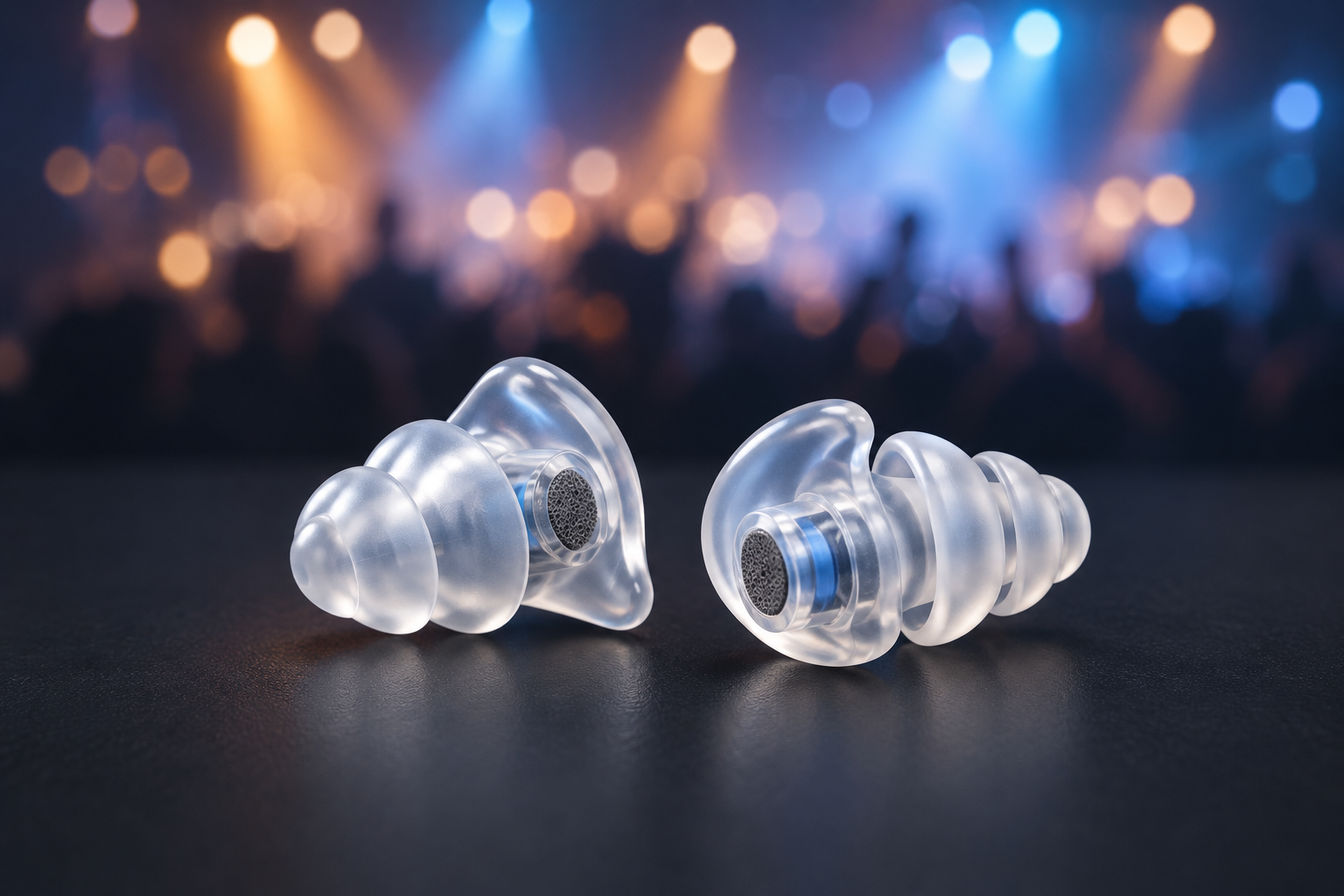
    High fidelity earplugs use a small acoustic filter instead of solid material. The filter is a tuned channel, a membrane, or a damper that lets sound pass at a controlled level. The goal is a flatter response: if the band drops by 20 dB, every part of the mix drops by roughly 20 dB.

    There is a second, less obvious reason foam sounds dull. Your open ear canal has a natural resonance around 2,500 to 3,000 Hz. It boosts that range, which is where much of the clarity in speech and music lives. Plug the canal and that boost vanishes. Good musician filters are designed to restore some of it, which is why they sound more natural than their decibel number suggests.

    No consumer earplug is perfectly flat. Cheaper filtered models are closer to “less muffled” than “transparent.” Even so, the difference from foam is obvious the first time you try a pair at a gig.

    For a broader look at how filtered plugs sit next to foam, wax and silicone, our guide to types of earplugs walks through each material.

    How Loud a Concert Really Is

    Live music commonly measures between 100 and 110 dBA near the stage, with peaks higher still. Clubs and festival stages often run in the same range for hours.

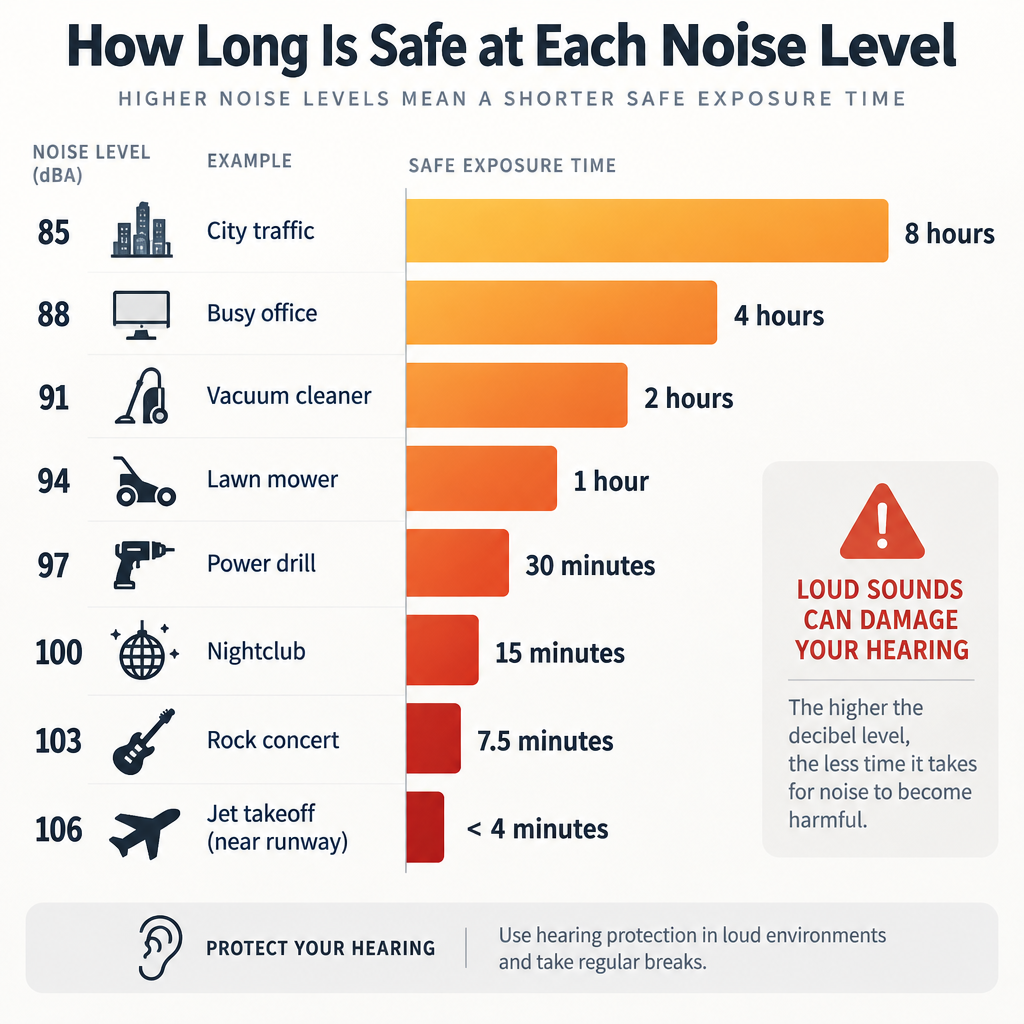
    The US National Institute for Occupational Safety and Health (NIOSH) sets its recommended limit at 85 dBA averaged over 8 hours. Every 3 dB increase halves the safe time. That math gets brutal very quickly.

    Sound level (dBA) NIOSH recommended max exposure Typical example
    85 8 hours Busy restaurant, heavy traffic
    88 4 hours Loud bar
    91 2 hours Subway platform, power tools
    94 1 hour Loud rehearsal room
    97 30 minutes Nightclub floor
    100 15 minutes Rock concert, mid-venue
    103 About 7.5 minutes Concert near the speakers
    106 Under 4 minutes Front row at a loud show

    Now see what a 20 dB cut does. A 105 dBA show becomes roughly 85 dBA at your eardrum, if the plugs fit well. That moves you from a safe window of a few minutes to several hours. This is the main argument for high fidelity earplugs for concerts.

    Hearing tip

    Check the actual volume with a sound meter on your wrist or phone. On Apple Watch, turn on Settings > Noise > Noise Notifications to get an alert when your surroundings stay loud.

    Reading the Numbers: NRR, SNR and Real-World Protection
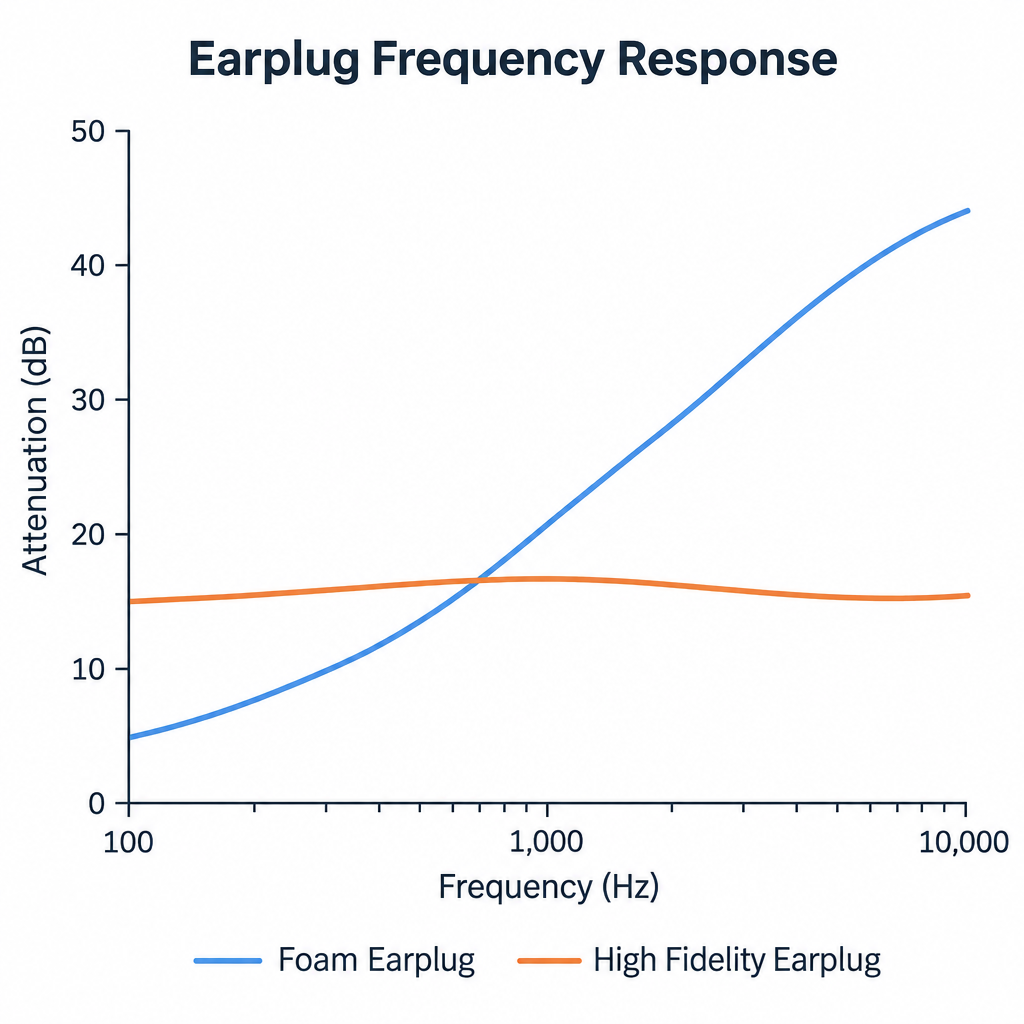
    Flat vs Uneven Frequency Attenuation

    You will see two main ratings on packaging.

    • NRR (Noise Reduction Rating): the US rating required by the EPA. It is measured in a lab with ideal fitting.
    • SNR (Single Number Rating): the European rating under EN 352 testing. It often reads a few dB higher than NRR for the same product.

    Neither number tells you how flat the response is. Two earplugs with the same rating can sound completely different. One might cut bass by 10 dB and treble by 30 dB, while the other cuts both by about 20 dB.

    Lab numbers also overstate what most people get. NIOSH’s 1998 guidance advises derating: subtract 50% from the NRR of formable (foam) plugs, 70% for all other earplugs, such as pre-molded or banded types, and 25% for earmuffs, to estimate typical real-world performance. Fit is the reason. A plug that sits shallow in your canal leaks sound around its edges.

    Many musician filters show a modest NRR that looks low on paper. Etymotic’s ER20XS, for example, carries an NRR of 12 dB, yet it is designed for roughly 20 dB of fairly even reduction. NRR testing weighs low frequencies heavily, and filtered plugs deliberately let more bass through than foam does.

    High Fidelity Earplugs Compared

    The figures below come from each maker’s published specifications. Prices change often, so treat the price bands as rough guides and check before buying.

    Attenuation and Filter Type

    Model Maker’s stated reduction Filter approach
    Loop Experience 2 17 dB (SNR) Acoustic channel and mesh
    Loop Experience 2 Plus 17 dB, plus about 5 dB with Mute insert Same, with add-on insert
    Etymotic ER20XS NRR 12 dB, about 20 dB even reduction Tuned filter in flanged tip
    Minuendo Lossless Adjustable, about 7 to 25 dB User-adjustable filter
    Custom ER9, ER15, ER25 9, 15 or 25 dB, near flat Etymotic filters in molded shells
    Standard foam earplug NRR commonly 29 to 33 dB Solid foam, uneven response

    Eargasm, Alpine, EarPeace and Vibes also publish ratings, but they have changed across product revisions. Read the rating printed on the box you actually buy rather than relying on older reviews.

    Features, Fit and Price Band

    Model Swappable filters Tip sizes included Carrying case Typical price band
    Loop Experience 2 No XS to L silicone, plus foam Yes $25 to $50
    Etymotic ER20XS No Standard or Large fit (sold separately) Yes, with cord Under $25
    Minuendo Lossless Adjustable instead Multiple sizes Yes $50 to $80
    Eargasm High Fidelity No Standard, smaller-ears version available Yes, aluminum $25 to $50
    Alpine MusicSafe Pro Yes, three filter sets One main size Yes $20 to $35
    EarPeace HD Yes, three filter levels Two sizes Yes $20 to $35
    Custom musician plugs Yes, ER filters swap Molded to your ears Usually $150 to $300+ with fitting

    Loop Experience 2 and Experience 2 Plus

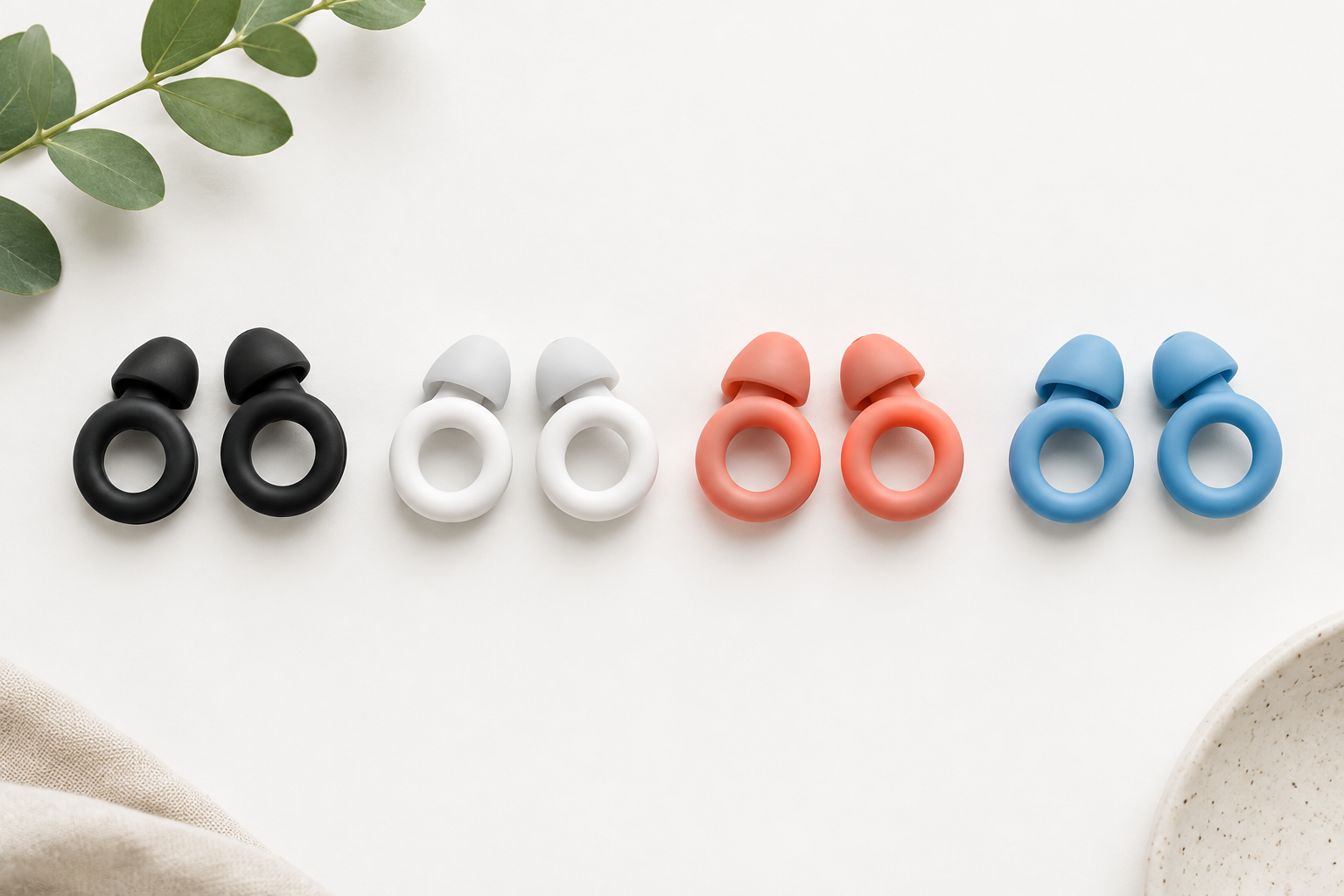
    Loop is the brand most people recognise, partly because the ring design looks like jewelry. The Experience 2 gives a solid 17 dB reduction and a comfortable fit, especially with the foam tip option. The Plus version adds the Loop Mute insert, a small plug that clicks into the ring for roughly 5 dB more when a set gets painfully loud.

    Sound is clear for the price, though treble is slightly rolled off compared with Etymotic. We compare the whole range, including the Engage and Switch lines, in our breakdown of Loop earplugs.

    Etymotic Research ER20XS

    Etymotic is the company behind the original musician filters used by audiologists for decades. The ER20XS is its low-cost, off-the-shelf take on that design. It uses triple-flange tips that sit deep in the canal.

    Many audiologists still point people to the ER20XS as the best value. The deep flanges take some getting used to. Once seated, they give one of the most balanced responses in this price range.

    Minuendo Lossless

    Minuendo’s selling point is adjustment. You turn the filter to choose your level, from light reduction at a quiet acoustic set up to heavy protection near the PA. That is useful if you go to very different kinds of shows.

    The trade-off is price and a bulkier body. People with small ear canals sometimes find the housing sticks out more than they would like.

    Eargasm High Fidelity

    Eargasm earplugs use a soft silicone body with an embedded filter and come in a sturdy aluminum keychain case. They are comfortable for long sets and easy to insert. The company also sells a version for smaller ears, which helps if standard tips never seal for you.

    Alpine MusicSafe Pro

    The MusicSafe Pro is aimed at musicians who want options. It ships with three filter sets you can swap depending on how loud the room is. The ability to change filters makes it handy for players who move between rehearsal rooms and big stages.

    EarPeace HD and Vibes

    EarPeace earned a following among concertgoers, helped by its collaboration with NPR Music. The HD model includes three filter levels and a tiny case that fits on a keyring. Vibes Hi-Fidelity earplugs focus on low-profile design and come with several tip sizes. Both are fair budget picks, though neither is as flat as Etymotic.

    Custom Musician Earplugs

    If you play or attend loud music every week, custom plugs are worth the cost. An audiologist takes impressions of your ear canals, and a lab makes silicone shells fitted with Etymotic ER9, ER15 or ER25 filters. The filters can be swapped later, so one set of molds covers quiet and loud work.

    Custom plugs fit better, seal more consistently and stay comfortable for hours. That consistency matters because a perfect seal is what delivers the rated protection.

    Choosing High Fidelity Earplugs for Concerts
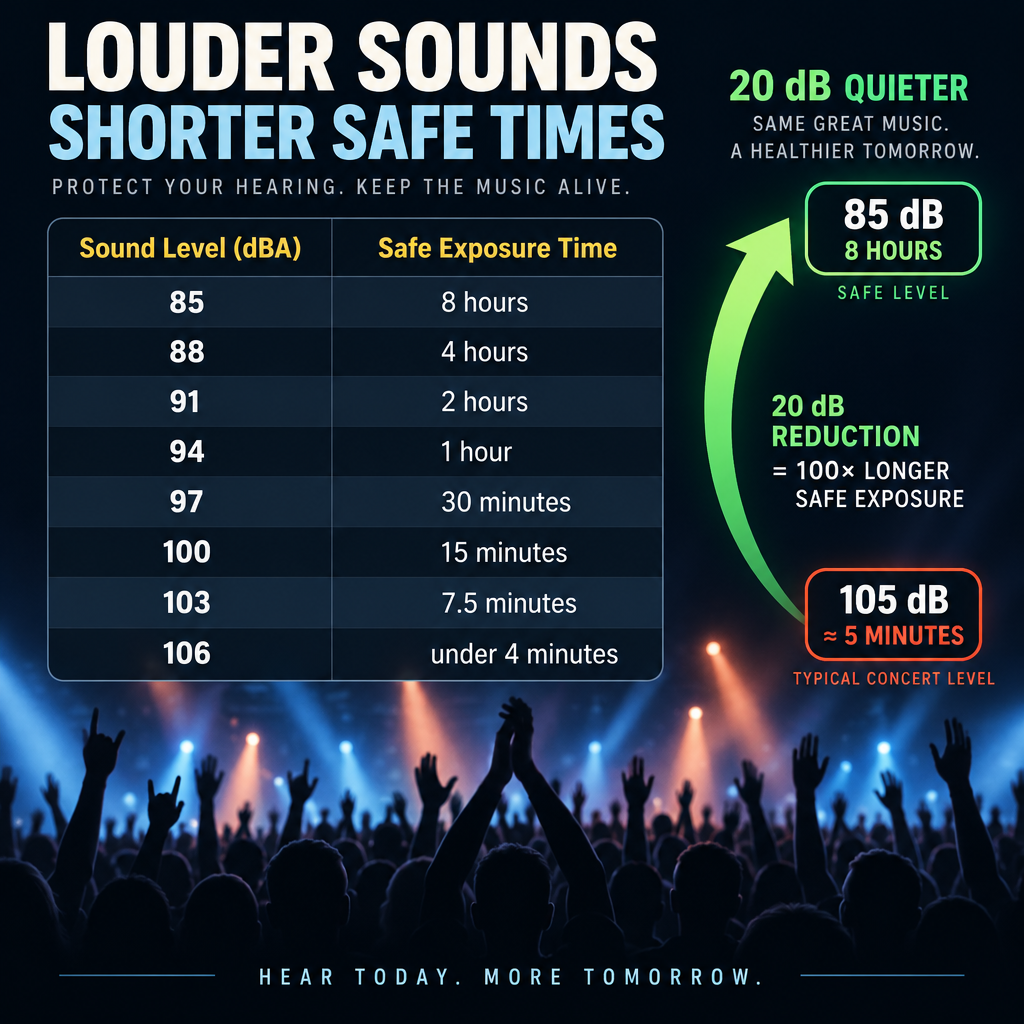
    Concert Safe Exposure Time Table

    Match the plug to how you listen.

    • Occasional concertgoer: Loop Experience 2 or Etymotic ER20XS. Both give around 17 to 20 dB of reduction, which is enough for most shows if you stay away from the speaker stacks.
    • Festival or club regular: Loop Experience 2 Plus or Minuendo, so you can add protection late in the night when sets tend to get louder.
    • Small ears: Eargasm’s smaller-ears version or the Loop XS tip. A plug that does not seal gives you almost no protection.
    • Gigging musician or DJ: custom ER15 or ER25 molds. Off-the-shelf plugs are a fine start, but they will not match a custom seal.
    • Kids at concerts: most adult plugs are too big for young children. Over-ear protective muffs sized for children are usually safer and easier.

    If you can only remember one rule, choose the plug you will actually wear for the whole show. A 33 dB foam plug in your pocket protects nothing.

    How to Fit Them So They Work

    Most complaints about high fidelity earplugs come from shallow fit. If the music barely seems quieter, the plug is probably not sealed.

    Fitting steps

    1. Start with the medium tip and wash your hands.
    2. Reach over your head with your opposite hand and gently pull the top of your ear up and back.
    3. Push the earplug in with a slight twisting motion until the tip sits snugly in the canal.
    4. Release your ear and hum. Your voice should sound louder and fuller inside your head, which means you have a seal.
    5. Rub your fingers near your ear. The sound should be clearly quieter than with the plug out.
    6. If it still sounds open or the plug works loose when you talk, move up one tip size.

    Put your earplugs in before you enter the venue. Your ears can be stressed by the first few songs, and it is easy to forget once the show starts.

    For Musicians: The Occlusion Effect

    Earplugs change how you hear your own voice and instrument. When the ear canal is sealed, sound that travels through your skull gets trapped and amplified at low frequencies. This is called the occlusion effect. Singers, brass players and woodwind players often find it the hardest part of switching to plugs.

    Deeper insertion reduces it. Triple-flange tips like the ER20XS and custom molds that extend past the bony part of the canal tend to cause less boominess than shallow designs. Some musicians also choose a lighter filter, such as the ER9 or ER15, so they can hear pitch and blend while still cutting harmful levels.

    Give it two or three rehearsals. Most players adjust, and their tone usually ends up better because they stop playing harder to hear themselves.

    Are High Fidelity Earplugs Snake Oil?

    This question pops up often on audio forums, and it deserves a straight answer. No, they are not snake oil. The physics of filtered attenuation is well established, and Etymotic’s flat filters have been used by orchestras and audiologists for decades.

    The skepticism comes from three real issues:

    1. “Flat” is a stretch for some cheap models. Budget filtered plugs still cut treble more than bass. They are better than foam, but they are not lab-grade.
    2. Fit varies more than people expect. A plug that leaks sounds clear because it barely blocks anything. Some users mistake poor protection for good fidelity.
    3. Marketing blurs the numbers. Mixing SNR and NRR figures, or quoting best-case attenuation, makes products hard to compare.

    The fair conclusion: a well-fitted pair from an established brand does a real job. Just judge them on protection first and sound second.

    Care, Cleaning and Product Warnings

    Reusable plugs last months or years if you look after them.

    • Wipe the tips after every use with a damp cloth or alcohol-free wipe. Earwax build-up can clog filters and dull the sound.
    • Remove silicone tips and wash them in mild soapy water about once a week if you use them often. Keep the filter itself dry unless the maker says otherwise.
    • Store them in the case. Loose plugs pick up lint and dirt in pockets.
    • Replace tips when they harden, tear or stop sealing.
    • Do not share earplugs. That spreads bacteria and fungal infections.

    Skip earplugs entirely and talk to a doctor first if you have an ear infection, ear pain, discharge, recent ear surgery or a perforated eardrum. Pushing anything into an injured canal can make things worse.

    Remove plugs slowly with a twisting motion. Yanking them out creates suction that can be uncomfortable and, rarely, harmful.

    See a professional

    Ringing or muffled hearing that lasts more than a day after a show needs an audiologist. Sudden hearing loss in one or both ears is a medical emergency: go to urgent care or an ER the same day.

    Why Protecting Your Hearing Now Matters

    Noise-induced hearing loss builds up over years and is permanent. The tiny hair cells in your inner ear do not grow back. Tinnitus, the ringing many people notice after a loud gig, can also become constant with repeated exposure. No earplug or device can cure either, so prevention is the only reliable strategy.

    High fidelity earplugs make that prevention easy because they do not ruin the show. You keep the music and lose most of the risk. For anyone going to more than a couple of concerts a year, a $20 to $50 pair is one of the cheapest ways to look after your hearing.

    FAQ

    How much do high fidelity earplugs reduce sound?

    Most off-the-shelf models cut about 15 to 25 dB, depending on design and fit. Etymotic’s ER20XS is rated NRR 12 dB but delivers around 20 dB of fairly even reduction. Custom musician plugs come in 9, 15 and 25 dB versions.

    Are high fidelity earplugs enough for a loud concert?

    For most concerts, yes, provided they fit well. A 20 dB cut brings a 105 dBA show down to roughly 85 dBA. Very loud shows near the speakers may need extra protection, such as the Loop Mute insert or a higher filter setting, plus breaks away from the stage.

    Do high fidelity earplugs work better than foam?

    Foam blocks more total noise, often NRR 29 to 33 dB. It also muffles high frequencies. High fidelity earplugs block less, but they keep music clear, so most people wear them for the full night. Consistent wear usually beats higher numbers.

    Can I sleep in high fidelity earplugs?

    You can, but they are not designed for it. They let more sound through than foam, and the hard filter body can press uncomfortably on a pillow. Soft foam or silicone sleep plugs are the better choice for sleep.

    How long do reusable earplugs last?

    With regular cleaning, the main body and filter often last a year or more. Silicone tips wear faster and should be replaced when they harden, crack or stop sealing.

    Can earplugs help with tinnitus?

    They can help prevent tinnitus from getting worse by limiting loud exposure. They do not cure or treat existing tinnitus. If your ringing is new, persistent or appears in one ear only, see an audiologist or doctor.
  • Earplugs Explained, From Foam to Silicone to Filtered

    Earplugs Explained, From Foam to Silicone to Filtered

    Last updated: October 29, 2026

    Earplugs protect hearing by sealing or filtering the ear canal. They cut the sound reaching your eardrum by roughly 12 to 33 decibels on paper, depending on the type. Foam plugs block the most noise, silicone putty seals best for water and sleep, and filtered plugs lower volume evenly so music and speech stay clear.

    Most protectionFoam, up to NRR 33
    Best for musicFiltered earplugs
    Best for swimmingSilicone putty
    Longest lastingCustom molded
    Typical costCents to $300+

    What Earplugs Actually Do, and What They Cannot

    An earplug is a passive barrier. It blocks or slows sound waves on their way to the eardrum, and it does this without power, apps or batteries. Electronic sleep buds and active hearing protectors are a separate category, which we cover further down.

    Noise damages hearing by overworking the hair cells in the cochlea, the snail-shaped organ of the inner ear. Those cells do not grow back in humans. Noise-induced hearing loss is permanent, and it often arrives together with tinnitus, a ringing, hissing or buzzing that can persist long after the noise stops.

    The World Health Organization estimates that more than a billion young people are at risk of hearing loss from unsafe listening. That includes personal audio and loud venues. Earplugs are the cheapest and most portable defense we have against this kind of damage.

    They have clear limits, too:

    • They do not restore hearing. No earplug repairs existing damage or cures tinnitus.
    • They cannot block bone conduction. Even a perfect seal lets some sound travel through the skull, which caps how much any plug can achieve.
    • A bad fit wipes out most of the benefit. A loosely inserted foam plug can deliver a fraction of its rated reduction.
    • More is not always better. Over-blocking in moderate noise makes speech harder to follow and tempts people to pull the plugs out entirely.

    The best earplug is the one you will actually wear, correctly, for the whole time you are exposed.

    How Noise Reduction Is Rated: NRR, SNR and Real-World Numbers

    Every hearing protector sold in the United States must carry a Noise Reduction Rating label. Europe and many other markets use a different system. The ratings are useful for comparison, but only once we understand what they leave out.

    NRR in the United States

    The Noise Reduction Rating (NRR) is required by the Environmental Protection Agency under a labeling rule dating from 1979. It is measured in a lab, with trained subjects and fittings done under ideal conditions. The number is expressed in decibels.

    The highest NRR on the US market for earplugs is 33. Several disposable foam products reach it, including well-known lines from Howard Leight, Moldex and Mack’s. Earmuffs top out a little lower.

    An NRR of 33 does not mean you hear 33 dB less in daily life. The lab method rewards an expert, deep fit that most people never achieve on their own.

    SNR and the EN 352 standard

    In Europe, earplugs are tested to EN 352-2 and rated with a Single Number Rating (SNR). The test method differs from the US method. For the same product, the SNR figure is usually a few decibels higher than the NRR.

    This matters when shopping online. Many popular concert and lifestyle brands are based in Europe and advertise SNR. Comparing an SNR from one brand with an NRR from another is comparing two different rulers.

    Some European packaging also lists H, M and L values. These show the expected reduction for high, medium and low frequency noise, which is handy for picking a plug for engines (low-frequency heavy) versus whistles or alarms (high-frequency heavy).

    Why your real protection is lower than the label

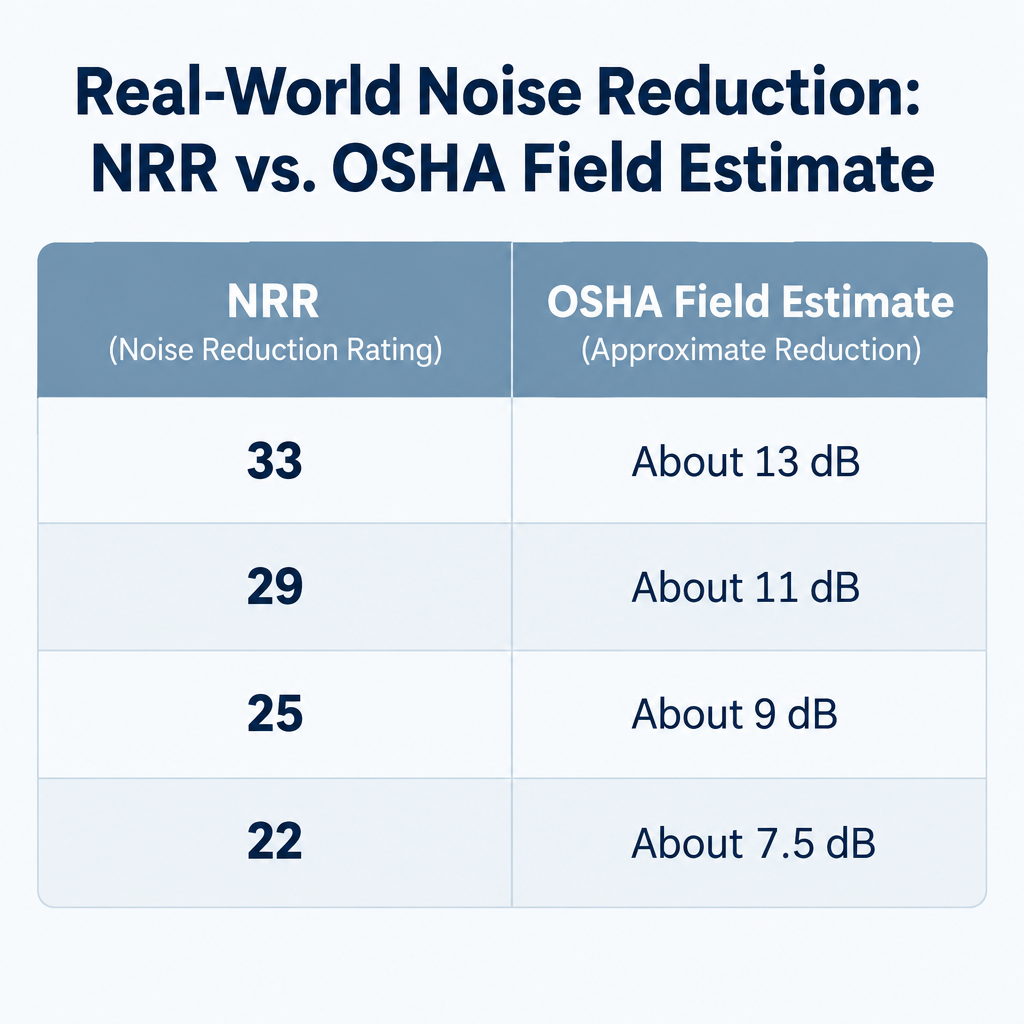
    Occupational safety agencies have long recognized the gap between lab and field. OSHA’s guidance for estimating real protection from a label is to subtract 7 from the NRR and then divide the result by two. NIOSH goes further and recommends derating formable foam plugs by 50 percent and most other earplugs by 70 percent.

    Here is what OSHA’s field method looks like in practice:

    Labeled NRR OSHA field estimate (NRR minus 7, then halved)
    33 About 13 dB
    29 About 11 dB
    25 About 9 dB
    22 About 7.5 dB

    These estimates are deliberately conservative. People who learn proper insertion routinely do much better. Workplaces that run individual fit tests, using systems such as 3M E-A-Rfit or Honeywell VeriPRO, measure a Personal Attenuation Rating (PAR) for each worker. That figure beats any label.

    Hearing tip

    Pairing earplugs with earmuffs does not add the two NRRs together. For this kind of dual protection, OSHA’s guidance is to add only about 5 dB to the NRR of the higher-rated protector.

    How Much Protection You Actually Need

    NRR Field Estimate Chart

    Choosing earplugs starts with knowing how loud your environment is. A free decibel meter app on a phone gives a rough reading. Apple’s Noise app on Apple Watch, and the headphone audio level tracking in the iPhone Health app, are good for spotting trends over a week.

    NIOSH recommends limiting exposure to an average of 85 dBA over eight hours. For every 3 dB increase, the safe time halves. That exchange rate is why a concert hurts hearing so much faster than a busy restaurant.

    Average level NIOSH recommended maximum Common examples (approximate)
    85 dBA 8 hours Heavy city traffic, a loud bar
    88 dBA 4 hours Food blender at close range
    91 dBA 2 hours Gas lawn mower
    94 dBA 1 hour Motorcycle wind noise at speed
    97 dBA 30 minutes Loud sports crowd
    100 dBA 15 minutes Nightclub dance floor, power tools
    103 dBA About 7.5 minutes Rock concert near the front
    106 dBA Under 4 minutes Concert near speaker stacks

    The WHO’s global standard for safe listening venues and events recommends that venues keep levels to no more than 100 dB averaged over 15 minutes. Many concerts and clubs exceed that.

    Once we know the level, the goal is to land comfortably under 85 dBA with the plugs in. At a 103 dBA show, a filtered concert plug giving 15 to 20 dB of real reduction brings us into the low to mid 80s, which is a safe target. On a firing range, where gunshots peak far above 140 dB, no earplug alone is enough.

    Over-protecting is a real problem as well. Dropping a 90 dB environment down to 57 dB with foam plugs makes conversation and warning signals hard to hear. Matching protection to noise is better practice than always grabbing the highest NRR.

    The Main Types of Earplugs

    Each material trades off reduction, comfort, sound quality and cost differently. We group them into seven families.

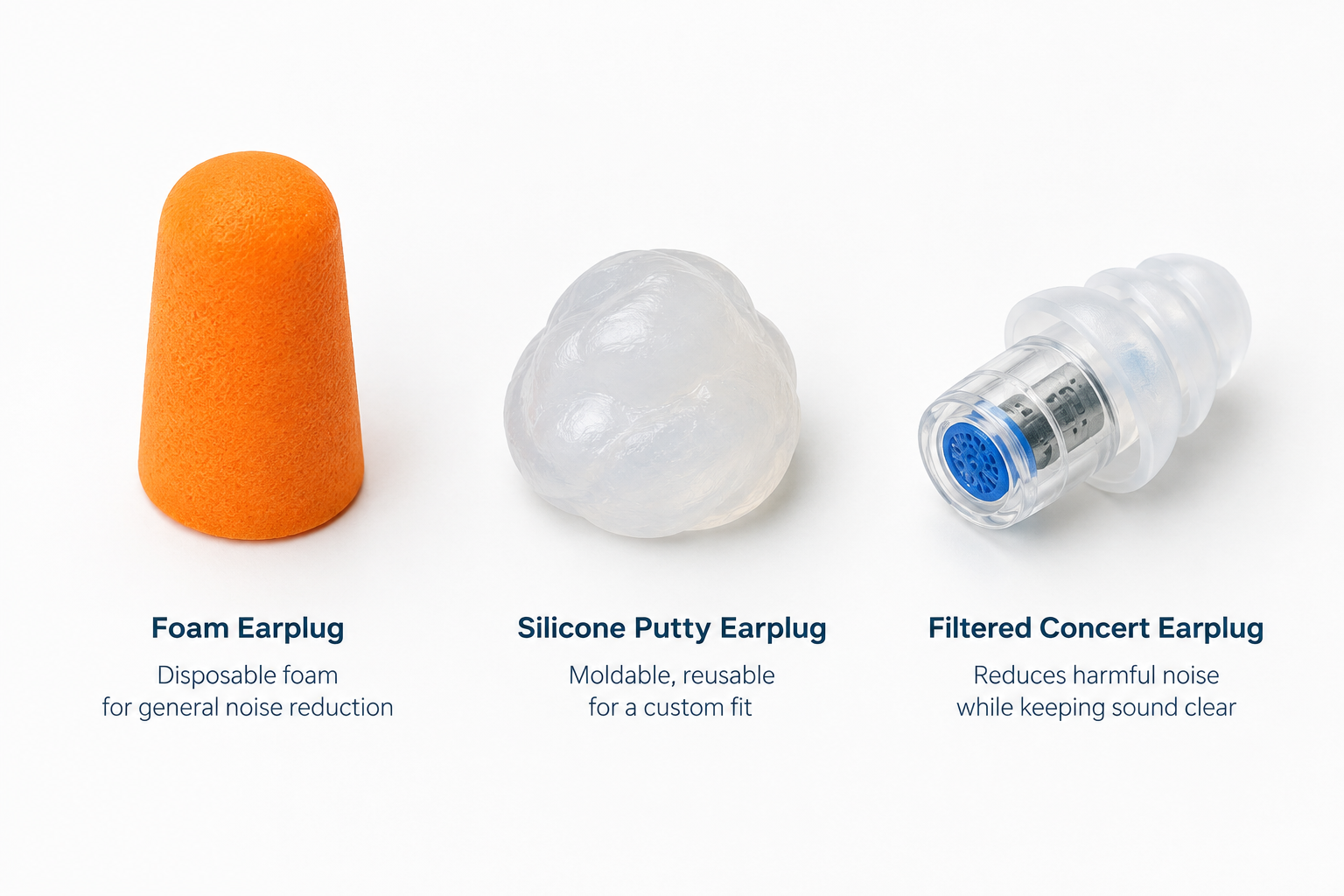
    Foam earplugs

    Disposable foam is the default ear plug for good reason. Slow-recovery polyurethane or PVC foam is rolled into a thin cylinder, inserted, and allowed to expand until it fills the canal. A well-inserted foam plug provides the strongest passive reduction of any earplug type.

    Foam is cheap, widely available and comes in tapered, bell and cylindrical shapes. Smaller sizes exist for narrow canals, and people who find standard plugs painful should try those before giving up on foam.

    Downsides: foam muffles high frequencies more than low ones, so music sounds dull and voices lose clarity. It also absorbs oil and debris, which makes it a poor long-term reusable. Insertion technique matters more with foam than with any other type.

    Best for: sleep, loud work, travel, mowing, short-term heavy noise.

    Silicone putty earplugs

    Moldable silicone putty is shaped into a ball and pressed over the opening of the ear canal, sealing it like a plug in a drain. It does not go deep into the canal. Mack’s Pillow Soft, one of the best-known examples, carries an NRR of 22.

    Putty seals out water extremely well. That makes it the usual choice for swimming, showering and protecting ears after a doctor has advised keeping water out.

    Many side sleepers find putty more comfortable than foam because nothing presses against the canal walls. It can pick up hair and lint, though, and it loses tackiness after a few uses.

    Best for: swimming, bathing, side sleeping, people who dislike deep insertion.

    Pre-molded flanged earplugs

    These are the reusable “Christmas tree” plugs made of silicone or soft thermoplastic, usually with two or three flanges and a stem for handling. They are washable, often come on a cord, and need no rolling.

    Their NRR is typically in the mid-20s. They are popular on job sites where workers remove and reinsert plugs many times a day with dirty hands, since you touch only the stem.

    Fit is less forgiving than foam. A flanged plug either matches your canal size or leaks, which is why many brands sell multiple sizes.

    Best for: repeated on-and-off use at work, people who want something reusable and cheap.

    Wax and cotton blend earplugs

    Wax earplugs have a long history in Europe. The German brand Ohropax, still sold today, is known for its plugs made from wax, cotton wool and petroleum jelly. Body heat softens the wax so it molds over the canal entrance.

    They seal well, block noise solidly, and many light sleepers swear by them. They can feel greasy and may leave residue in hair or on pillowcases.

    Best for: sleep, people who want a moldable seal but find silicone putty too firm.

    Filtered (high-fidelity) earplugs

    Filtered earplugs, often sold as concert or musician earplugs, use an acoustic filter or chamber to lower sound more evenly across frequencies. The aim is a quieter version of the same mix, without the muffled effect of foam.

    This category exploded over the last decade. The Etymotic ER20 (sold as ETY-Plugs) helped popularize it with an NRR of 12. Today the shelves include EARPEACE, Loop, Eargasm, Flare and many more. Several let you swap filters or inserts to change the level of reduction, and limited-edition colors and collaborations are common. EARPEACE, for instance, has partnered with the Rock & Roll Hall of Fame, and Loop has partnered with festivals such as Tomorrowland.

    Real-world reduction varies widely. Many filtered plugs sit between roughly NRR 12 and the low 20s, or a few decibels higher in SNR. Read the label in the units the brand uses, and pay attention to which ear tip size the rating was tested with.

    For a deeper breakdown of one popular brand’s lineup, our guide on loop earplugs compares each model and who it suits.

    Best for: concerts, festivals, clubs, rehearsals, bars, sporting events.

    Custom molded earplugs

    Custom earplugs are made from impressions of your ear canals, taken by an audiologist or hearing professional. The shell is usually medical-grade silicone or acrylic. Because they match your anatomy, they seal consistently and stay comfortable for hours.

    Musicians often pair custom shells with flat-attenuation filters. Etymotic’s long-running ER-9, ER-15 and ER-25 filters, named after their approximate decibels of reduction, are the classic examples. Solid custom plugs without filters are used for industrial work, shooting, motorsport and swimming.

    Some audiologists verify custom musician plugs with probe-microphone equipment similar to what they use for real ear measurement when fitting hearing aids. It is worth asking whether this is included, since it confirms the plugs deliver what they promise.

    Best for: professional musicians, sound engineers, frequent concertgoers, long daily wear.

    Electronic earplugs and sleep buds

    Electronic hearing protectors use microphones and a small amplifier. They let normal sound through at a safe level and clamp down instantly on loud impulses such as gunshots. Shooters and hunters use them so they can hear range commands and wildlife.

    Sleep earbuds are a different idea. They usually provide modest passive blocking and then play masking sounds or white noise to cover snoring and traffic. They need charging, cost far more than passive plugs, and do not provide the reduction of a deep foam seal.

    Best for: shooting and hunting (electronic protectors), light sleepers bothered by irregular noises who dislike silence (sleep buds).

    Comparison at a glance

    Type Typical NRR range Reusable Sound quality Water seal Comfort for sleep
    Foam About 29 to 33 No (a few nights at most) Muffled Poor Good
    Silicone putty About 22 to 23 Several uses Muffled Excellent Very good
    Pre-molded flanged About 24 to 27 Yes, months Muffled Fair Fair
    Wax blend Varies by brand Several uses Muffled Good Very good
    Filtered About 12 to low 20s Yes, months to years Clear and even Poor Fair to good
    Custom molded Depends on filter or design Yes, several years Clear with filters Good with swim design Very good

    Price Guide

    Noise Exposure Time Limits

    Prices shift often and vary between retailers. These are typical ranges we see in the US as of October 2026.

    Type Typical price Approximate cost per pair
    Foam, retail packs $5 to $15 for 20 to 50 pairs 10 to 50 cents
    Foam, bulk industrial boxes $25 to $45 for 200 pairs Under 25 cents
    Silicone putty $5 to $10 for 6 to 12 pairs About $1
    Pre-molded flanged $5 to $20 $1 to $5
    Filtered concert earplugs $20 to $50 Same (lasts months or years)
    Custom molded with filters $150 to $350+, plus fitting fees Same (lasts several years)
    Electronic shooting earplugs $50 to $300+ Same
    Sleep earbuds $150 to $300 Same

    Custom earplug costs vary most by location and clinic. Some audiology practices quote the impressions, shells and filters separately. Check before booking so the total does not surprise you.

    Choosing Earplugs by Use Case

    Most people need more than one type. A pack of foam for sleep and travel plus a pair of filtered plugs for live music covers the majority of everyday situations.

    Concerts, festivals and clubs

    Pick filtered earplugs. They keep vocals intelligible and the bass punchy while bringing levels down to a safe zone. Plugs with interchangeable filters are useful here, since a seated acoustic show and a festival main stage need very different amounts of reduction.

    Foam works in a pinch, and many venues hand it out for free at the bar or merchandise stand. It will still protect you better than nothing at all.

    Wear them from the opening act onward. Damage accumulates across the whole night, and the ringing in your ears on the way home is a warning sign, not a badge.

    Hearing tip

    Keep filtered earplugs on your keyring in their carry case. The best pair is the one you have on you when the support act starts.

    Musicians and sound engineers

    Players who are exposed several times a week benefit most from custom molded plugs with flat filters. Drummers and brass players often need stronger filters than singers or acoustic guitarists.

    Drummers sitting near cymbals, and anyone standing beside a guitar amplifier, should consider the stronger end of the range. Many professional musicians also move to in-ear monitors, which act as hearing protection when set at sensible volumes.

    History offers plenty of cautionary tales about musicians and hearing. Our piece answering the question of whether Beethoven was deaf shows how long the connection between music and hearing loss has fascinated people, even though his case was not caused by stage volume.

    Sleep

    For maximum quiet, foam is hard to beat. Back sleepers usually do well with standard tapered foam; side sleepers often prefer silicone putty, wax or low-profile soft foam that sits flush with the ear.

    A few practical points:

    • Choose the softest foam you can find, because firm foam presses into the canal for hours.
    • Replace foam plugs every few nights, or sooner if they stop expanding properly.
    • Keep an alarm you can still hear. Phone vibration under the pillow, a smartwatch tap alarm or a bed shaker are all options.

    Snoring partners are the most common reason people start sleeping with earplugs. Low-frequency rumble is hard to block completely, so some people combine foam plugs with a fan or white noise machine.

    Loud work and DIY

    For mowing, leaf blowing, power tools, workshops and manufacturing, foam and flanged plugs are standard. Workplaces covered by OSHA must provide hearing protection when noise reaches an eight-hour average of 85 dBA, and must offer a choice of protectors.

    Workers who take plugs in and out all day often prefer flanged or banded plugs. Banded plugs sit on a plastic band around the neck and pop in without being touched.

    If you work in noise regularly, ask whether your employer offers fit testing. A three-minute test tells you exactly how much your plugs are doing.

    Shooting and hunting

    Gunfire is impulse noise. A single unprotected shot from a high-powered rifle can cause immediate, permanent damage. Doubling up, with foam earplugs under earmuffs, is the standard advice for indoor ranges and for shooting large calibers.

    Electronic earplugs and muffs let you hear conversation and range commands at safe levels. They suppress impulses within milliseconds. Hunters often prefer electronic plugs over muffs because they do not interfere with a rifle stock against the cheek.

    Motorcycling

    A helmet does not keep out wind noise, which is often the loudest part of a ride at highway speed. Many riders find that foam plugs make long rides noticeably less tiring, and filtered plugs designed for riders let engine and traffic sounds through at lower levels.

    Check local laws before riding with earplugs. Rules about hearing protection while riding differ between US states and between countries.

    Swimming and surfing

    Use silicone putty, swim-specific flanged plugs or custom swim molds. Noise reduction is not the goal; keeping water out is.

    Regular cold-water surfers face a specific risk called surfer’s ear, a bony growth in the ear canal driven by repeated cold water and wind exposure. Vented surf earplugs block water and wind while letting some sound through so you can still hear other surfers.

    If a doctor has told you to keep water out after ear surgery, an infection or a perforated eardrum, follow their exact instructions on which plugs to use.

    Flying

    Pressure-regulating earplugs, such as EarPlanes, use a filter that slows the rate of pressure change on takeoff and landing. Some travelers with sensitive ears find them helpful. Plain foam also cuts cabin drone on long flights, making it easier to sleep.

    If you have a cold or blocked sinuses, earplugs will not stop the painful pressure that comes from a blocked Eustachian tube. Talk to a pharmacist or doctor about what to do before flying with congestion.

    Focus, study and sensory sensitivity

    Many people use earplugs to work in open-plan offices, study in noisy homes or manage sensory overload. Autistic people and those with sensory processing differences often find that reducing background sound makes busy places like supermarkets and airports more manageable.

    Filtered plugs work well here because they lower clatter without removing speech entirely. Several brands now market specific low-profile models for this purpose.

    Children

    Toddlers and young children are usually better served by kids’ earmuffs, which are easier to fit, harder to lose and do not pose a choking risk. Small foam and putty plugs can be swallowed or pushed too deep.

    Older children can use child-sized silicone putty or small filtered plugs, with an adult checking the fit. Babies at fireworks, motorsport and concerts should wear properly sized infant earmuffs.

    How to Insert Foam Earplugs Correctly

    Most complaints that foam earplugs “do not work” come down to shallow insertion. The roll, pull, hold method fixes this in under a minute.

    How to insert foam earplugs

    1. Wash and dry your hands so you do not push dirt into the canal.
    2. Roll the plug between finger and thumb into a thin, tight crease-free cylinder.
    3. Reach over your head with the opposite hand and pull the top of your ear up and back.
    4. Slide the rolled plug well into the canal while it is still compressed.
    5. Hold it in place with a fingertip for 20 to 30 seconds while it expands.
    6. Check the fit: your own voice should sound deep and hollow.

    When fitted well, most of the plug sits inside the canal and very little shows from the side. If half the plug is sticking out, it is not deep enough. If it hurts, try a smaller or softer foam rather than forcing it.

    To remove foam plugs, twist them gently while pulling slowly outward. Yanking them out quickly can create an uncomfortable suction effect.

    Checking the Seal

    There are three quick checks any earplug wearer can use.

    The voice test. Talk out loud with both plugs in. Your voice should sound louder inside your head and boomy. This is the occlusion effect, and it means the seal is working.

    The hands test. In a steady noise, such as a running fan, cup your hands tightly over your ears. If the sound drops noticeably with your hands in place, your plugs are leaking. Reinsert them.

    The comparison test. Try one ear at a time. Noise should be clearly lower on the plugged side. If both sides sound the same, the plug is not sealing.

    Filtered earplugs need a seal too. They lower sound through the filter, but only if air cannot leak around the tip. Try the different tip sizes that come in the box, and do not assume the medium tip is right.

    Care, Cleaning and Replacement

    Hygiene matters with anything worn in the ear. A dirty earplug can introduce bacteria into the ear canal, and the ear canal stays warm and moist under a plug.

    Type How to clean When to replace
    Foam Not designed for washing After one use, or a few nights for sleep
    Silicone putty Not washable; keep in its case When it loses stickiness or picks up debris
    Pre-molded flanged Mild soap and warm water, air dry When stiff, cracked or discolored
    Filtered Wipe tips with mild soap and water; keep filters dry Tips every few months; whole plug when worn
    Custom molded Mild soap and water, or wipes approved by the maker Usually every few years, or after weight change or ear growth

    Always store reusable earplugs in their carry case rather than loose in a pocket. Spare cases are cheap and save the plugs from lint and crushing. Never share earplugs, and do not use alcohol on filters unless the manufacturer says so, since some filters can be damaged by moisture or solvents.

    Safety: Earwax, Infections and Overuse

    Earplugs are low-risk for most people. Daily, all-night use does carry some well-documented issues, though.

    Earwax buildup. Earwax naturally migrates outward. Pushing a plug in every night can press wax deeper and contribute to blockage, especially for people who already make a lot of wax. Signs include muffled hearing that does not clear after removing the plugs, fullness or itching.

    Outer ear infections. Trapped moisture and dirty plugs raise the risk of otitis externa, a painful infection of the ear canal. Clean or replace plugs regularly and let your ears breathe during the day.

    Irritation or allergy. Some people react to particular foams or silicones. Switching materials usually solves it.

    Over-reliance in quiet places. Wearing earplugs constantly in normal, everyday sound can make the brain more sensitive to sound over time. Audiologists who treat hyperacusis and tinnitus generally advise reserving earplugs for genuinely loud situations.

    Missing alarms. Smoke alarms are loud enough to be heard through most earplugs, but heavy sleepers wearing deep foam may sleep through them. Interconnected alarms with strobe or bed-shaker accessories add a safety layer.

    See a professional

    Sudden hearing loss in one or both ears is a medical emergency. Get seen by a doctor within 24 to 48 hours. See an audiologist or doctor too for ear pain, discharge, persistent ringing or fullness that does not clear.

    Never try to dig out a plug that has gone too deep with tweezers or a cotton swab. A doctor or nurse can remove it safely.

    Earplugs for People Who Already Have Hearing Loss

    It is easy to assume that people who are already hard of hearing no longer need protection. The opposite is true. Remaining hearing is precious, and noise can still damage it further.

    Hearing aid users should take out their hearing aids before putting in earplugs, unless an audiologist has set up a specific protection solution. A hearing aid is not hearing protection. Many modern hearing aids do limit loud sounds, but they are not designed or rated to protect you at concerts or work.

    Some audiologists can make custom earmolds that function as both hearing aid molds and, with a different insert, as protection. Ask about this if you swap between noisy and quiet settings often.

    People who are Deaf or hard of hearing sometimes use earplugs at loud events to reduce physical discomfort or vibration, or to protect any residual hearing they have. If you rely on captions at events, many venues and streaming platforms offer closed captioning, and we explain how it works in a separate guide.

    Common Mistakes With Earplugs

    A few habits undo most of the protection a good earplug offers.

    1. Inserting foam without rolling it tight enough. It expands before it reaches the canal and sits at the entrance.
    2. Choosing by NRR alone. The highest rated plug is useless if it is too uncomfortable to keep in for the whole event.
    3. Putting plugs in only when it already feels too loud. By then your ears may already be fatigued.
    4. Taking them out to talk. At loud venues, speech is usually easier to understand with filtered plugs in, because your ears are not overloaded.
    5. Reusing foam for weeks. Old foam stops expanding properly and harbors bacteria.
    6. Wearing the wrong size. Small canals need small plugs; forcing a regular size causes pain and a poor seal.
    7. Treating earbuds as earplugs. Noise-canceling earbuds are not rated hearing protectors unless the maker has certified them as such. Turning up music to drown out noise adds exposure rather than reducing it.

    FAQ

    Which earplugs block the most noise?

    Disposable foam earplugs with an NRR of 33 block the most noise of any earplug type, provided they are inserted deeply. For extremely loud noise like gunfire, combine foam plugs with earmuffs.

    Are earplugs safe to wear every night?

    For most people, yes. Use soft foam or putty, replace or clean them regularly, and watch for signs of earwax buildup or irritation such as itching, fullness or muffled hearing during the day. If those appear, take a break and see a doctor.

    Do concert earplugs make music sound worse?

    Good filtered earplugs make music quieter rather than duller. Most people find that, after the first few minutes, the sound is clearer than unprotected listening, because their ears are not overloaded and distorting.

    What does NRR mean on earplugs?

    NRR stands for Noise Reduction Rating, a US label required by the EPA and measured under ideal lab conditions. Real-world reduction is usually lower, which is why OSHA suggests subtracting 7 and halving the number to estimate field performance.

    Is a higher NRR always better?

    No. Choose the NRR that brings the noise down to around 70 to 85 dBA. Too much protection in moderate noise makes speech and warning sounds hard to hear, and people are more likely to remove plugs they find isolating.

    Can earplugs cure tinnitus?

    No. Earplugs can help prevent noise from making tinnitus worse, but they do not cure it. Persistent ringing should be checked by an audiologist or doctor, and sudden new tinnitus with hearing loss needs urgent care.

    How long do reusable earplugs last?

    Filtered and flanged earplugs usually last several months to a few years, with replacement tips every few months. Custom molded earplugs often last several years, though they may need remaking if your ears change shape.

    Can I use earplugs with hearing aids?

    Not at the same time in the same ear. Remove your hearing aids and use earplugs in loud situations, or ask your audiologist about custom earmolds and protection options that suit your hearing aids.

    Are earplugs safe for children?

    Older children can use child-sized earplugs under adult supervision. Infants and toddlers should wear properly sized earmuffs instead, since small plugs can be a choking hazard or get pushed too deep.

  • Loop Earplugs Compared and Which Model Fits Your Needs

    Loop Earplugs Compared and Which Model Fits Your Needs

    Loop earplugs do work. They are reusable, filtered silicone earplugs that cut volume by roughly 16 to 27 dB depending on the model, so sound stays clear but gets quieter. This guide compares seven current Loop models, shows how much protection each one gives you in real situations, and matches them to concerts, work, sleep and sensory sensitivity.

    Last checked: October 29, 2026.

    The short answer: which Loop model to buy

    Most people only need one of four Loop earplugs. The others are variations with add-ons or adjustable settings.

    • Concerts, festivals, clubs and loud bars: Experience 2. If you stand near the speakers or spend whole days at festivals, choose Experience 2 Plus, which comes with an extra insert for more reduction.
    • Open offices, commuting, restaurants, family gatherings and noise sensitivity: Engage 2. It gives you the lightest reduction and keeps speech clearest.
    • Sleep, studying and blocking out a partner’s snoring: Quiet 2 for back sleepers and occasional use. Choose Dream if you sleep on your side.
    • One pair for everything: Switch 2. It has three modes on a dial, but you pay more for that flexibility.

    If you work in sustained industrial noise, use firearms, or run power tools all day, do not rely on any of these. Use protection rated for occupational noise, ideally fitted and fit-tested through your employer’s hearing conservation program.

    What Loop earplugs are, and what they are not

    Loop is a Belgian company founded in Antwerp in 2016. It sells reusable earplugs built around a distinctive ring, the “loop” that gives the brand its name. People search for them as loop earplugs, loop ear plugs and loops earplugs. All three refer to the same product family.

    Each earplug has a soft silicone tip that seals your ear canal. A rigid body behind the tip houses an acoustic channel and, on most models, a filter. The ring is a design feature. It also works as a grip, which makes it easier to remove the earplug.

    Loop markets the range as a lifestyle and wellness product. It has been the official earplug partner of the Tomorrowland festival, and it has released collaborations and special colourways, so the plugs show up as fashion accessories as well as hearing protection. That marketing is part of why they are popular. You are far more likely to wear an earplug you do not mind being seen in.

    Loop earplugs are not hearing aids. They do not amplify anything, they are not regulated by the FDA as hearing devices, and they do not treat hearing loss or tinnitus. If you already notice trouble following conversations, that is a separate problem. Since October 2022, adults with perceived mild to moderate hearing loss in the US can buy FDA-regulated over-the-counter hearing aids without a prescription. A hearing test with an audiologist is still the best starting point.

    How Loop earplugs reduce sound

    Loop Models Comparison Chart

    Cheap foam earplugs stuff your ear canal with dense material. They block high frequencies much more than low ones, so music turns muddy and voices sound distant. That is the main reason people take foam plugs out halfway through a gig.

    Filtered earplugs like Loop’s Experience and Engage models let sound pass through a channel and an acoustic filter. They aim for a flatter reduction across frequencies. The result is quieter sound rather than muffled sound. Loop’s designs are not perfectly flat, but they are much closer than foam, and that difference is what you notice on first use.

    The Quiet and Dream models work differently. They block as much as their size and softness allow, because at night clarity does not matter and comfort does.

    SNR, NRR and the number on the box

    Loop publishes its reduction figures as SNR (Single Number Rating), the European rating under the EN 352 standard. US products usually show NRR (Noise Reduction Rating), which is tested under different rules. The two are not interchangeable, and SNR figures usually run a few decibels higher than the NRR for the same plug. Do not compare a Loop SNR directly against a foam plug’s NRR.

    Both ratings come from lab tests with trained subjects and careful insertion. In everyday use you get less protection than the label says, mostly because of fit. A plug that is the wrong size, inserted too shallowly, or loosened by talking and chewing can lose a large share of its rated reduction. Assume your real protection will fall several decibels short of the box figure unless you size and insert the plugs carefully.

    Why a few decibels matter so much

    Decibels are logarithmic. Under the US National Institute for Occupational Safety and Health (NIOSH) guideline, 85 dBA is acceptable for 8 hours. Every 3 dB increase halves the safe time. A 17 dB reduction therefore moves you a long way down the risk curve. A 5 dB gap between two models matters more than the small numbers suggest.

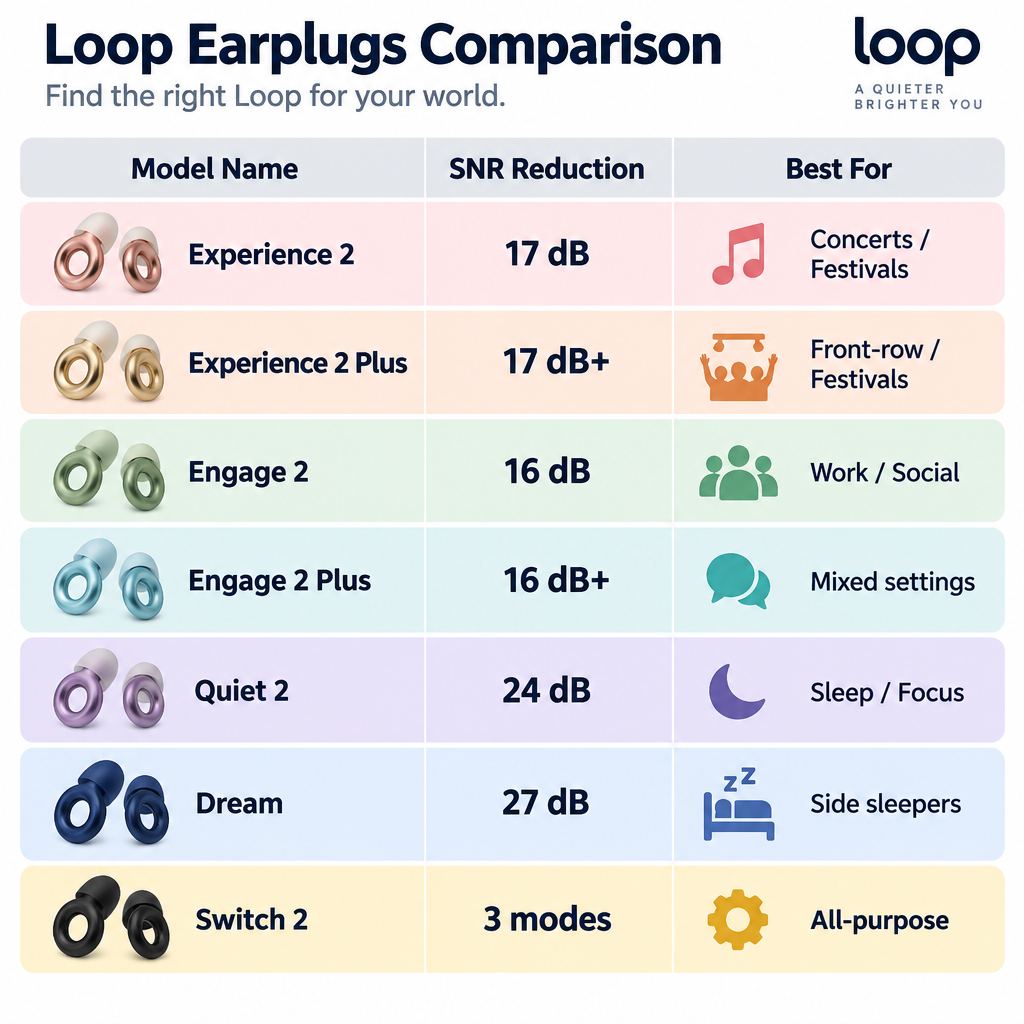
    The Loop lineup at a glance

    The table below covers the current generation as listed by Loop at our last check. Loop revises its figures between generations (the second-generation Experience is rated slightly differently from the original), so check the packaging of the exact version you buy.

    Model Loop’s stated reduction (SNR) Design Best for
    Experience 2 About 17 dB Filtered, ring body Concerts, festivals, nightlife
    Experience 2 Plus About 17 dB, more with Mute insert Filtered, includes Mute Front-row gigs, long festival days
    Engage 2 About 16 dB Filtered, speech-focused Work, social events, sensitivity
    Engage 2 Plus About 16 dB, more with Mute insert Filtered, includes Mute Mixed social and noisy settings
    Quiet 2 About 24 dB Soft, unfiltered silicone Sleep, focus, travel
    Dream About 27 dB Low-profile, sleep-specific Side sleepers, loud snorers
    Switch 2 Three modes via dial Adjustable filter One pair for many situations

    Price tiers

    Loop discounts heavily during sales periods, runs regional pricing, and adjusts list prices over time. We could not confirm the current list price for every model on October 29, 2026. The tiers below reflect the approximate US list prices these models have carried and should be treated as a guide, not a quote.

    Price tier (approx. US list) Models
    About $25 Quiet 2
    About $35 Experience 2, Engage 2
    About $45 to $50 Experience 2 Plus, Engage 2 Plus, Dream
    About $60 Switch 2

    Foam earplugs cost cents per pair. A custom-molded musician’s earplug from an audiologist usually costs well over $150. Loop sits between the two in price, and that is roughly where it sits in performance and convenience too.

    Model by model

    Loop Experience 2

    TypeFiltered reusable earplug
    ReductionAbout 17 dB SNR
    Price tierAbout $35
    Best forConcerts and festivals

    Experience 2 is the model most people picture when they think of Loop. It is tuned for live music. It turns down a loud room while keeping vocals, cymbals and bass detail more intact than foam would. Most wearers report that a gig sounds like the same gig with the volume knob turned down, and that is the point of the product.

    At about 17 dB SNR, it handles a typical club or mid-sized concert well. A loud arena show or a spot directly in front of a festival stack can push it to its limit, as the worked example later in this guide shows. You get four sizes of silicone tips (XS to L) on most packs, and getting the size right matters more than any other choice you make.

    Choose it if music is your main use and you rarely stand in the loudest spot in the venue.

    Loop Experience 2 Plus

    Experience 2 Plus is the same earplug bundled with Loop Mute. Mute is a small insert that closes off part of the acoustic channel for a few extra decibels of reduction. You can put it in when a set gets brutal, or for a DJ’s peak hour, and take it out for quieter stretches.

    This is the better buy if you go to festivals, play in a band, or tend to end up near the barrier. The price difference is small compared with the extra flexibility. Mute is tiny, though. Keep it in the case, not loose in your pocket.

    Loop Engage 2 (and Engage 2 Plus)

    TypeSpeech-focused filtered earplug
    ReductionAbout 16 dB SNR
    Price tierAbout $35
    Best forConversations and work

    Engage 2 gives the lightest reduction in the range, and Loop tunes it to keep speech intelligible. That makes it the right choice for loud restaurants, open-plan offices, crowded commutes, weddings and family gatherings. In those settings you want the background noise turned down without missing what the person beside you says.

    Engage is also the model people with sensory sensitivity most often settle on. That includes many autistic people and people with ADHD or misophonia. It takes the edge off overwhelming environments without the isolation of a stronger plug. Engage 2 Plus adds the Mute insert, which is useful if your day moves from a quiet meeting to a noisy event.

    Choose Engage over Experience if you mainly need to talk while wearing the plugs. For loud music, Experience protects you a little more.

    Loop Quiet 2

    TypeSoft sleep and focus earplug
    ReductionAbout 24 dB SNR
    Price tierAbout $25 to $30
    Best forSleep and study

    Quiet 2 is the cheapest Loop and the most different in design. It has no filter. It is a soft silicone plug built to block as much noise as possible while staying comfortable for hours. Loop rates it at about 24 dB SNR, much more than the filtered models.

    It works well for back sleepers, airplane cabins, studying in a noisy home and partners who snore at moderate volume. Side sleepers often find that the ring presses against the ear when the head is on a pillow, and that pressure gets uncomfortable over a full night. Foam earplugs with a high NRR can still block more noise than Quiet 2, so if raw blocking power matters more than comfort, foam still beats it on value.

    Loop Dream

    TypeSide-sleeper earplug
    ReductionAbout 27 dB SNR
    Price tierAbout $45 to $50
    Best forSide sleepers, snoring

    Dream is Loop’s sleep-specific model. It has a slimmer, lower-profile shape designed to sit flatter in the ear so a pillow does not push it in or pry it out. It is also the strongest Loop at about 27 dB SNR, which puts it in the range of good-quality foam plugs.

    It costs about double Quiet 2. That premium makes sense if you sleep on your side every night or share a bed with a heavy snorer. If you only need earplugs for occasional hotel stays, Quiet 2 is enough.

    Loop Switch 2

    Switch 2 has a small rotating dial that moves between three modes. Loop names them after its main product lines: an Engage-style mode for conversation, an Experience-style mode for music, and a Quiet-style mode for maximum blocking. Instead of carrying two or three pairs, you turn the dial.

    The trade-off is that each mode is a compromise. In Quiet mode, Switch 2 does not block as much as a dedicated Dream, and the dial makes the body bulkier than a standard Experience 2. Switch 2 suits travellers and people who move between very different environments in one day. If you mostly do one thing, a dedicated model works better and costs less.

    Features compared

    Feature Experience 2 Exp. 2 Plus Engage 2 Quiet 2 Dream Switch 2
    Acoustic filter Yes Yes Yes No No Yes
    Adjustable reduction No Via Mute No No No Three modes
    Speech stays clear Good Good Best Poor Poor Mode-dependent
    Comfortable side sleeping No No No Fair Yes No
    Includes Mute insert No Yes No (Plus: yes) No No No
    Reusable and washable Yes Yes Yes Yes Yes Yes

    None of the Loop models is rechargeable, electronic or Bluetooth-connected. They are purely passive. That is an advantage: no battery to die halfway through a festival, no app, and nothing to update.

    Help me choose: match the model to the noise

    Picking the right Loop depends more on how loud your situation is, and for how long, than on how the plug looks. This table uses the NIOSH guideline (85 dBA for 8 hours, with safe time halving every 3 dB) and typical sound levels. Real levels vary widely by venue and position.

    Situation Typical level Unprotected safe time (NIOSH)
    Busy restaurant 70 to 85 dBA Most of a workday or more
    Heavy city traffic About 85 dBA About 8 hours
    Subway platform, train arriving 90 to 100 dBA 2.5 hours down to 15 minutes
    Club dance floor About 100 dBA About 15 minutes
    Concert near the stage 100 to 110 dBA 15 minutes down to under 2 minutes

    Concerts and festivals

    Here is a worked example. Say a concert averages 103 dBA where you stand, which is common for rock and electronic shows. Unprotected, NIOSH puts your safe dose at about 7.5 minutes.

    Experience 2 is rated at about 17 dB. With careful fit you might get 12 to 15 dB in practice, which brings you to roughly 88 to 91 dBA. That gives you a safe time of about 2 to 4 hours. With a poor fit and only 10 dB of real reduction, you sit around 93 dBA and have barely over an hour.

    That is why a single headline act in Experience 2 is usually fine, while a 10-hour festival day near the main stage is where you should step up to Experience 2 Plus with Mute in. The other answer is to stand further back. Distance from the speakers is free protection, and it can easily give you several decibels.

    Hearing tip

    Put your earplugs in before the first band starts, not when it starts to hurt. Pain is a late signal, and ringing ears after a show mean you already took more than a safe dose.

    Work, commuting and open offices

    Engage 2 suits office life best. It takes the clatter out of an open-plan floor and the screech out of a train braking, and you can still hear a colleague say your name. For calls on a headset, take the earplugs out. Wearing both adds pressure and can muddy the call audio.

    If you work somewhere with legally regulated noise exposure, such as a factory, workshop, construction site or airport ramp, your employer’s hearing conservation program should specify protection. A lifestyle earplug is not a substitute for protection that has been fit-tested in that environment.

    Sleep

    Quiet 2 and Dream are the sleep options. Back sleepers usually do fine with Quiet 2. Side sleepers tend to prefer Dream’s lower profile. Keep your expectations realistic. No earplug fully blocks loud low-frequency snoring, because bass travels through your skull as well as your ear canal. Better earplugs turn snoring from a problem into background noise.

    If you wear earplugs every night, make sure you can still hear a smoke alarm. Test it once with your plugs in. If you cannot hear it clearly, look into a vibrating bed-shaker alarm or a strobe alarm. People who are Deaf or hard of hearing use these widely, and they are worth considering for anyone sleeping with strong protection.

    Sensory sensitivity, autism, ADHD and misophonia

    Many people buy Loop for sensory regulation rather than hearing protection, and Engage 2 is usually the best starting point. It takes the harshness out of supermarkets, classrooms, school pickups and busy offices while keeping you connected to conversation. Some people keep a Quiet 2 in their bag for moments when everything becomes too much.

    In the US, earplugs and quieter workspaces are common examples of workplace accommodations. The Americans with Disabilities Act is the main US disability rights act covering employment. It generally requires covered employers to provide reasonable accommodations for qualifying disabilities, which can include sensory needs. If your workplace is hostile to you wearing earplugs, that law is worth reading up on.

    Musicians, DJs and sound engineers

    Musicians playing every week usually need more than Loop. Experience 2 works well for a drummer’s occasional rehearsal or a DJ’s weekend set, especially the Plus version. People who play loud music professionally get better results from custom-molded musician’s earplugs fitted by an audiologist. Those use interchangeable flat-response filters and seal more consistently than off-the-shelf tips. They cost several times more, but they last for years and are far more consistent.

    Kids

    Loop’s tips can be small enough for older children, and Loop has offered child-focused options. For toddlers and young children at fireworks, sporting events or concerts, over-ear protective earmuffs are usually the safer choice. They are easier to fit, harder to lose and carry no risk of being pushed too far into a small ear canal. Infants should always wear earmuffs, never earplugs.

    Loop versus other hearing protection

    Option Sound quality Max blocking Cost Best for
    Foam earplugs Muffled Very high Very low Sleep, maximum noise
    Loop filtered models Clear, quieter Moderate Moderate Concerts, social, work
    Other filtered brands (e.g. Etymotic, Eargasm, Vibes) Clear, quieter Moderate Moderate Concerts, social
    Custom musician’s earplugs Most natural Moderate High Regular musicians
    Earmuffs Muffled High Low to moderate Kids, tools, shooting ranges
    ANC earbuds with loud sound reduction Varies Varies High Commuting, everyday noise

    Some earbuds now offer hearing protection features. Apple added a Hearing Protection feature to AirPods Pro 2 through a software update in 2024, which helps minimize exposure to loud environmental noise across listening modes. You can review it on an iPhone under Settings, then the AirPods name, then Hearing Health. The feature works, but the earbuds need charging, cost far more than a Loop, and are easier to lose or have stolen at a festival. For a long gig day, cheap passive earplugs are still the more practical choice.

    Fitting, sizing and care

    Fit decides how much protection you actually get. A perfectly rated Loop in the wrong tip size will protect you worse than a cheap foam plug inserted properly.

    How to fit Loop earplugs

    1. Start with the medium tip that comes pre-fitted.
    2. Reach over your head with the opposite hand and gently pull the top of your ear up and back to straighten the canal.
    3. Insert the tip with a slight twisting motion until it feels sealed, with the ring sitting naturally in your ear.
    4. Speak a sentence aloud. Your voice should sound noticeably fuller and more internal.
    5. Gently tug the ring. If the plug slides out easily or you can hear the room clearly, try the next size up.
    6. If it hurts, presses or itches after 10 minutes, try the next size down.

    Many people need different tip sizes for each ear, which is normal. Ear canals are rarely symmetrical.

    The “fuller voice” effect in step four is called the occlusion effect. It shows the plug is sealing properly. For some people it is the most annoying part of wearing earplugs, especially in conversation. It usually becomes less noticeable within a few uses. Engage 2 handles it a little better than the other models.

    Cleaning and replacing tips

    Wipe the plugs after each use. Every week or two, or after a sweaty festival, wash the silicone tips in lukewarm water with mild soap, rinse them, and let them dry fully before storing. Take the tips off the body first, and keep the body itself out of soaking water, because water can get into the filter.

    Replace the tips when they lose their bounce, become discoloured or stop sealing. Loop sells replacement tips, so you do not need to buy a whole new pair. Do not share earplugs. Ear canals carry bacteria and wax, and shared earplugs spread infections.

    Hearing tip

    Frequent earplug use can push earwax deeper into the canal. If your ears feel blocked after a few weeks of nightly wear, ask a doctor or audiologist to check. Do not dig around with cotton swabs.

    Honest drawbacks of Loop earplugs

    Loop earplugs come up constantly in online forums. When you look past the marketing, some complaints repeat across thousands of user reports.

    • The ring catches on things. Hair, hats, hoods and pillows snag on it. That is fine at a concert and annoying in bed, which is why Dream exists.
    • They can work loose. Talking, chewing and dancing move your jaw and gradually loosen the seal. Re-seat the plugs every hour or so at a long event.
    • They are easy to lose. The carry case is small. Clip it to a keyring or a bag zip.
    • Quiet 2 is not the strongest sleep option. If your only goal is maximum blocking at night, foam earplugs or Dream outperform it.
    • The price surprises people. You are paying for reusability, sound quality and design. If you only go to one concert a year, a pair of disposable filtered plugs or good foam plugs does the job.
    • Experience is not enough for everything. About 17 dB is right for most gigs and too little for a full day directly in front of the stage.

    Taken together, Loop’s main strength is that people actually wear them. A comfortable, discreet earplug you keep in for the whole show protects you better than a stronger plug you take out after twenty minutes because it makes the music sound like it’s underwater.

    Hearing health: when earplugs are not enough

    Earplugs prevent damage. They do not reverse it. If you already have symptoms, put down the shopping list and get your hearing checked.

    See a professional

    Sudden hearing loss in one or both ears is a medical emergency. See a doctor or go to urgent care the same day, because treatment works best within the first few days.

    You should also see an audiologist or doctor if:

    • Ringing, buzzing or muffled hearing after a loud event lasts longer than a day or two.
    • Tinnitus is new, gets worse, or is only in one ear.
    • Everyday sounds start to feel painfully loud (possible hyperacusis).
    • You often ask people to repeat themselves or turn the TV up more than the rest of your household.

    Tinnitus and overprotection

    Earplugs do not cure tinnitus, and no reputable earplug brand claims they do. For some people they make tinnitus more noticeable at night, because blocking the room sound leaves the ringing as the loudest thing you hear. A quiet fan or sound machine with Quiet 2, or with lighter protection, often works better than total silence.

    Audiologists also warn against wearing earplugs all the time in ordinary environments if you have sound sensitivity. The brain can respond to constant quiet by turning up its own sensitivity, which makes normal sounds feel even louder. Use your Loops for situations that are actually loud or overwhelming, and talk to an audiologist about sound therapy if sensitivity is affecting your daily life.

    If you already have hearing loss

    Earplugs and hearing aids do different jobs, and you cannot wear both at once. If you have hearing loss and still go to concerts, ask your audiologist about it. Many modern hearing aids have noise programs, and your audiologist can tell you whether to remove the aids and use plugs, or use a dedicated program.

    Earplugs can also make speech harder to follow if your hearing is already reduced. In noisy social settings, some hard of hearing people do better with assistive tools than with more blocking: a remote microphone paired to their hearing aids, live captions on a phone, or closed captioning on venue screens and at home. At home, if you wear Quiet 2 to shut out a noisy household while watching something, switching on captions keeps the dialogue accessible.

    Special editions and collaborations

    Loop releases limited editions regularly. Its long-running partnership as Tomorrowland’s official earplug brand has produced festival-branded versions, and collaborations such as the Paris Hilton edition have brought special colours and packaging. Loop also sells exclusive finishes through its own store.

    These editions are usually cosmetic variations of the core models, so the acoustic performance follows the base product. Before you buy, check which model a special edition is built on and confirm its stated reduction on the product page or box. A limited-edition Experience is still an Experience. Pick the model for your use first and the colour second.

    FAQ

    Do Loop Earplugs really work?

    Yes. Loop’s filtered models reduce volume by about 16 to 17 dB, and the sleep models by about 24 to 27 dB, according to the company’s published SNR figures. In real use you get somewhat less, mainly because of fit. With the right tip size and proper insertion, they meaningfully cut your noise dose at concerts, in loud venues and during sleep.

    What’s so special about Loop Earplugs?

    Three things set them apart. The filtered models reduce sound more evenly across frequencies than foam does, so music and speech stay clear. They are reusable with replaceable tips. And the design is comfortable and stylish enough that people actually wear them. Many people value that last point most, because an earplug you leave in your pocket protects no one.

    Can you still hear everything with Loop Earplugs?

    With Experience 2 and Engage 2 you still hear music, voices and announcements clearly, just more quietly. Engage 2 keeps speech the clearest. With Quiet 2 and Dream you hear far less, which is the point for sleep. Test that you can still hear your smoke alarm before relying on them at night.

    What is the difference between Loop Earplugs and regular earplugs?

    Regular foam earplugs block as much sound as possible and cut high frequencies hardest, so everything sounds muffled. Loop’s filtered models aim for a more balanced reduction that keeps sound natural. Loop plugs are also reusable and washable, while foam plugs are usually disposable. Foam can block more total noise for far less money, which still makes it a good choice for maximum blocking.

    Which Loop is best for concerts?

    Experience 2 suits most concerts. Choose Experience 2 Plus if you stand near the speakers, play in a band or attend multi-day festivals, because its Mute insert adds extra reduction for the loudest moments.

    Can you sleep in Loop Experience earplugs?

    You can, but they are not designed for it. The filter lets through more sound than a sleep plug, and the rigid ring presses against a pillow. Quiet 2 is the better choice for back sleepers and Dream for side sleepers.

    Do Loop earplugs help with tinnitus?

    They help prevent noise exposure that can cause or worsen tinnitus, but they do not treat it. If you have ongoing tinnitus, see an audiologist or doctor. Tinnitus in one ear, or tinnitus that comes with sudden hearing changes, needs prompt medical attention.