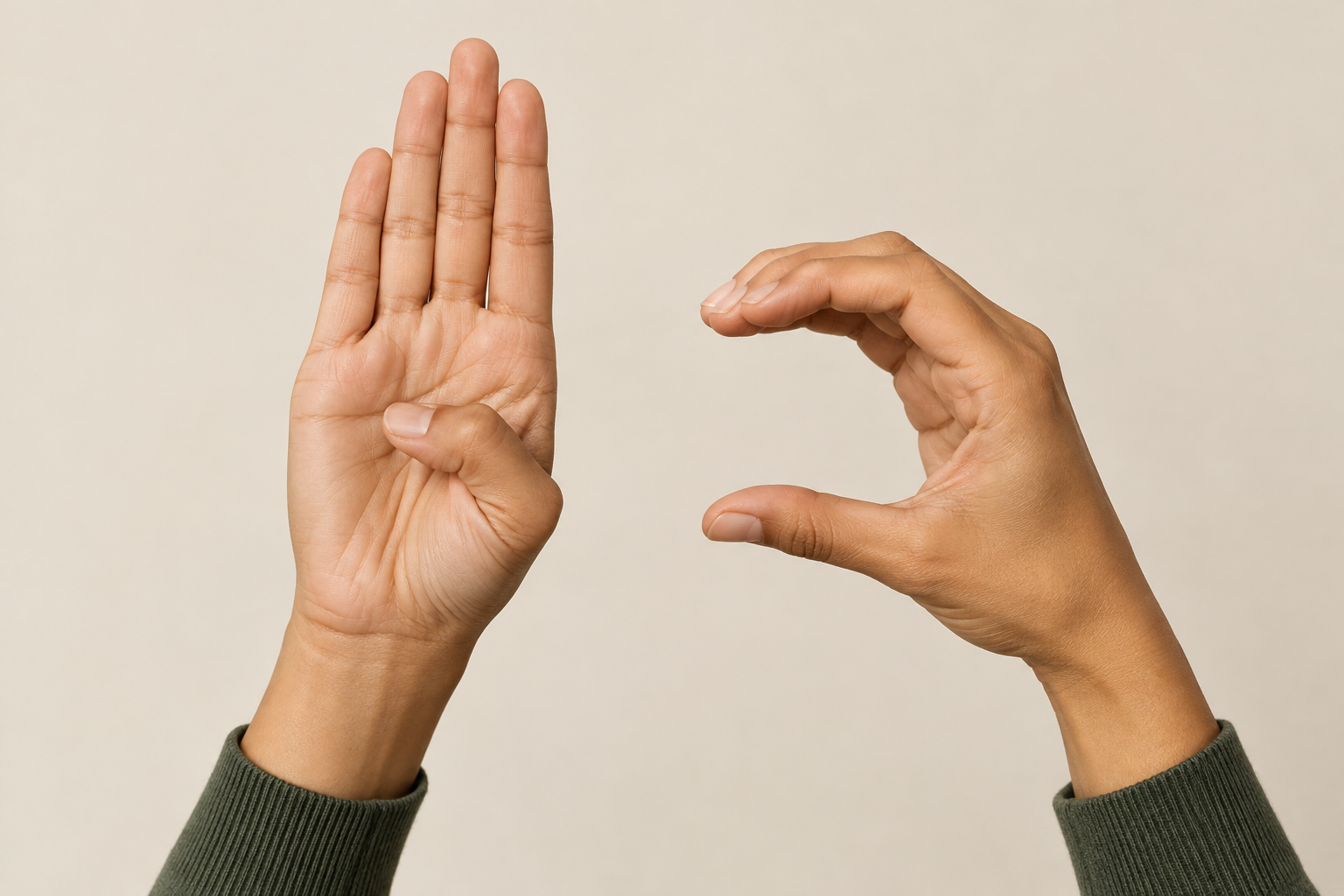
Category: ASL & Sign Language

  • What ASL Means and How American Sign Language Began

    What ASL Means and How American Sign Language Began

    ASL stands for American Sign Language, the visual language used by many Deaf and hard of hearing people in the United States and much of English-speaking Canada. It is a complete language with its own grammar, separate from English, and it took shape after America’s first permanent school for deaf students opened in Hartford, Connecticut, in 1817. Below you’ll find what the term means, where the language came from, and how to sign a few core words yourself.

    Full nameAmerican Sign Language
    Took shapeEarly 1800s, Hartford
    Main ancestorFrench Sign Language
    GrammarSeparate from English

    What ASL Means

    A sign language is a natural language that uses the hands, face and body in space instead of sound. In ASL, the meaning of a sign depends on five things: handshape, location, movement, palm orientation, and non-manual markers such as facial expression and head position.

    ASL is not English spelled out on the hands. Systems like Signed Exact English follow English word order, but ASL has its own syntax. To ask “Are you going to the store?” you might sign YOU GO STORE? with your eyebrows raised. Raised eyebrows mark a yes/no question. For a question like “What’s your name?” you would sign YOUR NAME WHAT? with your eyebrows pulled down.

    Your face is grammar in ASL, not decoration. Leave the eyebrows out and the sentence can read as a statement.

    Other Meanings of “asl” Online

    If you found this page through a text message, the letters may mean something else entirely.

    Term Meaning Where you’ll see it
    ASL American Sign Language Schools, the Deaf community, dictionaries
    a/s/l “Age, sex, location?” 1990s chat rooms and early messaging apps
    asl “As hell,” as in “tired asl” Recent texting and social media slang

    Context tells you which one is meant. Capitalized and in a sentence about deaf people or language, it is almost always American Sign Language.

    How American Sign Language Began

    Before 1817, deaf Americans used home signs and local sign systems. One of the best known grew up on Martha’s Vineyard, where hereditary deafness was common enough, especially around Chilmark, that hearing and deaf neighbors alike signed. Historians believe Martha’s Vineyard Sign Language fed into early ASL.

    The turning point came from Hartford. Mason Fitch Cogswell, a local doctor whose daughter Alice was deaf, helped send minister Thomas Hopkins Gallaudet to Europe in 1815 to study deaf education. The Braidwood family schools in Britain kept their methods close. In London, Gallaudet met Abbé Roch-Ambroise Sicard of the Paris school for the deaf and two Deaf teachers, Jean Massieu and Laurent Clerc.

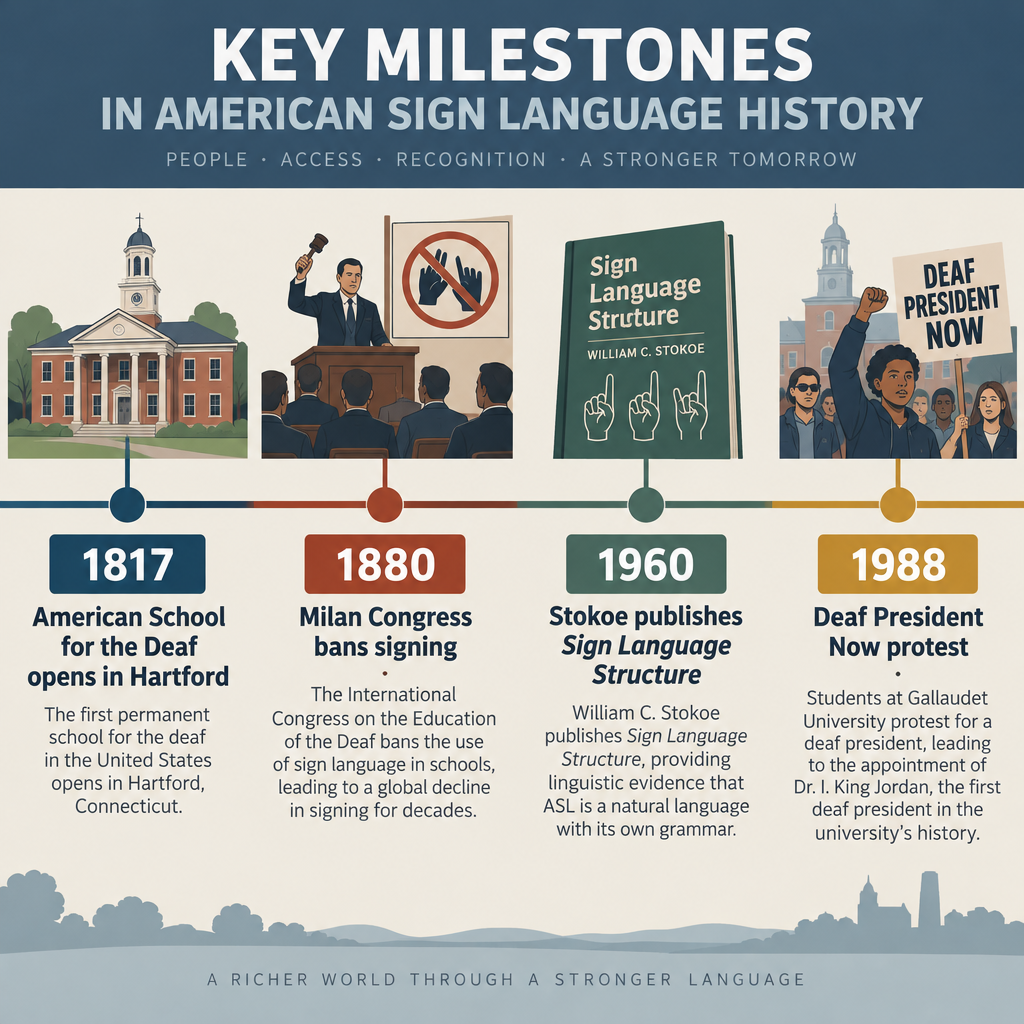
    Gallaudet studied in Paris, and Clerc agreed to come to America in 1816. Together they opened what is now the American School for the Deaf on April 15, 1817. Students arrived with their own home and regional signs, and those blended with Clerc’s French Sign Language (LSF). Comparisons of vocabulary have found that a little over half of core ASL signs share roots with LSF, which is why ASL is grouped in the French sign language family.

    Key Dates in ASL History

    Year Event
    1815 Gallaudet travels to Europe to study deaf education
    1817 American School for the Deaf opens in Hartford
    1864 Abraham Lincoln signs the charter for the college that becomes Gallaudet University
    1880 Milan congress votes for oral-only teaching; the National Association of the Deaf is founded
    1913 George Veditz films “The Preservation of the Sign Language”
    1960 William Stokoe publishes Sign Language Structure
    1965 Stokoe, Casterline and Croneberg publish A Dictionary of American Sign Language on Linguistic Principles
    1988 Deaf President Now protest; I. King Jordan becomes Gallaudet’s first Deaf president
    1990 The Americans with Disabilities Act is signed

    How ASL Survived the Oral Era

    ASL Origins Timeline

    In 1880, a mostly hearing gathering of educators in Milan voted that deaf children should be taught through speech and lipreading alone. Many American schools followed. Signing was banned in classrooms, and Deaf teachers lost their jobs.

    ASL survived anyway. Children passed it on in dormitories, and adults kept it alive in Deaf clubs, churches and Deaf families. In 1913, NAD president George Veditz recorded a signed film defending the language, including the line often quoted today: “As long as we have deaf people on earth, we will have signs.”

    When Linguists Recognized ASL

    William Stokoe, a hearing English professor at Gallaudet, showed in 1960 that signs break down into smaller parts the same way spoken words break into sounds. That work, and the dictionary that followed in 1965, convinced linguists that ASL was a real language. The 1988 Deaf President Now protest then put Deaf leadership in the national spotlight. Today many states accept ASL for high school world language credit.

    How many people use ASL? Nobody knows precisely. The U.S. Census doesn’t ask, and researchers have traced the frequently repeated 250,000 to 500,000 figure back to data from the 1970s.

    ASL Is Not Universal
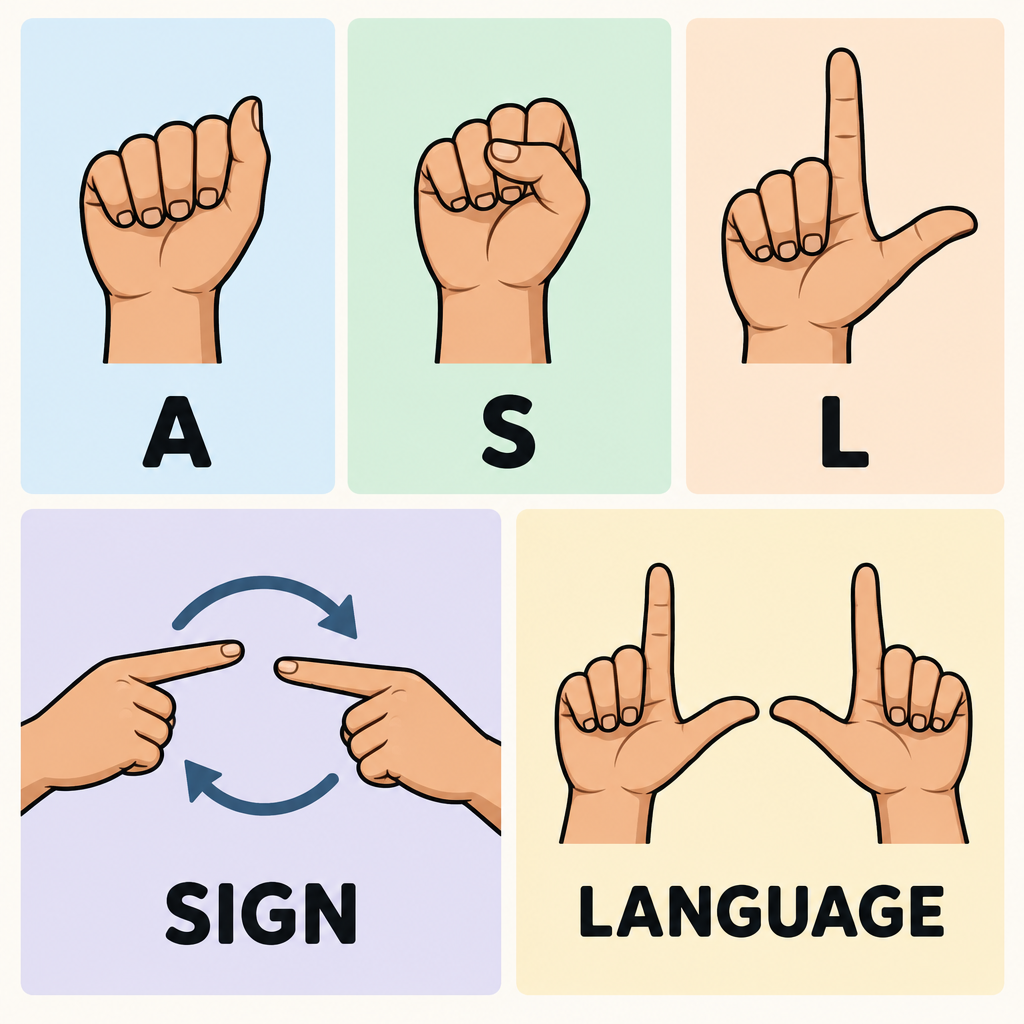
    ASL Basic Handshapes Chart

    Sign language isn’t one global language. The United Nations counts more than 300 sign languages worldwide, and ASL is only one. A British signer and an American signer can’t easily understand each other, even though both countries speak English.

    Sign language Main region Family
    ASL United States, English-speaking Canada French
    LSF France French
    LSQ Quebec French-influenced
    BSL United Kingdom BANZSL
    Auslan Australia BANZSL

    Even the manual alphabet differs. ASL fingerspelling is one-handed, while BSL uses two hands. Our sign language alphabet guide walks through every ASL letter from A to Z.

    How to Sign a Few Basic Words in ASL

    These descriptions use a right-handed signer. Left-handed signers mirror them.

    Word Handshape Location Movement
    ASL Letters A, S, L Near your shoulder Fingerspell in quick sequence; many signers trace a small circle
    SIGN Both index fingers extended In front of your chest Hands circle alternately back toward you
    LANGUAGE Both hands in L shape, palms down Thumbs nearly touching in front of you Pull apart while twisting slightly
    DEAF Index finger Cheek near the ear, then near the mouth Two light touches (either order is common)
    HEARING Index finger held sideways In front of your mouth Small forward circles
    MEAN Bent V on right hand, left palm up Right fingertips on left palm Touch, twist the wrist, touch again
    WHAT Both open hands, palms up In front of your body Small side-to-side shake, eyebrows down

    To sign “sign language” in ASL, sign SIGN followed by LANGUAGE.

    Practice steps

    1. Learn the manual alphabet first so you can fingerspell names.
    2. Watch videos made by Deaf signers.
    3. Replay each sign at half speed and copy it.
    4. Practice in a mirror, checking your face.
    5. Join a class or Deaf community event.

    Hearing tip

    You don’t need to unmute an ASL lesson. Turn the sound off and watch the hands and face, the way a Deaf signer would.

    Where You’ll See ASL Today

    ASL is everywhere once you look: interpreters at press briefings, Deaf performers on stage, and video relay calls. Video relay is one form of telecommunications relay service, connecting ASL users with hearing callers through an interpreter. Under the Americans with Disabilities Act, the main U.S. disability rights act, many businesses and public bodies must provide effective communication, which can mean an interpreter. Closed captioning helps many viewers, but it isn’t a full substitute, because English is a second language for many Deaf people whose first language is ASL.

    See a professional

    If you or your child notice hearing changes, book an audiologist. Sudden hearing loss in one or both ears is a medical emergency, so see a doctor right away.

    FAQ

    Is ASL the same as sign language?

    No. ASL is one specific sign language. “Sign language” is the umbrella term for all of them, including BSL, LSF and Auslan.

    Is ASL based on English?

    No. ASL developed largely from French Sign Language mixed with American home and regional signs. Its grammar differs from English.

    How do you sign “I love you” in ASL?

    Raise your hand with the palm facing out, then extend your thumb, index finger and pinky while folding your middle and ring fingers down. This handshape combines the letters I, L and Y.

    How long does it take to learn ASL?

    Basic conversation can come within months of regular classes and practice. Fluency takes years, just as it does with any spoken language.

    What does “asl” mean in a text?

    It usually means “as hell” in current slang. In older chat rooms, “a/s/l” asked for age, sex and location.
  • Sign Language Alphabet With Every Letter From A to Z

    Sign Language Alphabet With Every Letter From A to Z

    The American Sign Language (ASL) alphabet uses 26 one-handed handshapes, one for each letter from A to Z. Twenty-four letters are held still, and two (J and Z) are traced in the air. Below you’ll find a written description of every letter, the pairs beginners mix up most, and how other countries spell with their hands.

    Letters26 handshapes
    Hands usedOne
    Moving lettersJ and Z
    RootsFrench manual alphabet

    What the sign language alphabet is (and isn’t)

    The ASL alphabet is a manual alphabet. It represents the letters of written English on the hand. Signers call using it fingerspelling. It is a small part of ASL, not the whole language.

    Most ASL conversation runs on signs, which stand for whole words and concepts. Each sign has its own handshape, location, movement and facial expression. You fingerspell when no established sign exists or when the exact spelling matters:

    • Personal names and place names
    • Brand names, titles and technical terms
    • Words borrowed from English that a signer wants to show precisely
    • Clarifying a sign the other person doesn’t know

    Some fingerspelled words have been used so often that they’ve worn down into signs of their own. Linguists call these lexicalized fingerspellings. #OK, #NO, #JOB and #BACK are common examples, with the letters blended into a single quick movement.

    Research by linguist Carol Padden found that ASL signers fingerspell more often than users of many other sign languages. That means good fingerspelling skills pay off quickly once you start talking with Deaf people.

    Sign language is not universal

    A common surprise for new learners: there is no single world sign language. The World Federation of the Deaf estimates more than 300 sign languages are in use. Each grew up inside its own Deaf community, with its own grammar and vocabulary.

    Alphabets differ too. British, Australian and New Zealand signers share a two-handed alphabet. The United States and much of English-speaking Canada use the one-handed ASL alphabet. So “sign language alphabet” really means “a sign language’s alphabet.” This article focuses on the American one.

    How to hold your hand for fingerspelling

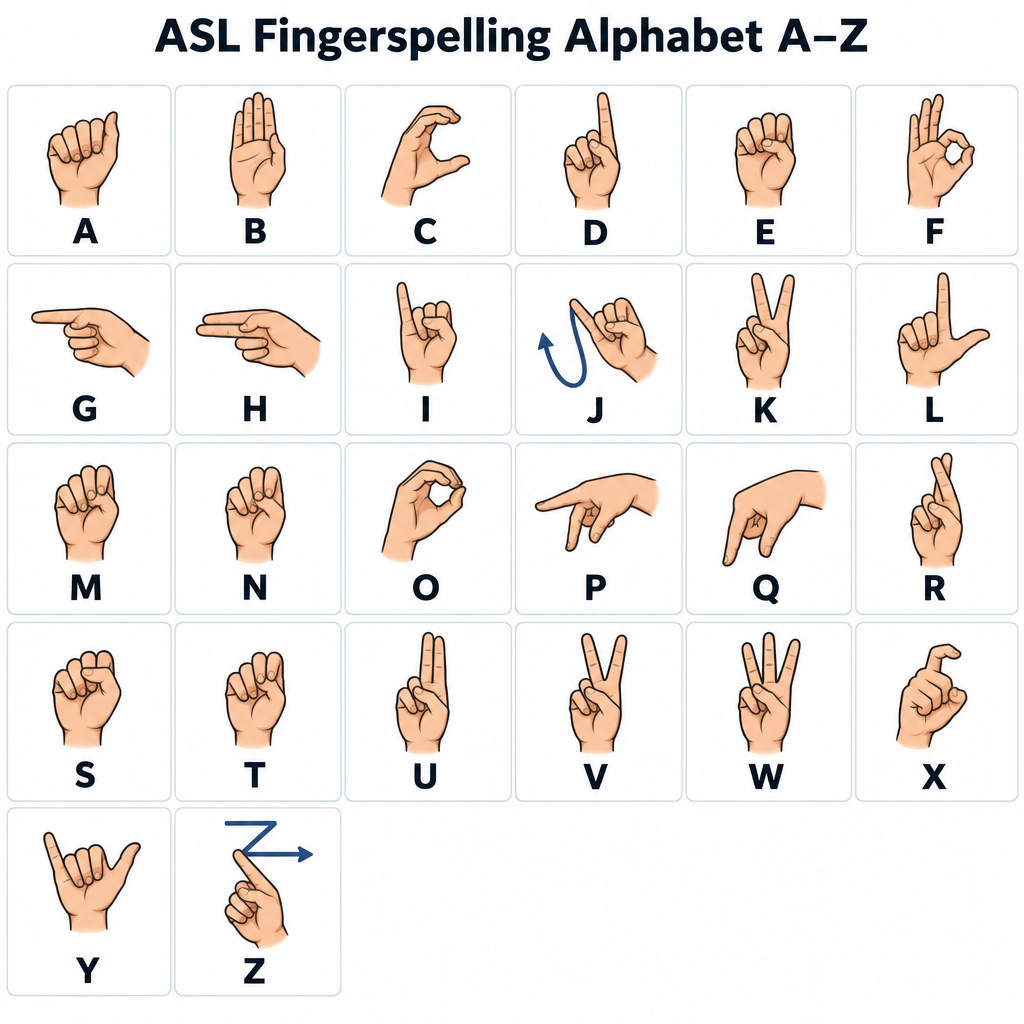
    ASL Alphabet A-Z Chart

    Before you learn the letters, set up your position. Good form makes you easier to read and saves your wrist during long practice sessions.

    Fingerspelling setup

    1. Use your dominant hand only (right if you’re right-handed).
    2. Hold your hand beside your chin or shoulder, slightly forward.
    3. Keep your elbow relaxed and close to your body.
    4. Face your palm toward the person watching, for most letters.
    5. Hold the hand steady; change only the handshape between letters.

    Avoid bouncing your hand on every letter. A small, deliberate bounce or slide is reserved for double letters, as in BOOK or HELLO.

    The ASL alphabet, letter by letter

    Each description assumes your palm faces outward unless noted.

    A to G

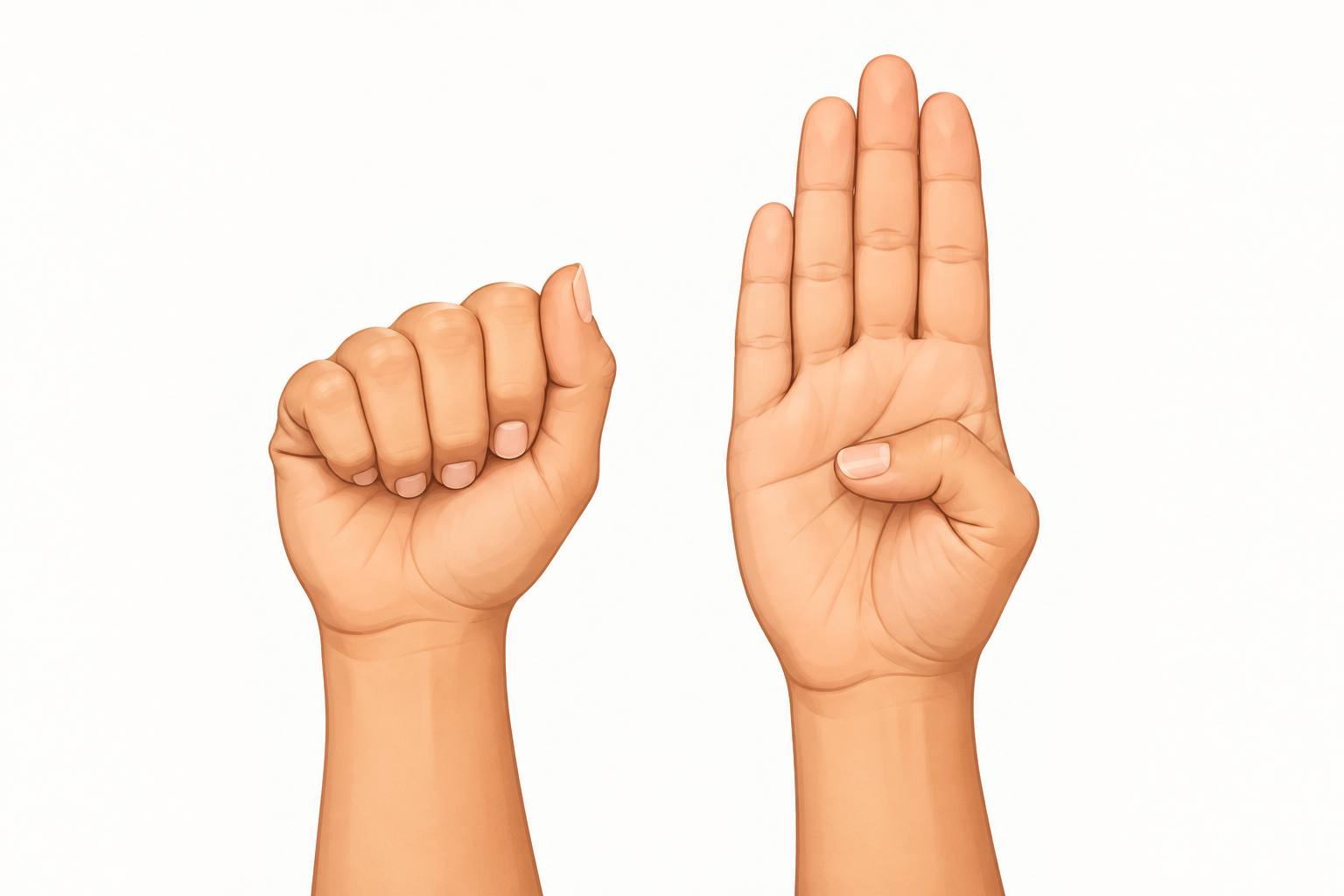
    • A: Make a fist. Rest your thumb against the side of your index finger, pointing up.
    • B: Hold four fingers straight up and pressed together. Fold your thumb across your palm.
    • C: Curve your fingers and thumb into a C shape. Turn your hand slightly so the viewer sees the curve from the side.
    • D: Point your index finger up. Touch the tips of your middle, ring and pinky fingers to your thumb, forming a rounded base.
    • E: Bend all four fingers down so the fingertips rest on or just above your thumb, which is tucked across your palm.
    • F: Touch your index fingertip to your thumb tip to make a circle. Hold the other three fingers up and slightly spread.
    • G: Extend your index finger and thumb parallel to each other, pointing sideways. Curl the other fingers in. Your palm faces you.

    H to N

    • H: Extend your index and middle fingers together, pointing sideways, palm facing you.
    • I: Make a fist with your thumb across the front and raise your pinky.
    • J: Start with the I handshape and draw a J in the air with your pinky, scooping down and curving toward you.
    • K: Raise your index finger, angle your middle finger forward, and place your thumb between them, touching the middle finger.
    • L: Raise your index finger and stick your thumb out to the side, making an L.
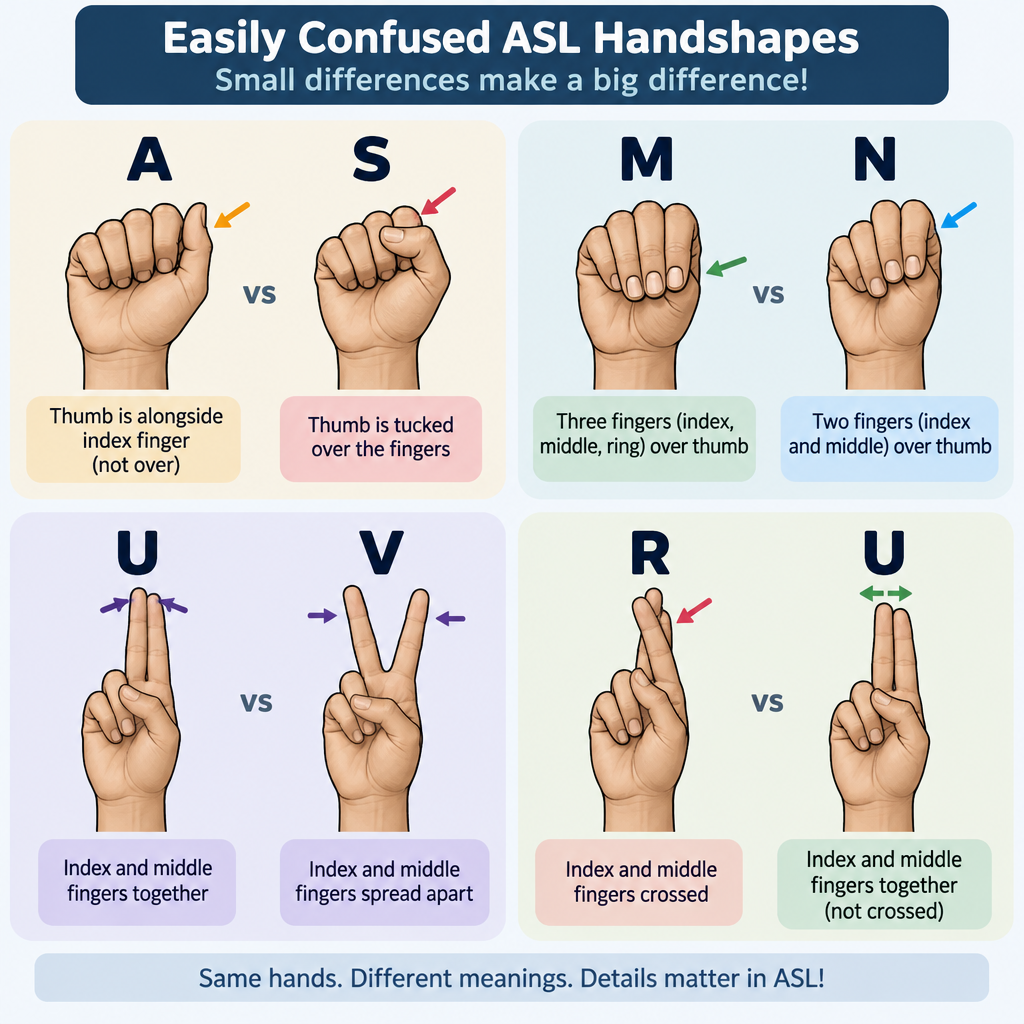
    • M: Tuck your thumb under your index, middle and ring fingers, which fold down over it.
    • N: Tuck your thumb under just your index and middle fingers.

    O to U

    • O: Curve all your fingers so the tips meet your thumb, forming an O.
    • P: Make a K, then tip your hand so your middle finger points down.
    • Q: Make a G, then tip your hand so the index finger and thumb point down.
    • R: Raise your index and middle fingers and cross the middle finger over the index.
    • S: Make a fist with your thumb wrapped across the front of your fingers.
    • T: Make a fist with your thumb poking up between your index and middle fingers.
    • U: Raise your index and middle fingers, held together.

    V to Z

    • V: Raise your index and middle fingers, spread apart.
    • W: Raise your index, middle and ring fingers, spread, with your thumb holding down your pinky.
    • X: Raise your index finger and hook it, like a bent finger beckoning. Keep the other fingers closed.
    • Y: Extend your thumb and pinky. Fold the three middle fingers down.
    • Z: Point your index finger and trace a Z in the air, from the viewer’s left to right.

    ASL alphabet quick-reference table

    Common Mix-Up Letter Pairs
    Letter Handshape summary Moves? Often confused with
    A Fist, thumb at side No S, T
    B Flat hand, thumb across palm No 4 (number)
    C Curved C shape No O
    D Index up, others touch thumb No 1 (number)
    E Fingertips bent onto thumb No O, S
    F Index-thumb circle, three fingers up No 9 (number)
    G Index and thumb point sideways No H, Q
    H Two fingers point sideways No G, U
    I Pinky up No J
    J Pinky traces a J Yes I
    K Index up, middle forward, thumb between No P, V
    L Index up, thumb out No None common
    M Thumb under three fingers No N
    N Thumb under two fingers No M
    O Fingertips meet thumb No C, E
    P K pointing down No K
    Q G pointing down No G
    R Index and middle crossed No U
    S Fist, thumb across front No A, E
    T Thumb between index and middle No A, N
    U Two fingers up together No V, R
    V Two fingers up, spread No U, 2 (number)
    W Three fingers up, spread No 6 (number)
    X Hooked index finger No None common
    Y Thumb and pinky out No None common
    Z Index traces a Z Yes 1 (number)

    The letter groups beginners mix up

    Most fingerspelling errors happen inside a few families of closed or near-identical handshapes. Drill these groups side by side until the differences feel automatic.

    Group What separates them
    A, S, T, M, N, E Where the thumb sits: beside the fist (A), across the front (S), between index and middle (T), under three fingers (M), under two (N), under bent fingertips (E)
    U, V, R Fingers together (U), spread (V), or crossed (R)
    G, H One finger with thumb (G) versus two fingers (H)
    K, P Same handshape; P points down
    G, Q Same handshape; Q points down
    I, J J adds a traced movement
    V, W, 2, 6 Letters and numbers share shapes; context tells you which

    Hearing tip

    Practice in front of a mirror, but remember the mirror flips your hand. Better still, record a short video on your phone and watch it back as a viewer would.

    Fingerspell like a pro

    Knowing all 26 letters is the easy part. Reading and producing them at conversational speed takes longer. These habits make the biggest difference.

    Read the word shape, not each letter. Fluent signers recognize the rhythm and outline of a whole word, much like you read printed words without sounding out every letter. Start with common names and short words.

    Don’t say the letters out loud or in your head. Mouthing “B… O… O… K” slows you down. If you mouth anything, mouth the whole word.

    Keep a steady rhythm. Even pacing beats raw speed. A smooth, moderate tempo is easier to read than a fast burst with hesitations.

    Pause slightly between words. A brief hold at the end of each word acts like a space.

    Mark double letters. Slide your hand a little to the side for letters like L or E, or give a small bounce for closed letters.

    Spell what matters, sign the rest. If a sign exists, use it. Fingerspelling every word reads like someone typing every word in capitals.

    Sign language alphabets from around the world

    Many manual alphabets trace back to Spain. In 1620, Juan Pablo Bonet published a book on teaching deaf people to speak that included a one-handed manual alphabet. Later, in the mid-1700s, the Abbé de l’Épée founded a school for deaf children in Paris, building on signs already used by deaf Parisians.

    The French link reached America in 1817. Thomas Hopkins Gallaudet brought Deaf French teacher Laurent Clerc to Hartford, Connecticut, where they founded what is now the American School for the Deaf. French Sign Language blended with local signing to form ASL. That is why the ASL and French alphabets still share many handshapes.

    Sign language Alphabet type Writing system Notes
    American Sign Language (ASL) One-handed Latin Used in the US and much of Canada
    French Sign Language (LSF) One-handed Latin Ancestor of ASL’s alphabet; several letters differ
    Irish Sign Language One-handed Latin Related to the French alphabet
    British Sign Language (BSL) Two-handed Latin Vowels touch the fingertips of the other hand
    Auslan and New Zealand Sign Language Two-handed Latin Share the BSL alphabet, part of the BANZSL family
    Indian Sign Language Two-handed Latin Influenced by the British system
    Russian Sign Language One-handed Cyrillic Spells Russian letters
    Japanese Sign Language One-handed Kana Spells syllables, not single letters

    The two-handed BANZSL alphabet works very differently from ASL. Your non-dominant hand acts as a base. You touch its thumb for A, index for E, middle finger for I, ring finger for O and pinky for U. Consonants combine both hands in set shapes.

    Plains Sign Talk

    Not every signing tradition has an alphabet. Plains Indian Sign Language, also called Plains Sign Talk or Hand Talk, was used across the Great Plains by nations including the Crow, Cheyenne, Kiowa, Arapaho, Lakota and Blackfoot. It served as a shared language between peoples who spoke different tongues and as a primary language for Deaf members of those communities.

    Plains Sign Talk communicates through signs for concepts rather than spelled letters. It is now endangered, though tribal communities and researchers continue to document and teach it.

    Learning American Sign Language beyond the ABCs

    The alphabet is a good first step, but it won’t carry a conversation. Plan your next stages:

    1. Numbers. ASL numbers 1 to 10 use their own handshapes, some identical to letters. After that, many learners pick up math terms such as the sign for more than.
    2. Core vocabulary. Greetings, family, questions (WHO, WHAT, WHERE) and everyday verbs.
    3. Grammar and facial expression. Raised or lowered eyebrows change a statement into a question. Your face carries grammar in ASL.
    4. Real conversation. Deaf events, ASL meetups and classes taught by Deaf instructors teach things no app can.

    Learning ASL also opens your eyes to the wider accessibility picture. You’ll notice how closed captioning, interpreters and phone options such as telecommunications relay service fit together, and how the Americans with Disabilities Act shapes access in US workplaces, schools and public places.

    Free and low-cost ways to learn the ASL alphabet

    Resource What you get Cost model
    Lifeprint (ASL University, Dr. Bill Vicars) Lessons, fingerspelling practice, video dictionary Free
    SignSchool Vocabulary, fingerspelling games Free
    Lingvano app Structured ASL lessons with video Free lessons, paid subscription
    Gallaudet University ASL Connect Courses from the leading Deaf university Some free content, paid courses
    Local Deaf community classes Live practice with fluent signers Varies, often low cost

    Pricing models change, so check current terms before you subscribe to any paid plan.

    See a professional

    If you’re learning sign language because your own hearing has changed, get a hearing test from an audiologist. Sudden hearing loss in one or both ears is a medical emergency, so see a doctor the same day.

    FAQ

    What are the 5 basics of sign language?

    Linguists describe five parameters that make up every sign: handshape, location, movement, palm orientation, and non-manual markers such as facial expression and head movement. Change any one of them and you can change the meaning. The alphabet mainly trains handshape and orientation.

    How do I sign “I’m sorry”?

    Make the A handshape (a fist with your thumb at the side). Place it over the center of your chest and move it in small circles. Pair it with a sincere, apologetic facial expression. You can point to yourself first for “I,” but SORRY with the right expression already reads as “I’m sorry.”

    Has the ASL alphabet changed?

    The core handshapes have been stable for generations, and the alphabet you learn today matches what Deaf adults use. Small variations exist. E has a few accepted forms, and some older or regional signers form letters like T slightly differently. Lexicalized fingerspellings, such as #JOB, keep evolving as everyday usage smooths them out.

    How can I teach myself sign language?

    Start with the alphabet and numbers using free video lessons, then build vocabulary a little each day. Record yourself so you can see your signing from the viewer’s side. Self-study only gets you so far, though. To become conversational, take a class with a Deaf instructor and spend time in Deaf community spaces where ASL is used naturally.

    Can I use the ASL alphabet in the UK or Australia?

    You can, but most Deaf people there use the two-handed BANZSL alphabet. Learn the local system if you plan to sign with British, Australian or New Zealand Deaf communities.

  • How to Sign More Than, Divide, Square and Approximately in ASL

    How to Sign More Than, Divide, Square and Approximately in ASL

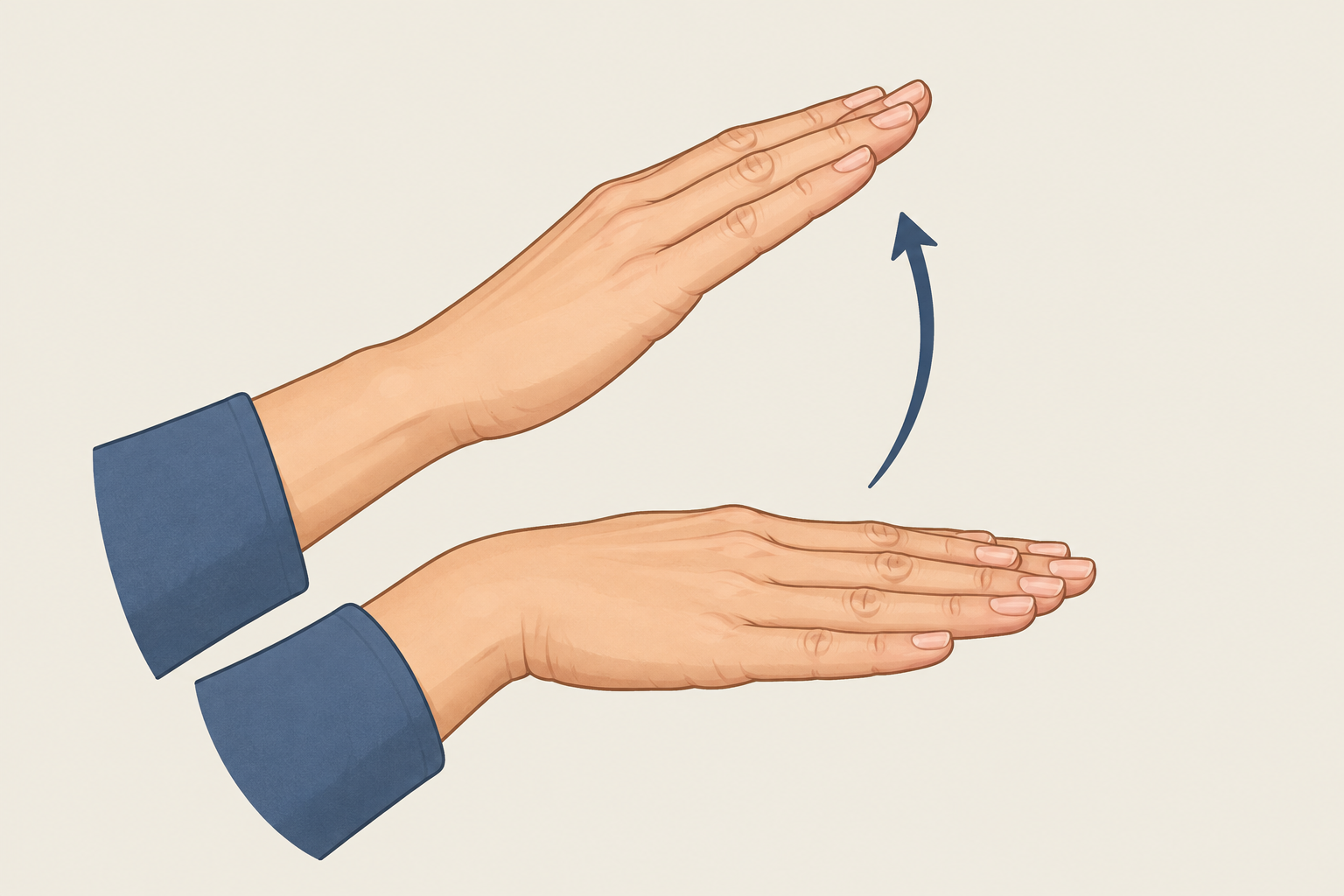
    To sign “more than” in ASL, hold your non-dominant hand flat with the palm down, rest your dominant flat hand on top of it, then lift the dominant hand up and slightly forward so it rises over the base. This guide covers that sign along with less than, divide, square, squared, square root and approximately, and explains how each one maps to the written math symbol.

    Last updated: October 29, 2026

    TopicASL math vocabulary
    Signs covered10 core signs
    LevelBeginner to intermediate
    Best forStudents, parents, tutors

    What the math symbols mean before you sign them

    You can only sign a concept clearly if you understand it, so here is the math first.

    The greater-than symbol (>) means the value on the left is bigger than the value on the right. The less-than symbol (<) means the left value is smaller. In both cases, the open side faces the bigger number and the pointed tip faces the smaller one. So 9 > 4 reads “nine is greater than four,” and 4 < 9 reads “four is less than nine.”

    Those two statements say the same thing. Flipping the numbers to opposite sides also flips the symbol. That matters in ASL, because signers often rearrange a statement for clarity, and you need to keep the meaning intact when you do.

    The other symbols in this guide work like this:

    • ÷ (divide): splits a number into equal parts. 12 ÷ 3 = 4.
    • ² (squared): multiplies a number by itself. 5² = 25.
    • √ (square root): undoes squaring. √25 = 5.
    • ≈ (approximately equal): the values are close but not exact. π ≈ 3.14.

    How to sign more than in ASL

    The sign most often used for “more than” in a comparison is the same sign that means EXCEED or OVER, in the sense of going past a level.

    • Handshape: Both hands flat, fingers together. Some signers bend the fingers slightly at the knuckles.
    • Location: In front of your chest, in neutral signing space.
    • Movement: Your dominant hand starts resting on the back of your non-dominant hand, palms down. Lift the dominant hand upward in a small arc, ending above and a little in front of the base hand.

    The base hand represents the comparison point. The rising hand shows something going past it. That picture makes the sign easy to remember.

    More than vs. MORE

    Learners mix these up constantly. The everyday sign MORE (as in “more food, please”) uses two flat-O hands, fingertips pinched to the thumbs, tapping together in front of you. That sign means “additional.” It does not compare two values. If you are signing 9 > 4, use the rising-hand sign, not MORE.

    Hearing tip

    Let your face carry the size of the gap. A small rise with a neutral face suggests “a bit more than.” A bigger rise with puffed cheeks suggests “way more than.” Non-manual markers like these are part of ASL grammar, so they belong in your signing.

    How to sign less than

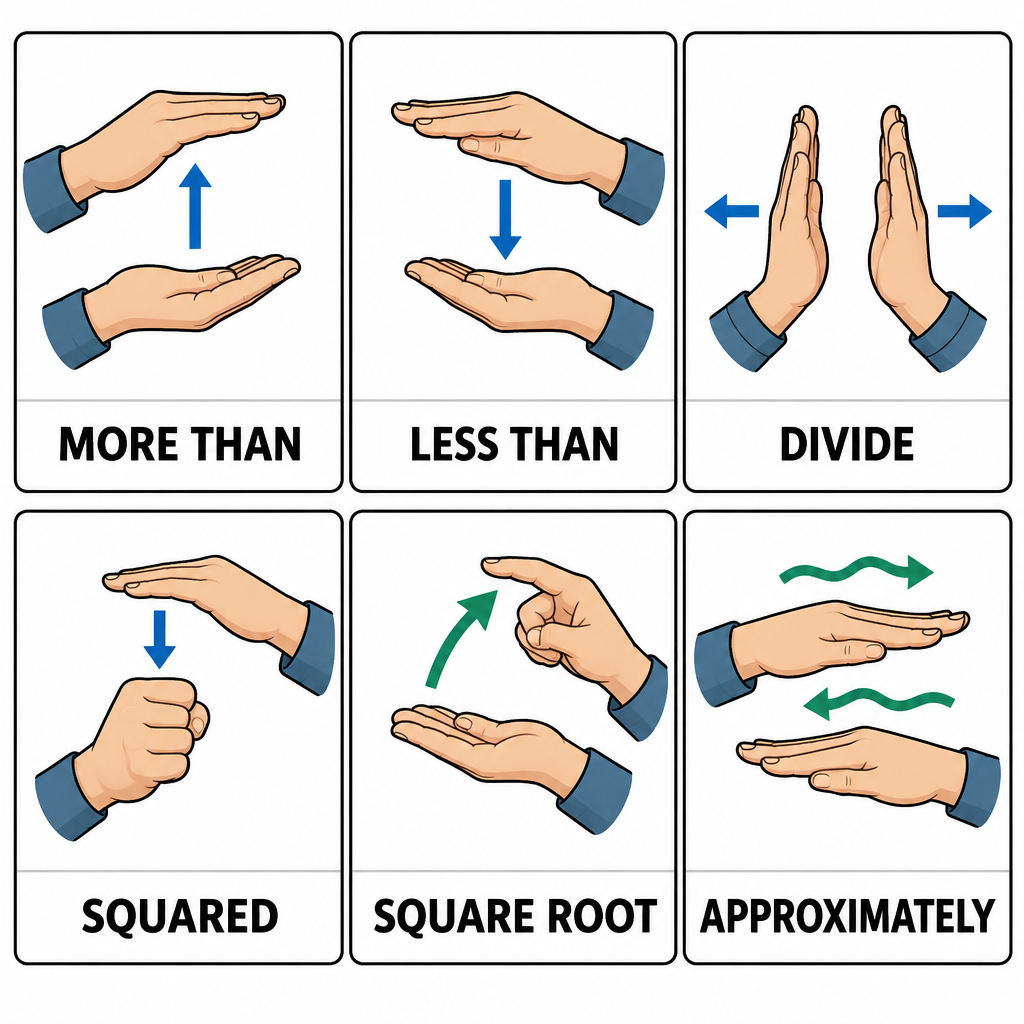
    ASL Math Signs Quick Reference Chart

    Less than mirrors more than. Start with the same two flat hands, palms down, dominant hand resting on the back of the base hand. Then move the dominant hand downward, dropping past the edge of the base hand so it ends below it.

    You will also see the plain sign LESS, where the dominant hand starts above the base hand and lowers toward it without passing it. Both show up in classrooms. If your teacher or interpreter uses one consistently, match them.

    Using space to sign a full comparison

    Here is where ASL differs from spoken English. You do not have to sign “nine is greater than four” word by word. Many signers set up the values in space first, then compare them.

    For 9 > 4, you might sign NINE and place it on your left, sign FOUR and place it on your right, then sign MORE-THAN starting from the nine’s side. The location does the work that word order does in English.

    This also makes changing sides painless. If you placed the values once, you can point back to either one and sign LESS-THAN or MORE-THAN without restating the numbers.

    How to sign divide

    • Handshape: Both hands flat, palms facing down or angled slightly toward each other.
    • Location: In front of your chest.
    • Movement: Cross your hands so the pinkie edge of your dominant hand rests across the index-finger edge of your base hand, making an X shape. Then pull both hands apart, moving down and out to the sides.

    The motion looks like breaking something into pieces, which is why the same sign also covers SPLIT and SEPARATE in everyday conversation. For “12 divided by 3,” sign TWELVE, DIVIDE, THREE.

    In written-math contexts, some teachers instead trace the ÷ symbol in the air with an index finger: a short horizontal line, a dot above, a dot below. That is handy when a student needs to copy notation onto paper exactly.

    How to sign square, squared and square root

    “Square” covers three different ideas in math, and each one has its own sign.

    Square (the shape)

    Both index fingers touch at the top center in front of you. Pull them apart horizontally, drop them straight down, then bring them back together at the bottom. You have traced the outline of a square. RECTANGLE uses the same motion with a wider horizontal pull.

    Squared (the exponent)

    To sign x² or 5², sign the base first, then sign the number TWO raised higher and slightly to the side, often with a small upward flick. The raised position echoes the small superscript in written math. CUBED follows the same pattern with THREE.

    Square root

    Most signers draw the radical symbol (√) with the index finger: a short tick down, a longer stroke up, then a line across the top. Then sign the number that sits under it. “Square root of 25” becomes the traced √ followed by TWENTY-FIVE.

    How to sign approximately

    • Handshape: Open hand, either a flat hand or a 5 hand with fingers spread.
    • Location: Near your dominant shoulder, palm facing out.
    • Movement: Make a few small circles.

    This sign covers APPROXIMATELY, ABOUT, ROUGHLY and AROUND in the sense of estimating. Sign it right before the number: APPROXIMATELY FIFTY. A slight squint or tilted head adds to the “give or take” feel.

    For the ≈ symbol in a formula, signers either use this sign or trace two wavy lines in the air.

    Quick reference: core math signs

    Concept Handshape Location Movement
    More than Two flat hands Chest height Dominant hand rises off the base hand
    Less than Two flat hands Chest height Dominant hand drops below the base hand
    Divide Two flat hands, crossed Chest height Hands pull apart, down and out
    Square (shape) Two index fingers In front of chest Trace a square outline
    Squared (x²) Number 2 handshape Raised, to the side Small upward flick after the base
    Square root Index finger In front of chest Trace the √ symbol
    Approximately Flat or 5 hand, palm out Near shoulder Small circles
    Equal Two bent hands, palms down Chest height Tap fingertips together

    Related signs you will need with these

    Inequalities rarely appear alone. These signs fill out most middle-school and algebra work.

    Symbol Meaning How it is commonly signed
    = Equal Two bent hands, palms down, fingertips tap together
    ≠ Not equal NOT, then EQUAL, or trace = with a slash
    ≥ Greater than or equal to MORE-THAN, OR, EQUAL, or trace the symbol
    ≤ Less than or equal to LESS-THAN, OR, EQUAL, or trace the symbol
    + Plus Two index fingers cross to form a plus sign
    − Minus Dominant index finger placed against the base palm
    × Times Two V hands, dominant V brushes across the base V

    Check your classroom's conventions

    Math signs vary by region, school and interpreter. Students taking exams with an interpreter should agree on sign choices for symbols in advance so nothing gets lost in translation.

    A worked example: signing an algebra inequality

    Take the problem x + 3 > 7.

    1. Sign or fingerspell X, sign PLUS, sign THREE.
    2. Sign MORE-THAN.
    3. Sign SEVEN.

    Now solve it. Subtract 3 from both sides and you get x > 4. Sign X, MORE-THAN, FOUR.

    The tricky part comes when you multiply or divide by a negative number. Inequalities flip when that happens. If −2x > 6, dividing both sides by −2 gives x < −3. In ASL, emphasize that switch. Many tutors sign the original MORE-THAN, sign a clear FLIP or CHANGE, then sign LESS-THAN. Seeing the hands literally reverse direction helps the rule stick.

    A real-life example: cutting rope

    Say you have a 10-foot rope and need pieces longer than 3 feet. How many can you cut?

    Signed naturally, that might go: ROPE TEN FOOT. NEED PIECE MORE-THAN THREE FOOT. HOW-MANY?

    The answer is 3 pieces at most, because 10 ÷ 3 ≈ 3.3, and each piece has to exceed 3 feet. Three pieces of about 3.3 feet each works. Four pieces would leave each one at 2.5 feet, which fails the test. That one problem uses MORE-THAN, DIVIDE and APPROXIMATELY together, which makes it great practice.

    How to remember greater than and less than

    Two tricks work well, and one ties directly to ASL handshapes.

    • The hungry mouth. The open side of the symbol always “eats” the bigger number. Kids often draw it as an alligator.
    • The left-hand L. Hold up your left hand with thumb and index finger extended in an L, then tilt it slightly. It looks like <, and L stands for Less than. Your right hand makes a backward L that resembles >.

    Typing the symbols when you write math notes

    Deaf and hard of hearing students often rely on text: chat with an interpreter, captioned lectures, shared notes. Being able to type these symbols quickly saves time.

    Symbol Unicode Windows Alt code (numpad) Mac shortcut
    > U+003E Alt+62 Shift+period
    < U+003C Alt+60 Shift+comma
    ≥ U+2265 Alt+242 Option+period
    ≤ U+2264 Alt+243 Option+comma
    ≈ U+2248 Alt+247 Option+X
    ÷ U+00F7 Alt+246 Option+slash
    √ U+221A Alt+251 Option+V
    ² U+00B2 Alt+253 Character Viewer

    In Microsoft Word, you can also type the Unicode number (for example, 2265) and press Alt+X to convert it to the symbol.

    Practice tips that actually work

    • Drill pairs, not singles. Practice MORE-THAN and LESS-THAN back to back so the direction becomes automatic.
    • Use real numbers. Sign comparisons from your day: prices, temperatures, game scores.
    • Record yourself. Check that your dominant hand clearly rises or drops, and that your face matches the size of the difference.
    • Learn from STEM sources. Projects like ASL Clear and ASLCORE focus on academic and technical vocabulary signed by Deaf content experts.
    • Sign homework aloud. Talking through each step in ASL forces you to understand the math and the grammar at once.

    Hearing tip

    Pick one version of each sign and stay consistent for a few weeks. Switching between variants too early slows down both your math and your signing.

    FAQ

    Is the sign for more than the same as the sign for MORE?

    No. MORE (flat-O hands tapping) means “additional.” The comparison sign uses flat hands, with the dominant hand rising off the base hand. Use the rising sign whenever you compare two values.

    How do you sign greater than or equal to?

    Most signers sign MORE-THAN, then OR, then EQUAL. In a written-math context, tracing the ≥ symbol in the air is also common and avoids ambiguity.

    Does ASL have one standard set of math signs?

    Not fully. Core signs like EQUAL, PLUS and DIVIDE are widely shared, but symbols like ≈, exponents and square roots vary between schools and regions. Ask your teacher or interpreter which version they use.

    How do you sign “about” for a time, like “about 3 o’clock”?

    Use the same APPROXIMATELY sign (open hand, palm out, small circles near the shoulder), then sign the time.

    Is DIVIDE the same sign as SPLIT?

    Yes, the same crossed-hands movement covers DIVIDE, SPLIT and SEPARATE. Context tells the viewer which meaning you intend.