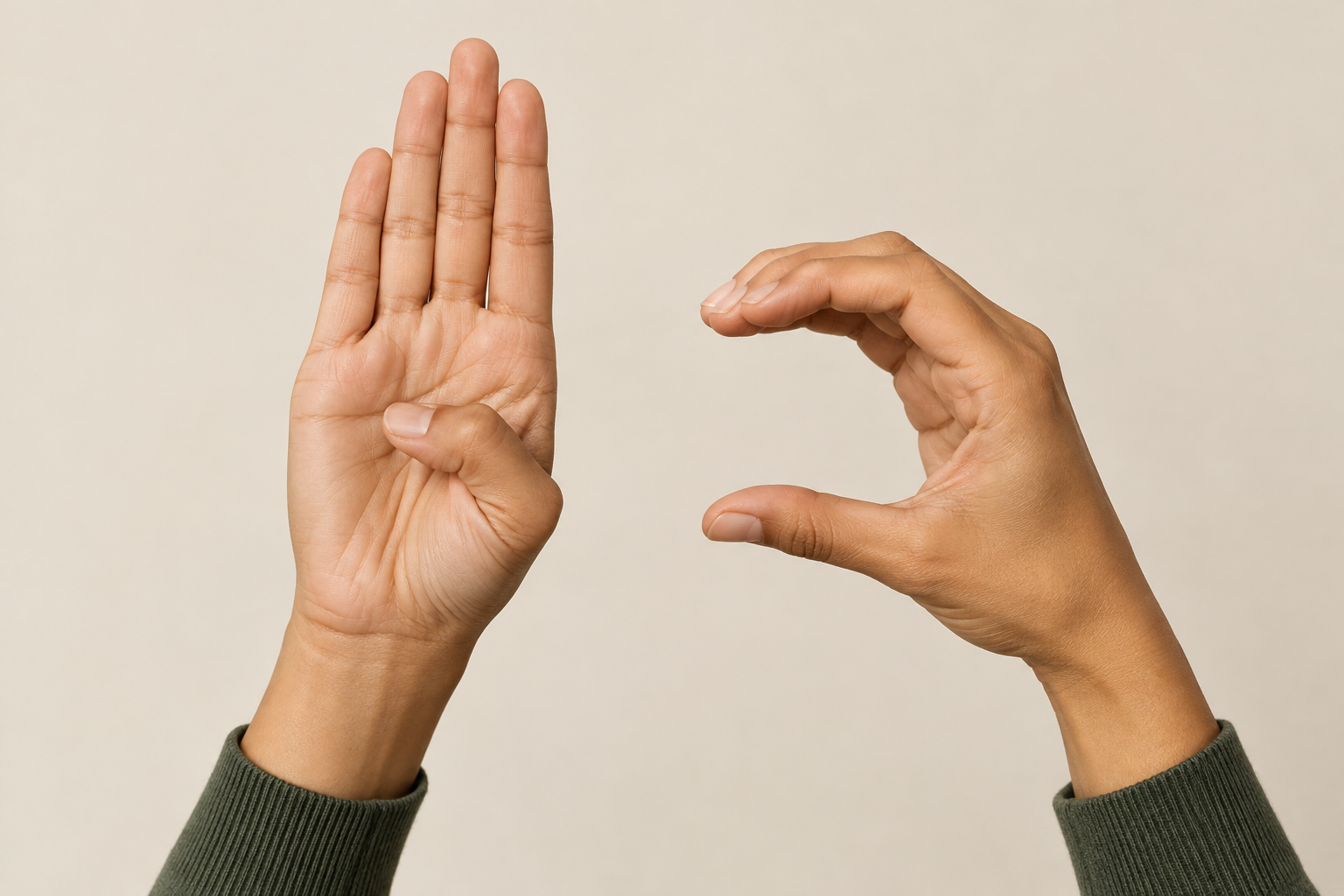
ASL stands for American Sign Language, the visual language used by many Deaf and hard of hearing people in the United States and much of English-speaking Canada. It is a complete language with its own grammar, separate from English, and it took shape after America’s first permanent school for deaf students opened in Hartford, Connecticut, in 1817. Below you’ll find what the term means, where the language came from, and how to sign a few core words yourself.
What ASL Means
A sign language is a natural language that uses the hands, face and body in space instead of sound. In ASL, the meaning of a sign depends on five things: handshape, location, movement, palm orientation, and non-manual markers such as facial expression and head position.
ASL is not English spelled out on the hands. Systems like Signed Exact English follow English word order, but ASL has its own syntax. To ask “Are you going to the store?” you might sign YOU GO STORE? with your eyebrows raised. Raised eyebrows mark a yes/no question. For a question like “What’s your name?” you would sign YOUR NAME WHAT? with your eyebrows pulled down.
Your face is grammar in ASL, not decoration. Leave the eyebrows out and the sentence can read as a statement.
Other Meanings of “asl” Online
If you found this page through a text message, the letters may mean something else entirely.
| Term | Meaning | Where you’ll see it |
|---|---|---|
| ASL | American Sign Language | Schools, the Deaf community, dictionaries |
| a/s/l | “Age, sex, location?” | 1990s chat rooms and early messaging apps |
| asl | “As hell,” as in “tired asl” | Recent texting and social media slang |
Context tells you which one is meant. Capitalized and in a sentence about deaf people or language, it is almost always American Sign Language.
How American Sign Language Began
Before 1817, deaf Americans used home signs and local sign systems. One of the best known grew up on Martha’s Vineyard, where hereditary deafness was common enough, especially around Chilmark, that hearing and deaf neighbors alike signed. Historians believe Martha’s Vineyard Sign Language fed into early ASL.
The turning point came from Hartford. Mason Fitch Cogswell, a local doctor whose daughter Alice was deaf, helped send minister Thomas Hopkins Gallaudet to Europe in 1815 to study deaf education. The Braidwood family schools in Britain kept their methods close. In London, Gallaudet met Abbé Roch-Ambroise Sicard of the Paris school for the deaf and two Deaf teachers, Jean Massieu and Laurent Clerc.
Gallaudet studied in Paris, and Clerc agreed to come to America in 1816. Together they opened what is now the American School for the Deaf on April 15, 1817. Students arrived with their own home and regional signs, and those blended with Clerc’s French Sign Language (LSF). Comparisons of vocabulary have found that a little over half of core ASL signs share roots with LSF, which is why ASL is grouped in the French sign language family.
Key Dates in ASL History
| Year | Event |
|---|---|
| 1815 | Gallaudet travels to Europe to study deaf education |
| 1817 | American School for the Deaf opens in Hartford |
| 1864 | Abraham Lincoln signs the charter for the college that becomes Gallaudet University |
| 1880 | Milan congress votes for oral-only teaching; the National Association of the Deaf is founded |
| 1913 | George Veditz films “The Preservation of the Sign Language” |
| 1960 | William Stokoe publishes Sign Language Structure |
| 1965 | Stokoe, Casterline and Croneberg publish A Dictionary of American Sign Language on Linguistic Principles |
| 1988 | Deaf President Now protest; I. King Jordan becomes Gallaudet’s first Deaf president |
| 1990 | The Americans with Disabilities Act is signed |
How ASL Survived the Oral Era
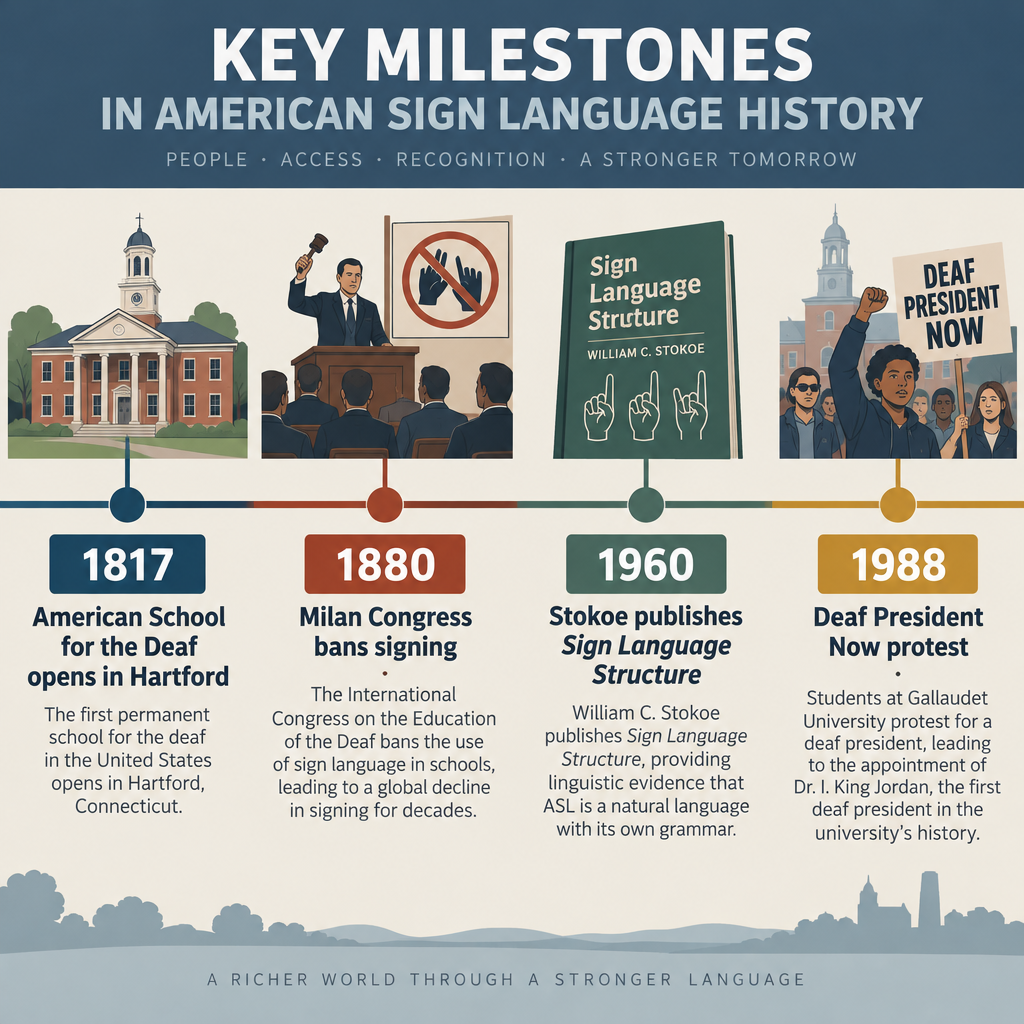
In 1880, a mostly hearing gathering of educators in Milan voted that deaf children should be taught through speech and lipreading alone. Many American schools followed. Signing was banned in classrooms, and Deaf teachers lost their jobs.
ASL survived anyway. Children passed it on in dormitories, and adults kept it alive in Deaf clubs, churches and Deaf families. In 1913, NAD president George Veditz recorded a signed film defending the language, including the line often quoted today: “As long as we have deaf people on earth, we will have signs.”
When Linguists Recognized ASL
William Stokoe, a hearing English professor at Gallaudet, showed in 1960 that signs break down into smaller parts the same way spoken words break into sounds. That work, and the dictionary that followed in 1965, convinced linguists that ASL was a real language. The 1988 Deaf President Now protest then put Deaf leadership in the national spotlight. Today many states accept ASL for high school world language credit.
How many people use ASL? Nobody knows precisely. The U.S. Census doesn’t ask, and researchers have traced the frequently repeated 250,000 to 500,000 figure back to data from the 1970s.
ASL Is Not Universal
Sign language isn’t one global language. The United Nations counts more than 300 sign languages worldwide, and ASL is only one. A British signer and an American signer can’t easily understand each other, even though both countries speak English.
| Sign language | Main region | Family |
|---|---|---|
| ASL | United States, English-speaking Canada | French |
| LSF | France | French |
| LSQ | Quebec | French-influenced |
| BSL | United Kingdom | BANZSL |
| Auslan | Australia | BANZSL |
Even the manual alphabet differs. ASL fingerspelling is one-handed, while BSL uses two hands. Our sign language alphabet guide walks through every ASL letter from A to Z.
How to Sign a Few Basic Words in ASL
These descriptions use a right-handed signer. Left-handed signers mirror them.
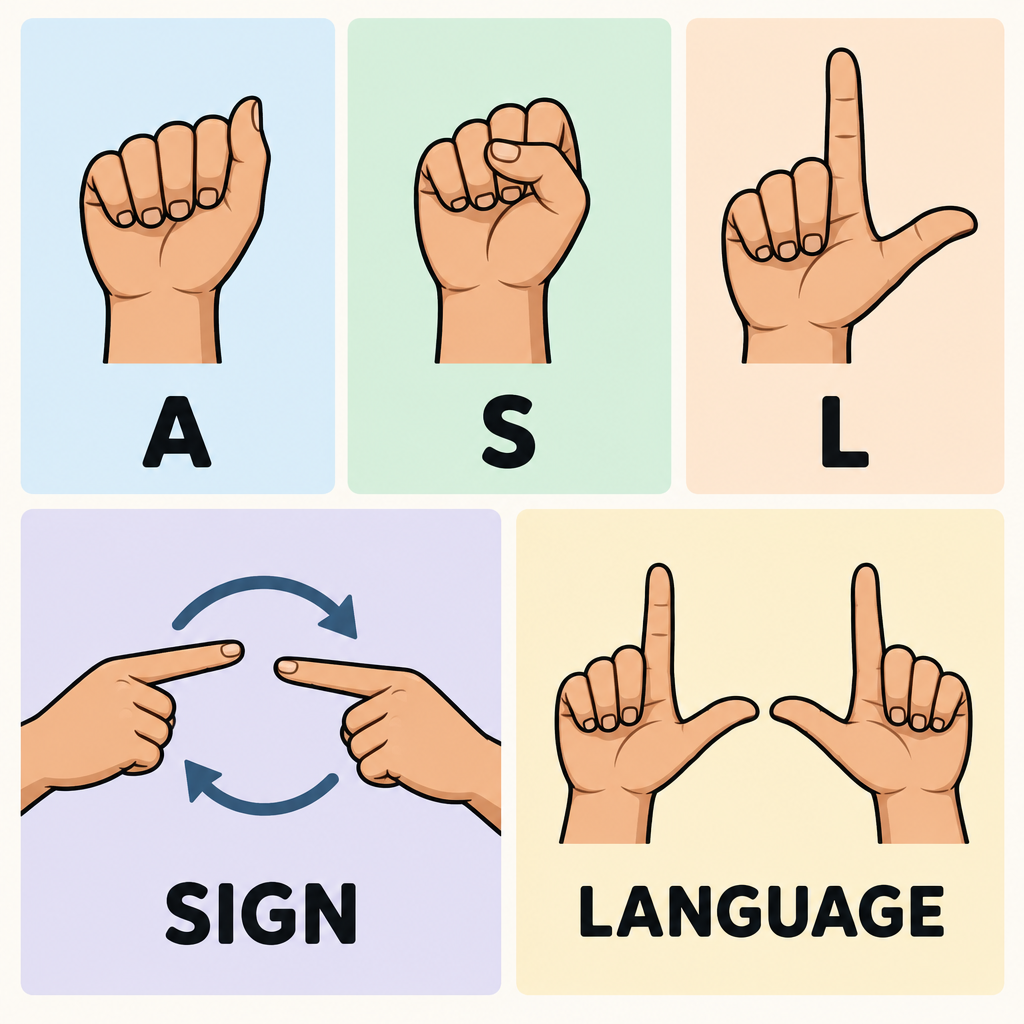
| Word | Handshape | Location | Movement |
|---|---|---|---|
| ASL | Letters A, S, L | Near your shoulder | Fingerspell in quick sequence; many signers trace a small circle |
| SIGN | Both index fingers extended | In front of your chest | Hands circle alternately back toward you |
| LANGUAGE | Both hands in L shape, palms down | Thumbs nearly touching in front of you | Pull apart while twisting slightly |
| DEAF | Index finger | Cheek near the ear, then near the mouth | Two light touches (either order is common) |
| HEARING | Index finger held sideways | In front of your mouth | Small forward circles |
| MEAN | Bent V on right hand, left palm up | Right fingertips on left palm | Touch, twist the wrist, touch again |
| WHAT | Both open hands, palms up | In front of your body | Small side-to-side shake, eyebrows down |
To sign “sign language” in ASL, sign SIGN followed by LANGUAGE.
Practice steps
- Learn the manual alphabet first so you can fingerspell names.
- Watch videos made by Deaf signers.
- Replay each sign at half speed and copy it.
- Practice in a mirror, checking your face.
- Join a class or Deaf community event.
Hearing tip
You don’t need to unmute an ASL lesson. Turn the sound off and watch the hands and face, the way a Deaf signer would.
Where You’ll See ASL Today
ASL is everywhere once you look: interpreters at press briefings, Deaf performers on stage, and video relay calls. Video relay is one form of telecommunications relay service, connecting ASL users with hearing callers through an interpreter. Under the Americans with Disabilities Act, the main U.S. disability rights act, many businesses and public bodies must provide effective communication, which can mean an interpreter. Closed captioning helps many viewers, but it isn’t a full substitute, because English is a second language for many Deaf people whose first language is ASL.
See a professional
If you or your child notice hearing changes, book an audiologist. Sudden hearing loss in one or both ears is a medical emergency, so see a doctor right away.
FAQ
Is ASL the same as sign language?
No. ASL is one specific sign language. “Sign language” is the umbrella term for all of them, including BSL, LSF and Auslan.
Is ASL based on English?
No. ASL developed largely from French Sign Language mixed with American home and regional signs. Its grammar differs from English.
How do you sign “I love you” in ASL?
Raise your hand with the palm facing out, then extend your thumb, index finger and pinky while folding your middle and ring fingers down. This handshape combines the letters I, L and Y.
How long does it take to learn ASL?
Basic conversation can come within months of regular classes and practice. Fluency takes years, just as it does with any spoken language.
What does “asl” mean in a text?
It usually means “as hell” in current slang. In older chat rooms, “a/s/l” asked for age, sex and location.