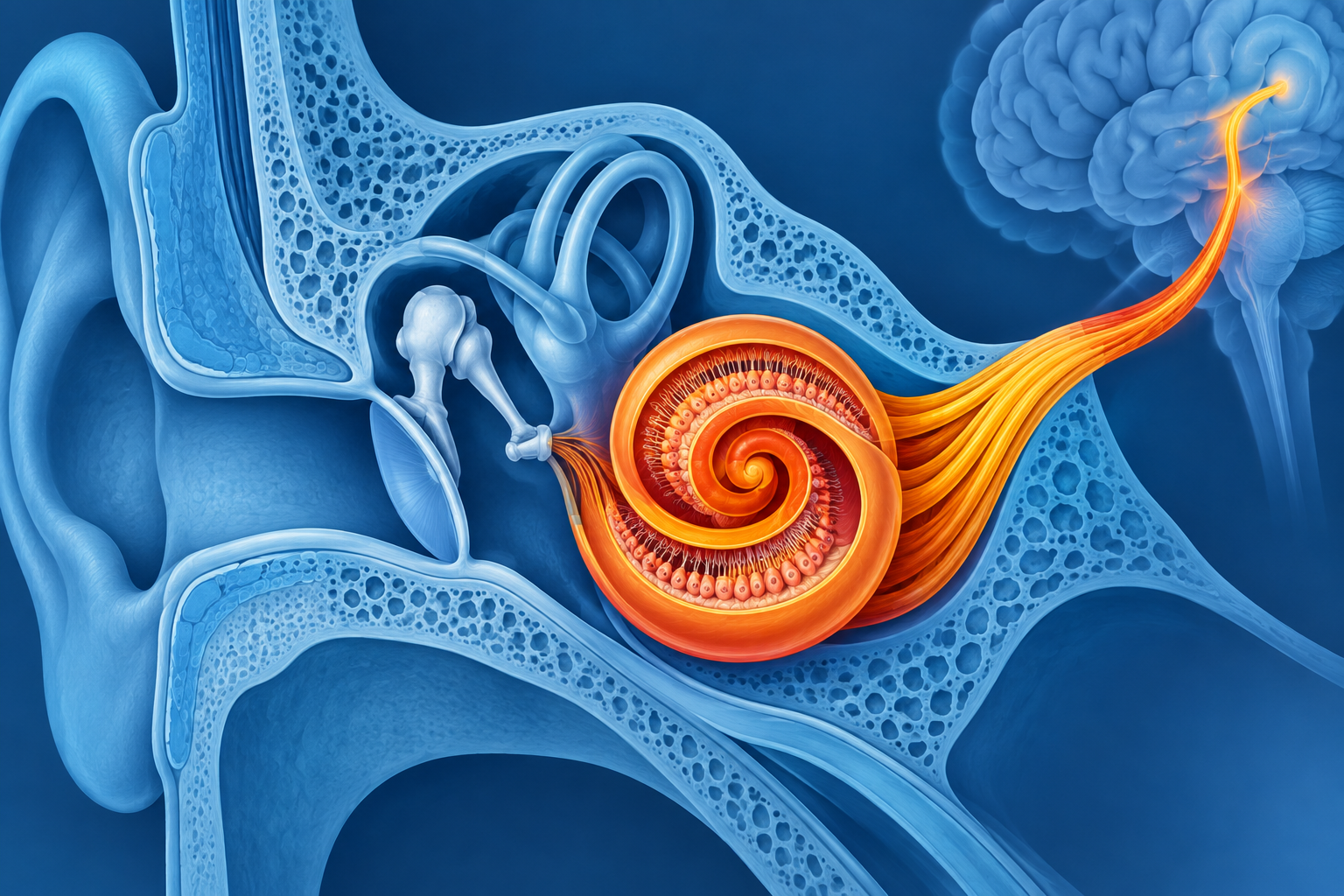
Sensorineural deafness is hearing loss caused by damage to the inner ear (the cochlea) or to the auditory nerve that carries sound signals to the brain. It is the most common type of permanent hearing loss in adults, and while it usually cannot be reversed, hearing aids, cochlear implants and fast medical care for sudden cases can make a large difference.
Last updated: October 30, 2026. General information only, not a diagnosis.
Sensorineural Deafness Definition
“Sensorineural” combines two words. Sensory refers to the hair cells inside the cochlea that turn sound vibrations into electrical signals. Neural refers to the auditory nerve that carries those signals to your brain. Damage to either part causes sensorineural hearing loss.
The medical abbreviation is SNHL. You may also see SSNHL or SSHL for sudden sensorineural hearing loss. Older texts and MedlinePlus list “nerve deafness” as an alternative name, although the nerve itself is often not the damaged part.
“Deafness” in a medical heading does not always mean total loss of hearing. Doctors use “sensorineural deafness” for anything from a mild high-pitch loss to profound hearing loss. In everyday use, “deaf” usually describes profound loss, and many people who identify as Deaf (capital D) see themselves as part of a cultural and linguistic community rather than as having a condition to fix.
How SNHL Differs From Other Types
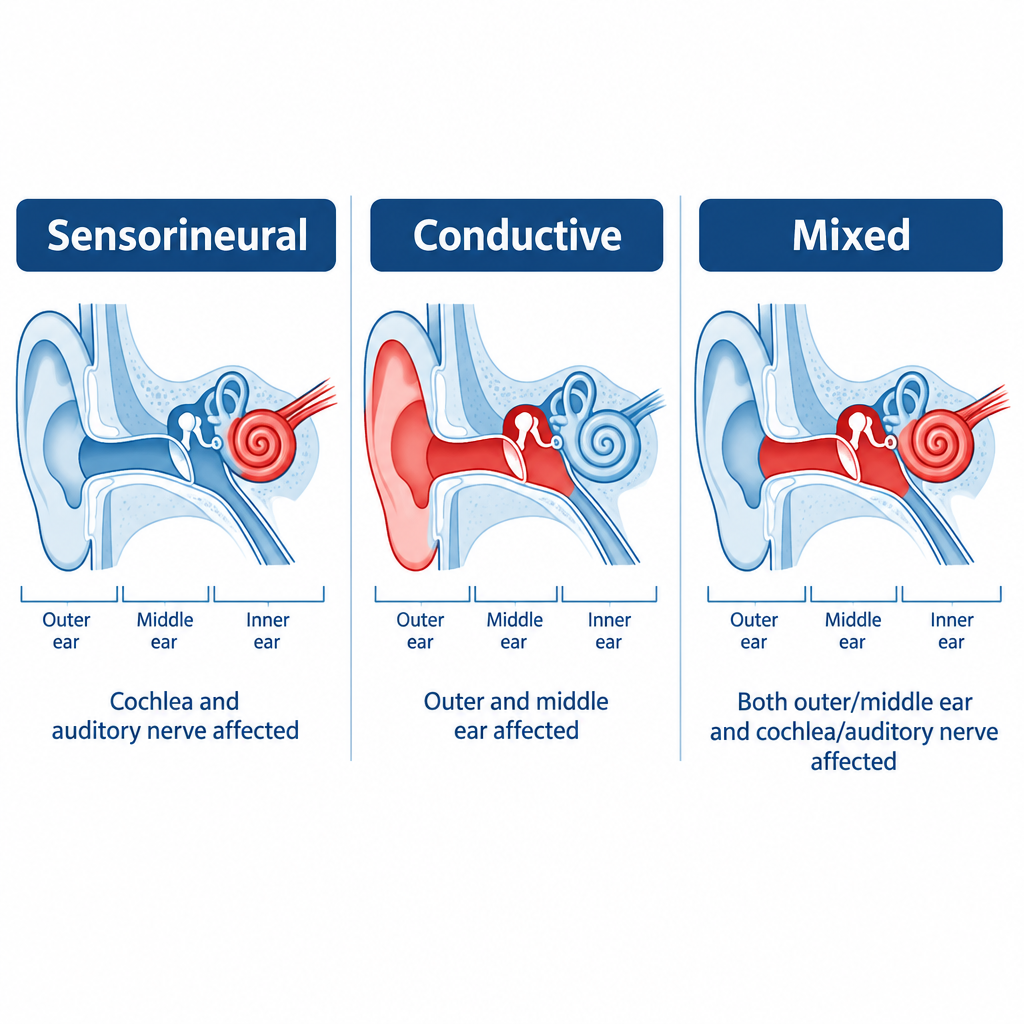
Hearing loss falls into three main types. Where the problem sits decides how it is treated.
| Type | Where the problem is | Common examples | Typical outlook |
|---|---|---|---|
| Sensorineural | Cochlea or auditory nerve | Aging, loud noise, genetics, some drugs | Usually permanent; managed with devices |
| Conductive | Outer or middle ear | Earwax, fluid, ear infection, perforated eardrum | Often treatable with medicine or surgery |
| Mixed | Both at once | Chronic ear disease plus age-related loss | Conductive part may be treatable |
A blocked ear from swimmer’s ear or a perforated eardrum stops sound reaching the inner ear. That is conductive loss, and it often clears up. With SNHL, sound arrives normally but the inner ear or nerve cannot process it properly.
Sensorineural loss is by far the most common type. Many clinical and industry sources put it at roughly 90% of hearing loss in adults.
Symptoms of Sensorineural Hearing Loss
SNHL usually creeps in slowly. Many people notice the effects on conversation before they notice “hearing loss” itself.
Common signs include:
- Speech sounds mumbled, especially in noisy restaurants or group settings
- Trouble hearing women’s and children’s voices, which tend to be higher pitched
- Missing consonants like “s,” “f,” “th” and “sh,” so words blur together
- Turning up the TV louder than others prefer
- Ringing, buzzing or hissing in the ears (tinnitus)
- Sounds seeming too loud and too quiet at the same time, called recruitment
- Dizziness or balance problems in some cases, since the inner ear also controls balance
The clarity problem matters. Damaged hair cells distort sound, so making it louder does not fully restore crispness. That is why people with SNHL often say, “I can hear you, I just can’t understand you.”
See a professional
Sudden hearing loss in one or both ears, over hours or up to three days, is a medical emergency. See a doctor or urgent care the same day, ideally within 72 hours.
What Causes Sensorineural Deafness
Many cases have more than one cause. Here are the main ones.
Aging (presbycusis)
Age-related hearing loss is the most common cause. According to the National Institute on Deafness and Other Communication Disorders (NIDCD), about one in three US adults aged 65 to 74 has hearing loss, and nearly half of those over 75 do. It usually affects both ears equally and hits high pitches first.
Loud noise exposure
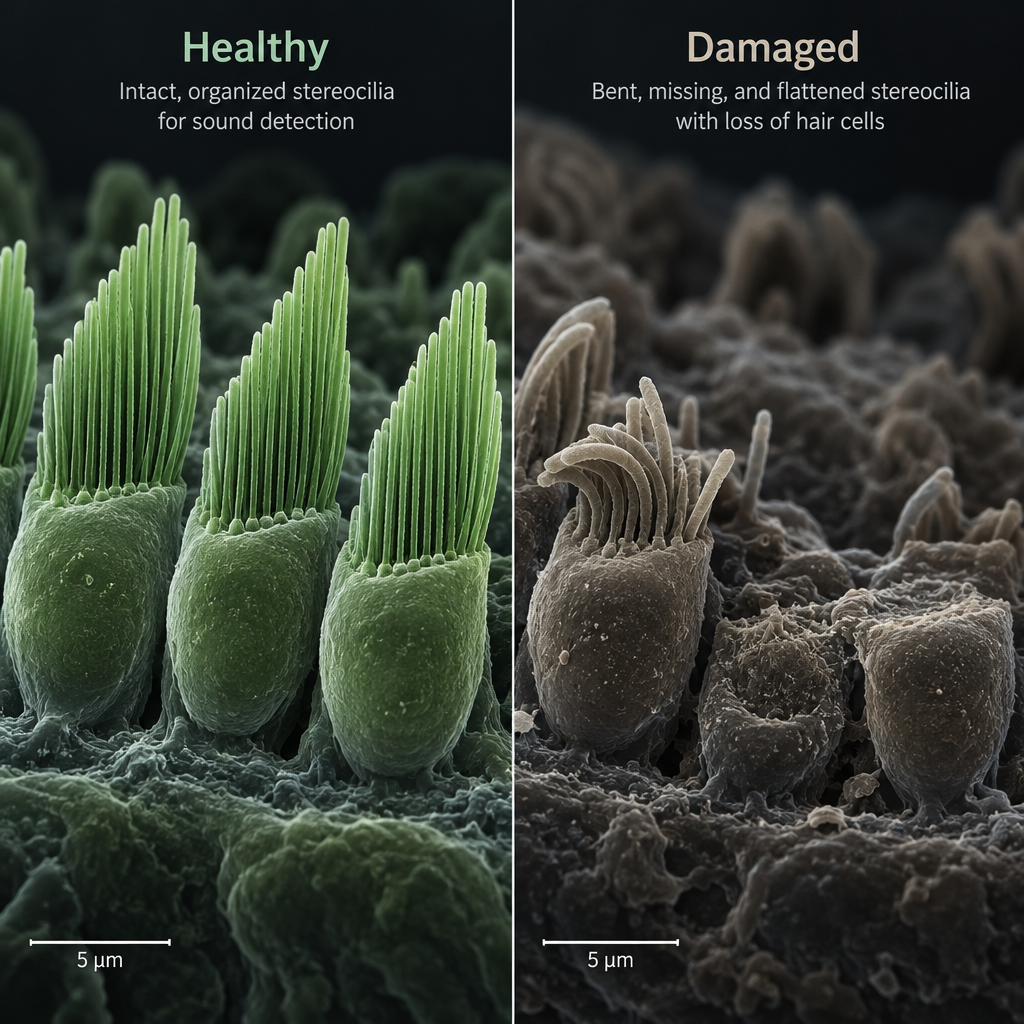
Noise damages the delicate hair cells in the cochlea. A single extreme blast, like a gunshot or explosion, can cause instant damage. More often, damage builds over years of loud work, concerts, power tools or earbuds turned up high.
Hair cells in humans do not grow back. Once enough are lost, the hearing loss is permanent.
Genetics and congenital causes
Some babies are born with SNHL, and some inherit genes that cause loss later in life. Changes in the GJB2 gene (connexin 26) are the most common genetic cause of congenital hearing loss in many populations. Cytomegalovirus (CMV) infection during pregnancy is the leading non-genetic cause of congenital SNHL. Newborn hearing screening in US hospitals is designed to catch these cases early.
Ototoxic medicines
Certain drugs can damage the inner ear. Known examples include:
- The chemotherapy drug cisplatin
- Aminoglycoside antibiotics such as gentamicin
- High doses of loop diuretics such as furosemide
- Very high doses of aspirin, where hearing effects are usually reversible
- Quinine
Never stop a prescribed medicine on your own. If you notice ringing or hearing changes during treatment, tell your prescriber.
Illness, injury and other conditions
- Infections: meningitis, measles, mumps and some viral infections
- Ménière’s disease: episodes of vertigo, tinnitus, ear fullness and fluctuating low-pitch hearing loss
- Autoimmune inner ear disease: the immune system attacks the inner ear, often causing loss in both ears over weeks to months
- Head trauma: skull fractures or concussion can injure the cochlea
- Vestibular schwannoma (acoustic neuroma): a noncancerous tumor on the nerve, usually causing loss in one ear only
- Blood flow problems: reduced blood supply to the inner ear, which is one suspected cause of sudden SNHL
Sudden sensorineural hearing loss
The NIDCD defines sudden SNHL as a loss of at least 30 decibels across three connected frequencies, happening within 72 hours. It usually affects one ear. Many people first notice it on waking, or after a “pop” in the ear.
In most cases, doctors never find a specific cause. The NIDCD reports that about half of people recover some or all of their hearing on their own, usually within one to two weeks. Prompt treatment, usually corticosteroids, gives you the best chance at recovery.
How Loud Is Too Loud?
Noise is the one major cause you can control. The National Institute for Occupational Safety and Health (NIOSH) recommends a limit of 85 decibels (dBA) averaged over 8 hours. For every 3 dB increase, the safe time halves.
| Sound level (dBA) | NIOSH recommended max time | Everyday comparison |
|---|---|---|
| 85 | 8 hours | Heavy city traffic |
| 88 | 4 hours | Lawn mower range |
| 91 | 2 hours | Loud power tools |
| 94 | 1 hour | Motorcycle |
| 97 | 30 minutes | Loud nightclub range |
| 100 | 15 minutes | Rock concert range |
The OSHA legal workplace limit is looser, at 90 dBA over 8 hours. Treat the NIOSH numbers as the safer target.
Hearing tip
Your phone can track noise for you. On iPhone, add the Noise control to Control Center or check Health > Hearing. On Apple Watch, the Noise app warns you when sound passes your chosen level.
For concerts, motorsports or loud work, choosing the right types of earplugs matters. Foam plugs block the most noise, while filtered “musician” plugs lower volume more evenly so music still sounds natural.
How SNHL Is Diagnosed
Diagnosis usually starts with a primary care doctor and moves to an audiologist and an ear, nose and throat specialist (ENT, also called an otolaryngologist).
What to expect at your visit
- History and exam. The doctor asks when the loss started, whether it affects one or both ears, and about noise, medicines, dizziness and family history. They look in your ears to rule out wax, infection or a damaged eardrum.
- Tuning fork tests. In the Weber test, a vibrating fork on your forehead sounds louder in the better ear when SNHL is present. The Rinne test compares hearing through air and through bone.
- Pure-tone audiogram. In a sound booth, you respond to beeps at different pitches. Testing through headphones (air conduction) and a bone vibrator (bone conduction) shows where the problem is. In SNHL, both results are lowered by a similar amount.
- Speech testing. You repeat words at set volumes. This shows how well you understand speech, which helps predict how much hearing aids will help.
- Tympanometry. A small probe checks how the eardrum and middle ear move.
- Further tests if needed. An MRI is often ordered for loss in one ear or uneven loss, to rule out a tumor on the nerve. Blood tests may check for infection or autoimmune disease.
Reading your audiogram
Results are measured in decibels hearing level (dB HL). Higher numbers mean you need louder sounds to hear. Clinics commonly use these ranges, based on the American Speech-Language-Hearing Association (ASHA) classification:
| Degree | Hearing threshold (dB HL) | What it often feels like |
|---|---|---|
| Normal | −10 to 15 | No trouble in quiet |
| Slight | 16 to 25 | Faint speech hard in noise |
| Mild | 26 to 40 | Soft speech and whispers missed |
| Moderate | 41 to 55 | Normal conversation is a strain |
| Moderately severe | 56 to 70 | Group talk very difficult |
| Severe | 71 to 90 | Only loud speech heard |
| Profound | 91+ | Most speech not heard without devices |
5 Treatment Options for Sensorineural Hearing Loss
No pill or surgery currently regrows hair cells. Treatment aims to restore access to sound and speech. The exception is sudden SNHL, where early medical treatment may bring hearing back.
1. Steroids for sudden SNHL
Corticosteroids, taken as pills or injected through the eardrum, are the standard treatment for sudden SNHL. Clinical guidelines favor starting within two weeks of onset, and sooner is better. Some clinics also offer hyperbaric oxygen therapy as an add-on. Steroids are not used for gradual age-related or noise-related loss.
2. Hearing aids
Hearing aids are the main treatment for most people with SNHL. They amplify the frequencies you have lost and reduce background noise. Modern models are often rechargeable, connect to phones over Bluetooth, and adjust through an app.
You have two routes in the US:
- Over the counter hearing aids: The FDA created this category in a rule that took effect on October 17, 2022. They are for adults 18 and older with perceived mild to moderate hearing loss. You can buy them without an exam or prescription.
- Prescription hearing aids: Fitted by an audiologist or hearing aid specialist. These suit severe loss, children, unusual hearing patterns and anyone who wants professional fine-tuning.
Telecoil-equipped aids can also pick up hearing loop systems in theaters and places of worship. Newer aids increasingly support Auracast broadcast audio, which streams sound from venue systems or TVs straight to compatible hearing devices.
3. Cochlear implants
When hearing aids no longer provide clear speech, a cochlear implant may help. A surgeon places an electrode array inside the cochlea. It bypasses the damaged hair cells and stimulates the auditory nerve directly. An external processor worn behind the ear picks up sound.
Implants are FDA-approved for both children and adults with severe to profound SNHL. Candidacy has widened over time, and some people with single-sided deafness now qualify. The brain needs time to learn the new signal, so auditory rehabilitation afterward is part of the process.
4. Options for single-sided deafness
If one ear has severe SNHL and the other hears well, you have specific choices:
- CROS hearing aids: a microphone on the deaf side sends sound to a receiver in the hearing ear
- Bone-conduction devices: these send sound vibrations through the skull to the working cochlea
- Cochlear implant: an option for some people, as noted above
5. Assistive technology and communication
Devices and skills fill the gaps where hearing aids fall short:
- Live captioning on phones, such as Live Caption on Android and Live Captions on iPhone
- Captioned telephones and relay services
- Remote microphones that clip onto a speaker’s shirt
- Visual alerts, like a light for telephone calls, doorbells and smoke alarms
- Speechreading lessons and American Sign Language (ASL)
For tinnitus that often comes with SNHL, sound therapy can make it less intrusive. Hearing aids with built-in tinnitus sounds or a white noise maker for tinnitus at bedtime help many people, though neither cures it.
What about gene therapy?
Research is moving fast. In 2024, early clinical trials reported that gene therapy restored some hearing in children with a rare form of genetic deafness caused by changes in the OTOF gene. These treatments are experimental. They apply only to specific genetic causes and are not available as routine care. Be wary of any clinic or supplement that claims to reverse SNHL.
Outlook and Prognosis
Your outlook depends on the cause:
- Age and noise-related loss: permanent and often slowly progressive. Regular hearing tests track changes.
- Sudden SNHL: around half recover some or all hearing on their own, and early treatment improves the odds. Severe initial loss and accompanying vertigo tend to predict a poorer recovery.
- Drug-related loss: usually permanent once it happens, though aspirin-related changes often reverse.
- Congenital loss: early detection and fitting with hearing aids or implants, or early access to sign language, gives children the best language outcomes.
Treating hearing loss matters beyond hearing itself. Untreated hearing loss in older adults is linked to social isolation and has been identified as a risk factor for dementia. The 2023 ACHIEVE trial found that hearing intervention slowed cognitive decline in older adults who were at higher risk.
Living With Sensorineural Hearing Loss
Daily habits that help
- Get a baseline hearing test now, then retest as advised.
- Wear hearing aids all waking hours so your brain adapts.
- Ask people to face you and speak clearly, not loudly.
- Choose quiet restaurant seats away from kitchens and speakers.
- Turn on captions for TV, video calls and phone calls.
- Protect the hearing you have from loud noise.
Tell people what helps you. A simple “I hear better when you face me” works better than nodding along. Many people also find support groups, such as local chapters of the Hearing Loss Association of America, useful for practical tips and connection.
FAQ
What does SNHL stand for in medical terms?
SNHL stands for sensorineural hearing loss. It means hearing loss caused by damage to the cochlea in the inner ear or to the auditory nerve. SSNHL or SSHL refers to sudden sensorineural hearing loss.
Can sensorineural deafness be cured?
In most cases, no. Damaged inner ear hair cells do not regrow in humans. Sudden SNHL is the main exception, where steroids and natural recovery may restore some or all hearing. Hearing aids and cochlear implants do not cure SNHL, but they restore access to sound.
Is sensorineural hearing loss the same as nerve deafness?
“Nerve deafness” is an older name for the same thing. It is a bit misleading, since the damage is usually in the cochlea’s hair cells rather than the nerve itself.
Will over the counter hearing aids work for SNHL?
They can, if your loss is mild to moderate and you are 18 or older. They are designed for exactly that range. For severe loss, loss in one ear only, sudden changes, ear pain or dizziness, see an audiologist or doctor first.
Does sensorineural hearing loss get worse over time?
Age-related and noise-related SNHL often progresses slowly. Protecting your ears from loud noise and avoiding ototoxic drugs where possible can help slow further damage. Regular testing lets you adjust your hearing aids as your hearing changes.
How fast do I need to see a doctor for sudden hearing loss?
Treat it as an emergency and go the same day if you can. Steroid treatment works best when started early, and guidelines favor starting within two weeks of onset.