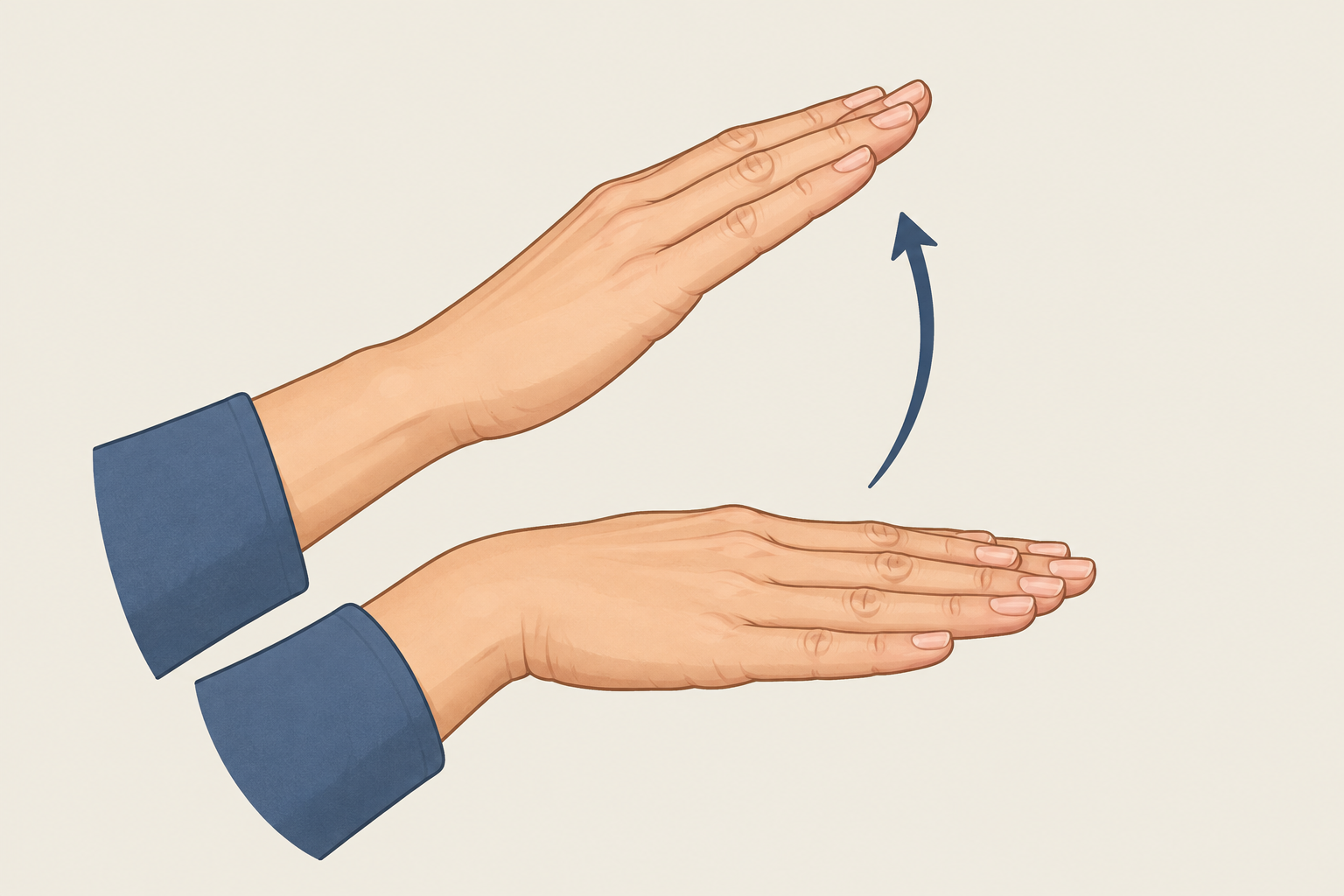
To sign “more than” in ASL, hold your non-dominant hand flat with the palm down, rest your dominant flat hand on top of it, then lift the dominant hand up and slightly forward so it rises over the base. This guide covers that sign along with less than, divide, square, squared, square root and approximately, and explains how each one maps to the written math symbol.
Last updated: October 29, 2026
What the math symbols mean before you sign them
You can only sign a concept clearly if you understand it, so here is the math first.
The greater-than symbol (>) means the value on the left is bigger than the value on the right. The less-than symbol (<) means the left value is smaller. In both cases, the open side faces the bigger number and the pointed tip faces the smaller one. So 9 > 4 reads “nine is greater than four,” and 4 < 9 reads “four is less than nine.”
Those two statements say the same thing. Flipping the numbers to opposite sides also flips the symbol. That matters in ASL, because signers often rearrange a statement for clarity, and you need to keep the meaning intact when you do.
The other symbols in this guide work like this:
- ÷ (divide): splits a number into equal parts. 12 ÷ 3 = 4.
- ² (squared): multiplies a number by itself. 5² = 25.
- √ (square root): undoes squaring. √25 = 5.
- ≈ (approximately equal): the values are close but not exact. π ≈ 3.14.
How to sign more than in ASL
The sign most often used for “more than” in a comparison is the same sign that means EXCEED or OVER, in the sense of going past a level.
- Handshape: Both hands flat, fingers together. Some signers bend the fingers slightly at the knuckles.
- Location: In front of your chest, in neutral signing space.
- Movement: Your dominant hand starts resting on the back of your non-dominant hand, palms down. Lift the dominant hand upward in a small arc, ending above and a little in front of the base hand.
The base hand represents the comparison point. The rising hand shows something going past it. That picture makes the sign easy to remember.
More than vs. MORE
Learners mix these up constantly. The everyday sign MORE (as in “more food, please”) uses two flat-O hands, fingertips pinched to the thumbs, tapping together in front of you. That sign means “additional.” It does not compare two values. If you are signing 9 > 4, use the rising-hand sign, not MORE.
Hearing tip
Let your face carry the size of the gap. A small rise with a neutral face suggests “a bit more than.” A bigger rise with puffed cheeks suggests “way more than.” Non-manual markers like these are part of ASL grammar, so they belong in your signing.
How to sign less than
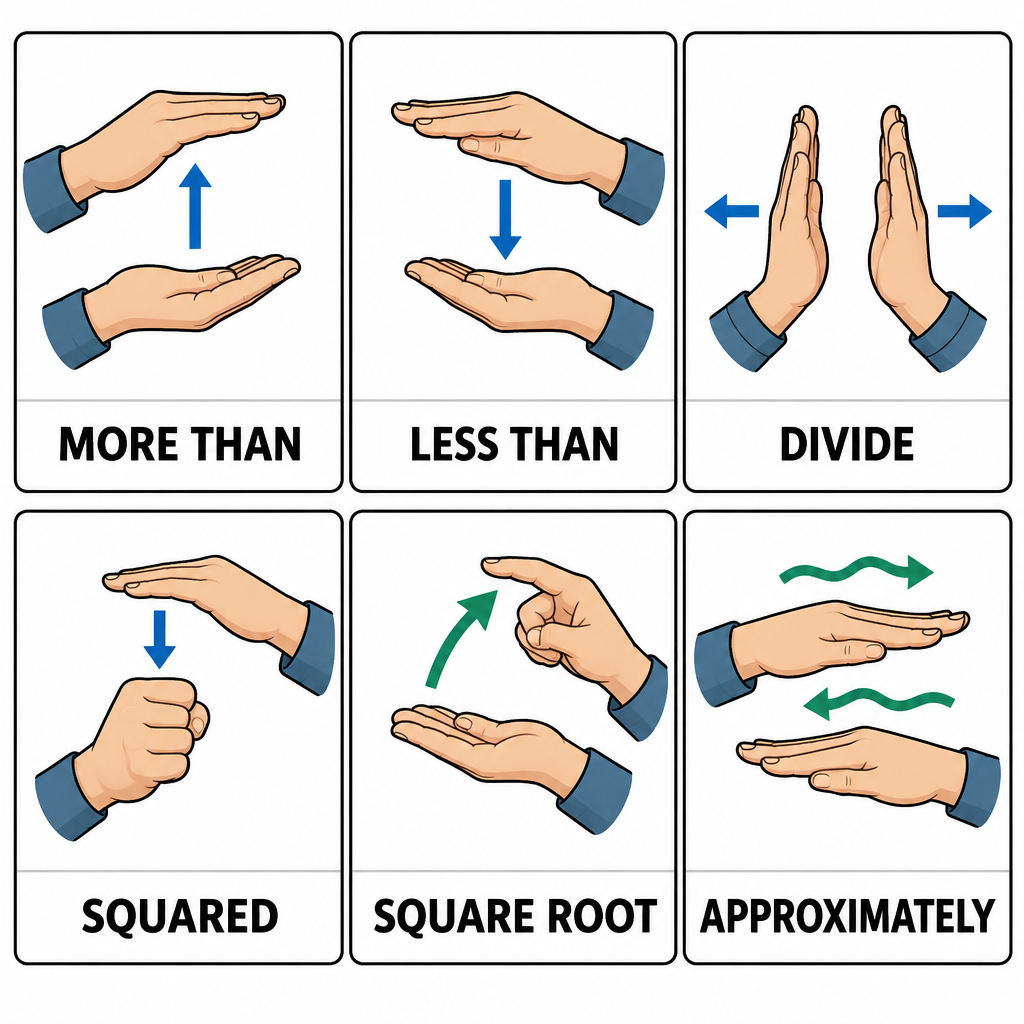
Less than mirrors more than. Start with the same two flat hands, palms down, dominant hand resting on the back of the base hand. Then move the dominant hand downward, dropping past the edge of the base hand so it ends below it.
You will also see the plain sign LESS, where the dominant hand starts above the base hand and lowers toward it without passing it. Both show up in classrooms. If your teacher or interpreter uses one consistently, match them.
Using space to sign a full comparison
Here is where ASL differs from spoken English. You do not have to sign “nine is greater than four” word by word. Many signers set up the values in space first, then compare them.
For 9 > 4, you might sign NINE and place it on your left, sign FOUR and place it on your right, then sign MORE-THAN starting from the nine’s side. The location does the work that word order does in English.
This also makes changing sides painless. If you placed the values once, you can point back to either one and sign LESS-THAN or MORE-THAN without restating the numbers.
How to sign divide
- Handshape: Both hands flat, palms facing down or angled slightly toward each other.
- Location: In front of your chest.
- Movement: Cross your hands so the pinkie edge of your dominant hand rests across the index-finger edge of your base hand, making an X shape. Then pull both hands apart, moving down and out to the sides.
The motion looks like breaking something into pieces, which is why the same sign also covers SPLIT and SEPARATE in everyday conversation. For “12 divided by 3,” sign TWELVE, DIVIDE, THREE.
In written-math contexts, some teachers instead trace the ÷ symbol in the air with an index finger: a short horizontal line, a dot above, a dot below. That is handy when a student needs to copy notation onto paper exactly.
How to sign square, squared and square root
“Square” covers three different ideas in math, and each one has its own sign.
Square (the shape)
Both index fingers touch at the top center in front of you. Pull them apart horizontally, drop them straight down, then bring them back together at the bottom. You have traced the outline of a square. RECTANGLE uses the same motion with a wider horizontal pull.
Squared (the exponent)
To sign x² or 5², sign the base first, then sign the number TWO raised higher and slightly to the side, often with a small upward flick. The raised position echoes the small superscript in written math. CUBED follows the same pattern with THREE.
Square root
Most signers draw the radical symbol (√) with the index finger: a short tick down, a longer stroke up, then a line across the top. Then sign the number that sits under it. “Square root of 25” becomes the traced √ followed by TWENTY-FIVE.
How to sign approximately
- Handshape: Open hand, either a flat hand or a 5 hand with fingers spread.
- Location: Near your dominant shoulder, palm facing out.
- Movement: Make a few small circles.
This sign covers APPROXIMATELY, ABOUT, ROUGHLY and AROUND in the sense of estimating. Sign it right before the number: APPROXIMATELY FIFTY. A slight squint or tilted head adds to the “give or take” feel.
For the ≈ symbol in a formula, signers either use this sign or trace two wavy lines in the air.
Quick reference: core math signs
| Concept | Handshape | Location | Movement |
|---|---|---|---|
| More than | Two flat hands | Chest height | Dominant hand rises off the base hand |
| Less than | Two flat hands | Chest height | Dominant hand drops below the base hand |
| Divide | Two flat hands, crossed | Chest height | Hands pull apart, down and out |
| Square (shape) | Two index fingers | In front of chest | Trace a square outline |
| Squared (x²) | Number 2 handshape | Raised, to the side | Small upward flick after the base |
| Square root | Index finger | In front of chest | Trace the √ symbol |
| Approximately | Flat or 5 hand, palm out | Near shoulder | Small circles |
| Equal | Two bent hands, palms down | Chest height | Tap fingertips together |
Related signs you will need with these
Inequalities rarely appear alone. These signs fill out most middle-school and algebra work.
| Symbol | Meaning | How it is commonly signed |
|---|---|---|
| = | Equal | Two bent hands, palms down, fingertips tap together |
| ≠ | Not equal | NOT, then EQUAL, or trace = with a slash |
| ≥ | Greater than or equal to | MORE-THAN, OR, EQUAL, or trace the symbol |
| ≤ | Less than or equal to | LESS-THAN, OR, EQUAL, or trace the symbol |
| + | Plus | Two index fingers cross to form a plus sign |
| − | Minus | Dominant index finger placed against the base palm |
| × | Times | Two V hands, dominant V brushes across the base V |
Check your classroom's conventions
Math signs vary by region, school and interpreter. Students taking exams with an interpreter should agree on sign choices for symbols in advance so nothing gets lost in translation.
A worked example: signing an algebra inequality
Take the problem x + 3 > 7.
- Sign or fingerspell X, sign PLUS, sign THREE.
- Sign MORE-THAN.
- Sign SEVEN.
Now solve it. Subtract 3 from both sides and you get x > 4. Sign X, MORE-THAN, FOUR.
The tricky part comes when you multiply or divide by a negative number. Inequalities flip when that happens. If −2x > 6, dividing both sides by −2 gives x < −3. In ASL, emphasize that switch. Many tutors sign the original MORE-THAN, sign a clear FLIP or CHANGE, then sign LESS-THAN. Seeing the hands literally reverse direction helps the rule stick.
A real-life example: cutting rope
Say you have a 10-foot rope and need pieces longer than 3 feet. How many can you cut?
Signed naturally, that might go: ROPE TEN FOOT. NEED PIECE MORE-THAN THREE FOOT. HOW-MANY?
The answer is 3 pieces at most, because 10 ÷ 3 ≈ 3.3, and each piece has to exceed 3 feet. Three pieces of about 3.3 feet each works. Four pieces would leave each one at 2.5 feet, which fails the test. That one problem uses MORE-THAN, DIVIDE and APPROXIMATELY together, which makes it great practice.
How to remember greater than and less than
Two tricks work well, and one ties directly to ASL handshapes.
- The hungry mouth. The open side of the symbol always “eats” the bigger number. Kids often draw it as an alligator.
- The left-hand L. Hold up your left hand with thumb and index finger extended in an L, then tilt it slightly. It looks like <, and L stands for Less than. Your right hand makes a backward L that resembles >.
Typing the symbols when you write math notes
Deaf and hard of hearing students often rely on text: chat with an interpreter, captioned lectures, shared notes. Being able to type these symbols quickly saves time.
| Symbol | Unicode | Windows Alt code (numpad) | Mac shortcut |
|---|---|---|---|
| > | U+003E | Alt+62 | Shift+period |
| < | U+003C | Alt+60 | Shift+comma |
| ≥ | U+2265 | Alt+242 | Option+period |
| ≤ | U+2264 | Alt+243 | Option+comma |
| ≈ | U+2248 | Alt+247 | Option+X |
| ÷ | U+00F7 | Alt+246 | Option+slash |
| √ | U+221A | Alt+251 | Option+V |
| ² | U+00B2 | Alt+253 | Character Viewer |
In Microsoft Word, you can also type the Unicode number (for example, 2265) and press Alt+X to convert it to the symbol.
Practice tips that actually work
- Drill pairs, not singles. Practice MORE-THAN and LESS-THAN back to back so the direction becomes automatic.
- Use real numbers. Sign comparisons from your day: prices, temperatures, game scores.
- Record yourself. Check that your dominant hand clearly rises or drops, and that your face matches the size of the difference.
- Learn from STEM sources. Projects like ASL Clear and ASLCORE focus on academic and technical vocabulary signed by Deaf content experts.
- Sign homework aloud. Talking through each step in ASL forces you to understand the math and the grammar at once.
Hearing tip
Pick one version of each sign and stay consistent for a few weeks. Switching between variants too early slows down both your math and your signing.
FAQ
Is the sign for more than the same as the sign for MORE?
No. MORE (flat-O hands tapping) means “additional.” The comparison sign uses flat hands, with the dominant hand rising off the base hand. Use the rising sign whenever you compare two values.
How do you sign greater than or equal to?
Most signers sign MORE-THAN, then OR, then EQUAL. In a written-math context, tracing the ≥ symbol in the air is also common and avoids ambiguity.
Does ASL have one standard set of math signs?
Not fully. Core signs like EQUAL, PLUS and DIVIDE are widely shared, but symbols like ≈, exponents and square roots vary between schools and regions. Ask your teacher or interpreter which version they use.
How do you sign “about” for a time, like “about 3 o’clock”?
Use the same APPROXIMATELY sign (open hand, palm out, small circles near the shoulder), then sign the time.
Is DIVIDE the same sign as SPLIT?
Yes, the same crossed-hands movement covers DIVIDE, SPLIT and SEPARATE. Context tells the viewer which meaning you intend.