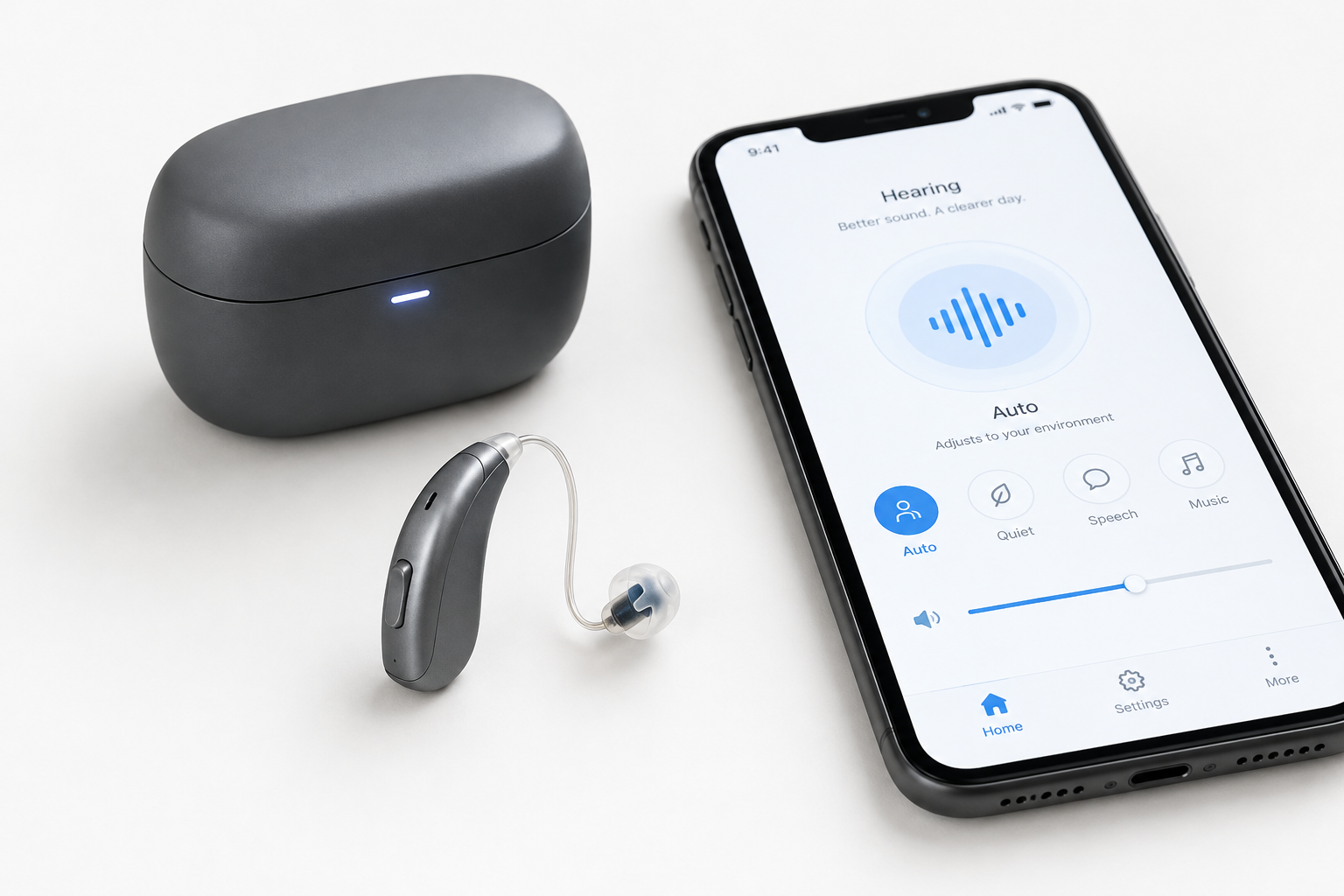
Over the counter hearing aids are FDA-regulated devices that adults 18 and older with perceived mild to moderate hearing loss can buy without an exam, prescription or fitting appointment. Prescription hearing aids are fitted by an audiologist or hearing instrument specialist, cost more, and handle a much wider range of hearing loss. The right choice depends on how much hearing you’ve lost, how comfortable you are with self-setup, and how much support you want afterwards.
Last updated: October 30, 2026
What counts as an over-the-counter hearing aid
The OTC category is new. Congress passed the Over-the-Counter Hearing Aid Act in 2017. The FDA finalized the rule in August 2022, and it took effect on October 17, 2022. Before that, every hearing aid in the US went through a licensed professional, and many states required a medical evaluation or a signed waiver first.
The rule created a separate class of hearing aids you can buy in a pharmacy, big-box store or online. To be sold as OTC, a device has to meet FDA requirements on safety and labeling, including:
- An output cap. Maximum sound output is limited to 111 dB SPL, or 117 dB SPL for devices with input-controlled compression and a volume control you can adjust. This limit is designed to protect your remaining hearing.
- User control. You must be able to adjust the device yourself, usually through buttons, presets or a phone app.
- Clear labeling. The box has to list “red flag” symptoms that mean you should see a doctor rather than self-treat. It also has to state that the device is for adults with perceived mild to moderate loss.
“Perceived” is the important word. Nobody checks your hearing before you buy. The device is aimed at people who notice trouble in specific situations, like noisy restaurants, group conversations or the TV, and who still do fine in quiet one-on-one talks.
OTC hearing aids are not the same as PSAPs
Personal sound amplification products (PSAPs) are sold for people with normal hearing who want a boost in certain settings, such as birdwatching or hunting. They aren’t regulated as medical devices and can’t legally be marketed to treat hearing loss. Some cheap “hearing amplifiers” sold online are really PSAPs with misleading packaging.
A real OTC hearing aid will say “OTC hearing aid” on the packaging. If a $30 product doesn’t, treat it as an amplifier, not a hearing aid.
Hearing aid software in earbuds
OTC hearing doesn’t always come in a dedicated device anymore. In September 2024, the FDA authorized Apple’s hearing aid feature for AirPods Pro 2. This was the first over-the-counter hearing aid software to run on consumer earbuds. Apple also supports the feature on AirPods Pro 3. You take a hearing test on your iPhone, and the earbuds apply a personalized profile to the sounds around you, as well as to music and calls.
This route makes sense if you already own compatible AirPods and have mild to moderate loss. The trade-off is battery life and comfort. Earbuds aren’t designed to be worn all day, every day, the way a small behind-the-ear aid is.
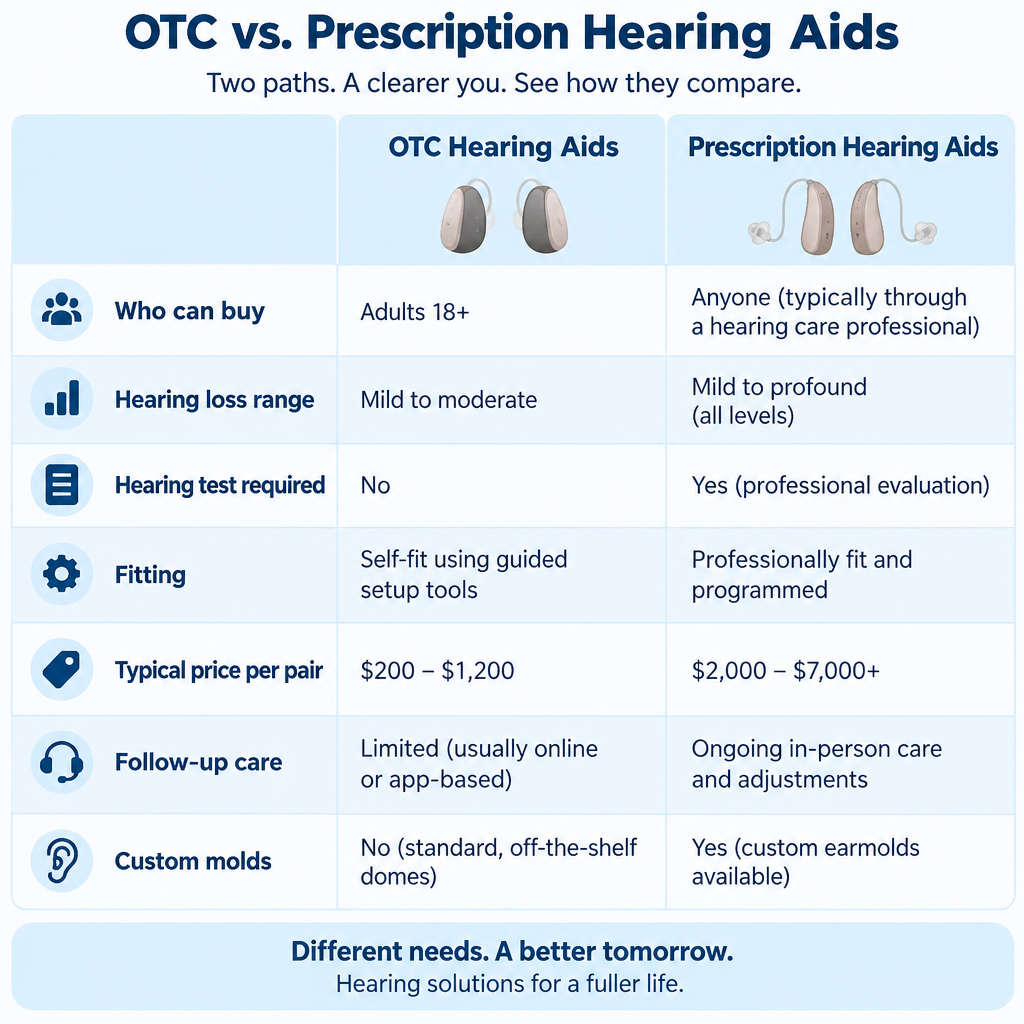
OTC vs prescription hearing aids: the 7 key differences
| OTC hearing aids | Prescription hearing aids | |
|---|---|---|
| Who can buy | Adults 18+ | Any age, through a professional |
| Hearing loss range | Perceived mild to moderate | Mild to profound |
| Hearing test required | No | Yes |
| Fitting | Self-fit with presets or app | Professional fitting and verification |
| Typical price per pair | Hundreds to about $2,000 | About $2,000 to $7,000+ |
| Follow-up care | Phone, chat or app support | In-person adjustments, cleanings, repairs |
| Custom molds | Rare | Common |
- The range of hearing loss covered. OTC devices are capped for mild to moderate loss. Severe or profound loss needs more power and finer control than the OTC rules allow.
- Who fits them. With OTC, you’re the fitter. Prescription devices are programmed to your audiogram, often across many separate frequency channels.
- Verification. A good audiologist confirms the fit with real ear measurement. A tiny microphone in your ear canal checks that the aid is actually delivering the prescribed sound levels. OTC devices skip this step entirely.
- Age. OTC is for adults only. Children and teens need a professional, because their hearing needs and ear canals change quickly.
- Cost and bundling. Prescription prices often bundle the device with years of appointments. OTC prices cover the hardware and whatever remote support the brand offers.
- Physical fit. Prescription aids can use custom earmolds made from impressions of your ear. Most OTC aids come with a few sizes of silicone domes.
- Ongoing care. With prescription aids, you can walk into a clinic for a re-program, a deep clean or a repair. OTC support happens mostly by phone, video or app, and repairs usually mean mailing the device back.
What OTC hearing aids cost compared with prescription
Prices change often, so treat these as typical ranges as of October 2026, not quotes.
| Option | Typical price per pair | What’s usually included |
|---|---|---|
| Basic OTC hearing aids | About $200 to $600 | Preset programs, limited app control |
| Mid to premium OTC hearing aids | About $600 to $2,000 | App fitting, rechargeable case, remote support |
| Earbuds with hearing aid software | Price of the earbuds | Hearing test and profile through your phone |
| Warehouse-club prescription aids | Around $1,500 to $2,000 | Hearing test, fitting, follow-ups |
| Clinic prescription aids | About $2,000 to $7,000+ | Exam, fitting, verification, multi-year care |
Warehouse clubs sit in an interesting middle ground. You get a professional test and fitting at a price closer to premium OTC. If that appeals to you, our guide to hearing aids Costco shoppers buy explains how their hearing centers work.
Are you a good candidate for OTC hearing aids?
OTC devices tend to work well if most of these describe you:
- You’re 18 or older.
- You hear fine in quiet rooms but struggle in restaurants, meetings or the car.
- People seem to mumble, especially women and children, whose voices are higher-pitched.
- You turn the TV up louder than others in the room like.
- You can follow a phone call, though you sometimes ask people to repeat themselves.
- Your hearing changed gradually, over years rather than days.
OTC is usually the wrong choice if you can’t follow conversation even in a quiet room, rely heavily on lipreading, or have trouble hearing loud speech. Those are signs of moderately severe loss or worse.
See a professional
Sudden hearing loss in one or both ears is a medical emergency, so get to a doctor or urgent care the same day. Also see a doctor for ear pain, drainage, dizziness, loss in only one ear, or a feeling of blockage.
The FDA labeling for OTC aids lists these same red flags. Sudden sensorineural hearing loss responds best to treatment started quickly, often within days. Don’t wait it out with an amplifier.
Before you buy an OTC hearing aid: what to check

Get a hearing test anyway
You don’t need a test to buy OTC, but one is still worth getting. An audiologist can give you an audiogram without selling you anything, and you can then use that result to set up an OTC device. Some OTC apps even let you enter your audiogram numbers directly. A test also rules out simple problems. Earwax buildup, for example, can mimic hearing loss and is easily treated.
If cost is the barrier, many OTC apps and phone platforms include a self-test. These are less precise than a sound booth, but they’re far better than guessing.
Pick a style you’ll actually wear
- Behind-the-ear (BTE) or receiver-in-canal (RIC): A small body sits behind your ear, and a thin wire or tube runs to a dome in your canal. This is the most common OTC style. It handles feedback well and fits larger batteries.
- In-the-canal / completely-in-canal: Small and discreet, but harder to handle and usually shorter on battery and features.
- Earbud style: Looks like wireless earbuds and often streams audio well. It’s bulkier in the ear and more obvious in social settings.
If you have arthritis or limited dexterity, avoid the tiniest models. Fiddly charging contacts and dome changes become a daily annoyance.
Read the return policy before the spec sheet
The return window may be the most important number on the page. It takes time for your brain to adjust to amplified sound, and you won’t know if a device works for you after one afternoon. Look for at least 30 days, a full refund with no restocking fee, and clear warranty terms. Some brands offer longer trials.
Hearing tip
Write the return deadline on your calendar the day the box arrives, and wear the aids daily from then on. You need real-world use in noisy places to judge them fairly before the window closes.
Features worth paying for
| Feature | What it does | Who needs it |
|---|---|---|
| App-based fitting | Tunes sound to your test results | Almost everyone |
| Rechargeable battery | Charges in a case overnight | Anyone who hates tiny batteries |
| Directional microphones | Focus on voices in front of you | Restaurant and meeting goers |
| Noise reduction | Softens steady background noise | City dwellers, commuters |
| Bluetooth streaming | Calls, music, TV straight to the aids | Phone and podcast users |
| Telecoil | Picks up hearing loop signals | Theater, church and transit users |
| Auracast support | Receives broadcast audio streams | Early adopters, frequent travelers |
| Feedback cancellation | Reduces whistling | Open-fit dome users |
Rechargeable models usually advertise a full day of use on a charge. Real battery life drops with heavy streaming, so check the stated hours both with and without streaming.
Telecoils are less common in OTC devices than in prescription ones. If you regularly attend venues with hearing loops, look for a telecoil before you buy. Newer devices are starting to add Bluetooth LE Audio, and our explainer on Auracast broadcast audio covers why that could matter in airports, gyms and lecture halls over the next few years.
After you buy: setting up and adjusting
Most OTC hearing aids follow a similar setup flow. Exact menus vary by brand, so use the steps below as a general guide.
Setup steps
- Charge the aids fully in their case before first use.
- Install the brand’s app and create an account.
- Pair the aids through the app, not your phone’s Bluetooth menu, unless instructed otherwise.
- Run the in-app hearing test in a quiet room, or enter your audiogram.
- Try each dome size and choose the one that seals comfortably without pain.
- Start at the recommended volume and wear the aids for a few hours a day.
- Increase daily wear over the first two weeks.
If you’re using AirPods Pro with a supported iPhone, Apple’s path is built into Settings.
AirPods hearing aid setup
- Update your iPhone and AirPods to the latest software.
- Put your AirPods in and open Settings.
- Tap your AirPods name near the top of Settings.
- Under Hearing Health, tap Take a Hearing Test.
- When finished, open Hearing Assistance and turn on Hearing Aid.
Expect an adjustment period
Your brain has gotten used to a quieter world. At first, amplified sound can seem tinny, sharp or overwhelming. Your own voice may sound strange, and the hum of your fridge may suddenly feel loud. That’s normal. Most people settle in over a few weeks of consistent use.
Resist the urge to crank the volume. Start low, wear the aids daily, and make small adjustments. If speech still sounds muffled after two or three weeks, contact the brand’s support team. If problems continue, get a professional hearing test before your return window closes.
Care and cleaning
Wipe the aids daily with a dry cloth, and change wax guards and domes as the manual recommends. Store them in the charging case. Keep them out of the bathroom while you shower, because moisture and earwax cause most hearing aid failures.
When prescription hearing aids are the better choice
Choose prescription if you have more than moderate loss, if your two ears are very different, or if a doctor has found a medical cause like otosclerosis. Prescription is also the better route for children and teens.
It’s also a good choice if you tried OTC aids and couldn’t get comfortable. Some people simply do better with a professional handling the fine-tuning. That isn’t a failure. Often an OTC trial is how you learn what you need.
If you’re buying prescription hearing aids
Ask these questions before you sign anything:
- Is the price bundled or unbundled? Bundled pricing includes years of visits. Unbundled pricing is cheaper upfront, but you pay per appointment.
- Do you perform real ear measurement? Clinics that verify fittings this way consistently deliver more accurate results. Our explainer on real ear measurement covers what happens during the test.
- What’s the trial period? Many states require a trial window for prescription aids. Ask for the terms in writing.
- Who owns the programming? Some aids are “locked” to the original clinic, which makes switching providers harder later.
Paying for OTC and prescription hearing aids
Medicare. Original Medicare (Parts A and B) doesn’t cover hearing aids, although it can cover a diagnostic hearing exam ordered by a doctor. Many Medicare Advantage plans include some hearing aid benefit. Check your plan’s details, because some benefits only apply through specific providers.
Private insurance. Coverage varies widely, and some states mandate hearing aid coverage for children. Call your insurer and ask specifically whether OTC devices count, since some plans only reimburse prescription aids.
HSA and FSA. Hearing aids, including OTC models, are generally eligible medical expenses. Keep the receipt and packaging that shows “OTC hearing aid.”
Veterans. Eligible veterans can often get hearing aids through the VA. If you served, it’s worth checking before you pay out of pocket.
OTC hearing aids and tinnitus
Many people with ringing in their ears also have some hearing loss. Amplifying outside sounds can make tinnitus less noticeable. Some devices also include a sound generator that plays soft background noise. Neither approach cures tinnitus, and results vary from person to person. Our guide to hearing aids for tinnitus walks through what the research supports.
If your tinnitus is only in one ear, pulses with your heartbeat, or came on suddenly, see a doctor before you buy anything.
FAQ
Do I need a prescription for OTC hearing aids?
No. Adults 18 and older can buy OTC hearing aids in stores or online without a prescription, exam or fitting appointment. A hearing test is still a smart first step, even though the law doesn’t require it.
Are non-prescription hearing aids as good as prescription ones?
For mild to moderate loss, a well-fitted OTC device can work very well, especially in everyday situations. Prescription aids pull ahead with more severe loss, unusual hearing patterns, and in tough settings where professional fine-tuning and verification make a difference.
Can OTC hearing aids damage my hearing?
The FDA caps OTC output to limit that risk, and following the labeling keeps it low. Keep the volume at a comfortable level. If you notice pain, worsening hearing or new ringing, stop using the aids and see a professional.
Can teenagers use OTC hearing aids?
No. The OTC category is limited to adults 18 and older. Anyone younger should be evaluated and fitted by an audiologist.
Does Medicare pay for over the counter hearing aids?
Original Medicare doesn’t. Some Medicare Advantage plans offer an allowance that may apply to OTC or prescription aids. Check your specific plan’s benefits.
Can AirPods really work as hearing aids?
Yes, with limits. AirPods Pro 2 and AirPods Pro 3 support Apple’s FDA-authorized hearing aid feature for perceived mild to moderate loss. You need a compatible iPhone and current software. They’re best for part-time use rather than all-day wear.
How long do OTC hearing aids last?
Most hearing aids last several years with good care. Rechargeable batteries gradually lose capacity over time. Check the warranty length and whether the brand offers battery replacement before you buy.