Last updated: October 29, 2026
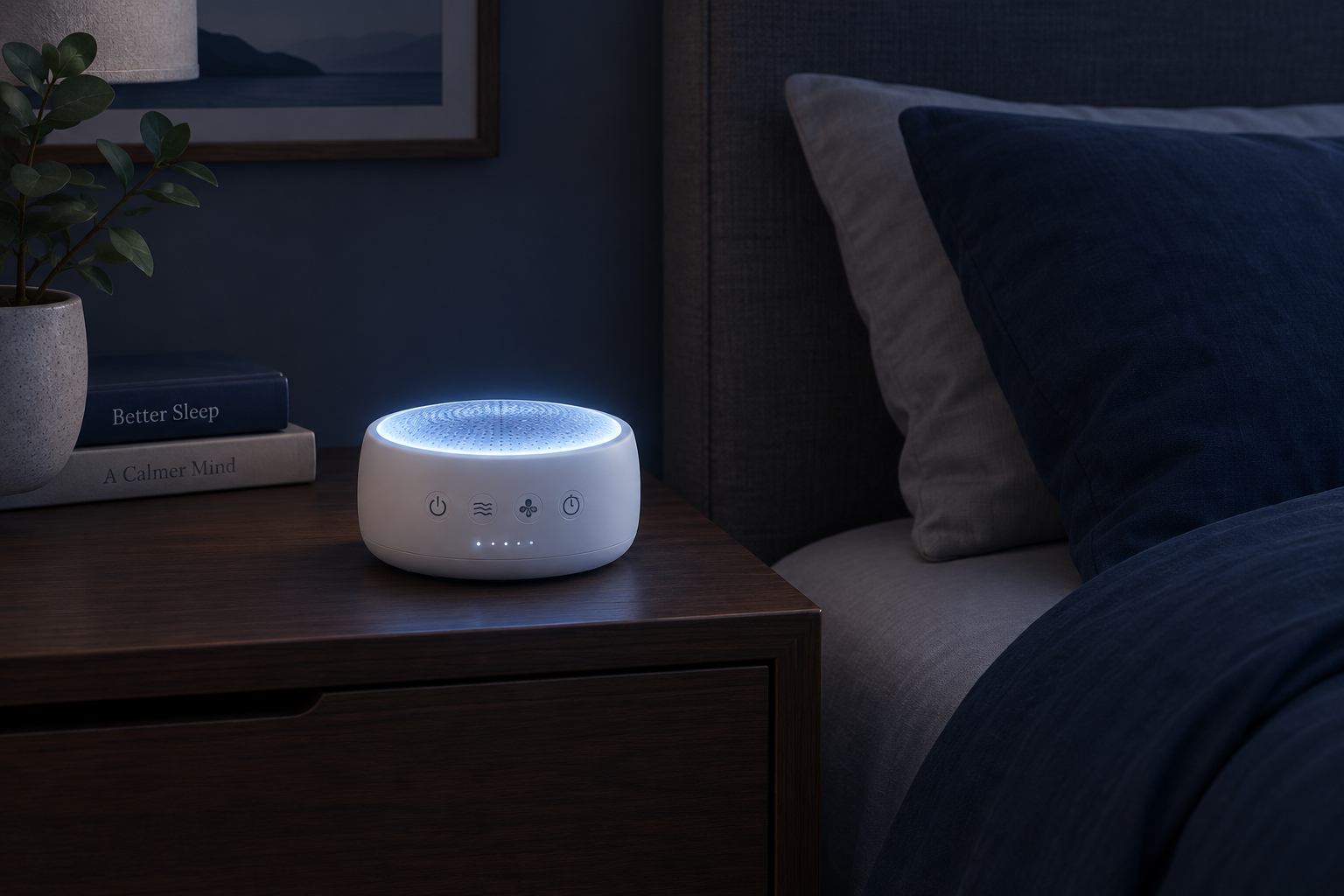
A white noise maker for tinnitus works by filling the silence of your bedroom so the ringing stands out less, which helps many people fall asleep faster. For most people, the best choice is a non-looping machine with adjustable tone and a very quiet lowest volume. The LectroFan Classic is our top pick, and a real-fan machine like the Yogasleep Dohm suits you if digital noise sounds harsh. None of these devices cures tinnitus, but the right one can make nights much easier.
Why Sound Helps Tinnitus at Night
Tinnitus usually feels loudest when you lie down. Daytime noise from traffic, voices, the fridge and the TV partly covers the ringing. At night that background noise disappears, and your brain turns up its attention to the one sound left: the one it produces itself.
Roughly 1 in 10 US adults reported tinnitus in the past year in a large national survey published in JAMA Otolaryngology in 2016. Trouble sleeping is one of the most common complaints in that group.
Sound therapy targets that contrast. Steady background sound does three useful things:
- It lowers the contrast between the tinnitus and the room, so the ringing feels less intrusive.
- It gives your attention somewhere neutral to rest. A smooth, predictable sound is easy for the brain to ignore, and some of the ringing gets ignored along with it.
- It supports habituation over time. This is the process of your brain learning to class tinnitus as unimportant. Tinnitus Retraining Therapy uses low-level sound for exactly this reason.
The American Academy of Otolaryngology–Head and Neck Surgery’s clinical guideline on tinnitus lists sound therapy as an option for people with persistent, bothersome tinnitus. That is a modest endorsement, and an honest one. Sound helps many people cope, especially at bedtime, but research does not show it reduces tinnitus itself.
When White Noise Isn’t the Right Tool
The research on white noise and tinnitus has a skeptical side, and you should know about it before you buy anything.
In 2018, researchers Mouna Attarha, James Bigelow and Michael Merzenich published a review in JAMA Otolaryngology–Head & Neck Surgery titled “Unintended Consequences of White Noise Therapy for Tinnitus–Otolaryngology’s Cobra Effect: A Review.” They argued that long, constant exposure to unstructured noise could encourage unhelpful changes in how the brain processes sound. This was a review built on animal research and theory. It did not include a clinical trial showing harm in people with tinnitus.
Even so, it supports a sensible middle ground that most audiologists already recommend:
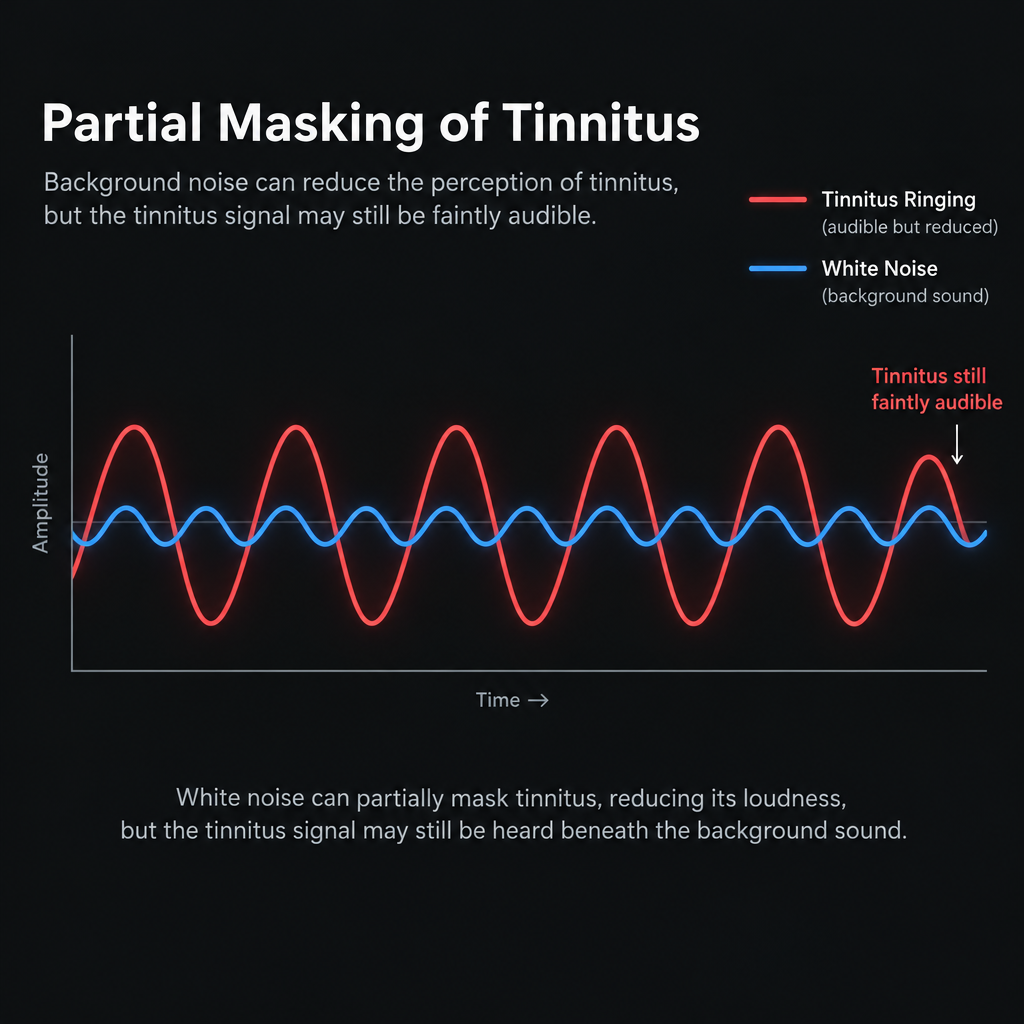
- Keep the volume low. Set it so you can still faintly hear your tinnitus underneath. Audiologists call this partial masking, or finding the “mixing point.” Drowning the ringing out completely is not the goal.
- Prefer gentler sounds over harsh hiss if both work for you. Pink noise, fan sounds, rain or ocean are easier to live with for hours.
- Pair sound with other support. Sound therapy works best alongside good sleep habits and, for bothersome tinnitus, cognitive behavioral therapy (CBT). The AAO-HNS guideline recommends CBT more strongly than sound devices.
See a professional
Sudden hearing loss in one ear is a medical emergency, so get seen within a day or two. Also see a doctor if your tinnitus pulses with your heartbeat, affects only one ear, or comes with dizziness.
Tinnitus that starts after an ear injury, such as a perforated eardrum, also needs a proper check before you rely on a sound machine to manage it.
What to Look For in a White Noise Maker for Tinnitus
Most sound machines are designed and marketed for babies and light sleepers. People with tinnitus need a few specific things that general reviews often skip.
Non-looping sound
Cheap machines play a short recorded clip on repeat. Once you notice the seam where the loop restarts, you can’t stop hearing it. That defeats the whole point, which is giving your brain something it can ignore. Look for machines that generate sound digitally in real time or use a real fan.
Adjustable tone or noise color
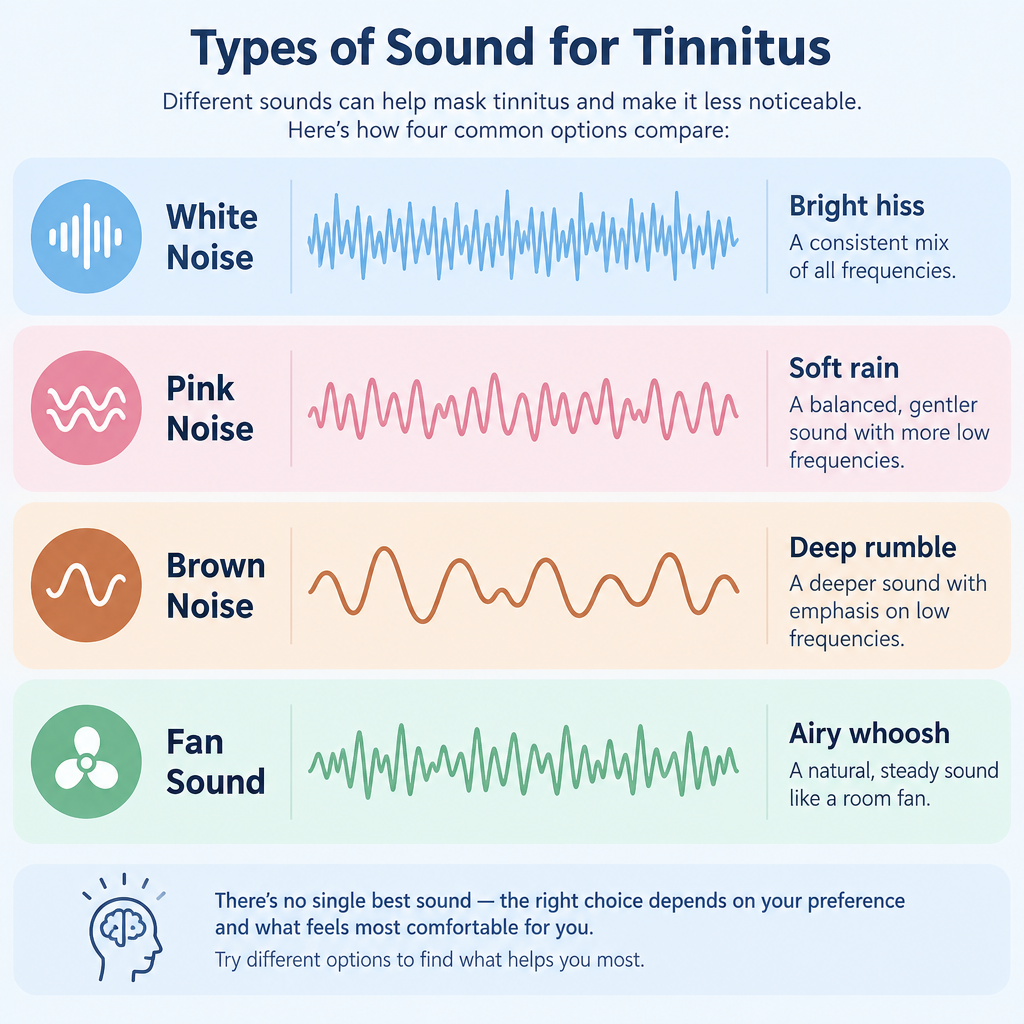
Tinnitus comes in different pitches. A high-pitched whine and a low hum respond differently to different noise. Machines that offer several noise colors, or let you shift the tone up and down, give you a much better chance of finding the sound that blends with your tinnitus.
| Noise type | How it sounds | Where the energy sits | Often suits |
|---|---|---|---|
| White noise | Bright hiss, like TV static | Equal energy across all frequencies | High-pitched ringing or whistling |
| Pink noise | Softer, like steady rain | Energy falls 3 dB per octave | Mixed or mid-pitched tinnitus, all-night use |
| Brown (red) noise | Deep rumble, like a waterfall | Energy falls 6 dB per octave | Low hums and buzzing; people who find hiss harsh |
| Fan sound | Airy whoosh with low-end body | Varies by fan and speed | People who already sleep with a fan |
| Nature sounds | Rain, surf, stream | Varies, with natural variation | Those who find pure noise boring or irritating |
These are starting points, not rules. Plenty of people with high-pitched tinnitus prefer brown noise because it feels calmer. Try each option for a few nights before you decide.
A very quiet lowest setting
This matters more than how loud a machine gets. With tinnitus you want sound just at or below the level of your ringing, which can be very soft. Some machines jump from silence straight to fairly loud. Check reviews for comments on the minimum volume.
Timer or all-night play
Opinions differ, so pick a machine that supports how you sleep. A timer helps if you only struggle to fall asleep. Continuous play helps if you wake at 3 a.m. and the silence makes the ringing roar back. Many people with tinnitus do better with all-night sound at a low level.
Headphone or pillow speaker output
If you share a bed, a headphone jack or Bluetooth output lets you send sound to a pillow speaker or sleep earbuds, so your partner sleeps in silence. Few dedicated machines offer this, so it narrows the field quickly.
Power and portability
Plug-in machines are fine at home. If you travel, a USB-powered or rechargeable model means you don’t face a silent hotel room. Silent rooms are often the worst nights for people with tinnitus.
Our 6 Picks at a Glance
Prices below are typical US retail as of late October 2026. Sound machines go on sale often, so treat these as ballpark figures.
| Pick | Best for | Typical price (Oct 2026) | Sound source |
|---|---|---|---|
| LectroFan Classic | Best overall | About $45 to $55 | Digital, non-looping |
| Yogasleep Dohm Classic | Real fan sound | About $45 to $55 | Mechanical fan |
| Snooz Original | App control with a real fan | About $100 | Mechanical fan |
| Hatch Restore 3 | All-in-one bedside device | About $170 | Digital library |
| LectroFan Micro2 | Travel | About $40 to $55 | Digital, non-looping |
| iPhone Background Sounds | Free option | Free | Built into iOS |
| Feature | LectroFan Classic | Dohm Classic | Snooz Original | Hatch Restore 3 | LectroFan Micro2 |
|---|---|---|---|---|---|
| Non-looping | Yes | Yes (real fan) | Yes (real fan) | Varies by sound | Yes |
| Noise colors | White, pink, brown | Fan only | Fan only | Several | White and others |
| Tone control | Via sound choice | Twist collar | Twist collar | Via sound choice | Via sound choice |
| Timer | 60-minute | No | In app | In app | No |
| App control | No | No | Yes | Yes | No |
| Battery | No | No | No | No | Yes, rechargeable |
1. LectroFan Classic: Best Overall
The LectroFan Classic from Adaptive Sound Technologies has stayed popular in tinnitus communities for years, for good reason. It offers 20 sounds: 10 fan sounds and 10 noise variations covering white, pink and brown noise. All of them are generated so they never loop.
That range matters for tinnitus. You can step through the noise colors in small increments until one sits right on top of your ringing without fighting it. Volume adjusts in fine steps, so finding a soft setting near your mixing point is easy.
It runs from USB or the included AC adapter and has a simple 60-minute timer. The design is plain. You get no app, no lights to dim and no subscription, which many people prefer for a bedside device.
Drawbacks: No headphone output on this model, and no nature sounds. If you want ocean sounds, the LectroFan Evo adds them along with a headphone jack.
Who it suits: Anyone who wants to experiment with noise colors to match their tinnitus, without spending much.
2. Yogasleep Dohm Classic: Best for Real Fan Sound
The Dohm (sold for decades under the Marpac name before the brand became Yogasleep) contains an actual fan inside a housing. It moves air you can hear but barely feel. Since the sound comes from a physical fan, it never loops and has a natural, slightly uneven texture.
You get two speeds. You adjust the tone by twisting the cap and collar to open or close the air vents, which shifts the sound from a higher whoosh to a deeper rumble. That analog tone control works well for tinnitus because you can fine-tune by ear.
Some people with tinnitus find digital white noise thin or harsh after a few hours. If that’s you, a real fan is worth trying.
Drawbacks: Only two volume levels, and even the low setting may be louder than ideal in a very quiet room. You get no timer and it must be plugged in.
Who it suits: Fan sleepers, and anyone bothered by the electronic quality of digital noise.
3. Snooz Original: Best App-Controlled Fan
Snooz also uses a real fan, but it pairs with a phone app over Bluetooth. That adds finer volume control, timers and schedules. You can set it to start at bedtime and fade off at your wake-up time without touching the device in the dark.
The tone adjusts with a rotating collar, much like the Dohm. Finer volume steps are the real advantage for tinnitus. You can bring a fan sound down to a soft background level that the two-speed Dohm can’t match.
The company also sells a portable Snooz Go and a pricier Snooz Pro with more app features.
Drawbacks: Costs roughly twice as much as a Dohm. App-dependent devices also rely on the company keeping its software updated.
Who it suits: People who love fan sound but need quieter low settings or automatic schedules.
4. Hatch Restore 3: Best All-in-One Bedside Device
The Hatch Restore 3 combines a sound machine with a sunrise alarm clock, a reading light and guided wind-down routines. You can build a bedtime sequence: dim light and a calming sound, then a low noise for the night, then a gradual light-based wake-up.
For tinnitus, the appeal is the structure. Many people find a consistent wind-down helps them stop focusing on the ringing at bedtime. The core sounds and features work without paying, while the optional Hatch+ subscription unlocks a larger library of sounds and content.
Drawbacks: Expensive if you only want noise. The best content sits behind a subscription, and the device works best with its app.
Who it suits: People whose tinnitus is tied to a broader sleep struggle and who would use the light and routine features.
5. LectroFan Micro2: Best for Travel
The Micro2 is a small, rechargeable version of the LectroFan. It offers a handful of non-looping fan, noise and ocean sounds and doubles as a Bluetooth speaker. It fits in a jacket pocket and charges over USB.
For tinnitus sufferers, travel nights can be rough. Hotel rooms often have no fan or steady background noise, and unfamiliar surroundings add stress. A pocket machine fixes that cheaply.
Drawbacks: The small speaker has less low-end depth than a full-size machine, so brown noise and fan sounds feel thinner. Battery life also depends on volume.
Who it suits: Frequent travelers, or anyone who wants a backup machine in a bag.
6. iPhone Background Sounds: Best Free Option
Before you spend anything, try what’s already on your phone. Since iOS 15, iPhones include Background Sounds in the accessibility settings. Apple has expanded the list over time. It now includes Balanced Noise, Bright Noise and Dark Noise (roughly white, brighter and brown), plus rain, ocean, stream and several other ambient sounds.
Background Sounds can keep playing under other audio, and you can choose whether they stop when the phone locks. That makes it a genuinely useful free test. You’ll find out which noise color suits your tinnitus before you buy a dedicated machine.
Turn on Background Sounds on iPhone
- Open Settings and tap Accessibility.
- Tap Audio & Visual, then Background Sounds.
- Switch Background Sounds on and tap Sound to choose one.
- Adjust the Volume slider to just below your tinnitus.
- Turn off Stop Sounds When Locked for all-night play.
- Add the Hearing control in Control Center for quick access.
Drawbacks: Phone speakers are small, and keeping your phone near your pillow can tempt you to scroll. You can pair it with a Bluetooth speaker or pillow speaker to solve both problems.
Free Tinnitus Apps Worth Trying
Several hearing aid companies offer free tinnitus apps, and most work without their hearing aids. These apps go beyond plain noise. Many include relaxation exercises and education designed around tinnitus specifically.
| App | Made by | Platforms | What stands out |
|---|---|---|---|
| ReSound Relief | ReSound (GN) | iOS, Android | Mix your own soundscapes; breathing and relaxation exercises |
| Widex Zen | Widex | iOS, Android | Zen fractal tones, a chime-like alternative to noise |
| Starkey Relax | Starkey | iOS, Android | Simple tinnitus sounds and relaxation content |
| myNoise | Independent | Web, iOS, Android | Highly adjustable noise generators you can tune by frequency |
| Background Sounds | Apple | iOS (built in) | No download needed; noise and nature options |
The Widex Zen tones are worth a mention. They are gentle, random, chime-like tones rather than noise. Some people with tinnitus find them more relaxing than any hiss, while others find them distracting. Few machines offer anything similar, so an app is the easiest way to try them.
Hearing tip
Spend a week with free apps before buying a machine. Note which sound you still like on night five, because the one that sounds best in the first minute is not always the one you can sleep with.
How to Set Up Your Machine for Better Sleep
Where you put the machine and how loud you set it matter as much as which one you buy. These steps work for any of the picks above.
Set up a sound machine for tinnitus
- Place it 1 to 2 meters from your head, not on the pillow.
- Sit in bed with the room quiet and start at zero volume.
- Raise the volume slowly until the ringing blends with the sound.
- Stop while you can still faintly hear your tinnitus underneath.
- Try each noise color or tone for at least three nights.
- Choose all-night play if waking in silence restarts the ringing.
Keep the volume safe
The volume needed for tinnitus relief is usually low, which also keeps your ears safe. Problems start when people turn machines up to fully drown out loud tinnitus. A 2014 study in Pediatrics measured infant sound machines and found some could exceed 85 dB at maximum volume. That is the workplace limit set by NIOSH for an 8-hour exposure. Running a machine that loud all night is a bad idea for anyone.
Aim for a level quieter than a normal conversation. If you want a number, the free NIOSH Sound Level Meter app for iPhone lets you check your machine from your pillow.
Skip the earplugs at night if they make things worse
Many people with tinnitus find that sleeping in earplugs makes the ringing louder, because blocking outside sound raises the contrast. If you need earplugs for a snoring partner or street noise, our guide to types of earplugs explains which styles let some sound through. Pairing low-level noise with filtered plugs can be a reasonable compromise.
Pillow Speakers and Sleep Earbuds for Shared Bedrooms
A white noise machine works for the room. That’s a problem if your partner hates noise. You have two good workarounds.
Pillow speakers are thin, flat speakers that slip inside a pillowcase. You hear the sound when your head is on the pillow, and someone beside you barely notices it. You connect one to a machine with a headphone jack, such as the LectroFan Evo, or to your phone.
Sleep earbuds are small, low-profile buds built for side sleeping. Ozlo Sleepbuds, from a team that previously worked on Bose’s discontinued Sleepbuds, and Anker’s Soundcore Sleep line are two current options. Most can stream any audio from your phone, so you can play Background Sounds or a tinnitus app through them. Check how comfortable they are for side sleeping before you commit, and use the lowest volume that works.
Hearing Aids With Built-In Tinnitus Sounds
If you have hearing loss as well as tinnitus, and many people do, a white noise machine may not be your best first step. Hearing aids often reduce tinnitus during the day by restoring the outside sound your brain has been missing. Many prescription models also include a built-in tinnitus sound generator.
| Brand | Tinnitus feature |
|---|---|
| Phonak | Tinnitus Balance sound generator |
| Oticon | Tinnitus SoundSupport |
| ReSound | Built-in tinnitus sound generator, controlled with the Relief app |
| Widex | Zen tinnitus program with fractal tones |
| Signia | Notch Therapy and tinnitus noise options |
| Starkey | Multiflex Tinnitus technology |
An audiologist fits these features and adjusts the sound to your tinnitus and hearing. Most people remove hearing aids at night, so these features mostly help during the day. Many people still use a bedside machine for sleep.
If cost is a barrier, warehouse clubs sell prescription hearing aids at lower prices than many private clinics. Our piece on buying hearing aids at Costco covers what to expect. Over-the-counter hearing aids are another option for adults with perceived mild to moderate hearing loss, though tinnitus features on OTC models vary widely.
See a professional
If you notice trouble following conversations, turning the TV up, or ringing that started alongside hearing changes, book a hearing test with an audiologist before relying on a sound machine alone.
Which White Noise Maker Should You Choose?
Here is how to narrow it down quickly:
- You want one solid machine and you don’t know your preferred sound yet: LectroFan Classic. The range of noise colors makes it the best tool for finding your match.
- Digital noise sounds tinny or irritating: Yogasleep Dohm Classic, or Snooz Original if you need quieter settings and schedules.
- Tinnitus is part of a bigger sleep problem: Hatch Restore 3, for its wind-down routines and wake light.
- You travel often: LectroFan Micro2.
- You share a bed with a light sleeper: A machine with a headphone jack, or your phone, paired with a pillow speaker or sleep earbuds.
- You’re unsure sound will help at all: Start free with iPhone Background Sounds or ReSound Relief.
People have been looking for ways to live with ringing ears for a long time. Beethoven described constant buzzing and humming in a 1801 letter to a friend, years before his hearing failed badly. The tools are far better now. Still, the most effective approach combines a comfortable sound, a sensible volume, and professional help when tinnitus starts affecting your mood, work or relationships.
FAQ
Does a white noise maker for tinnitus actually work?
For many people it helps with sleep, because steady sound lowers the contrast between the ringing and a silent room. It does not cure tinnitus or make it permanently quieter. Clinical guidelines treat sound therapy as a reasonable option, and they rate CBT as better supported for reducing tinnitus distress.
Is white, pink or brown noise best for tinnitus?
No single color is best. White noise often blends well with high-pitched ringing, while pink and brown noise feel softer and suit low hums or people who find hiss harsh. Try each one for a few nights at a low volume and pick the one you can tolerate for hours.
Should I leave my sound machine on all night?
Leaving it on all night is fine and often helpful, because waking in total silence can make tinnitus feel louder. Keep the volume low, quieter than normal conversation, and avoid placing the machine right next to your head.
Can white noise make tinnitus worse?
There is no solid clinical evidence that low-level white noise worsens tinnitus. A 2018 review paper raised a theoretical concern about long-term constant noise, so many audiologists suggest keeping the volume below your tinnitus level and choosing gentler sounds. Very loud noise played all night can damage hearing, which could worsen tinnitus over time.
Can I just use a fan instead of a sound machine?
Yes, if it works for you. A household fan provides steady, non-looping sound for free. Dedicated machines are quieter mechanically, offer tone control, and won’t chill you on cold nights, but a fan is a fine first experiment.
When should I see a doctor about tinnitus?
See a doctor urgently if you have sudden hearing loss, especially in one ear. Book an appointment if your tinnitus is in one ear only, pulses in time with your heartbeat, comes with dizziness or ear pain, or is affecting your sleep and mood for more than a few weeks.