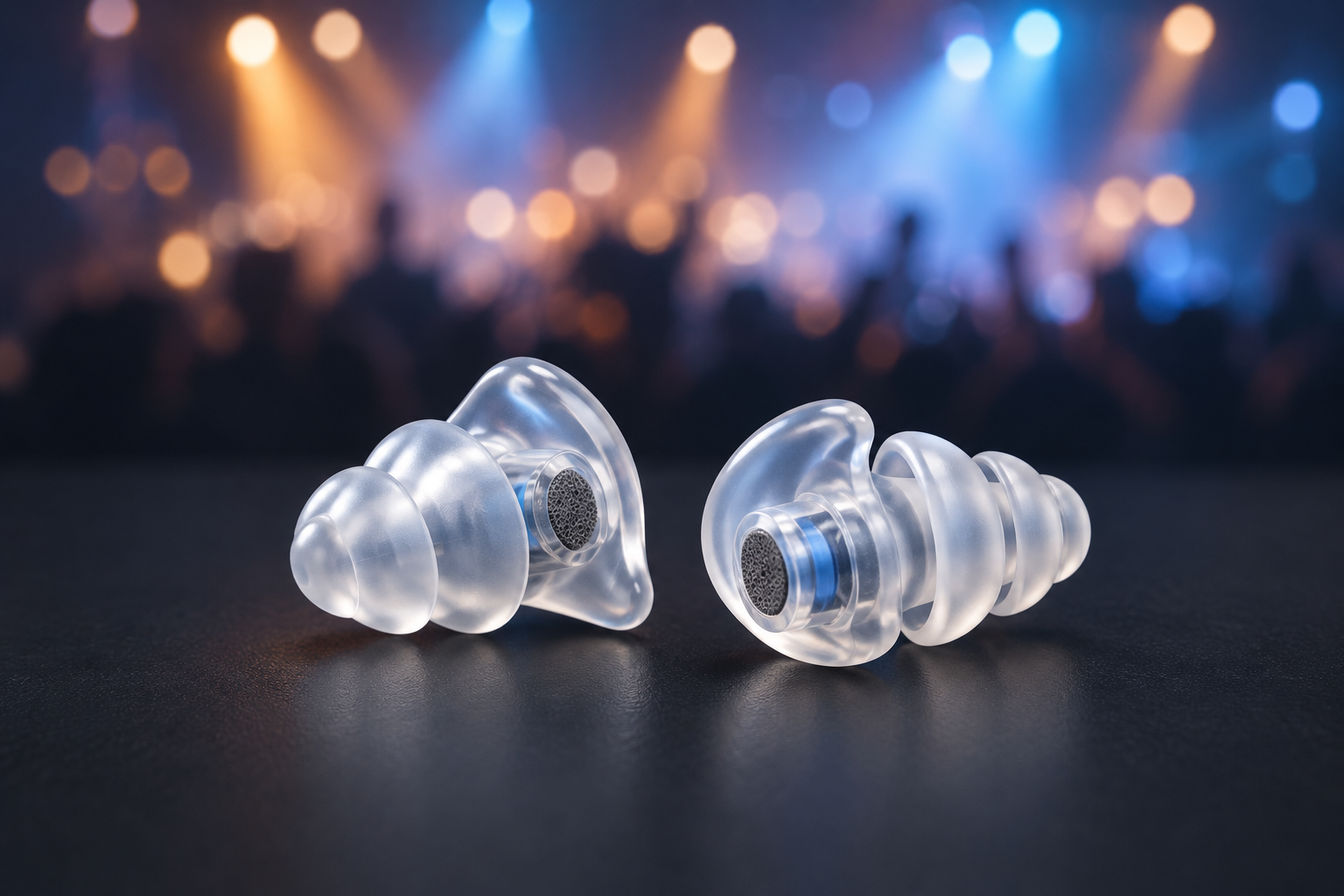
High fidelity earplugs lower the volume of sound fairly evenly across bass, mids and treble, so music sounds quieter but still clear instead of muffled. Most consumer models cut about 15 to 25 decibels, which is enough to bring a loud concert down to a level your ears can tolerate for much longer. This guide covers how they work, how the leading models compare and how to fit them so they actually protect you.
What High Fidelity Earplugs Actually Do
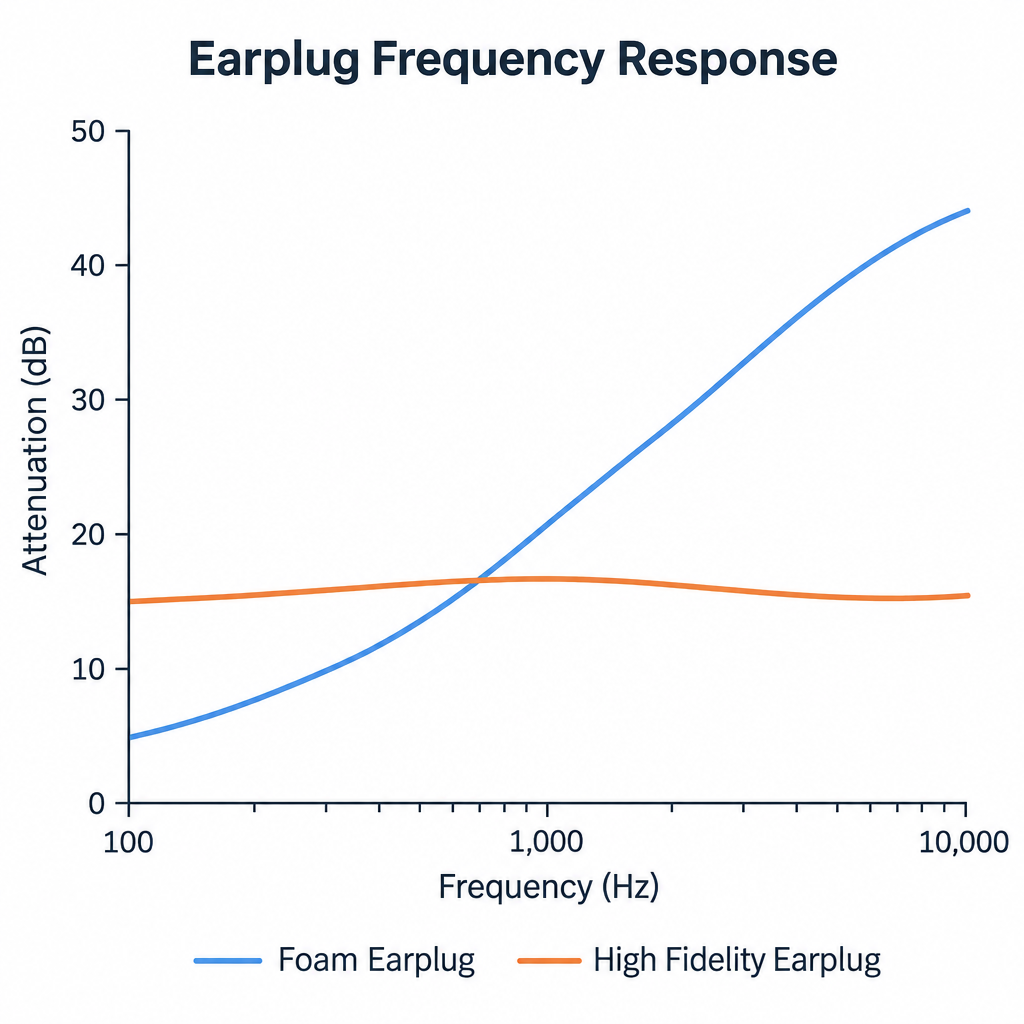
A foam earplug blocks sound unevenly. It cuts high frequencies much more than low ones. Cymbals, vocals and guitar detail disappear, while bass and kick drum still come through. The result is the familiar “head under a pillow” effect.
High fidelity earplugs use a small acoustic filter instead of solid material. The filter is a tuned channel, a membrane, or a damper that lets sound pass at a controlled level. The goal is a flatter response: if the band drops by 20 dB, every part of the mix drops by roughly 20 dB.
There is a second, less obvious reason foam sounds dull. Your open ear canal has a natural resonance around 2,500 to 3,000 Hz. It boosts that range, which is where much of the clarity in speech and music lives. Plug the canal and that boost vanishes. Good musician filters are designed to restore some of it, which is why they sound more natural than their decibel number suggests.
No consumer earplug is perfectly flat. Cheaper filtered models are closer to “less muffled” than “transparent.” Even so, the difference from foam is obvious the first time you try a pair at a gig.
For a broader look at how filtered plugs sit next to foam, wax and silicone, our guide to types of earplugs walks through each material.
How Loud a Concert Really Is
Live music commonly measures between 100 and 110 dBA near the stage, with peaks higher still. Clubs and festival stages often run in the same range for hours.
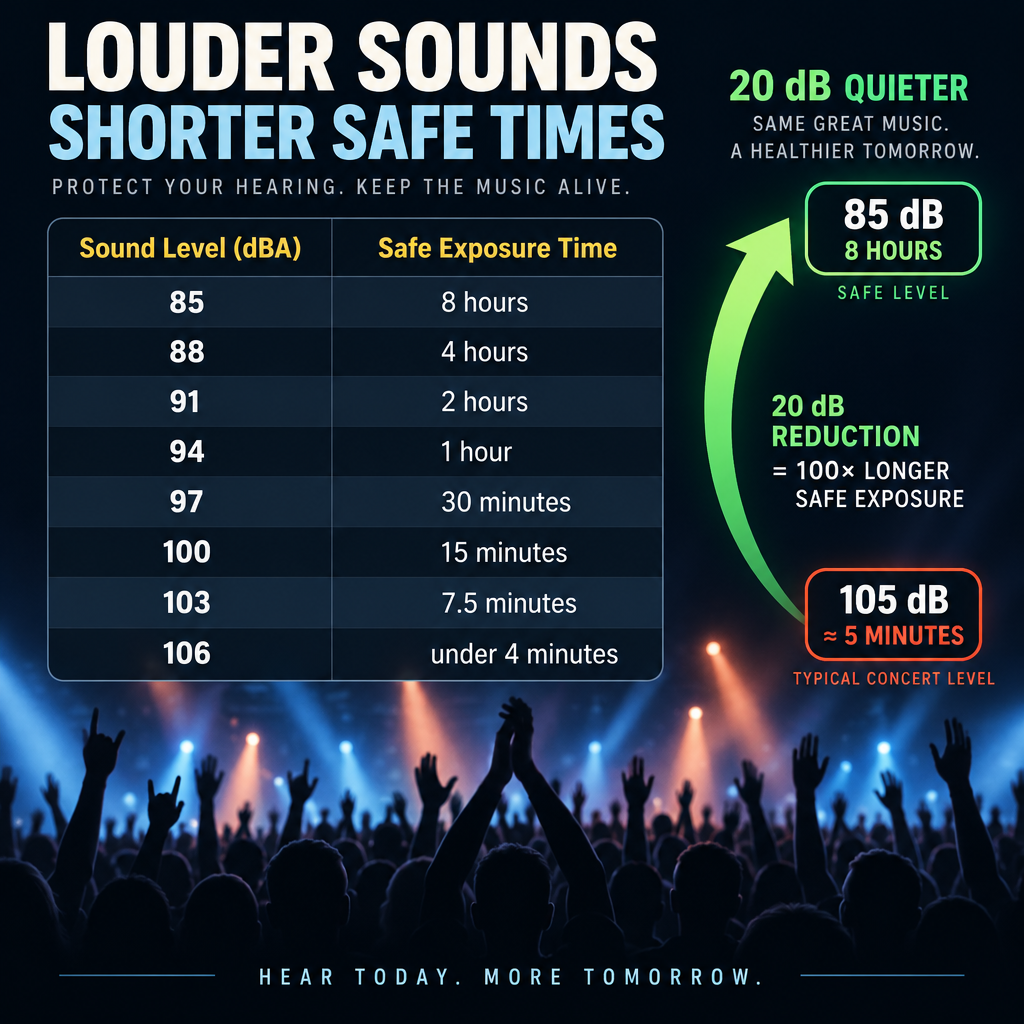
The US National Institute for Occupational Safety and Health (NIOSH) sets its recommended limit at 85 dBA averaged over 8 hours. Every 3 dB increase halves the safe time. That math gets brutal very quickly.
| Sound level (dBA) | NIOSH recommended max exposure | Typical example |
|---|---|---|
| 85 | 8 hours | Busy restaurant, heavy traffic |
| 88 | 4 hours | Loud bar |
| 91 | 2 hours | Subway platform, power tools |
| 94 | 1 hour | Loud rehearsal room |
| 97 | 30 minutes | Nightclub floor |
| 100 | 15 minutes | Rock concert, mid-venue |
| 103 | About 7.5 minutes | Concert near the speakers |
| 106 | Under 4 minutes | Front row at a loud show |
Now see what a 20 dB cut does. A 105 dBA show becomes roughly 85 dBA at your eardrum, if the plugs fit well. That moves you from a safe window of a few minutes to several hours. This is the main argument for high fidelity earplugs for concerts.
Hearing tip
Check the actual volume with a sound meter on your wrist or phone. On Apple Watch, turn on Settings > Noise > Noise Notifications to get an alert when your surroundings stay loud.
Reading the Numbers: NRR, SNR and Real-World Protection
You will see two main ratings on packaging.
- NRR (Noise Reduction Rating): the US rating required by the EPA. It is measured in a lab with ideal fitting.
- SNR (Single Number Rating): the European rating under EN 352 testing. It often reads a few dB higher than NRR for the same product.
Neither number tells you how flat the response is. Two earplugs with the same rating can sound completely different. One might cut bass by 10 dB and treble by 30 dB, while the other cuts both by about 20 dB.
Lab numbers also overstate what most people get. NIOSH’s 1998 guidance advises derating: subtract 50% from the NRR of formable (foam) plugs, 70% for all other earplugs, such as pre-molded or banded types, and 25% for earmuffs, to estimate typical real-world performance. Fit is the reason. A plug that sits shallow in your canal leaks sound around its edges.
Many musician filters show a modest NRR that looks low on paper. Etymotic’s ER20XS, for example, carries an NRR of 12 dB, yet it is designed for roughly 20 dB of fairly even reduction. NRR testing weighs low frequencies heavily, and filtered plugs deliberately let more bass through than foam does.
High Fidelity Earplugs Compared
The figures below come from each maker’s published specifications. Prices change often, so treat the price bands as rough guides and check before buying.
Attenuation and Filter Type
| Model | Maker’s stated reduction | Filter approach |
|---|---|---|
| Loop Experience 2 | 17 dB (SNR) | Acoustic channel and mesh |
| Loop Experience 2 Plus | 17 dB, plus about 5 dB with Mute insert | Same, with add-on insert |
| Etymotic ER20XS | NRR 12 dB, about 20 dB even reduction | Tuned filter in flanged tip |
| Minuendo Lossless | Adjustable, about 7 to 25 dB | User-adjustable filter |
| Custom ER9, ER15, ER25 | 9, 15 or 25 dB, near flat | Etymotic filters in molded shells |
| Standard foam earplug | NRR commonly 29 to 33 dB | Solid foam, uneven response |
Eargasm, Alpine, EarPeace and Vibes also publish ratings, but they have changed across product revisions. Read the rating printed on the box you actually buy rather than relying on older reviews.
Features, Fit and Price Band
| Model | Swappable filters | Tip sizes included | Carrying case | Typical price band |
|---|---|---|---|---|
| Loop Experience 2 | No | XS to L silicone, plus foam | Yes | $25 to $50 |
| Etymotic ER20XS | No | Standard or Large fit (sold separately) | Yes, with cord | Under $25 |
| Minuendo Lossless | Adjustable instead | Multiple sizes | Yes | $50 to $80 |
| Eargasm High Fidelity | No | Standard, smaller-ears version available | Yes, aluminum | $25 to $50 |
| Alpine MusicSafe Pro | Yes, three filter sets | One main size | Yes | $20 to $35 |
| EarPeace HD | Yes, three filter levels | Two sizes | Yes | $20 to $35 |
| Custom musician plugs | Yes, ER filters swap | Molded to your ears | Usually | $150 to $300+ with fitting |
Loop Experience 2 and Experience 2 Plus
Loop is the brand most people recognise, partly because the ring design looks like jewelry. The Experience 2 gives a solid 17 dB reduction and a comfortable fit, especially with the foam tip option. The Plus version adds the Loop Mute insert, a small plug that clicks into the ring for roughly 5 dB more when a set gets painfully loud.
Sound is clear for the price, though treble is slightly rolled off compared with Etymotic. We compare the whole range, including the Engage and Switch lines, in our breakdown of Loop earplugs.
Etymotic Research ER20XS
Etymotic is the company behind the original musician filters used by audiologists for decades. The ER20XS is its low-cost, off-the-shelf take on that design. It uses triple-flange tips that sit deep in the canal.
Many audiologists still point people to the ER20XS as the best value. The deep flanges take some getting used to. Once seated, they give one of the most balanced responses in this price range.
Minuendo Lossless
Minuendo’s selling point is adjustment. You turn the filter to choose your level, from light reduction at a quiet acoustic set up to heavy protection near the PA. That is useful if you go to very different kinds of shows.
The trade-off is price and a bulkier body. People with small ear canals sometimes find the housing sticks out more than they would like.
Eargasm High Fidelity
Eargasm earplugs use a soft silicone body with an embedded filter and come in a sturdy aluminum keychain case. They are comfortable for long sets and easy to insert. The company also sells a version for smaller ears, which helps if standard tips never seal for you.
Alpine MusicSafe Pro
The MusicSafe Pro is aimed at musicians who want options. It ships with three filter sets you can swap depending on how loud the room is. The ability to change filters makes it handy for players who move between rehearsal rooms and big stages.
EarPeace HD and Vibes
EarPeace earned a following among concertgoers, helped by its collaboration with NPR Music. The HD model includes three filter levels and a tiny case that fits on a keyring. Vibes Hi-Fidelity earplugs focus on low-profile design and come with several tip sizes. Both are fair budget picks, though neither is as flat as Etymotic.
Custom Musician Earplugs
If you play or attend loud music every week, custom plugs are worth the cost. An audiologist takes impressions of your ear canals, and a lab makes silicone shells fitted with Etymotic ER9, ER15 or ER25 filters. The filters can be swapped later, so one set of molds covers quiet and loud work.
Custom plugs fit better, seal more consistently and stay comfortable for hours. That consistency matters because a perfect seal is what delivers the rated protection.
Choosing High Fidelity Earplugs for Concerts
Match the plug to how you listen.
- Occasional concertgoer: Loop Experience 2 or Etymotic ER20XS. Both give around 17 to 20 dB of reduction, which is enough for most shows if you stay away from the speaker stacks.
- Festival or club regular: Loop Experience 2 Plus or Minuendo, so you can add protection late in the night when sets tend to get louder.
- Small ears: Eargasm’s smaller-ears version or the Loop XS tip. A plug that does not seal gives you almost no protection.
- Gigging musician or DJ: custom ER15 or ER25 molds. Off-the-shelf plugs are a fine start, but they will not match a custom seal.
- Kids at concerts: most adult plugs are too big for young children. Over-ear protective muffs sized for children are usually safer and easier.
If you can only remember one rule, choose the plug you will actually wear for the whole show. A 33 dB foam plug in your pocket protects nothing.
How to Fit Them So They Work
Most complaints about high fidelity earplugs come from shallow fit. If the music barely seems quieter, the plug is probably not sealed.
Fitting steps
- Start with the medium tip and wash your hands.
- Reach over your head with your opposite hand and gently pull the top of your ear up and back.
- Push the earplug in with a slight twisting motion until the tip sits snugly in the canal.
- Release your ear and hum. Your voice should sound louder and fuller inside your head, which means you have a seal.
- Rub your fingers near your ear. The sound should be clearly quieter than with the plug out.
- If it still sounds open or the plug works loose when you talk, move up one tip size.
Put your earplugs in before you enter the venue. Your ears can be stressed by the first few songs, and it is easy to forget once the show starts.
For Musicians: The Occlusion Effect
Earplugs change how you hear your own voice and instrument. When the ear canal is sealed, sound that travels through your skull gets trapped and amplified at low frequencies. This is called the occlusion effect. Singers, brass players and woodwind players often find it the hardest part of switching to plugs.
Deeper insertion reduces it. Triple-flange tips like the ER20XS and custom molds that extend past the bony part of the canal tend to cause less boominess than shallow designs. Some musicians also choose a lighter filter, such as the ER9 or ER15, so they can hear pitch and blend while still cutting harmful levels.
Give it two or three rehearsals. Most players adjust, and their tone usually ends up better because they stop playing harder to hear themselves.
Are High Fidelity Earplugs Snake Oil?
This question pops up often on audio forums, and it deserves a straight answer. No, they are not snake oil. The physics of filtered attenuation is well established, and Etymotic’s flat filters have been used by orchestras and audiologists for decades.
The skepticism comes from three real issues:
- “Flat” is a stretch for some cheap models. Budget filtered plugs still cut treble more than bass. They are better than foam, but they are not lab-grade.
- Fit varies more than people expect. A plug that leaks sounds clear because it barely blocks anything. Some users mistake poor protection for good fidelity.
- Marketing blurs the numbers. Mixing SNR and NRR figures, or quoting best-case attenuation, makes products hard to compare.
The fair conclusion: a well-fitted pair from an established brand does a real job. Just judge them on protection first and sound second.
Care, Cleaning and Product Warnings
Reusable plugs last months or years if you look after them.
- Wipe the tips after every use with a damp cloth or alcohol-free wipe. Earwax build-up can clog filters and dull the sound.
- Remove silicone tips and wash them in mild soapy water about once a week if you use them often. Keep the filter itself dry unless the maker says otherwise.
- Store them in the case. Loose plugs pick up lint and dirt in pockets.
- Replace tips when they harden, tear or stop sealing.
- Do not share earplugs. That spreads bacteria and fungal infections.
Skip earplugs entirely and talk to a doctor first if you have an ear infection, ear pain, discharge, recent ear surgery or a perforated eardrum. Pushing anything into an injured canal can make things worse.
Remove plugs slowly with a twisting motion. Yanking them out creates suction that can be uncomfortable and, rarely, harmful.
See a professional
Ringing or muffled hearing that lasts more than a day after a show needs an audiologist. Sudden hearing loss in one or both ears is a medical emergency: go to urgent care or an ER the same day.
Why Protecting Your Hearing Now Matters
Noise-induced hearing loss builds up over years and is permanent. The tiny hair cells in your inner ear do not grow back. Tinnitus, the ringing many people notice after a loud gig, can also become constant with repeated exposure. No earplug or device can cure either, so prevention is the only reliable strategy.
High fidelity earplugs make that prevention easy because they do not ruin the show. You keep the music and lose most of the risk. For anyone going to more than a couple of concerts a year, a $20 to $50 pair is one of the cheapest ways to look after your hearing.
FAQ
How much do high fidelity earplugs reduce sound?
Most off-the-shelf models cut about 15 to 25 dB, depending on design and fit. Etymotic’s ER20XS is rated NRR 12 dB but delivers around 20 dB of fairly even reduction. Custom musician plugs come in 9, 15 and 25 dB versions.
Are high fidelity earplugs enough for a loud concert?
For most concerts, yes, provided they fit well. A 20 dB cut brings a 105 dBA show down to roughly 85 dBA. Very loud shows near the speakers may need extra protection, such as the Loop Mute insert or a higher filter setting, plus breaks away from the stage.
Do high fidelity earplugs work better than foam?
Foam blocks more total noise, often NRR 29 to 33 dB. It also muffles high frequencies. High fidelity earplugs block less, but they keep music clear, so most people wear them for the full night. Consistent wear usually beats higher numbers.
Can I sleep in high fidelity earplugs?
You can, but they are not designed for it. They let more sound through than foam, and the hard filter body can press uncomfortably on a pillow. Soft foam or silicone sleep plugs are the better choice for sleep.
How long do reusable earplugs last?
With regular cleaning, the main body and filter often last a year or more. Silicone tips wear faster and should be replaced when they harden, crack or stop sealing.
Can earplugs help with tinnitus?
They can help prevent tinnitus from getting worse by limiting loud exposure. They do not cure or treat existing tinnitus. If your ringing is new, persistent or appears in one ear only, see an audiologist or doctor.