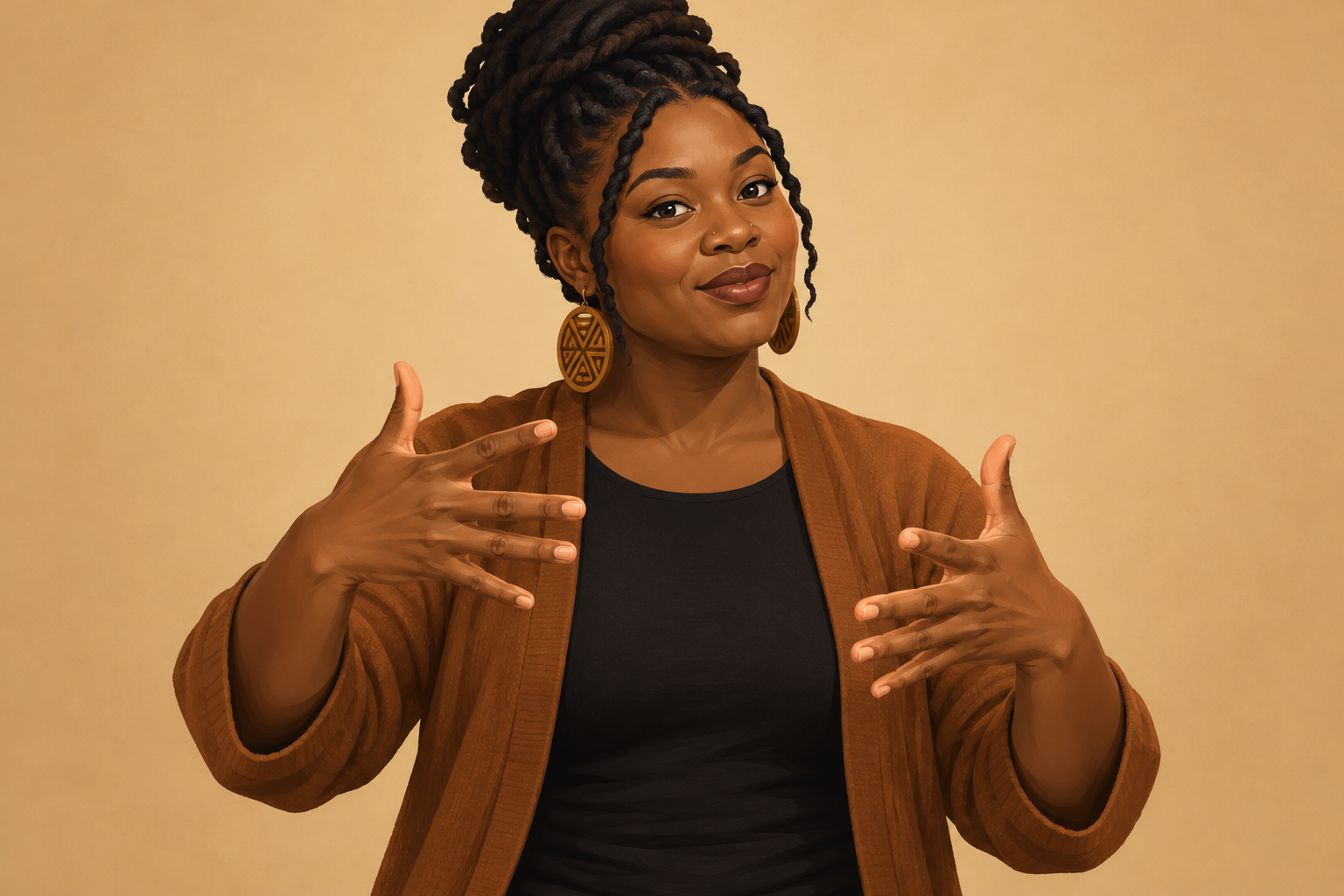
Black American Sign Language (BASL, often called Black ASL or Black sign language) is a distinct variety of American Sign Language that developed among Black Deaf people in the segregated schools of the American South. It shares ASL’s grammar and most of its vocabulary, but it has its own signs, a larger signing space, and a style shaped by Black culture and generations of racial separation.
Last updated: October 29, 2026
What Black American Sign Language actually is
When I first started reading about BASL, the question I kept running into was whether it counts as its own language. The researchers who have studied it most closely describe it as a dialect, or variety, of ASL. A Black Deaf signer and a white Deaf signer can usually understand each other, much as speakers of African American English and other English varieties can.
That label should not make it sound minor. BASL has consistent, documented differences in vocabulary, sign formation and use of space. Linguists treat those differences as systematic, which means they follow rules. They are not mistakes or “sloppy” signing, and they are not slang.
If you want the wider background on where ASL itself came from, our guide to what ASL means and how American Sign Language began covers the founding of the first permanent Deaf school in Hartford in 1817. BASL branches off that same family tree, but its story runs through the Jim Crow South.
How segregation created a distinct variety
Separate schools, separate signing
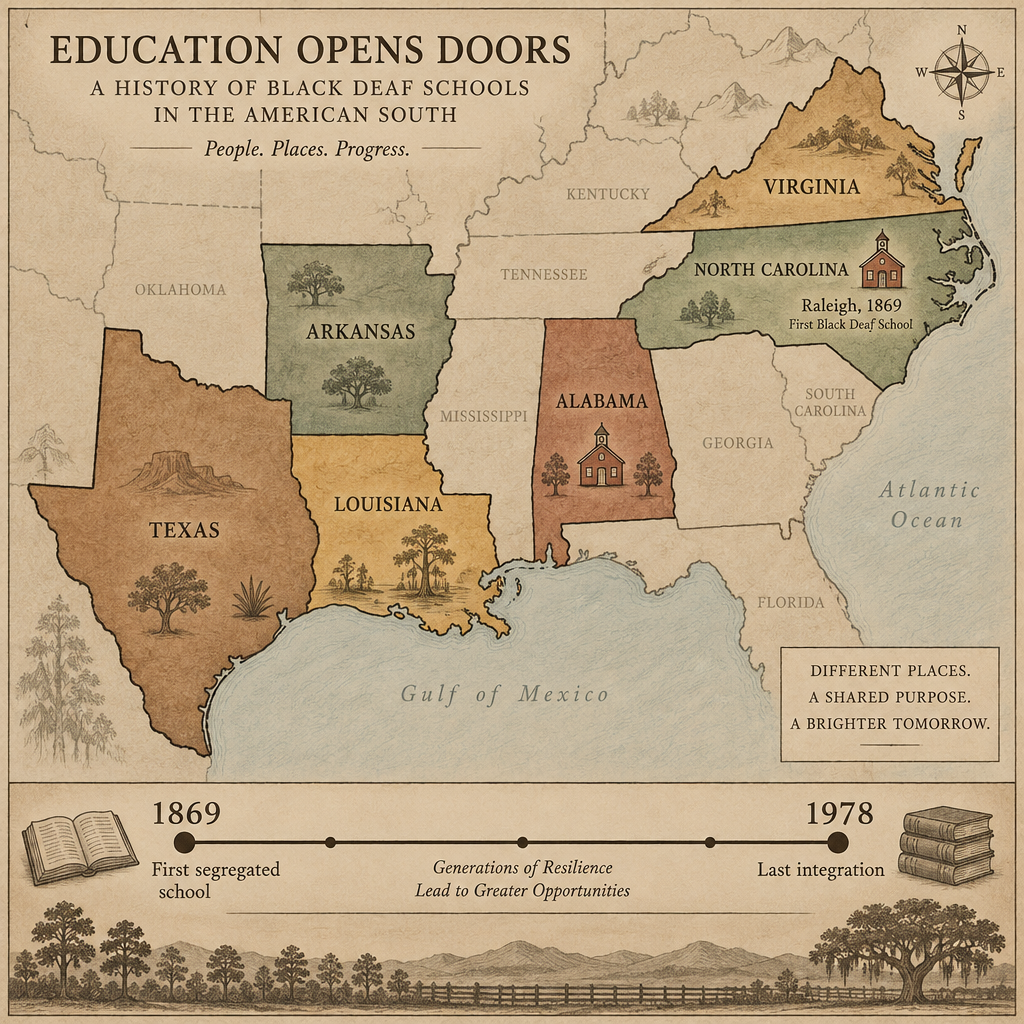
For most of the 19th and 20th centuries, Deaf children in the South were educated in racially segregated schools. The first school for Black Deaf children opened in Raleigh, North Carolina, in 1869. Other Southern states followed with “colored” schools or separate departments, often on different campuses from the white schools.
Those Black schools were consistently underfunded. They had older buildings, fewer books and less trained staff. Black Deaf students lived and learned together, often for years at a time, with little contact with white Deaf peers. Any community that isolated develops its own way of talking, and that is exactly what happened with signing.
Oralism hit white schools harder
There is a twist here that surprises many readers. In the late 1800s, much of American Deaf education swung toward oralism, a method that tried to force Deaf children to lipread and speak while banning sign language in class. White schools adopted oralism widely.
Many Black schools were treated as a lower priority, so the push toward oral methods reached them later or less forcefully. Signing often stayed in use in Black classrooms and dormitories. Researchers believe this is one reason older Black signers preserved some older forms of ASL that white schools had pushed aside.
Desegregation came late
Deaf schools desegregated slowly. Some did so in the 1950s and 1960s, and the last state school, in Louisiana, did not integrate until 1978. That means Black Deaf people who are alive today attended schools that were fully segregated by law.
In Washington, D.C., a 1952 court case brought on behalf of Black Deaf children forced the Kendall School to admit them. Before that ruling, Black Deaf children from the District had been sent out of town to be educated.
Carolyn McCaskill and the Black ASL Project
The person most associated with BASL research is Carolyn McCaskill, a Black Deaf scholar and longtime Gallaudet University professor. She grew up attending the segregated Alabama School for the Negro Deaf and Blind. When integration moved her to a formerly white school in the late 1960s, she has described being unable to understand the white teacher’s signing at first, even though both of them were using “ASL.”
That experience fed directly into the Black ASL Project. McCaskill worked with linguists Ceil Lucas, Robert Bayley and Joseph Hill, with funding from the National Science Foundation. The team filmed 96 Black Deaf signers in six Southern states: North Carolina, Alabama, Arkansas, Louisiana, Texas and Virginia.
The study compared older signers, who had attended segregated schools, with younger signers educated after integration. The results were published in 2011 by Gallaudet University Press as The Hidden Treasure of Black ASL: Its History and Structure. It remains the foundational book on the subject, and I would put it first on any reading list.
6 features that make Black ASL distinct
The research identified a set of patterns that show up more often in Black signing than in mainstream ASL. Not every Black Deaf person signs this way, and the features are strongest among older signers from the South.
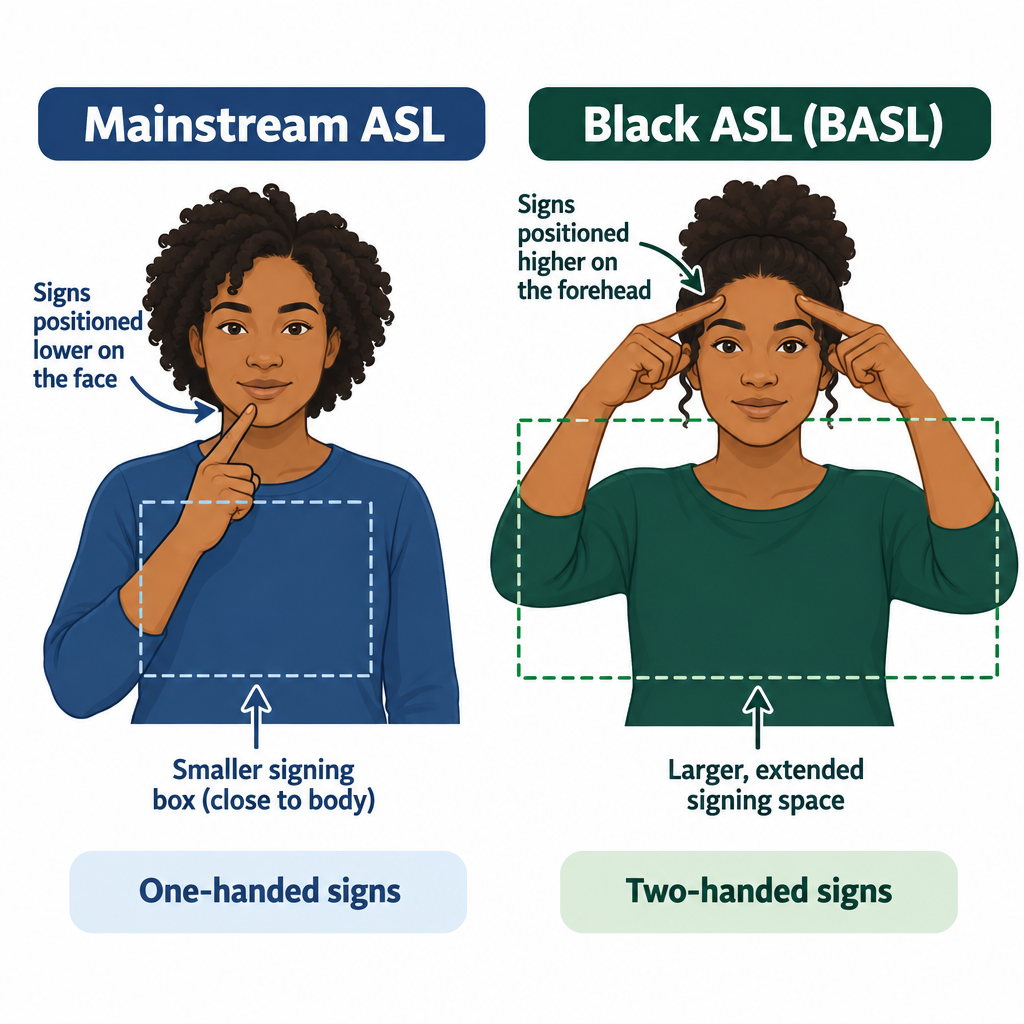
1. More two-handed signs
Many ASL signs can be made with one hand or two. Over time, mainstream ASL drifted toward one-handed versions. Older Black signers in the study used the two-handed forms noticeably more often, keeping a variant that white schools had moved away from.
2. A larger signing space
Signing space is the area in front of the body where signs are produced. Mainstream ASL generally keeps signs in a box from roughly the top of the head to the waist. Black signers in the study often used a bigger space, with signs extending further out and away from the body. Community members often describe this as signing “bigger.”
3. Signs kept higher on the face
Some ASL signs are traditionally made at the forehead. A well-documented example is KNOW, formed with a bent hand tapping the forehead. Many signers today make it lower, near the cheek. The Black ASL Project found that older Black signers lowered these signs less often, preserving the older forehead location.
4. Distinct vocabulary
BASL has lexical variants, meaning different signs for the same concept. Some came from the specific schools Black Deaf children attended, so variants can be regional as well as racial. A signer from a Black school in Texas might use a different sign than one from North Carolina.
5. Influence from African American English
Younger Black signers in the study incorporated phrases and expressions from African American English into their signing. These are expressions a hearing Black friend or relative might say, carried into ASL with their tone and meaning intact. This is where BASL shows how Black Deaf people participate in wider Black culture, including hearing Black culture.
6. Facial expression, rhythm and body movement
Facial expression is part of ASL grammar for everyone. Many Black Deaf signers, along with community educators, describe BASL as using more expression, rhythm and body movement. This one rests more on community description than on the 2011 measurements, so I treat it as a strong, widely shared observation rather than a lab finding.
| Feature | Mainstream ASL tendency | Black ASL tendency |
|---|---|---|
| Hands | One-handed variants common | Two-handed variants more often |
| Signing space | Compact, close to body | Larger, extends further out |
| Forehead signs (e.g., KNOW) | Often lowered toward cheek | More often kept at forehead |
| Vocabulary | Standard national signs | Some distinct, often regional, signs |
| English influence | Mainstream English mouthing and idioms | African American English expressions |
| Style | Varies by signer | Often described as more expressive |
Hearing tip
If you are learning ASL and meet a Black Deaf signer who uses a sign you were not taught, ask what it means and where they learned it. Do not “correct” them toward your textbook version.
Black Deaf identity and community
BASL sits inside a larger community story. Andrew Foster became Gallaudet’s first Black graduate in 1954 and went on to found dozens of schools for Deaf children across Africa. National Black Deaf Advocates (NBDA), founded in 1982, works on the specific issues Black Deaf people face, from education to employment.
Black Deaf people often describe a double layer of exclusion. In hearing Black spaces, communication barriers shut them out. In mostly white Deaf spaces, racism and cultural differences can do the same. BASL is one of the clearest expressions of a community that built its own space when neither world fully made room for it.
Public visibility has grown a lot in recent years. In 2020, Deaf content creator Nakia Smith posted videos signing with her grandfather that showed BASL to millions of people online. The same year, the Language & Life Project at North Carolina State University released Signing Black in America, a documentary featuring Joseph Hill and other Black Deaf signers.
Black Deaf performers have also put Black signing on huge stages. Warren “Wawa” Snipe performed in ASL during the 2022 Super Bowl halftime show. In 2023, Justina Miles became the first Deaf woman to perform at a Super Bowl halftime show, signing for Rihanna, and her performance drew wide praise for its energy and style.
Why this matters in higher education settings
Gallaudet University, the world’s leading university for Deaf and hard of hearing students, opened a Center for Black Deaf Studies, with Carolyn McCaskill as founding director. That shift matters. For decades, Deaf studies programs taught ASL as if it had one “correct” form, and Black students could find their home signing treated as wrong.
For colleges and employers, the practical issue is interpreting. Under the Americans with Disabilities Act, institutions must provide effective communication, which usually means qualified interpreters. “Effective” is the key word. An interpreter who does not recognize BASL variants or African American English may miss meaning, tone or humor.
Black Deaf students and professionals often request Black interpreters for exactly this reason. Many also prefer Deaf interpreters working alongside hearing ones for complex situations. Our explainer on what the Americans with Disabilities Act is and who it protects covers the legal side of requesting accommodations.
See a professional
If a school, court or medical provider refuses a qualified interpreter, an advocacy organization or disability rights attorney can explain your options. For hearing changes, see an audiologist; sudden hearing loss is a medical emergency.
Is Black ASL disappearing?
My honest answer: it is changing, and parts of it are at risk. The features researchers measured most clearly belong to older signers who attended segregated schools. As that generation ages, some of those older forms will fade, much like older dialect words fade in spoken languages.
Integration also pulled Black Deaf students into schools dominated by mainstream signing. Many Black Deaf people describe code-switching, using mainstream ASL in white or formal settings and BASL among family and Black Deaf friends.
At the same time, younger signers are creating new features, especially through African American English and social media. Black ASL is not a museum piece. It is a living variety with a long history behind it, and documentation projects like McCaskill’s give the older forms a record that will outlast any one generation.
How to learn about BASL respectfully
Hearing learners and white Deaf learners sometimes ask me whether they should “learn BASL.” I think the better goal is to understand it, recognize it and learn from the people who use it.
Learning about Black ASL respectfully
- Learn mainstream ASL basics first, starting with the sign language alphabet.
- Read The Hidden Treasure of Black ASL.
- Watch Signing Black in America.
- Follow Black Deaf educators and creators directly.
- Take workshops taught by Black Deaf instructors.
- Ask before using a BASL sign or expression.
Avoid treating BASL as a trend or a costume. Copying expressions without understanding their cultural meaning is the fastest way to turn appreciation into appropriation. Pay Black Deaf teachers for their knowledge, and credit them when you share what you learned.
FAQ
Is Black American Sign Language a separate language from ASL?
No. Linguists classify it as a dialect or variety of ASL. It shares ASL’s core grammar, and signers of both can usually understand each other, though some signs and styles differ enough to cause confusion.
Where did Black ASL come from?
It developed in segregated schools for Black Deaf children, mostly in the Southern United States, starting with the first such school in Raleigh, North Carolina, in 1869. Isolation from white schools let Black Deaf communities develop their own signing patterns over generations.
Is BASL just slang?
No. Its features are systematic and rule-governed, which is what linguists look for in a dialect. Some younger signers do use expressions from African American English, but that is a feature of the variety, not evidence that it is informal or incorrect.
Who is Carolyn McCaskill?
She is a Black Deaf scholar at Gallaudet University who attended a segregated Deaf school in Alabama. She co-led the Black ASL Project and co-wrote The Hidden Treasure of Black ASL, and she became founding director of Gallaudet’s Center for Black Deaf Studies.
Can hearing people learn Black ASL?
Hearing people can learn to recognize and understand it, ideally from Black Deaf teachers after building a solid base in ASL. The respectful approach is to learn about it from the community rather than adopt its expressions casually.