Category: Deaf Culture

  • Can Deaf People Drive? Licenses, Safety and Adaptations

    Can Deaf People Drive? Licenses, Safety and Adaptations

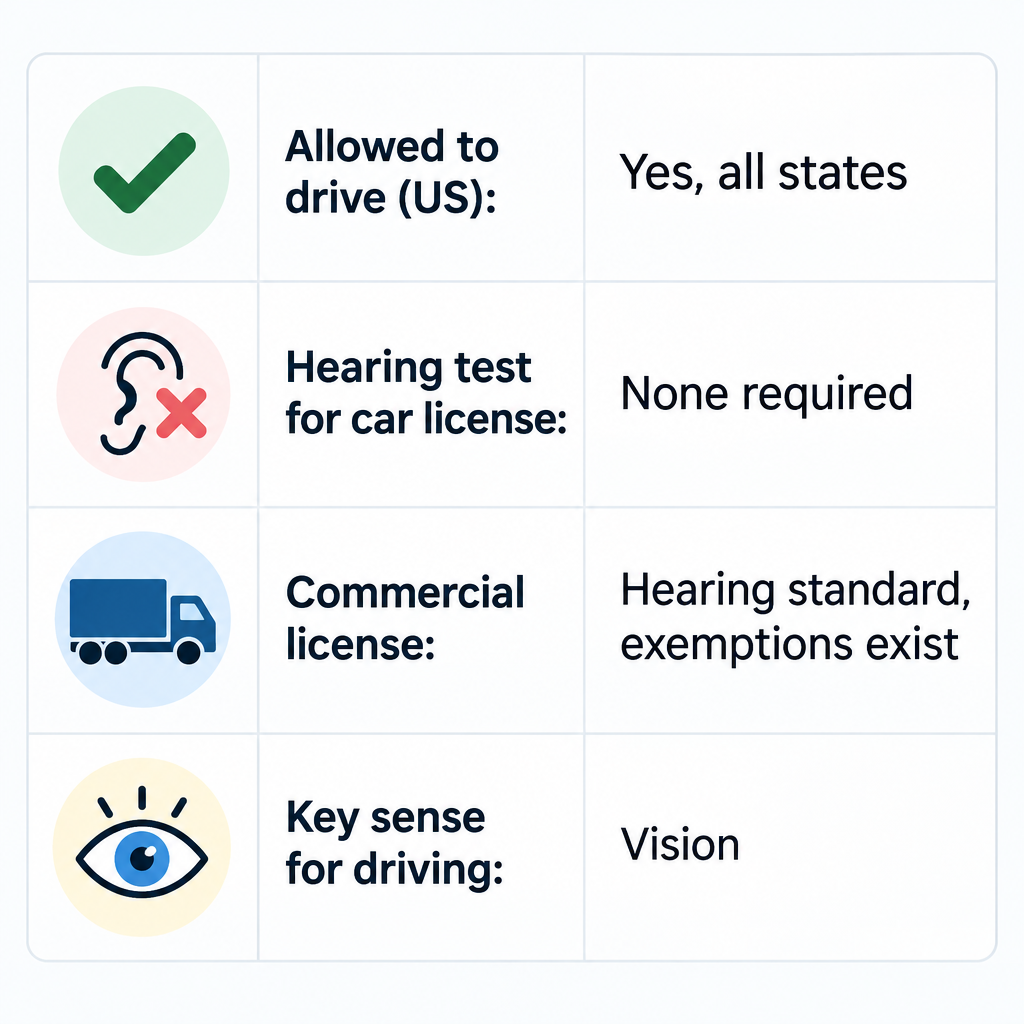
    Yes, deaf people can drive. Every US state licenses deaf and hard of hearing drivers on the same terms as everyone else, and no state requires a hearing test for a regular car license. This guide covers the actual rules, where hearing standards still apply, and how deaf drivers handle sirens, police stops and breakdowns.

    Last updated: October 30, 2026

    Allowed to drive (US)Yes, all states
    Hearing test for car licenseNone required
    Commercial licenseHearing standard, exemptions exist
    Key sense for drivingVision

    Are deaf people allowed to drive?

    Deaf people are allowed to drive in the United States. A person who is profoundly deaf from birth goes through the same licensing process as a hearing teenager: a written knowledge test, a vision screening and a road test. Hearing never enters the scoring.

    The reasoning is simple. Driving is a visual task. You read signs, track lane markings, watch brake lights, check mirrors and judge gaps in traffic with your eyes. Sound adds some information, but it is never the main channel. That is why every state requires a vision test and none requires a hearing test for a standard license.

    This has not always been settled. In the early 20th century, some states tried to bar or restrict deaf drivers. The National Association of the Deaf (NAD) campaigned against those rules for decades, using deaf drivers’ safety records as evidence. Today the question “do deaf people drive?” has a boring answer: millions do, every day, and the law treats them as ordinary drivers.

    What the licensing process looks like

    Getting a license as a deaf or hard of hearing person follows the standard path for your state. The differences are about communication, not qualification.

    • Written test: This is already a reading test, so it is accessible as is. Some DMVs also offer the knowledge test in other formats.
    • Vision test: This is the same for everyone. If your vision meets the state standard, you pass.
    • Road test: The examiner gives spoken directions in most cases. Here you can ask for an accommodation.

    DMVs are state agencies, so they fall under Title II of the Americans with Disabilities Act. That means they must provide effective communication. In practice, you can request an ASL interpreter for the road test or classroom portions, or ask the examiner to use written cards or agreed hand signals for turns and stops. Our article on the disability rights act explains who the ADA covers and how Title II works.

    Ask for the accommodation when you book the test, not on the day. Some offices need lead time to schedule an interpreter.

    Hearing tip

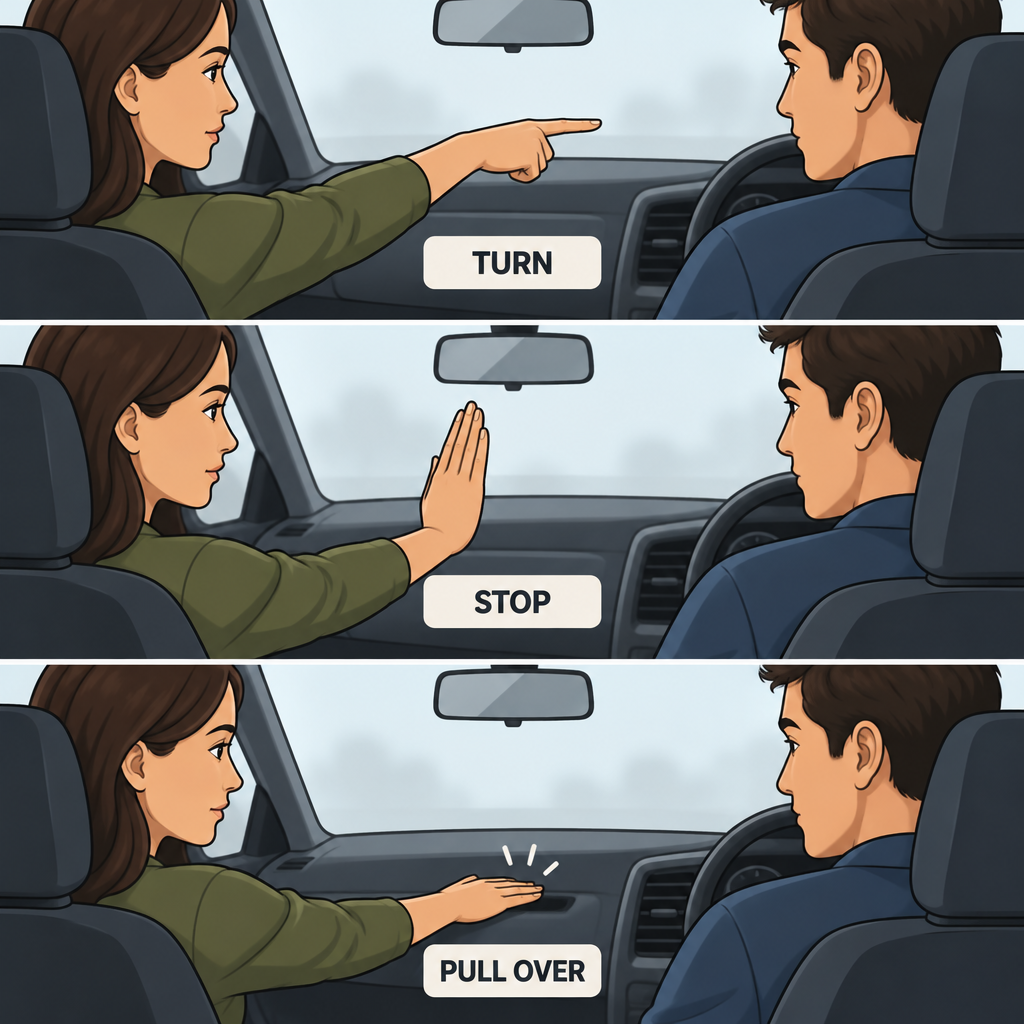
    Before your road test, agree on simple signals with the examiner: a pointed finger for turns, a flat palm for stop, a tap on the dashboard to pull over. Agreeing in advance means fewer surprises during the drive.

    Commercial licenses: where hearing standards still apply

    The one big exception in the US is commercial driving. The Federal Motor Carrier Safety Administration (FMCSA) sets medical standards for interstate commercial drivers, and hearing is one of them.

    Under the federal rule, a commercial driver must either perceive a forced whispered voice at 5 feet or more in the better ear, or have an average hearing loss no greater than 40 dB at 500, 1,000 and 2,000 Hz in the better ear. Hearing aids can be worn during the test. Many hard of hearing drivers pass this way.

    Drivers who cannot meet the standard are not automatically shut out. In 2013, after advocacy led by the NAD, FMCSA granted its first hearing exemptions to deaf drivers, and the program has continued since. An exemption allows a deaf driver to operate a commercial vehicle in interstate commerce if they meet every other qualification. Exemptions must be renewed, so check FMCSA’s current requirements before you apply.

    A few points matter here:

    • The federal hearing rule covers interstate commercial driving. Rules for intrastate commercial driving are set by each state and can differ.
    • School bus and passenger transport jobs often carry extra state or employer requirements.
    • A standard car license is never affected by the commercial hearing rule.

    Deaf truck drivers work across the country today. The obstacles that remain are mostly employer attitudes and paperwork, not ability.

    Driving outside the US
    Deaf Driving License Summary Chart

    Most high-income countries also license deaf drivers for ordinary cars. In the UK, for example, the DVLA says you do not need to tell it about deafness if you hold a car or motorcycle license. Drivers of buses, coaches and lorries must declare it, much like the US commercial rule.

    If you plan to drive abroad or move countries, check the licensing authority’s medical rules before you go. Rules for heavy vehicles vary more than rules for cars.

    Do deaf drivers have more crashes?

    The fear behind “are deaf people allowed to drive?” is usually about safety. The evidence does not support it. There is no solid research showing that deaf drivers crash more often than hearing drivers, and insurers and licensing agencies do not treat deafness as a risk category for regular licenses.

    There are reasonable explanations for this:

    • Visual attention: Lab research on deaf adults, notably work by cognitive scientist Daphne Bavelier and colleagues, has found that deaf people who use sign language often show stronger attention to their peripheral vision. That is useful for spotting a car drifting into your lane or a cyclist at the edge of your view.
    • Compensation: Swedish driving-simulator research on drivers with hearing loss found they tended to drive more cautiously and scan more. The same research suggested they were more affected when given demanding secondary tasks. That is a reminder that distraction is the real hazard.
    • Fewer audio distractions: A deaf driver is not half-listening to a podcast or an argument on speakerphone.

    Distraction is the common thread. A deaf driver reading a text is as dangerous as a hearing driver reading one. Hearing status does not change that.

    Why driving depends on sight far more than sound
    Road Test Hand Signals

    Think about what sound actually tells a hearing driver. Horns, sirens, a train crossing bell, an engine noise that signals a problem, or a passenger’s warning shout. That is a short list, and every item on it has a visual backup.

    Sound cue Visual or physical backup
    Emergency siren Flashing lights, traffic pulling over, mirror checks
    Car horn Driver behavior around you, mirror scanning
    Railroad crossing bell Flashing signals, gates, crossbuck signs
    Turn signal clicking Dashboard indicator arrow
    Engine or brake trouble Warning lights, gauges, vibration, smell
    Tire going flat Tire pressure warning light, pull to one side

    Hearing drivers also miss sounds all the time. Modern cabins are well insulated, and many people drive with music up and windows closed. A siren often reaches a hearing driver late. Sometimes it is only noticed after the lights appear in the mirror. That is the same moment a deaf driver notices it.

    How to drive safely as a deaf driver

    Most deaf drivers build these habits early, often without thinking about them. If you have lost hearing as an adult, these are the adjustments worth making on purpose.

    Scan your mirrors more often

    Check your rearview and side mirrors every few seconds, especially on highways and in city traffic. Some drivers add a wide-angle or panoramic rearview mirror that clips over the factory one. It gives you a broader view of the lanes behind you and makes approaching flashing lights obvious sooner.

    Watch other drivers for emergency vehicles

    When cars ahead start slowing and moving right for no visible reason, assume an emergency vehicle is coming. Check all mirrors, slow down and pull over safely. Watching the traffic around you works as well as sound, and it often works better.

    Use your car’s safety features

    Driver-assistance features help every driver, and several are especially useful if you cannot hear:

    • Blind-spot monitoring: A light in or near the side mirror flags a car you might not see.
    • Lane departure and lane-keeping alerts: Many systems can vibrate the steering wheel instead of beeping.
    • Haptic seat alerts: Some General Motors vehicles offer a Safety Alert Seat that vibrates the left or right side of the seat cushion to signal where a hazard is.
    • Rear cross-traffic alerts: These are useful when backing out of parking spaces, where you would otherwise listen for approaching cars.
    • Tire pressure monitoring: This catches a slow leak you cannot hear.

    When you shop for a car, ask whether alerts can be set to vibration or visual only. Many cars let you switch alert style in the settings menu. The test drive is the time to check.

    Make dashboard checks routine

    Get in the habit of glancing at the instrument cluster: turn signal arrows, warning lights, temperature and fuel. A turn signal left blinking is a classic giveaway for any driver. The arrow on the dash is your cue to cancel it.

    Set up phone sound alerts as a backup

    Both iPhone and Android can listen for certain sounds and flash or vibrate an alert. These features are a backup, not a replacement for watching the road. They can miss sounds in a noisy cabin, and you should never look at the phone while moving.

    Turn on siren alerts on your phone

    1. iPhone: open Settings, then Accessibility, then Sound Recognition.
    2. Turn on Sound Recognition, tap Sounds, then turn on Siren.
    3. Android: open Settings, then Accessibility, then Sound Notifications (names vary by brand).
    4. Turn it on and allow it to listen for alarms and sirens.
    5. Mount the phone in a dashboard holder so a flash is visible without picking it up.

    Sign with passengers carefully

    For ASL users, conversation in the car is visual, which pulls the driver’s eyes off the road. Many deaf drivers handle this by letting passengers sign while the driver keeps their eyes forward and answers briefly at red lights. Longer conversations wait until you park. Front-seat passengers can also act as a second set of eyes and tap your arm when they spot an emergency vehicle.

    Wear your hearing aids if you use them

    If you are hard of hearing and use hearing aids, wear them while driving. They can help with sirens and horns, and many Bluetooth models stream navigation prompts straight to your ears. Some hearing aids offer a car or noise program that cuts down road rumble. Ask your audiologist to set one up if road noise drowns everything out.

    Headphones vs hearing loss: why the law treats them differently

    A common question on forums is why it is illegal to drive with headphones when deaf people can drive. California’s Vehicle Code, for example, bans wearing a headset or earplugs in both ears while driving, with an exception for hearing aids. Several other states have similar rules.

    The difference comes down to distraction and adaptation, not the volume of sound reaching your ears.

    • Headphones add a distraction. Music, podcasts and calls compete for attention, and the driver chose that distraction.
    • Headphones disrupt a driver who relies on sound. A hearing driver has built habits around hearing horns and sirens. Suddenly blocking them removes a cue the driver expects, and the driver has not built visual habits to replace it.
    • Deaf drivers have adapted. They have built their scanning habits around vision from the start. Nothing is suddenly missing.

    Hearing aids are exempt for the same reason. They restore sound rather than block it.

    Know your rights at a traffic stop

    Police stops are the part of driving that worries deaf drivers most, and for good reason. Officers give spoken commands, and a driver who does not respond can be misread as uncooperative. A few steps lower that risk.

    Before a stop happens:

    • Ask your state DMV about deaf or hard of hearing notations. Some states offer a voluntary flag on your license or vehicle record that an officer sees when running your plate. Others hand out visor communication cards.
    • Keep a visor card or printed card that says you are deaf and how you communicate. Many state commissions for the deaf and hard of hearing distribute these.
    • Keep a pen and notepad within easy view, not in the glove box.

    During a stop:

    1. Pull over safely, turn off the engine, and turn on the dome light if it is dark.
    2. Keep both hands on the steering wheel where they are visible.
    3. Do not reach for your phone, wallet or glove box until the officer understands you are deaf.
    4. When the officer approaches, point to your ear and shake your head, or hold up your visor card.
    5. Ask to communicate in writing, or by typing on a phone once the officer agrees.

    Under the ADA, police departments must communicate effectively with deaf people. For a simple traffic stop, writing notes is often enough. For an arrest or questioning about a serious matter, you can request a qualified ASL interpreter. If an officer refused reasonable communication, write down the date, location and badge number afterward and contact a disability rights organization.

    Breakdowns and emergencies on the road

    Plan how you will get help before you need it. Phone calls are the default for roadside assistance and emergencies, so line up text-based options.

    • Text-to-911: This works in many areas of the US, but not all of them. If it is not available, you will get a bounce-back message telling you to use another method. Check your area’s coverage in advance.
    • Real-time text (RTT): Many phones support RTT calls to 911, which send each character as you type.
    • Relay services: You can reach roadside assistance through a telecommunications relay service, including video relay in ASL.
    • Roadside apps: Most insurers and auto clubs let you request a tow through their app, with no voice call needed.

    Keep a written card in the glove box with your insurance details, your auto club number and a note explaining you are deaf. If a tow driver or bystander arrives, you can hand it over.

    When hearing changes affect your driving

    Stable deafness is not a driving problem. Some hearing-related conditions do affect safety, though, mostly through balance and dizziness rather than hearing itself.

    Conditions such as Ménière’s disease and other inner ear disorders can cause sudden vertigo. A vertigo attack at the wheel is dangerous. If you have episodes of spinning dizziness, talk to your doctor about whether and when it is safe to drive.

    See a professional

    Sudden hearing loss in one or both ears is a medical emergency. See a doctor or go to urgent care within a day or two, and do not drive if you also have vertigo or severe dizziness.

    If your hearing has been fading slowly, a hearing test with an audiologist is worth booking. Treating hearing loss will not change your license status. It can make driving less tiring and help you notice sirens and horns sooner.

    Key takeaways

    • Deaf people can drive legally in every US state, and no hearing test is required for a standard car license.
    • DMVs must offer communication accommodations such as ASL interpreters for road tests under the ADA.
    • Commercial drivers face a federal hearing standard, but FMCSA has granted exemptions to deaf drivers since 2013.
    • Research does not show deaf drivers are less safe. Distraction is the real risk for everyone.
    • Mirror scanning, haptic car alerts and phone sound alerts cover most of what hearing provides.
    • At a traffic stop, keep your hands visible, show a visor card and ask to communicate in writing.

    FAQ

    Can 100% deaf people drive?

    Yes. A person with no measurable hearing can get a regular driver’s license in every US state. Licensing depends on vision, knowledge of traffic laws and road skills, not hearing.

    Can you drive if you are totally deaf?

    You can. Total deafness does not disqualify you from a car license in the US or the UK. The only hearing standards apply to commercial driving, and even there US federal exemptions exist for deaf drivers.

    Can you drive if you are deaf in the US?

    Yes, in all 50 states. You take the same written, vision and road tests as any other applicant, and you can request an ASL interpreter or written instructions for the road test.

    Why is it illegal to drive with headphones but deaf people can drive?

    Headphone bans target distraction and the sudden loss of cues that hearing drivers depend on. Deaf drivers have built their driving habits around vision and are not choosing to add an audio distraction. Hearing aids are specifically exempt in states like California.

    Can hearing impaired people drive with hearing aids?

    Yes, and wearing them is a good idea if you use them every day. Hearing aids are allowed under state headphone laws. Bluetooth models can also stream navigation directions.

    Do I have to tell the DMV I am deaf?

    Not for a regular US car license. Some states let you add a voluntary notation so police know before approaching your car. Commercial drivers must disclose hearing loss during the DOT medical exam.

  • Black American Sign Language and Its History in the Deaf Community

    Black American Sign Language and Its History in the Deaf Community

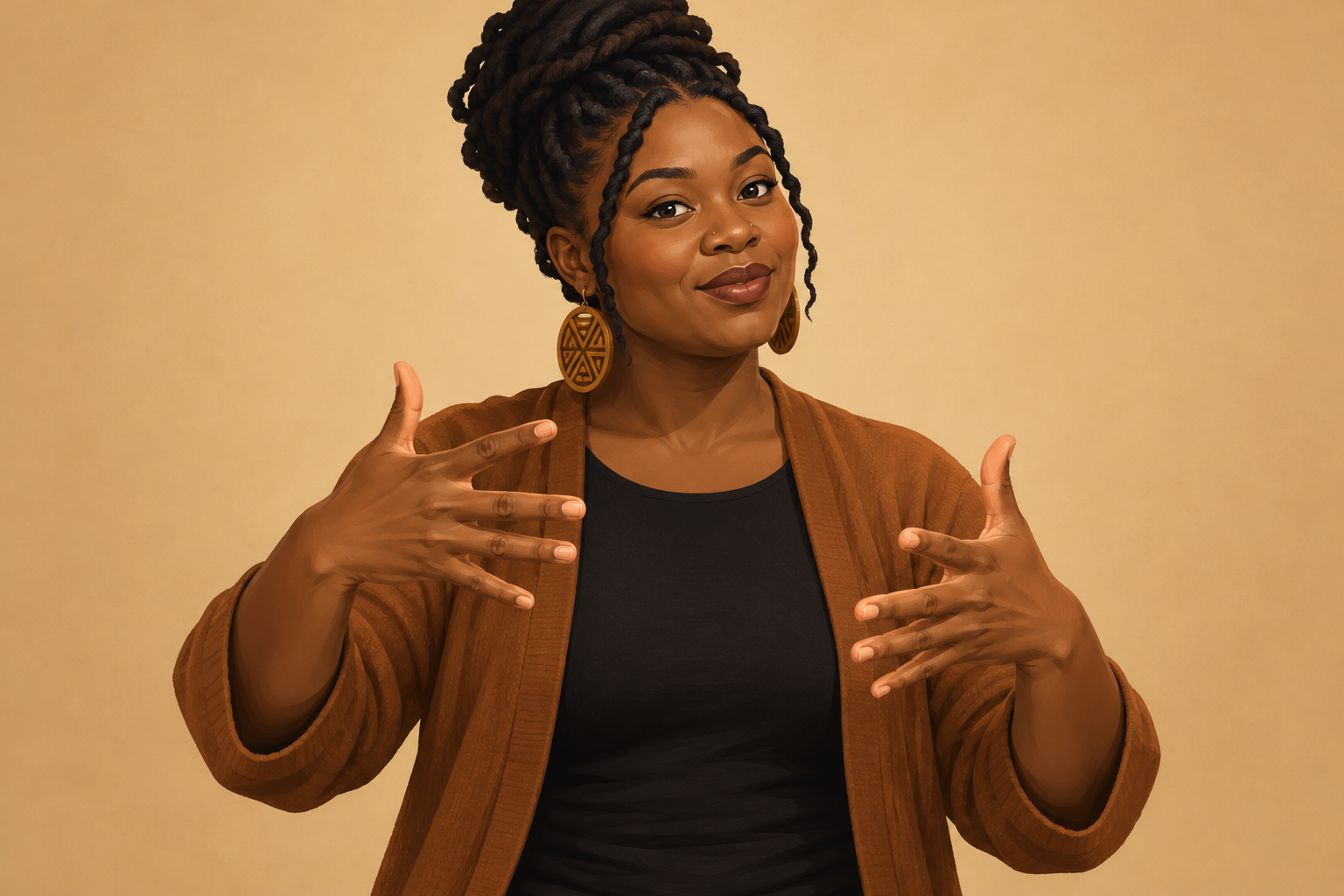
    Black American Sign Language (BASL, often called Black ASL or Black sign language) is a distinct variety of American Sign Language that developed among Black Deaf people in the segregated schools of the American South. It shares ASL’s grammar and most of its vocabulary, but it has its own signs, a larger signing space, and a style shaped by Black culture and generations of racial separation.

    Last updated: October 29, 2026

    TypeVariety of ASL
    OriginSegregated Southern Deaf schools
    Key studyThe Black ASL Project
    Key bookThe Hidden Treasure of Black ASL
    Main usersBlack Deaf signers

    What Black American Sign Language actually is

    When I first started reading about BASL, the question I kept running into was whether it counts as its own language. The researchers who have studied it most closely describe it as a dialect, or variety, of ASL. A Black Deaf signer and a white Deaf signer can usually understand each other, much as speakers of African American English and other English varieties can.

    That label should not make it sound minor. BASL has consistent, documented differences in vocabulary, sign formation and use of space. Linguists treat those differences as systematic, which means they follow rules. They are not mistakes or “sloppy” signing, and they are not slang.

    If you want the wider background on where ASL itself came from, our guide to what ASL means and how American Sign Language began covers the founding of the first permanent Deaf school in Hartford in 1817. BASL branches off that same family tree, but its story runs through the Jim Crow South.

    How segregation created a distinct variety

    Separate schools, separate signing

    For most of the 19th and 20th centuries, Deaf children in the South were educated in racially segregated schools. The first school for Black Deaf children opened in Raleigh, North Carolina, in 1869. Other Southern states followed with “colored” schools or separate departments, often on different campuses from the white schools.

    Those Black schools were consistently underfunded. They had older buildings, fewer books and less trained staff. Black Deaf students lived and learned together, often for years at a time, with little contact with white Deaf peers. Any community that isolated develops its own way of talking, and that is exactly what happened with signing.

    Oralism hit white schools harder

    There is a twist here that surprises many readers. In the late 1800s, much of American Deaf education swung toward oralism, a method that tried to force Deaf children to lipread and speak while banning sign language in class. White schools adopted oralism widely.

    Many Black schools were treated as a lower priority, so the push toward oral methods reached them later or less forcefully. Signing often stayed in use in Black classrooms and dormitories. Researchers believe this is one reason older Black signers preserved some older forms of ASL that white schools had pushed aside.

    Desegregation came late

    Deaf schools desegregated slowly. Some did so in the 1950s and 1960s, and the last state school, in Louisiana, did not integrate until 1978. That means Black Deaf people who are alive today attended schools that were fully segregated by law.

    In Washington, D.C., a 1952 court case brought on behalf of Black Deaf children forced the Kendall School to admit them. Before that ruling, Black Deaf children from the District had been sent out of town to be educated.

    Carolyn McCaskill and the Black ASL Project

    Segregated Deaf Schools Map

    The person most associated with BASL research is Carolyn McCaskill, a Black Deaf scholar and longtime Gallaudet University professor. She grew up attending the segregated Alabama School for the Negro Deaf and Blind. When integration moved her to a formerly white school in the late 1960s, she has described being unable to understand the white teacher’s signing at first, even though both of them were using “ASL.”

    That experience fed directly into the Black ASL Project. McCaskill worked with linguists Ceil Lucas, Robert Bayley and Joseph Hill, with funding from the National Science Foundation. The team filmed 96 Black Deaf signers in six Southern states: North Carolina, Alabama, Arkansas, Louisiana, Texas and Virginia.

    The study compared older signers, who had attended segregated schools, with younger signers educated after integration. The results were published in 2011 by Gallaudet University Press as The Hidden Treasure of Black ASL: Its History and Structure. It remains the foundational book on the subject, and I would put it first on any reading list.

    6 features that make Black ASL distinct

    The research identified a set of patterns that show up more often in Black signing than in mainstream ASL. Not every Black Deaf person signs this way, and the features are strongest among older signers from the South.

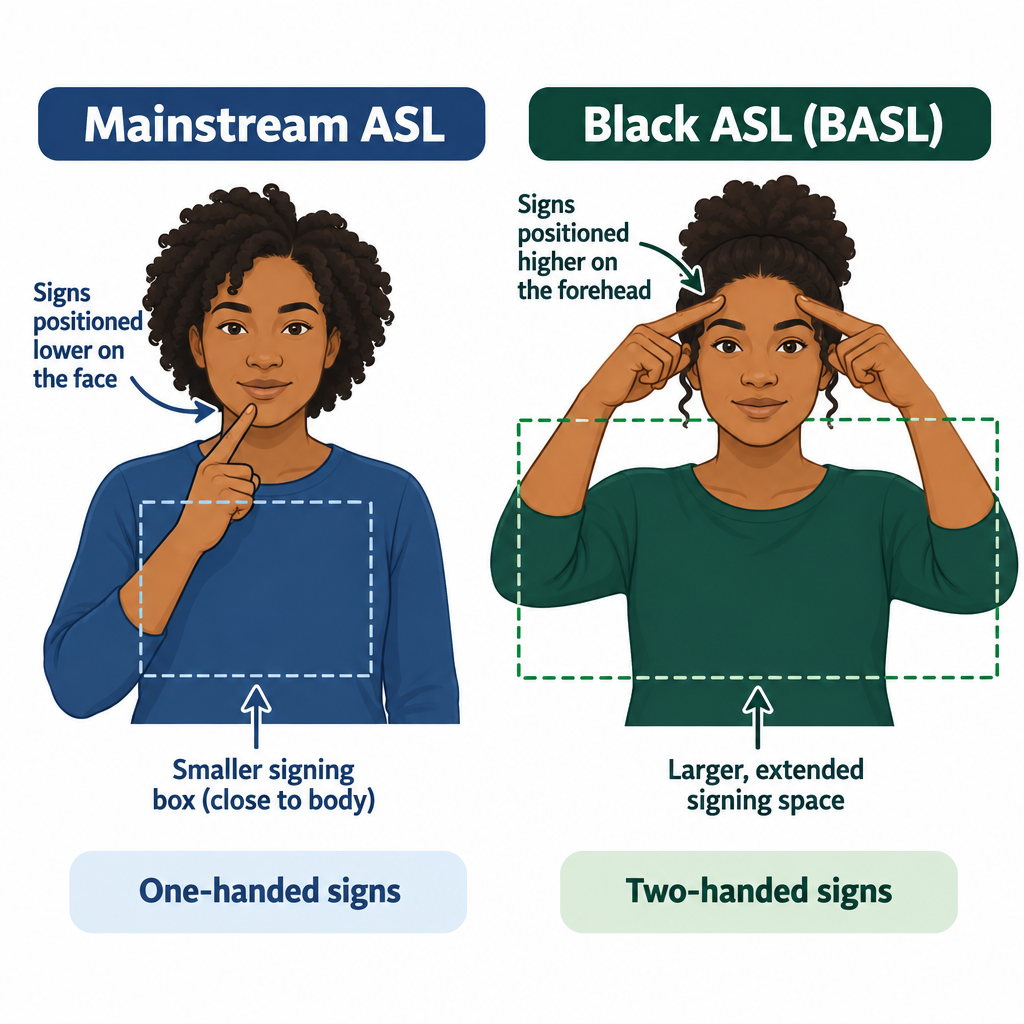
    1. More two-handed signs

    Many ASL signs can be made with one hand or two. Over time, mainstream ASL drifted toward one-handed versions. Older Black signers in the study used the two-handed forms noticeably more often, keeping a variant that white schools had moved away from.

    2. A larger signing space

    Signing space is the area in front of the body where signs are produced. Mainstream ASL generally keeps signs in a box from roughly the top of the head to the waist. Black signers in the study often used a bigger space, with signs extending further out and away from the body. Community members often describe this as signing “bigger.”

    3. Signs kept higher on the face

    Some ASL signs are traditionally made at the forehead. A well-documented example is KNOW, formed with a bent hand tapping the forehead. Many signers today make it lower, near the cheek. The Black ASL Project found that older Black signers lowered these signs less often, preserving the older forehead location.

    4. Distinct vocabulary

    BASL has lexical variants, meaning different signs for the same concept. Some came from the specific schools Black Deaf children attended, so variants can be regional as well as racial. A signer from a Black school in Texas might use a different sign than one from North Carolina.

    5. Influence from African American English

    Younger Black signers in the study incorporated phrases and expressions from African American English into their signing. These are expressions a hearing Black friend or relative might say, carried into ASL with their tone and meaning intact. This is where BASL shows how Black Deaf people participate in wider Black culture, including hearing Black culture.

    6. Facial expression, rhythm and body movement

    Facial expression is part of ASL grammar for everyone. Many Black Deaf signers, along with community educators, describe BASL as using more expression, rhythm and body movement. This one rests more on community description than on the 2011 measurements, so I treat it as a strong, widely shared observation rather than a lab finding.

    Feature Mainstream ASL tendency Black ASL tendency
    Hands One-handed variants common Two-handed variants more often
    Signing space Compact, close to body Larger, extends further out
    Forehead signs (e.g., KNOW) Often lowered toward cheek More often kept at forehead
    Vocabulary Standard national signs Some distinct, often regional, signs
    English influence Mainstream English mouthing and idioms African American English expressions
    Style Varies by signer Often described as more expressive

    Hearing tip

    If you are learning ASL and meet a Black Deaf signer who uses a sign you were not taught, ask what it means and where they learned it. Do not “correct” them toward your textbook version.

    Black Deaf identity and community

    BASL Distinct Features Diagram

    BASL sits inside a larger community story. Andrew Foster became Gallaudet’s first Black graduate in 1954 and went on to found dozens of schools for Deaf children across Africa. National Black Deaf Advocates (NBDA), founded in 1982, works on the specific issues Black Deaf people face, from education to employment.

    Black Deaf people often describe a double layer of exclusion. In hearing Black spaces, communication barriers shut them out. In mostly white Deaf spaces, racism and cultural differences can do the same. BASL is one of the clearest expressions of a community that built its own space when neither world fully made room for it.

    Public visibility has grown a lot in recent years. In 2020, Deaf content creator Nakia Smith posted videos signing with her grandfather that showed BASL to millions of people online. The same year, the Language & Life Project at North Carolina State University released Signing Black in America, a documentary featuring Joseph Hill and other Black Deaf signers.

    Black Deaf performers have also put Black signing on huge stages. Warren “Wawa” Snipe performed in ASL during the 2022 Super Bowl halftime show. In 2023, Justina Miles became the first Deaf woman to perform at a Super Bowl halftime show, signing for Rihanna, and her performance drew wide praise for its energy and style.

    Why this matters in higher education settings

    Gallaudet University, the world’s leading university for Deaf and hard of hearing students, opened a Center for Black Deaf Studies, with Carolyn McCaskill as founding director. That shift matters. For decades, Deaf studies programs taught ASL as if it had one “correct” form, and Black students could find their home signing treated as wrong.

    For colleges and employers, the practical issue is interpreting. Under the Americans with Disabilities Act, institutions must provide effective communication, which usually means qualified interpreters. “Effective” is the key word. An interpreter who does not recognize BASL variants or African American English may miss meaning, tone or humor.

    Black Deaf students and professionals often request Black interpreters for exactly this reason. Many also prefer Deaf interpreters working alongside hearing ones for complex situations. Our explainer on what the Americans with Disabilities Act is and who it protects covers the legal side of requesting accommodations.

    See a professional

    If a school, court or medical provider refuses a qualified interpreter, an advocacy organization or disability rights attorney can explain your options. For hearing changes, see an audiologist; sudden hearing loss is a medical emergency.

    Is Black ASL disappearing?

    My honest answer: it is changing, and parts of it are at risk. The features researchers measured most clearly belong to older signers who attended segregated schools. As that generation ages, some of those older forms will fade, much like older dialect words fade in spoken languages.

    Integration also pulled Black Deaf students into schools dominated by mainstream signing. Many Black Deaf people describe code-switching, using mainstream ASL in white or formal settings and BASL among family and Black Deaf friends.

    At the same time, younger signers are creating new features, especially through African American English and social media. Black ASL is not a museum piece. It is a living variety with a long history behind it, and documentation projects like McCaskill’s give the older forms a record that will outlast any one generation.

    How to learn about BASL respectfully

    Hearing learners and white Deaf learners sometimes ask me whether they should “learn BASL.” I think the better goal is to understand it, recognize it and learn from the people who use it.

    Learning about Black ASL respectfully

    1. Learn mainstream ASL basics first, starting with the sign language alphabet.
    2. Read The Hidden Treasure of Black ASL.
    3. Watch Signing Black in America.
    4. Follow Black Deaf educators and creators directly.
    5. Take workshops taught by Black Deaf instructors.
    6. Ask before using a BASL sign or expression.

    Avoid treating BASL as a trend or a costume. Copying expressions without understanding their cultural meaning is the fastest way to turn appreciation into appropriation. Pay Black Deaf teachers for their knowledge, and credit them when you share what you learned.

    FAQ

    Is Black American Sign Language a separate language from ASL?

    No. Linguists classify it as a dialect or variety of ASL. It shares ASL’s core grammar, and signers of both can usually understand each other, though some signs and styles differ enough to cause confusion.

    Where did Black ASL come from?

    It developed in segregated schools for Black Deaf children, mostly in the Southern United States, starting with the first such school in Raleigh, North Carolina, in 1869. Isolation from white schools let Black Deaf communities develop their own signing patterns over generations.

    Is BASL just slang?

    No. Its features are systematic and rule-governed, which is what linguists look for in a dialect. Some younger signers do use expressions from African American English, but that is a feature of the variety, not evidence that it is informal or incorrect.

    Who is Carolyn McCaskill?

    She is a Black Deaf scholar at Gallaudet University who attended a segregated Deaf school in Alabama. She co-led the Black ASL Project and co-wrote The Hidden Treasure of Black ASL, and she became founding director of Gallaudet’s Center for Black Deaf Studies.

    Can hearing people learn Black ASL?

    Hearing people can learn to recognize and understand it, ideally from Black Deaf teachers after building a solid base in ASL. The respectful approach is to learn about it from the community rather than adopt its expressions casually.

  • Was Beethoven Deaf? How He Kept Composing Through Hearing Loss

    Was Beethoven Deaf? How He Kept Composing Through Hearing Loss

    Yes, Beethoven was deaf. His hearing began to fail in his late twenties, around 1798, and by about 1818 he could no longer follow conversation at all. He wrote some of his greatest music, including the Ninth Symphony, after he had lost almost all of his hearing.

    First symptomsAround age 27
    Fully deaf byAbout 1818
    Main symptomsTinnitus, muffled sound
    CauseStill unknown

    When Beethoven Started Going Deaf

    Ludwig van Beethoven was born in Bonn in December 1770 and moved to Vienna in 1792 to make his name as a pianist. A few years later, while still in his twenties, he noticed that something was wrong with his ears.

    He kept it secret for several years. A deaf composer sounds like a contradiction, and a deaf piano virtuoso would have lost his income. He finally confessed in letters to two close friends in 1801: the physician Franz Wegeler and the violinist Karl Amenda.

    The letter to Wegeler gives a clear picture of the symptoms. Beethoven described a constant humming and buzzing in his ears, which we would now call tinnitus. He could not hear the high notes of instruments or voices from a distance in the theater. Speech reached him as sound, but he couldn’t make out the words. He also found loud noise painful. If someone shouted, he said, he could not bear it.

    Audiologists recognize that pattern today. When you lose sensitivity to soft sounds, loud sounds can still feel uncomfortably loud. The ear has a narrower comfortable range.

    The Heiligenstadt Testament

    In October 1802, on the advice of his doctor, Beethoven spent months in Heiligenstadt, then a quiet village outside Vienna. There he wrote a long letter to his brothers Carl and Johann. It was never sent. It was found among his papers after his death and is now called the Heiligenstadt Testament.

    It is a painful document. Beethoven describes pulling away from company because he could not bear people noticing that he could not hear. He describes standing beside a companion who heard a distant flute or a shepherd singing when he heard nothing. He admits he came close to ending his life. Only his art held him back, he wrote. He could not leave the world until he had brought out everything he felt was in him.

    He went back to Vienna and into the most productive stretch of his life. The “heroic” middle period followed, including the Third Symphony (Eroica), the Fifth, the Violin Concerto and the opera Fidelio.

    How His Hearing Got Worse Over Time

    Timeline of Beethoven's Hearing Loss

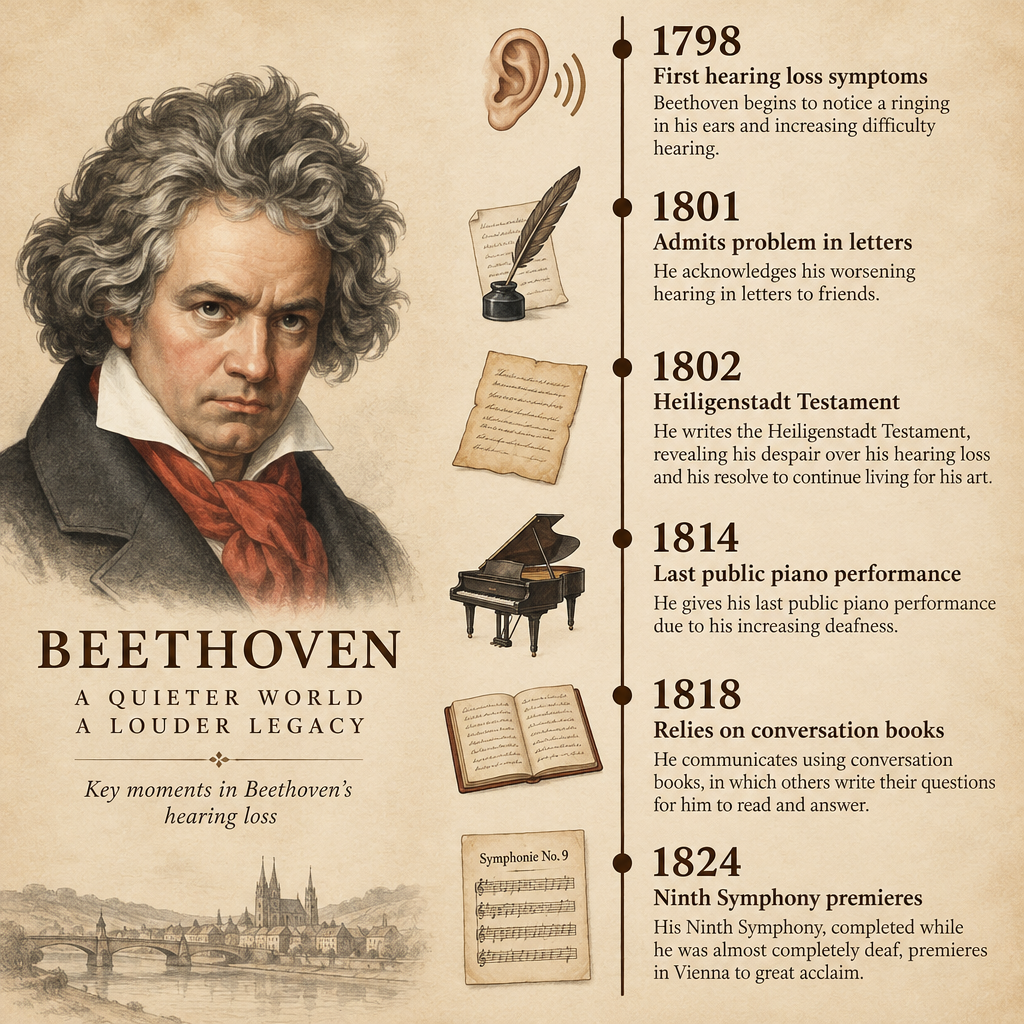
    Beethoven’s deafness came on gradually over about 20 years.

    Year Age (approx.) What happened
    c. 1798 27 First signs of hearing loss and tinnitus
    1801 30 Admits the problem in letters to Wegeler and Amenda
    1802 31 Writes the Heiligenstadt Testament
    c. 1813–1814 42–43 Uses ear trumpets made by Johann Nepomuk Mälzel
    1814 43 Struggles in one of his last public piano performances
    1818 47 Begins relying on written conversation books
    1824 53 Ninth Symphony premieres in Vienna
    1827 56 Dies in Vienna in March

    Performing went first. The composer Louis Spohr heard him rehearse the “Archduke” Trio in 1814. He wrote that the playing was harsh and uneven, too loud in some places and inaudible in others. After that, Beethoven largely stopped appearing as a pianist. Conducting lasted a little longer, but it also became impossible.

    How Beethoven Kept Composing

    You don’t need working ears to write music down. Beethoven had trained since childhood, and he could hear a score in his head the way a skilled reader hears a sentence without saying it aloud. Musicians call this inner hearing. He had decades of sound stored in memory, and he could imagine how a chord or orchestral color would sound before anyone played it.

    He also used every tool available to him:

    • Ear trumpets. Mälzel, the inventor best known for the metronome, built him several brass ear trumpets. A few survive at the Beethoven-Haus museum in Bonn. They helped for a while, then stopped being enough.
    • Louder pianos. In 1818 the London maker Broadwood sent him a piano, and the Viennese builder Conrad Graf later lent him an instrument with four strings per note for extra volume. A sound-reflecting cover is said to have been fitted over it.
    • Vibration. A story often told about Beethoven says he held a rod between his teeth and pressed it against the piano to feel the sound through his jawbone. That is bone conduction, the same principle used in some modern headphones and hearing devices. The story is plausible but secondhand, so treat the details with caution.
    • Conversation books. From around 1818, visitors wrote their side of the conversation in notebooks, and Beethoven usually answered aloud. Over a hundred of these books survive. They are a remarkable record of daily life, although his secretary Anton Schindler later destroyed some and added fake entries to others.

    The conversation books were an early version of something many deaf and hard of hearing people use today. Live closed captioning and text relay services such as telecommunications relay service do the same job of turning speech into something you can read.

    Did Deafness Change His Music?

    Beethoven's Coping Tools

    It did, and researchers have tried to measure it. A 2011 study in the BMJ analyzed the notes in Beethoven’s string quartets across his career. As his hearing worsened in his middle years, he used fewer high notes, which were the frequencies he had the most trouble hearing. In the late quartets, written when he was almost completely deaf, the high notes came back. The authors suggested that once he could no longer hear anything, he relied entirely on his inner ear and stopped writing around his damaged hearing.

    The late works are often described as the most inward and experimental music he wrote. They include the Hammerklavier Sonata, the Missa Solemnis, the Ninth Symphony and the late string quartets, including the Grosse Fuge. You can argue about cause and effect, but isolation from the sounding world clearly didn’t make his music simpler.

    The Ninth Symphony Premiere

    The Ninth Symphony premiered at Vienna’s Kärntnertortheater on May 7, 1824. Beethoven stood on stage beside the official conductor, Michael Umlauf, and indicated the tempos. The musicians had reportedly been told to follow Umlauf.

    The most famous story from that night comes at the end. Beethoven was still facing the orchestra, out of step with the music or simply unaware it had finished. The contralto soloist Caroline Unger turned him around so he could see the audience applauding. Many accounts say people waved hats and handkerchiefs so he could see the ovation he couldn’t hear.

    The “Ode to Joy” finale, a setting of Friedrich Schiller’s poem, became one of the most recognized pieces of music in the world. Beethoven never heard it performed.

    What Caused Beethoven’s Deafness?

    Nobody knows for sure. Theories have included otosclerosis (abnormal bone growth in the middle ear), Paget’s disease of bone, typhus, autoimmune disease, syphilis and lead poisoning. The autopsy in 1827 recorded shrunken auditory nerves and a badly damaged liver. That fits nerve-related hearing loss but doesn’t identify a cause.

    DNA testing has added real evidence. A 2023 study in Current Biology sequenced authenticated locks of his hair. It found a genetic risk for liver disease and signs of hepatitis B infection, but no clear genetic cause for his deafness. The same team showed that one famous lock, long used to support the lead theory, actually came from a woman.

    A 2024 follow-up in Clinical Chemistry tested other authenticated locks and found lead at dozens of times the normal level. The researchers said lead exposure could have contributed to his hearing loss and other illnesses. Possible sources included wine sweetened with lead compounds and lead-glazed tableware. They did not claim lead alone explains everything. The honest answer remains that his deafness probably had more than one cause.

    Other Deaf Musicians After Beethoven

    Beethoven is the most famous deaf composer, but he isn’t the only musician to keep working with hearing loss.

    • Bedřich Smetana lost his hearing at 50. In his String Quartet No. 1, “From My Life,” a long, high-pitched violin note depicts the tinnitus that came before his deafness.
    • Gabriel Fauré struggled with hearing loss and distorted pitch in his final decades and kept composing.
    • Evelyn Glennie, the Scottish percussionist, has been profoundly deaf since childhood and plays barefoot to feel vibrations through the floor.
    • Mandy Harvey, an American singer who lost her hearing at 18, also performs barefoot to sense pitch and rhythm. She reached the finals of America’s Got Talent in 2017.

    Hearing tip

    If you play or listen to loud music regularly, musicians’ earplugs such as Loop earplugs reduce volume without muffling sound the way foam plugs do.

    What Beethoven’s Symptoms Would Mean Today

    Beethoven’s early complaints were ringing in the ears, trouble hearing high pitches, and speech that sounded loud but unclear. Many people describe the same thing to an audiologist today. The difference is that you now have options he never had: a proper hearing test, prescription and over-the-counter hearing aids, cochlear implants for severe loss, and captioning on almost every screen.

    See a professional

    If your hearing drops suddenly in one or both ears, treat it as an emergency and get medical care the same day. Ongoing tinnitus or gradually muffled hearing deserves a visit to an audiologist or doctor.

    FAQ

    At what age did Beethoven go deaf?

    His symptoms began around age 27, in about 1798. His hearing declined over roughly 20 years, and he was essentially deaf by his late forties.

    Was Beethoven completely deaf when he wrote the Ninth Symphony?

    He was profoundly deaf by then. He composed the Ninth mainly between 1822 and 1824, relying on inner hearing and decades of musical training.

    Could Beethoven hear anything at the end of his life?

    Accounts suggest he could still sense some very loud sounds and vibrations, but he could not follow speech or music. That is why visitors wrote in his conversation books.

    Did Beethoven use sign language?

    No. Beethoven relied on written notes, lip reading and his own speech, which he kept throughout his life.

    Is Beethoven the only famous deaf composer?

    No. Bedřich Smetana and Gabriel Fauré also composed with serious hearing loss, and performers such as Evelyn Glennie and Mandy Harvey work as deaf musicians today.

  • What the Americans with Disabilities Act Is and Who It Protects

    What the Americans with Disabilities Act Is and Who It Protects

    The Americans with Disabilities Act (ADA) is a federal civil rights law, signed on July 26, 1990, that bans discrimination against people with disabilities in jobs, government services, public places, transportation and telecommunications. It protects anyone with a physical or mental impairment that substantially limits a major life activity, anyone with a record of one, and anyone treated as if they have one. This guide covers what each of its five titles requires, who enforces them, and how to file a complaint.

    Last checked: October 29, 2026

    TypeFederal civil rights law
    SignedJuly 26, 1990
    Major amendmentADA Amendments Act, 2008
    Enforced byDOJ, EEOC, FCC, DOT

    ADA meaning: what the statute actually says

    ADA stands for the Americans with Disabilities Act. People also search for it as the “American Disabilities Act” or “American with Disabilities Act,” but the official name uses the plural. The statute is Public Law 101-336. Most of it is codified at 42 U.S.C. § 12101 and the sections that follow. The telecommunications parts sit in Title 47 of the U.S. Code.

    Congress modeled the ADA on the Civil Rights Act of 1964. It also built on Section 504 of the Rehabilitation Act of 1973. Section 504 only reached programs that receive federal money. The ADA carried similar protections into private employers, state and local government, and most businesses open to the public.

    The federal government is not covered by the ADA. Federal agencies and federal contractors fall under the Rehabilitation Act instead.

    Who the ADA protects

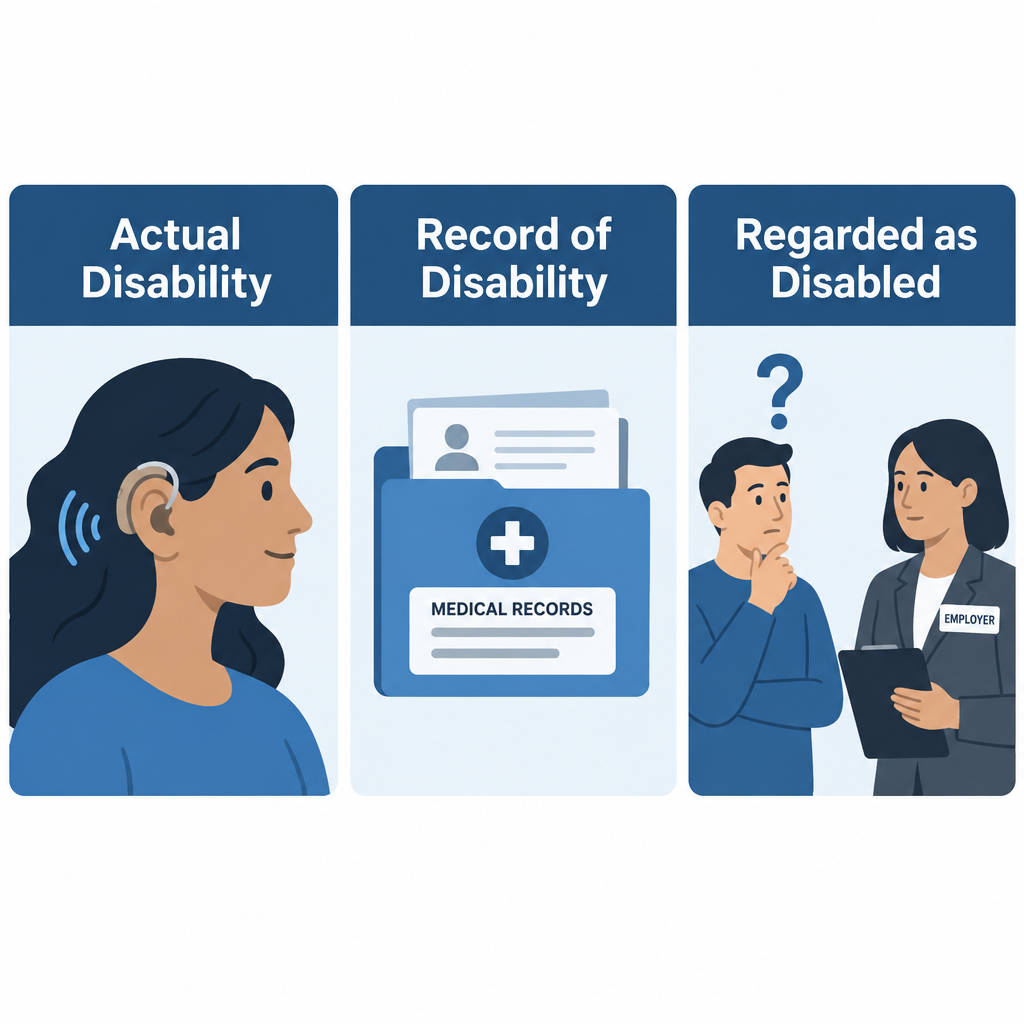
    The law uses a three-part definition of disability. A person qualifies under any one of these:

    • Actual disability: a physical or mental impairment that substantially limits one or more major life activities, such as hearing, seeing, walking, communicating or working.
    • Record of disability: a history of such an impairment, like a past cancer diagnosis.
    • Regarded as disabled: being treated as impaired, even when the person is not.

    After the Supreme Court read the definition narrowly in cases from the late 1990s and early 2000s, Congress passed the ADA Amendments Act of 2008, which took effect January 1, 2009. It told courts to interpret “disability” broadly. It also said to judge an impairment without mitigating measures. That point matters a lot for my readers. A person whose hearing loss is helped by hearing aids or a cochlear implant can still have a disability under the law. Ordinary eyeglasses and contact lenses are the one stated exception.

    The ADA also protects people who are associated with someone who has a disability, such as a parent caring for a Deaf child. The CDC estimates that about 1 in 4 U.S. adults lives with some type of disability.

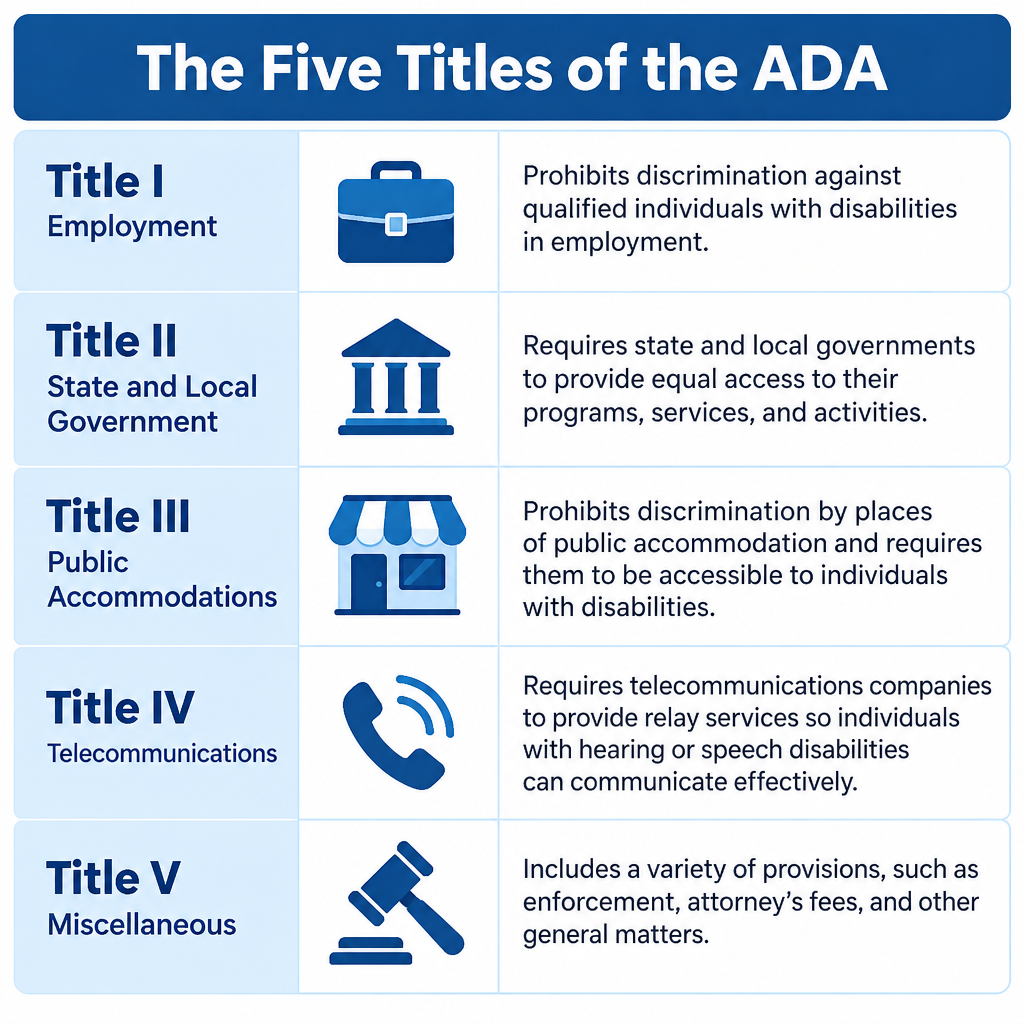
    The five titles of the Americans with Disabilities Act

    ADA Five Titles Overview Chart
    Title Covers Main enforcer Example requirement
    I: Employment Private employers with 15+ employees, state and local governments, unions, employment agencies EEOC Reasonable accommodations such as an ASL interpreter for a training session
    II: State and local government All state and local agencies, regardless of size, plus public transit Department of Justice; DOT for transit Captioned city council meetings and accessible courthouses
    III: Public accommodations Private businesses open to the public and commercial facilities Department of Justice Effective communication at hospitals, hotels, theaters and stores
    IV: Telecommunications Telephone carriers and federally funded TV public service announcements FCC Nationwide relay services
    V: Miscellaneous Applies across the whole law Varies Ban on retaliation and coercion

    Title I (Employment)

    Employers can’t discriminate in hiring, pay, promotion, training or firing against a qualified person with a disability. They have to provide reasonable accommodations unless doing so would cause “undue hardship,” meaning significant difficulty or expense. Before a job offer, an employer can’t ask whether you have a disability or require a medical exam. In my experience, the accommodation requests I see most from hard of hearing workers are captioned phones, CART for meetings and seating with clear sightlines.

    Title II (State and local government)

    Title II covers every service, program and activity of state and local governments. That includes schools, courts, police, voting, parks and public transportation. Agencies must communicate as effectively with people who have disabilities as with others. For Deaf and hard of hearing people, that can mean interpreters, captioning or assistive listening systems.

    Title III (Public accommodations)

    Restaurants, hotels, doctors’ offices, retail stores, gyms, private schools, movie theaters and similar businesses must remove barriers where it is “readily achievable.” They must also provide auxiliary aids so people can communicate effectively. Religious organizations and private clubs are exempt. A private lawsuit under Title III can win changes and attorney’s fees, but not money damages. The Justice Department can seek civil penalties. The statute set them at up to $50,000 for a first violation and $100,000 for later ones, and those caps are adjusted for inflation.

    Title IV (Telecommunications)

    Title IV required phone companies to offer telecommunications relay service nationwide, so people who are Deaf, hard of hearing or speech-disabled can make calls through a relay operator or text interface. Dialing 711 reaches relay anywhere in the U.S. Title IV also requires closed captioning on federally funded television public service announcements.

    Title V (Miscellaneous provisions)

    Title V holds the rules that tie everything together. It prohibits retaliation against anyone who files a complaint, and it allows courts to award attorney’s fees. It confirms that the ADA doesn’t weaken stronger state laws. It also excludes current illegal drug use from protection.

    Key dates in ADA history

    Year Milestone
    1990 President George H.W. Bush signs the ADA on July 26
    1991 Justice Department publishes the first ADA Standards for Accessible Design
    2008 ADA Amendments Act restores a broad definition of disability
    2010 Revised ADA Standards for Accessible Design adopted
    2012 2010 Standards become mandatory on March 15
    2024 DOJ final rule sets WCAG 2.1 Level AA for state and local government websites and apps

    Service animals under the ADA

    ADA Three-Part Disability Definition

    Under the ADA, a service animal is a dog individually trained to do work or perform tasks for a person with a disability. A hearing dog that alerts its handler to a doorbell or smoke alarm qualifies. Separate rules allow trained miniature horses in some cases. Emotional support animals don’t count as service animals under the ADA.

    When the need isn’t obvious, staff may ask only two questions. They can ask whether the dog is required because of a disability, and what task it has been trained to perform. They can’t demand paperwork or ask the dog to demonstrate.

    Guide to the ADA Standards: what they mean for hearing access

    The 2010 ADA Standards for Accessible Design set technical rules for buildings and facilities. One section I point readers to often is the assistive listening requirement. Assembly areas where audible communication is integral, such as courtrooms, theaters and lecture halls, must provide assistive listening systems. A set share of the receivers must work with hearing aids, typically through neckloops.

    Seating capacity Minimum receivers Hearing-aid compatible receivers
    50 or fewer 2 2
    51 to 200 2, plus 1 per 25 seats over 50 2
    201 to 500 2, plus 1 per 25 seats over 50 1 per 4 receivers
    501 to 1,000 20, plus 1 per 33 seats over 500 1 per 4 receivers
    1,001 to 2,000 35, plus 1 per 50 seats over 1,000 1 per 4 receivers
    2,001 and over 55, plus 1 per 100 seats over 2,000 1 per 4 receivers

    Hearing tip

    If your hearing aids have a telecoil, ask venue staff for a neckloop or look for the hearing loop symbol. A loop can send sound straight to your aids without a separate headset.

    Future ADA issues: web accessibility

    Digital access is the biggest open area. In April 2024, the Justice Department published a Title II rule requiring state and local government websites and mobile apps to meet WCAG 2.1 Level AA. As published, the rule set compliance dates of April 24, 2026 for governments serving 50,000 or more people, and April 26, 2027 for smaller governments and special districts. I couldn’t confirm whether those dates have been revised, so check ADA.gov for the current status. No equivalent final regulation exists for private businesses under Title III. Courts there still decide website cases one lawsuit at a time.

    How to report a disability rights violation

    Where you file depends on the title involved.

    Filing an ADA complaint

    1. For employment discrimination, file a charge with the EEOC through its online Public Portal, by phone or in person.
    2. For state or local government, businesses or public places, file through the Justice Department’s online civil rights portal, or by mail.
    3. For relay or captioning problems, file a complaint with the FCC.
    4. Keep copies of emails, names, dates and any written denials of your request.
    5. For questions before you file, call the ADA Information Line at 800-514-0301 (voice) or 833-610-1264 (TTY).

    Deadlines matter

    EEOC charges generally must be filed within 180 days, or 300 days in states with their own disability law. If you have lost a job or been denied services, talk to a disability rights attorney or your state protection and advocacy agency quickly.

    FAQ

    Is the ADA a medical law or a civil rights law?

    It is a civil rights law. It doesn’t pay for hearing aids, treatment or medical care. It requires equal access and bans discrimination.

    Does the ADA apply to small businesses?

    Title III applies to public accommodations of any size. Title I’s employment rules only apply to employers with 15 or more employees. Many state laws cover smaller employers.

    Does the ADA require businesses to provide sign language interpreters?

    They must provide effective communication. For a medical appointment or legal meeting, that often means a qualified interpreter. For a quick retail exchange, written notes may be enough. The business pays, not the customer.

    What’s the difference between the ADA and Section 504?

    Section 504 of the Rehabilitation Act covers federal agencies and programs that receive federal funds. The ADA extends similar protections to private employers, state and local governments and most businesses.

    Is hearing loss a disability under the ADA?

    It often is. Since the 2008 amendments, hearing loss is assessed without counting the benefit of hearing aids or cochlear implants. Many hard of hearing and Deaf people qualify.