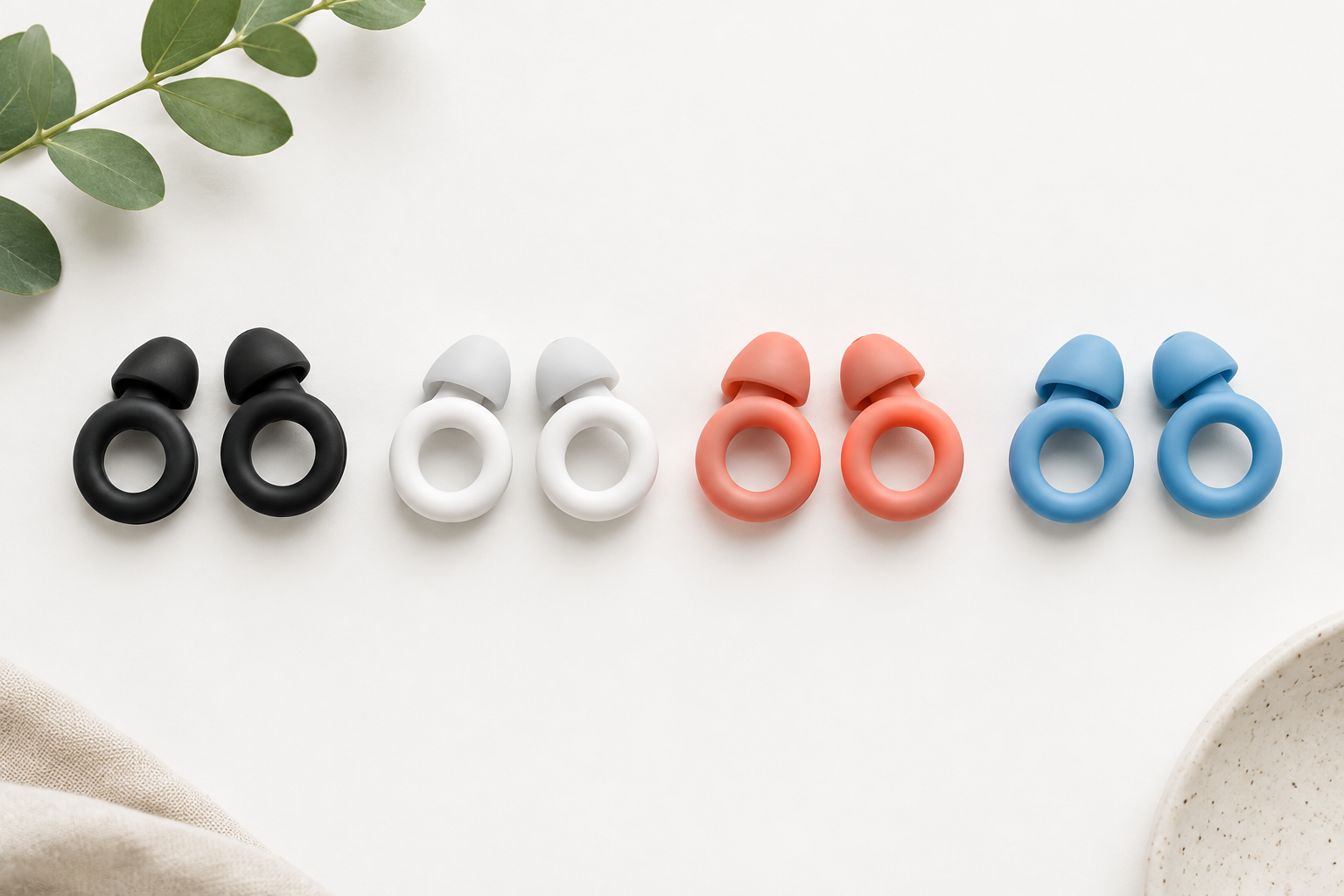
Loop earplugs do work. They are reusable, filtered silicone earplugs that cut volume by roughly 16 to 27 dB depending on the model, so sound stays clear but gets quieter. This guide compares seven current Loop models, shows how much protection each one gives you in real situations, and matches them to concerts, work, sleep and sensory sensitivity.
Last checked: October 29, 2026.
The short answer: which Loop model to buy
Most people only need one of four Loop earplugs. The others are variations with add-ons or adjustable settings.
- Concerts, festivals, clubs and loud bars: Experience 2. If you stand near the speakers or spend whole days at festivals, choose Experience 2 Plus, which comes with an extra insert for more reduction.
- Open offices, commuting, restaurants, family gatherings and noise sensitivity: Engage 2. It gives you the lightest reduction and keeps speech clearest.
- Sleep, studying and blocking out a partner’s snoring: Quiet 2 for back sleepers and occasional use. Choose Dream if you sleep on your side.
- One pair for everything: Switch 2. It has three modes on a dial, but you pay more for that flexibility.
If you work in sustained industrial noise, use firearms, or run power tools all day, do not rely on any of these. Use protection rated for occupational noise, ideally fitted and fit-tested through your employer’s hearing conservation program.
What Loop earplugs are, and what they are not
Loop is a Belgian company founded in Antwerp in 2016. It sells reusable earplugs built around a distinctive ring, the “loop” that gives the brand its name. People search for them as loop earplugs, loop ear plugs and loops earplugs. All three refer to the same product family.
Each earplug has a soft silicone tip that seals your ear canal. A rigid body behind the tip houses an acoustic channel and, on most models, a filter. The ring is a design feature. It also works as a grip, which makes it easier to remove the earplug.
Loop markets the range as a lifestyle and wellness product. It has been the official earplug partner of the Tomorrowland festival, and it has released collaborations and special colourways, so the plugs show up as fashion accessories as well as hearing protection. That marketing is part of why they are popular. You are far more likely to wear an earplug you do not mind being seen in.
Loop earplugs are not hearing aids. They do not amplify anything, they are not regulated by the FDA as hearing devices, and they do not treat hearing loss or tinnitus. If you already notice trouble following conversations, that is a separate problem. Since October 2022, adults with perceived mild to moderate hearing loss in the US can buy FDA-regulated over-the-counter hearing aids without a prescription. A hearing test with an audiologist is still the best starting point.
How Loop earplugs reduce sound
Cheap foam earplugs stuff your ear canal with dense material. They block high frequencies much more than low ones, so music turns muddy and voices sound distant. That is the main reason people take foam plugs out halfway through a gig.
Filtered earplugs like Loop’s Experience and Engage models let sound pass through a channel and an acoustic filter. They aim for a flatter reduction across frequencies. The result is quieter sound rather than muffled sound. Loop’s designs are not perfectly flat, but they are much closer than foam, and that difference is what you notice on first use.
The Quiet and Dream models work differently. They block as much as their size and softness allow, because at night clarity does not matter and comfort does.
SNR, NRR and the number on the box
Loop publishes its reduction figures as SNR (Single Number Rating), the European rating under the EN 352 standard. US products usually show NRR (Noise Reduction Rating), which is tested under different rules. The two are not interchangeable, and SNR figures usually run a few decibels higher than the NRR for the same plug. Do not compare a Loop SNR directly against a foam plug’s NRR.
Both ratings come from lab tests with trained subjects and careful insertion. In everyday use you get less protection than the label says, mostly because of fit. A plug that is the wrong size, inserted too shallowly, or loosened by talking and chewing can lose a large share of its rated reduction. Assume your real protection will fall several decibels short of the box figure unless you size and insert the plugs carefully.
Why a few decibels matter so much
Decibels are logarithmic. Under the US National Institute for Occupational Safety and Health (NIOSH) guideline, 85 dBA is acceptable for 8 hours. Every 3 dB increase halves the safe time. A 17 dB reduction therefore moves you a long way down the risk curve. A 5 dB gap between two models matters more than the small numbers suggest.
The Loop lineup at a glance
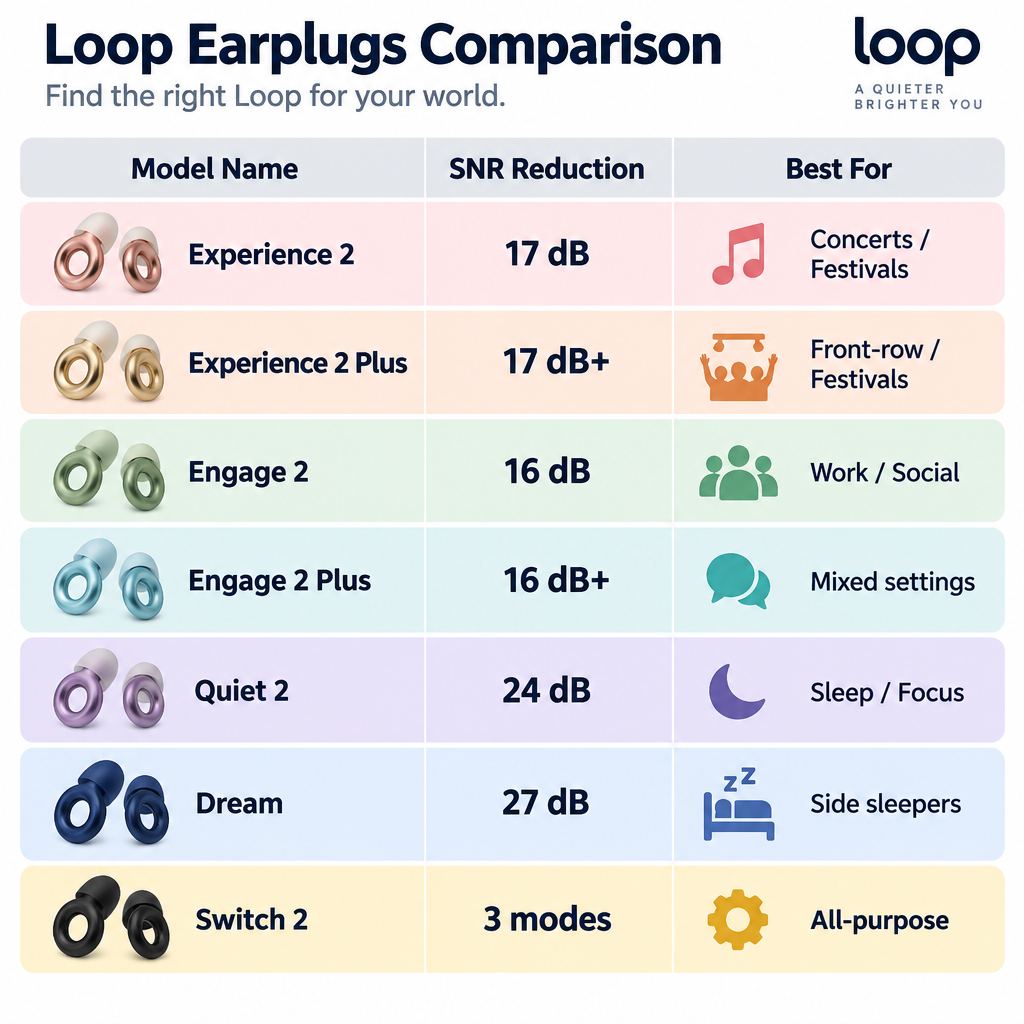
The table below covers the current generation as listed by Loop at our last check. Loop revises its figures between generations (the second-generation Experience is rated slightly differently from the original), so check the packaging of the exact version you buy.
| Model | Loop’s stated reduction (SNR) | Design | Best for |
|---|---|---|---|
| Experience 2 | About 17 dB | Filtered, ring body | Concerts, festivals, nightlife |
| Experience 2 Plus | About 17 dB, more with Mute insert | Filtered, includes Mute | Front-row gigs, long festival days |
| Engage 2 | About 16 dB | Filtered, speech-focused | Work, social events, sensitivity |
| Engage 2 Plus | About 16 dB, more with Mute insert | Filtered, includes Mute | Mixed social and noisy settings |
| Quiet 2 | About 24 dB | Soft, unfiltered silicone | Sleep, focus, travel |
| Dream | About 27 dB | Low-profile, sleep-specific | Side sleepers, loud snorers |
| Switch 2 | Three modes via dial | Adjustable filter | One pair for many situations |
Price tiers
Loop discounts heavily during sales periods, runs regional pricing, and adjusts list prices over time. We could not confirm the current list price for every model on October 29, 2026. The tiers below reflect the approximate US list prices these models have carried and should be treated as a guide, not a quote.
| Price tier (approx. US list) | Models |
|---|---|
| About $25 | Quiet 2 |
| About $35 | Experience 2, Engage 2 |
| About $45 to $50 | Experience 2 Plus, Engage 2 Plus, Dream |
| About $60 | Switch 2 |
Foam earplugs cost cents per pair. A custom-molded musician’s earplug from an audiologist usually costs well over $150. Loop sits between the two in price, and that is roughly where it sits in performance and convenience too.
Model by model
Loop Experience 2
Experience 2 is the model most people picture when they think of Loop. It is tuned for live music. It turns down a loud room while keeping vocals, cymbals and bass detail more intact than foam would. Most wearers report that a gig sounds like the same gig with the volume knob turned down, and that is the point of the product.
At about 17 dB SNR, it handles a typical club or mid-sized concert well. A loud arena show or a spot directly in front of a festival stack can push it to its limit, as the worked example later in this guide shows. You get four sizes of silicone tips (XS to L) on most packs, and getting the size right matters more than any other choice you make.
Choose it if music is your main use and you rarely stand in the loudest spot in the venue.
Loop Experience 2 Plus
Experience 2 Plus is the same earplug bundled with Loop Mute. Mute is a small insert that closes off part of the acoustic channel for a few extra decibels of reduction. You can put it in when a set gets brutal, or for a DJ’s peak hour, and take it out for quieter stretches.
This is the better buy if you go to festivals, play in a band, or tend to end up near the barrier. The price difference is small compared with the extra flexibility. Mute is tiny, though. Keep it in the case, not loose in your pocket.
Loop Engage 2 (and Engage 2 Plus)
Engage 2 gives the lightest reduction in the range, and Loop tunes it to keep speech intelligible. That makes it the right choice for loud restaurants, open-plan offices, crowded commutes, weddings and family gatherings. In those settings you want the background noise turned down without missing what the person beside you says.
Engage is also the model people with sensory sensitivity most often settle on. That includes many autistic people and people with ADHD or misophonia. It takes the edge off overwhelming environments without the isolation of a stronger plug. Engage 2 Plus adds the Mute insert, which is useful if your day moves from a quiet meeting to a noisy event.
Choose Engage over Experience if you mainly need to talk while wearing the plugs. For loud music, Experience protects you a little more.
Loop Quiet 2
Quiet 2 is the cheapest Loop and the most different in design. It has no filter. It is a soft silicone plug built to block as much noise as possible while staying comfortable for hours. Loop rates it at about 24 dB SNR, much more than the filtered models.
It works well for back sleepers, airplane cabins, studying in a noisy home and partners who snore at moderate volume. Side sleepers often find that the ring presses against the ear when the head is on a pillow, and that pressure gets uncomfortable over a full night. Foam earplugs with a high NRR can still block more noise than Quiet 2, so if raw blocking power matters more than comfort, foam still beats it on value.
Loop Dream
Dream is Loop’s sleep-specific model. It has a slimmer, lower-profile shape designed to sit flatter in the ear so a pillow does not push it in or pry it out. It is also the strongest Loop at about 27 dB SNR, which puts it in the range of good-quality foam plugs.
It costs about double Quiet 2. That premium makes sense if you sleep on your side every night or share a bed with a heavy snorer. If you only need earplugs for occasional hotel stays, Quiet 2 is enough.
Loop Switch 2
Switch 2 has a small rotating dial that moves between three modes. Loop names them after its main product lines: an Engage-style mode for conversation, an Experience-style mode for music, and a Quiet-style mode for maximum blocking. Instead of carrying two or three pairs, you turn the dial.
The trade-off is that each mode is a compromise. In Quiet mode, Switch 2 does not block as much as a dedicated Dream, and the dial makes the body bulkier than a standard Experience 2. Switch 2 suits travellers and people who move between very different environments in one day. If you mostly do one thing, a dedicated model works better and costs less.
Features compared
| Feature | Experience 2 | Exp. 2 Plus | Engage 2 | Quiet 2 | Dream | Switch 2 |
|---|---|---|---|---|---|---|
| Acoustic filter | Yes | Yes | Yes | No | No | Yes |
| Adjustable reduction | No | Via Mute | No | No | No | Three modes |
| Speech stays clear | Good | Good | Best | Poor | Poor | Mode-dependent |
| Comfortable side sleeping | No | No | No | Fair | Yes | No |
| Includes Mute insert | No | Yes | No (Plus: yes) | No | No | No |
| Reusable and washable | Yes | Yes | Yes | Yes | Yes | Yes |
None of the Loop models is rechargeable, electronic or Bluetooth-connected. They are purely passive. That is an advantage: no battery to die halfway through a festival, no app, and nothing to update.
Help me choose: match the model to the noise
Picking the right Loop depends more on how loud your situation is, and for how long, than on how the plug looks. This table uses the NIOSH guideline (85 dBA for 8 hours, with safe time halving every 3 dB) and typical sound levels. Real levels vary widely by venue and position.
| Situation | Typical level | Unprotected safe time (NIOSH) |
|---|---|---|
| Busy restaurant | 70 to 85 dBA | Most of a workday or more |
| Heavy city traffic | About 85 dBA | About 8 hours |
| Subway platform, train arriving | 90 to 100 dBA | 2.5 hours down to 15 minutes |
| Club dance floor | About 100 dBA | About 15 minutes |
| Concert near the stage | 100 to 110 dBA | 15 minutes down to under 2 minutes |
Concerts and festivals
Here is a worked example. Say a concert averages 103 dBA where you stand, which is common for rock and electronic shows. Unprotected, NIOSH puts your safe dose at about 7.5 minutes.
Experience 2 is rated at about 17 dB. With careful fit you might get 12 to 15 dB in practice, which brings you to roughly 88 to 91 dBA. That gives you a safe time of about 2 to 4 hours. With a poor fit and only 10 dB of real reduction, you sit around 93 dBA and have barely over an hour.
That is why a single headline act in Experience 2 is usually fine, while a 10-hour festival day near the main stage is where you should step up to Experience 2 Plus with Mute in. The other answer is to stand further back. Distance from the speakers is free protection, and it can easily give you several decibels.
Hearing tip
Put your earplugs in before the first band starts, not when it starts to hurt. Pain is a late signal, and ringing ears after a show mean you already took more than a safe dose.
Work, commuting and open offices
Engage 2 suits office life best. It takes the clatter out of an open-plan floor and the screech out of a train braking, and you can still hear a colleague say your name. For calls on a headset, take the earplugs out. Wearing both adds pressure and can muddy the call audio.
If you work somewhere with legally regulated noise exposure, such as a factory, workshop, construction site or airport ramp, your employer’s hearing conservation program should specify protection. A lifestyle earplug is not a substitute for protection that has been fit-tested in that environment.
Sleep
Quiet 2 and Dream are the sleep options. Back sleepers usually do fine with Quiet 2. Side sleepers tend to prefer Dream’s lower profile. Keep your expectations realistic. No earplug fully blocks loud low-frequency snoring, because bass travels through your skull as well as your ear canal. Better earplugs turn snoring from a problem into background noise.
If you wear earplugs every night, make sure you can still hear a smoke alarm. Test it once with your plugs in. If you cannot hear it clearly, look into a vibrating bed-shaker alarm or a strobe alarm. People who are Deaf or hard of hearing use these widely, and they are worth considering for anyone sleeping with strong protection.
Sensory sensitivity, autism, ADHD and misophonia
Many people buy Loop for sensory regulation rather than hearing protection, and Engage 2 is usually the best starting point. It takes the harshness out of supermarkets, classrooms, school pickups and busy offices while keeping you connected to conversation. Some people keep a Quiet 2 in their bag for moments when everything becomes too much.
In the US, earplugs and quieter workspaces are common examples of workplace accommodations. The Americans with Disabilities Act is the main US disability rights act covering employment. It generally requires covered employers to provide reasonable accommodations for qualifying disabilities, which can include sensory needs. If your workplace is hostile to you wearing earplugs, that law is worth reading up on.
Musicians, DJs and sound engineers
Musicians playing every week usually need more than Loop. Experience 2 works well for a drummer’s occasional rehearsal or a DJ’s weekend set, especially the Plus version. People who play loud music professionally get better results from custom-molded musician’s earplugs fitted by an audiologist. Those use interchangeable flat-response filters and seal more consistently than off-the-shelf tips. They cost several times more, but they last for years and are far more consistent.
Kids
Loop’s tips can be small enough for older children, and Loop has offered child-focused options. For toddlers and young children at fireworks, sporting events or concerts, over-ear protective earmuffs are usually the safer choice. They are easier to fit, harder to lose and carry no risk of being pushed too far into a small ear canal. Infants should always wear earmuffs, never earplugs.
Loop versus other hearing protection
| Option | Sound quality | Max blocking | Cost | Best for |
|---|---|---|---|---|
| Foam earplugs | Muffled | Very high | Very low | Sleep, maximum noise |
| Loop filtered models | Clear, quieter | Moderate | Moderate | Concerts, social, work |
| Other filtered brands (e.g. Etymotic, Eargasm, Vibes) | Clear, quieter | Moderate | Moderate | Concerts, social |
| Custom musician’s earplugs | Most natural | Moderate | High | Regular musicians |
| Earmuffs | Muffled | High | Low to moderate | Kids, tools, shooting ranges |
| ANC earbuds with loud sound reduction | Varies | Varies | High | Commuting, everyday noise |
Some earbuds now offer hearing protection features. Apple added a Hearing Protection feature to AirPods Pro 2 through a software update in 2024, which helps minimize exposure to loud environmental noise across listening modes. You can review it on an iPhone under Settings, then the AirPods name, then Hearing Health. The feature works, but the earbuds need charging, cost far more than a Loop, and are easier to lose or have stolen at a festival. For a long gig day, cheap passive earplugs are still the more practical choice.
Fitting, sizing and care
Fit decides how much protection you actually get. A perfectly rated Loop in the wrong tip size will protect you worse than a cheap foam plug inserted properly.
How to fit Loop earplugs
- Start with the medium tip that comes pre-fitted.
- Reach over your head with the opposite hand and gently pull the top of your ear up and back to straighten the canal.
- Insert the tip with a slight twisting motion until it feels sealed, with the ring sitting naturally in your ear.
- Speak a sentence aloud. Your voice should sound noticeably fuller and more internal.
- Gently tug the ring. If the plug slides out easily or you can hear the room clearly, try the next size up.
- If it hurts, presses or itches after 10 minutes, try the next size down.
Many people need different tip sizes for each ear, which is normal. Ear canals are rarely symmetrical.
The “fuller voice” effect in step four is called the occlusion effect. It shows the plug is sealing properly. For some people it is the most annoying part of wearing earplugs, especially in conversation. It usually becomes less noticeable within a few uses. Engage 2 handles it a little better than the other models.
Cleaning and replacing tips
Wipe the plugs after each use. Every week or two, or after a sweaty festival, wash the silicone tips in lukewarm water with mild soap, rinse them, and let them dry fully before storing. Take the tips off the body first, and keep the body itself out of soaking water, because water can get into the filter.
Replace the tips when they lose their bounce, become discoloured or stop sealing. Loop sells replacement tips, so you do not need to buy a whole new pair. Do not share earplugs. Ear canals carry bacteria and wax, and shared earplugs spread infections.
Hearing tip
Frequent earplug use can push earwax deeper into the canal. If your ears feel blocked after a few weeks of nightly wear, ask a doctor or audiologist to check. Do not dig around with cotton swabs.
Honest drawbacks of Loop earplugs
Loop earplugs come up constantly in online forums. When you look past the marketing, some complaints repeat across thousands of user reports.
- The ring catches on things. Hair, hats, hoods and pillows snag on it. That is fine at a concert and annoying in bed, which is why Dream exists.
- They can work loose. Talking, chewing and dancing move your jaw and gradually loosen the seal. Re-seat the plugs every hour or so at a long event.
- They are easy to lose. The carry case is small. Clip it to a keyring or a bag zip.
- Quiet 2 is not the strongest sleep option. If your only goal is maximum blocking at night, foam earplugs or Dream outperform it.
- The price surprises people. You are paying for reusability, sound quality and design. If you only go to one concert a year, a pair of disposable filtered plugs or good foam plugs does the job.
- Experience is not enough for everything. About 17 dB is right for most gigs and too little for a full day directly in front of the stage.
Taken together, Loop’s main strength is that people actually wear them. A comfortable, discreet earplug you keep in for the whole show protects you better than a stronger plug you take out after twenty minutes because it makes the music sound like it’s underwater.
Hearing health: when earplugs are not enough
Earplugs prevent damage. They do not reverse it. If you already have symptoms, put down the shopping list and get your hearing checked.
See a professional
Sudden hearing loss in one or both ears is a medical emergency. See a doctor or go to urgent care the same day, because treatment works best within the first few days.
You should also see an audiologist or doctor if:
- Ringing, buzzing or muffled hearing after a loud event lasts longer than a day or two.
- Tinnitus is new, gets worse, or is only in one ear.
- Everyday sounds start to feel painfully loud (possible hyperacusis).
- You often ask people to repeat themselves or turn the TV up more than the rest of your household.
Tinnitus and overprotection
Earplugs do not cure tinnitus, and no reputable earplug brand claims they do. For some people they make tinnitus more noticeable at night, because blocking the room sound leaves the ringing as the loudest thing you hear. A quiet fan or sound machine with Quiet 2, or with lighter protection, often works better than total silence.
Audiologists also warn against wearing earplugs all the time in ordinary environments if you have sound sensitivity. The brain can respond to constant quiet by turning up its own sensitivity, which makes normal sounds feel even louder. Use your Loops for situations that are actually loud or overwhelming, and talk to an audiologist about sound therapy if sensitivity is affecting your daily life.
If you already have hearing loss
Earplugs and hearing aids do different jobs, and you cannot wear both at once. If you have hearing loss and still go to concerts, ask your audiologist about it. Many modern hearing aids have noise programs, and your audiologist can tell you whether to remove the aids and use plugs, or use a dedicated program.
Earplugs can also make speech harder to follow if your hearing is already reduced. In noisy social settings, some hard of hearing people do better with assistive tools than with more blocking: a remote microphone paired to their hearing aids, live captions on a phone, or closed captioning on venue screens and at home. At home, if you wear Quiet 2 to shut out a noisy household while watching something, switching on captions keeps the dialogue accessible.
Special editions and collaborations
Loop releases limited editions regularly. Its long-running partnership as Tomorrowland’s official earplug brand has produced festival-branded versions, and collaborations such as the Paris Hilton edition have brought special colours and packaging. Loop also sells exclusive finishes through its own store.
These editions are usually cosmetic variations of the core models, so the acoustic performance follows the base product. Before you buy, check which model a special edition is built on and confirm its stated reduction on the product page or box. A limited-edition Experience is still an Experience. Pick the model for your use first and the colour second.
FAQ
Do Loop Earplugs really work?
Yes. Loop’s filtered models reduce volume by about 16 to 17 dB, and the sleep models by about 24 to 27 dB, according to the company’s published SNR figures. In real use you get somewhat less, mainly because of fit. With the right tip size and proper insertion, they meaningfully cut your noise dose at concerts, in loud venues and during sleep.
What’s so special about Loop Earplugs?
Three things set them apart. The filtered models reduce sound more evenly across frequencies than foam does, so music and speech stay clear. They are reusable with replaceable tips. And the design is comfortable and stylish enough that people actually wear them. Many people value that last point most, because an earplug you leave in your pocket protects no one.
Can you still hear everything with Loop Earplugs?
With Experience 2 and Engage 2 you still hear music, voices and announcements clearly, just more quietly. Engage 2 keeps speech the clearest. With Quiet 2 and Dream you hear far less, which is the point for sleep. Test that you can still hear your smoke alarm before relying on them at night.
What is the difference between Loop Earplugs and regular earplugs?
Regular foam earplugs block as much sound as possible and cut high frequencies hardest, so everything sounds muffled. Loop’s filtered models aim for a more balanced reduction that keeps sound natural. Loop plugs are also reusable and washable, while foam plugs are usually disposable. Foam can block more total noise for far less money, which still makes it a good choice for maximum blocking.
Which Loop is best for concerts?
Experience 2 suits most concerts. Choose Experience 2 Plus if you stand near the speakers, play in a band or attend multi-day festivals, because its Mute insert adds extra reduction for the loudest moments.
Can you sleep in Loop Experience earplugs?
You can, but they are not designed for it. The filter lets through more sound than a sleep plug, and the rigid ring presses against a pillow. Quiet 2 is the better choice for back sleepers and Dream for side sleepers.
Do Loop earplugs help with tinnitus?
They help prevent noise exposure that can cause or worsen tinnitus, but they do not treat it. If you have ongoing tinnitus, see an audiologist or doctor. Tinnitus in one ear, or tinnitus that comes with sudden hearing changes, needs prompt medical attention.