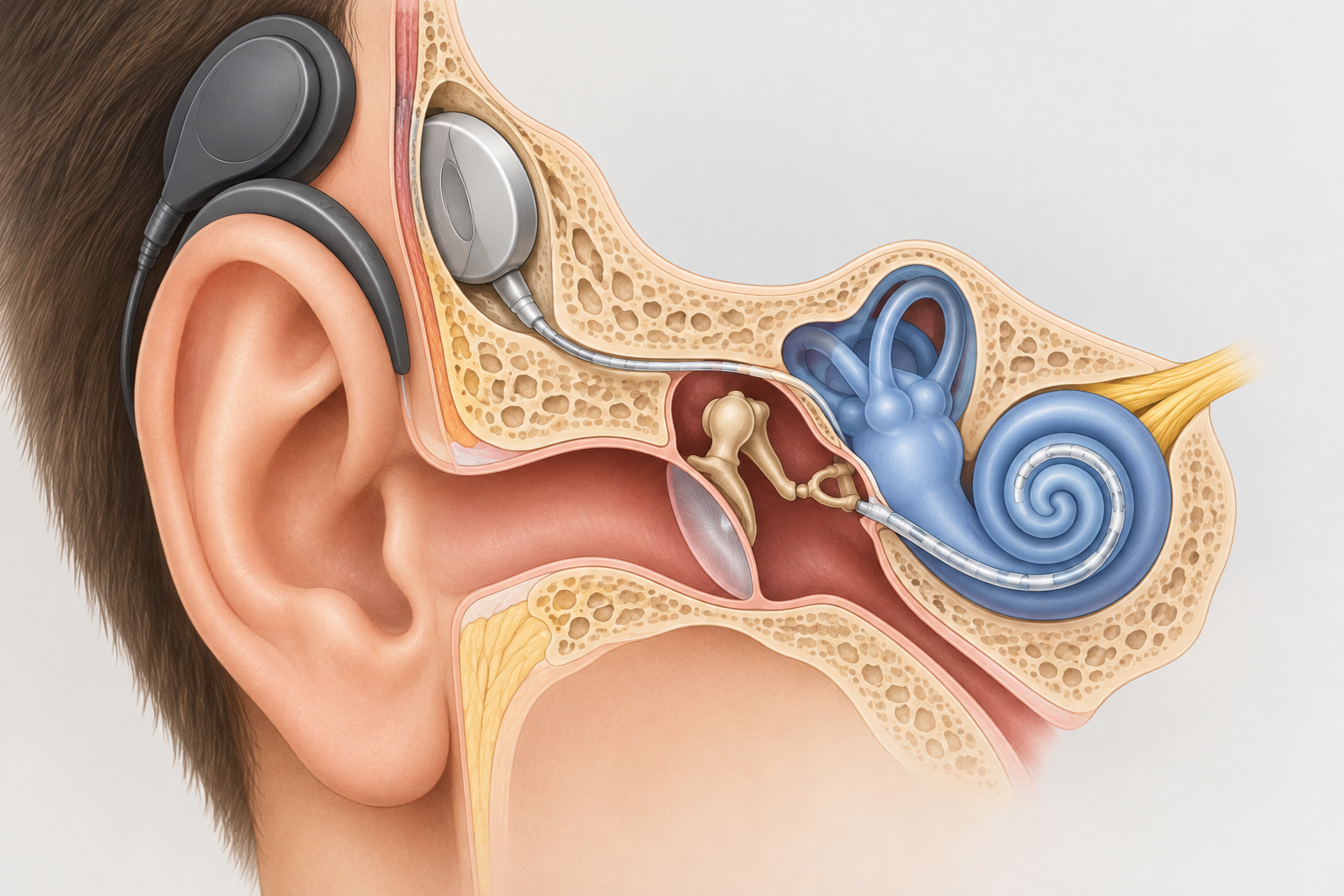
Cochlear implant surgery is usually a 1.5 to 3 hour operation done under general anesthesia through a small cut behind your ear. Most adults go home the same day or the next morning and are back to light routines within about a week. The implant is not switched on until a follow-up visit, often 2 to 4 weeks later.
Last updated: October 30, 2026. This is general information, not medical advice. Your surgeon’s instructions always come first.
Before surgery: what happens first
You don’t book this operation the way you book a hearing test. A cochlear implant team first checks whether you are a candidate. Expect hearing tests with well-fitted hearing aids, speech recognition testing, and a CT or MRI scan of your inner ear.
Your surgeon also reviews your general health for anesthesia. In the US, the CDC recommends that people getting cochlear implants be up to date on pneumococcal vaccines, because implant recipients have a higher risk of bacterial meningitis. Ask for your vaccines early, since some need to be given at least two weeks before surgery.
You will also choose a device. Three manufacturers make FDA-approved implants in the US: Cochlear (Nucleus), Advanced Bionics and MED-EL. Your surgeon may recommend one based on your anatomy, the MRI compatibility you need, and which processor features matter to you.
The cochlear surgery procedure, step by step
Every surgeon’s technique differs slightly. This is the general sequence most hospitals describe.
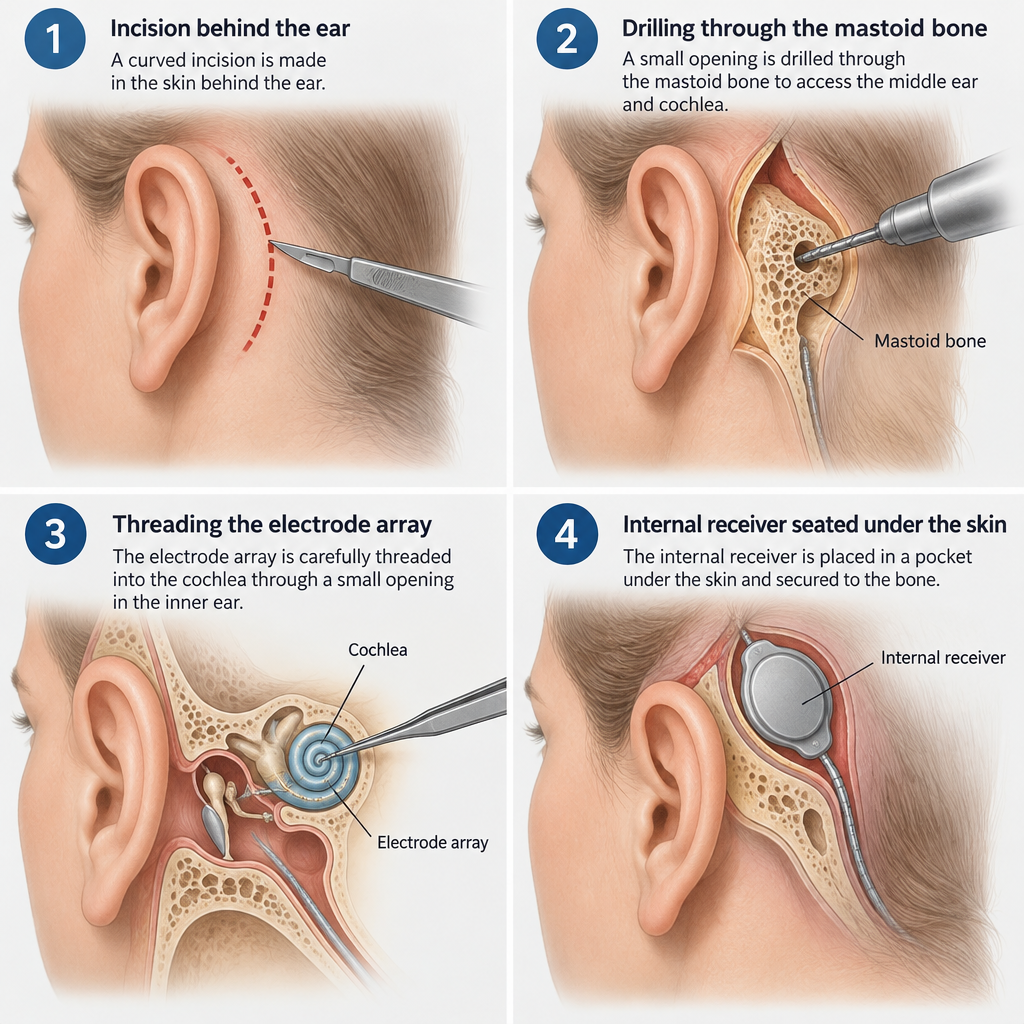
What happens in the operating room
- You are given general anesthesia, so you are asleep throughout.
- A small area of hair behind the ear may be shaved, and a curved incision is made.
- The surgeon drills through the mastoid bone behind the ear to reach the middle ear.
- A shallow bed or snug pocket is made under the skin for the internal receiver.
- The electrode array is threaded into the cochlea, usually through the round window.
- The team tests the implant’s electrodes and your auditory nerve response while you sleep.
- The incision is closed and covered with a pressure dressing.
Throughout the operation, the team monitors your facial nerve, which runs close to the surgical route. Some hospitals take an X-ray afterward to confirm the electrode’s position.
Insights a surgeon will usually share
Surgeons often stress two points. The first is that the operation is on bone and the inner ear, not the brain. The second is that many teams now use “soft” insertion techniques and thinner electrodes to try to preserve whatever natural low-pitch hearing you still have. Preservation isn’t guaranteed, so ask your surgeon for their own results.
Recovery timeline
| When | What is typical |
|---|---|
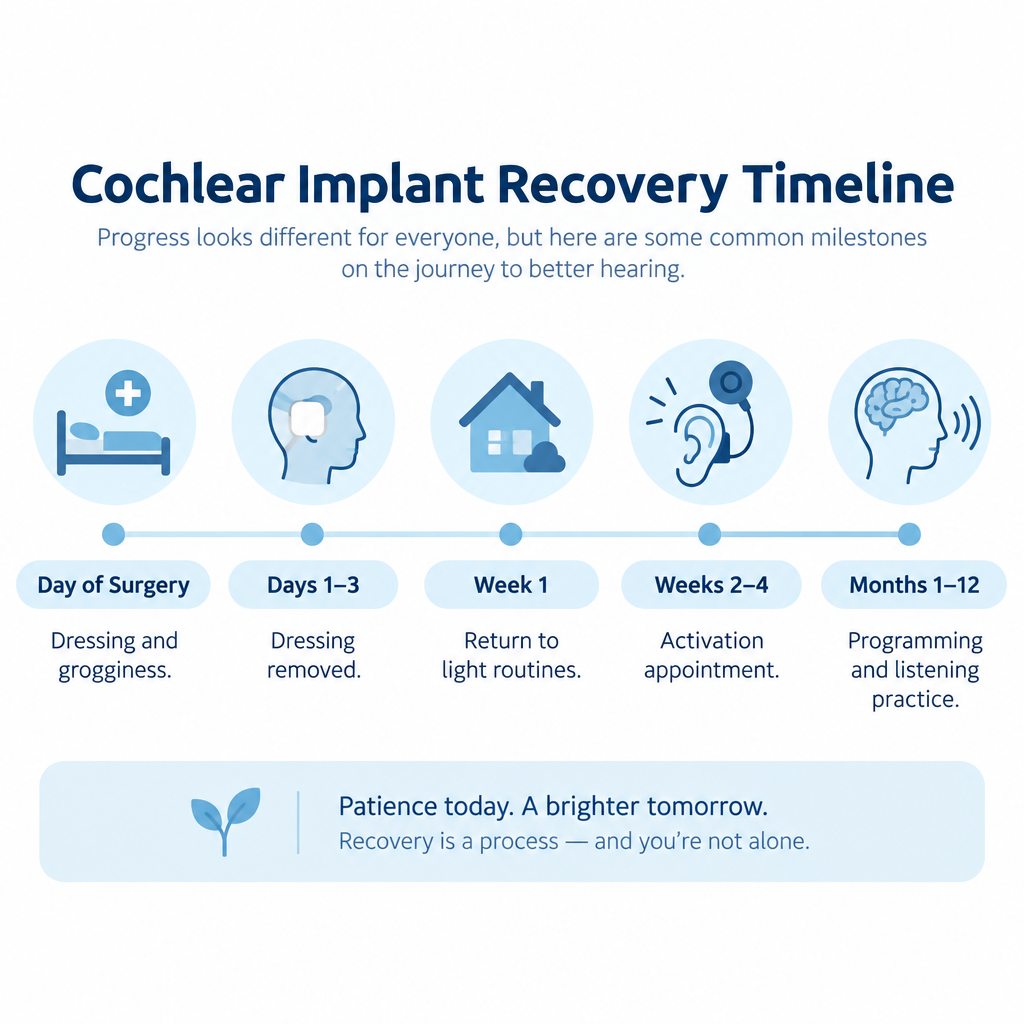
| Day of surgery | Grogginess, ear pressure, a head dressing, mild to moderate pain |
| Days 1 to 3 | Dressing removed, some dizziness, tenderness behind the ear |
| Week 1 | Most adults return to desk work and light activity |
| Weeks 1 to 2 | Stitches removed or dissolving, swelling fading |
| Weeks 2 to 4 | Activation appointment at many centers |
| Months 1 to 12 | Repeated programming visits and listening practice |
In the first weeks, you may notice a few side effects:
- Dizziness or imbalance often settles within days, though some people feel it for longer.
- Taste changes, such as a metallic taste on one side of the tongue, happen because a small taste nerve runs through the middle ear.
- Numbness around the ear may last for weeks.
- Tinnitus can change, either for better or worse.
Keep the incision dry until your team clears it. You will also be told to avoid heavy lifting, contact sports and blowing your nose hard for a few weeks.
Hearing tip
Before activation, you’ll hear little or nothing on the implanted side. Turn on closed captioning for TV and video calls, and set up telecommunications relay service for phone calls so you don’t miss anything important.
See a professional
Call your surgeon promptly for fever, spreading redness, fluid from the wound, facial weakness, a stiff neck or a severe headache. If you notice sudden hearing loss in your other ear, treat it as a medical emergency.
Hearing with your new device
Activation is when an audiologist attaches the external sound processor and programs it. First sounds are often described as beeps, robotic voices or high-pitched chatter. That is normal. Your brain needs time to adapt to electrical hearing.
Most people improve noticeably over the first 3 to 6 months, and many keep improving for a year or more. Daily listening practice speeds this up. Some newer processors support Bluetooth streaming, and a few are ready for Auracast broadcast audio, which helps in venues that offer it.
Questions for your surgeon
- How many implant operations do you perform each year?
- Will this be outpatient, or should I plan to stay overnight?
- What are your rates of infection, facial nerve injury and device failure?
- How likely is it that I’ll keep some natural hearing?
- Is my device safe for MRI scans, and with what precautions?
- When will activation happen, and how many programming visits come after?
Supporting your child
Children can receive implants from as young as 9 months, depending on the device and their hearing loss. The operation itself is similar to the adult version. Younger children usually bounce back from surgery quickly, but they need close supervision so they don’t knock or scratch the incision.
Prepare your child with simple, honest words about a “sleepy medicine” and a bandage. Bring a favorite toy. Many families keep using sign language alongside spoken language during the early months, and you should plan for regular speech and listening therapy afterward.
FAQ
How serious is cochlear implant surgery?
It is a well-established operation with a low rate of serious complications. It still carries real risks: infection, dizziness, taste changes, facial nerve injury, meningitis and device failure. Most of these are uncommon, and facial nerve injury is rare.
How painful is cochlear implant surgery?
Most people describe aching, pressure and tenderness behind the ear rather than severe pain. It is usually managed with over-the-counter pain relief or a short course of prescription medication. Discomfort typically eases within a few days.
Is cochlear implant surgery major surgery?
It involves general anesthesia and drilling through bone, so it is a significant operation. Even so, it is often done as a same-day or overnight procedure, and recovery is shorter than many people expect.
How long does it take to fully recover from cochlear implant surgery?
The incision usually heals within 2 to 4 weeks, and most adults resume normal activities within one to two weeks. Learning to hear with the implant is a separate process that unfolds over months, often a year or longer.