
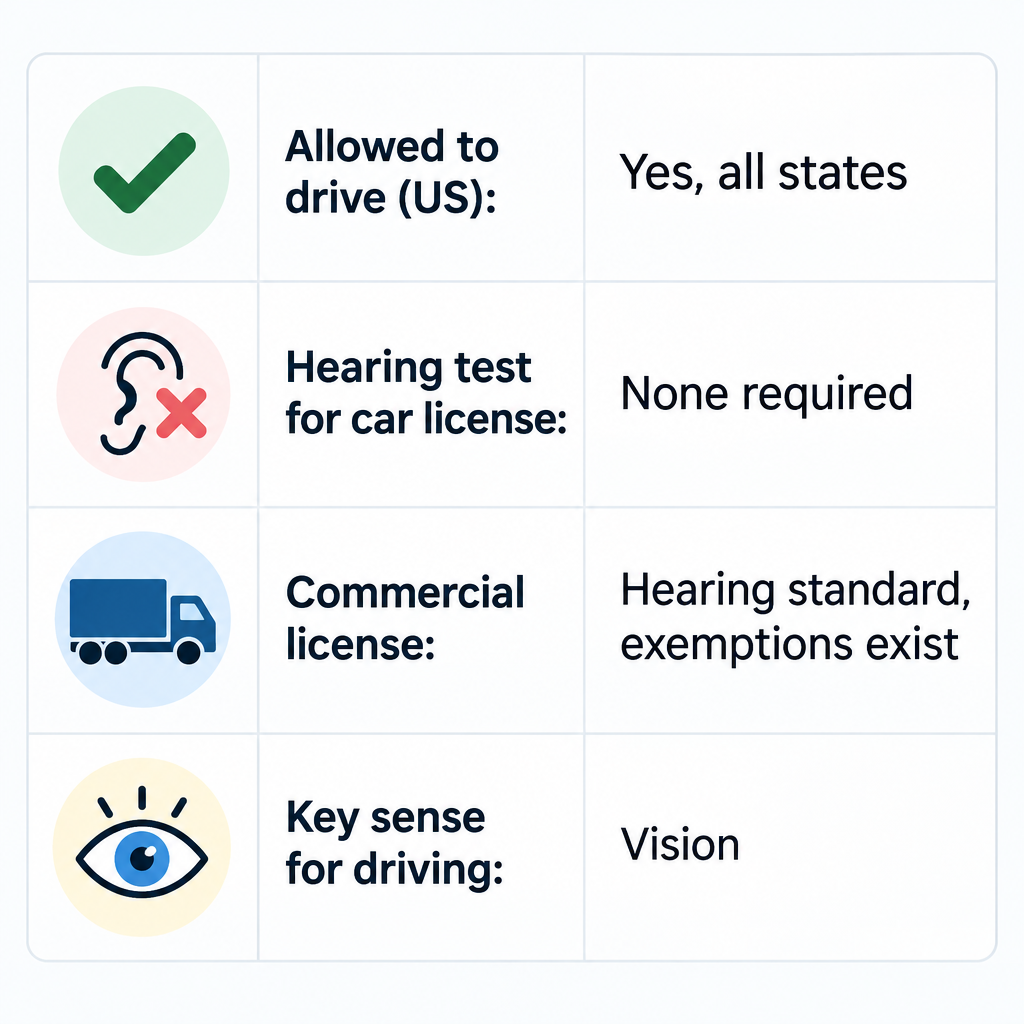
Yes, deaf people can drive. Every US state licenses deaf and hard of hearing drivers on the same terms as everyone else, and no state requires a hearing test for a regular car license. This guide covers the actual rules, where hearing standards still apply, and how deaf drivers handle sirens, police stops and breakdowns.
Last updated: October 30, 2026
Are deaf people allowed to drive?
Deaf people are allowed to drive in the United States. A person who is profoundly deaf from birth goes through the same licensing process as a hearing teenager: a written knowledge test, a vision screening and a road test. Hearing never enters the scoring.
The reasoning is simple. Driving is a visual task. You read signs, track lane markings, watch brake lights, check mirrors and judge gaps in traffic with your eyes. Sound adds some information, but it is never the main channel. That is why every state requires a vision test and none requires a hearing test for a standard license.
This has not always been settled. In the early 20th century, some states tried to bar or restrict deaf drivers. The National Association of the Deaf (NAD) campaigned against those rules for decades, using deaf drivers’ safety records as evidence. Today the question “do deaf people drive?” has a boring answer: millions do, every day, and the law treats them as ordinary drivers.
What the licensing process looks like
Getting a license as a deaf or hard of hearing person follows the standard path for your state. The differences are about communication, not qualification.
- Written test: This is already a reading test, so it is accessible as is. Some DMVs also offer the knowledge test in other formats.
- Vision test: This is the same for everyone. If your vision meets the state standard, you pass.
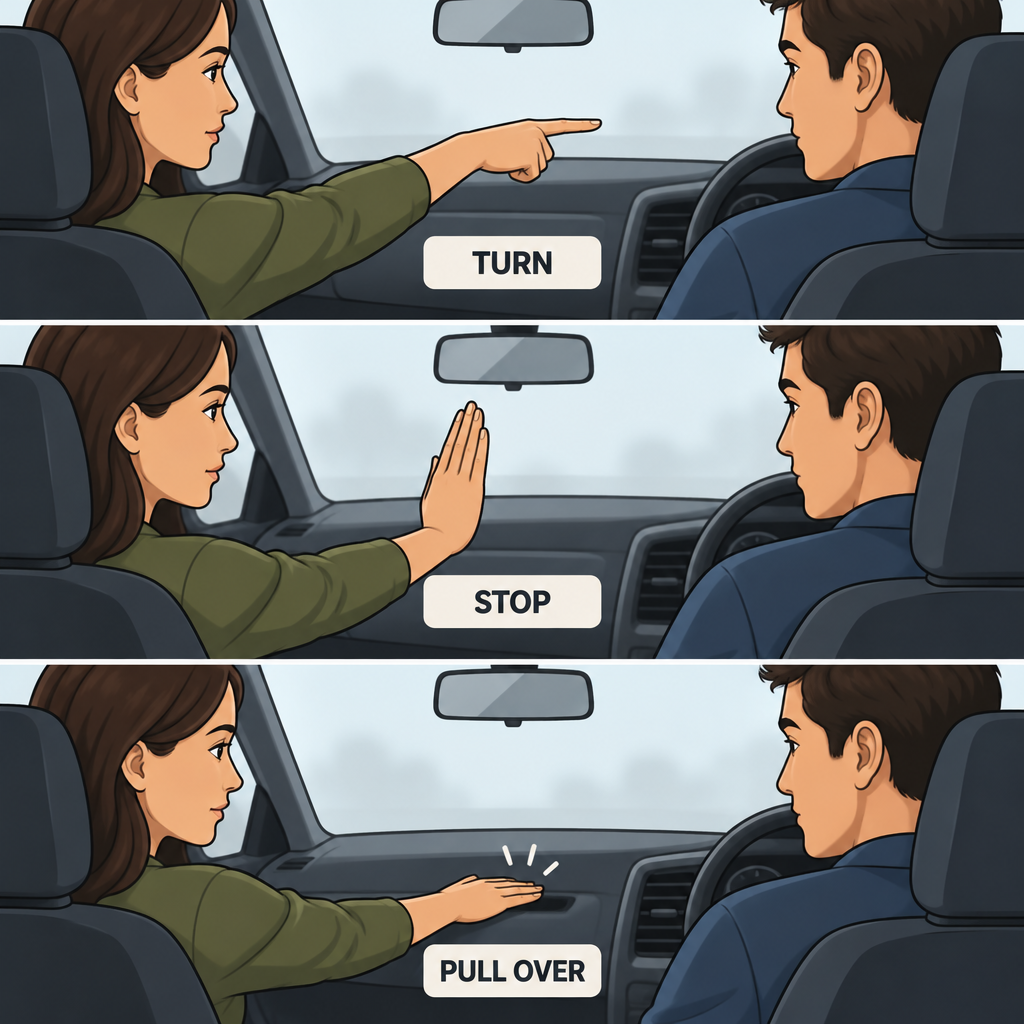
- Road test: The examiner gives spoken directions in most cases. Here you can ask for an accommodation.
DMVs are state agencies, so they fall under Title II of the Americans with Disabilities Act. That means they must provide effective communication. In practice, you can request an ASL interpreter for the road test or classroom portions, or ask the examiner to use written cards or agreed hand signals for turns and stops. Our article on the disability rights act explains who the ADA covers and how Title II works.
Ask for the accommodation when you book the test, not on the day. Some offices need lead time to schedule an interpreter.
Hearing tip
Before your road test, agree on simple signals with the examiner: a pointed finger for turns, a flat palm for stop, a tap on the dashboard to pull over. Agreeing in advance means fewer surprises during the drive.
Commercial licenses: where hearing standards still apply
The one big exception in the US is commercial driving. The Federal Motor Carrier Safety Administration (FMCSA) sets medical standards for interstate commercial drivers, and hearing is one of them.
Under the federal rule, a commercial driver must either perceive a forced whispered voice at 5 feet or more in the better ear, or have an average hearing loss no greater than 40 dB at 500, 1,000 and 2,000 Hz in the better ear. Hearing aids can be worn during the test. Many hard of hearing drivers pass this way.
Drivers who cannot meet the standard are not automatically shut out. In 2013, after advocacy led by the NAD, FMCSA granted its first hearing exemptions to deaf drivers, and the program has continued since. An exemption allows a deaf driver to operate a commercial vehicle in interstate commerce if they meet every other qualification. Exemptions must be renewed, so check FMCSA’s current requirements before you apply.
A few points matter here:
- The federal hearing rule covers interstate commercial driving. Rules for intrastate commercial driving are set by each state and can differ.
- School bus and passenger transport jobs often carry extra state or employer requirements.
- A standard car license is never affected by the commercial hearing rule.
Deaf truck drivers work across the country today. The obstacles that remain are mostly employer attitudes and paperwork, not ability.
Driving outside the US
Most high-income countries also license deaf drivers for ordinary cars. In the UK, for example, the DVLA says you do not need to tell it about deafness if you hold a car or motorcycle license. Drivers of buses, coaches and lorries must declare it, much like the US commercial rule.
If you plan to drive abroad or move countries, check the licensing authority’s medical rules before you go. Rules for heavy vehicles vary more than rules for cars.
Do deaf drivers have more crashes?
The fear behind “are deaf people allowed to drive?” is usually about safety. The evidence does not support it. There is no solid research showing that deaf drivers crash more often than hearing drivers, and insurers and licensing agencies do not treat deafness as a risk category for regular licenses.
There are reasonable explanations for this:
- Visual attention: Lab research on deaf adults, notably work by cognitive scientist Daphne Bavelier and colleagues, has found that deaf people who use sign language often show stronger attention to their peripheral vision. That is useful for spotting a car drifting into your lane or a cyclist at the edge of your view.
- Compensation: Swedish driving-simulator research on drivers with hearing loss found they tended to drive more cautiously and scan more. The same research suggested they were more affected when given demanding secondary tasks. That is a reminder that distraction is the real hazard.
- Fewer audio distractions: A deaf driver is not half-listening to a podcast or an argument on speakerphone.
Distraction is the common thread. A deaf driver reading a text is as dangerous as a hearing driver reading one. Hearing status does not change that.
Why driving depends on sight far more than sound
Think about what sound actually tells a hearing driver. Horns, sirens, a train crossing bell, an engine noise that signals a problem, or a passenger’s warning shout. That is a short list, and every item on it has a visual backup.
| Sound cue | Visual or physical backup |
|---|---|
| Emergency siren | Flashing lights, traffic pulling over, mirror checks |
| Car horn | Driver behavior around you, mirror scanning |
| Railroad crossing bell | Flashing signals, gates, crossbuck signs |
| Turn signal clicking | Dashboard indicator arrow |
| Engine or brake trouble | Warning lights, gauges, vibration, smell |
| Tire going flat | Tire pressure warning light, pull to one side |
Hearing drivers also miss sounds all the time. Modern cabins are well insulated, and many people drive with music up and windows closed. A siren often reaches a hearing driver late. Sometimes it is only noticed after the lights appear in the mirror. That is the same moment a deaf driver notices it.
How to drive safely as a deaf driver
Most deaf drivers build these habits early, often without thinking about them. If you have lost hearing as an adult, these are the adjustments worth making on purpose.
Scan your mirrors more often
Check your rearview and side mirrors every few seconds, especially on highways and in city traffic. Some drivers add a wide-angle or panoramic rearview mirror that clips over the factory one. It gives you a broader view of the lanes behind you and makes approaching flashing lights obvious sooner.
Watch other drivers for emergency vehicles
When cars ahead start slowing and moving right for no visible reason, assume an emergency vehicle is coming. Check all mirrors, slow down and pull over safely. Watching the traffic around you works as well as sound, and it often works better.
Use your car’s safety features
Driver-assistance features help every driver, and several are especially useful if you cannot hear:
- Blind-spot monitoring: A light in or near the side mirror flags a car you might not see.
- Lane departure and lane-keeping alerts: Many systems can vibrate the steering wheel instead of beeping.
- Haptic seat alerts: Some General Motors vehicles offer a Safety Alert Seat that vibrates the left or right side of the seat cushion to signal where a hazard is.
- Rear cross-traffic alerts: These are useful when backing out of parking spaces, where you would otherwise listen for approaching cars.
- Tire pressure monitoring: This catches a slow leak you cannot hear.
When you shop for a car, ask whether alerts can be set to vibration or visual only. Many cars let you switch alert style in the settings menu. The test drive is the time to check.
Make dashboard checks routine
Get in the habit of glancing at the instrument cluster: turn signal arrows, warning lights, temperature and fuel. A turn signal left blinking is a classic giveaway for any driver. The arrow on the dash is your cue to cancel it.
Set up phone sound alerts as a backup
Both iPhone and Android can listen for certain sounds and flash or vibrate an alert. These features are a backup, not a replacement for watching the road. They can miss sounds in a noisy cabin, and you should never look at the phone while moving.
Turn on siren alerts on your phone
- iPhone: open Settings, then Accessibility, then Sound Recognition.
- Turn on Sound Recognition, tap Sounds, then turn on Siren.
- Android: open Settings, then Accessibility, then Sound Notifications (names vary by brand).
- Turn it on and allow it to listen for alarms and sirens.
- Mount the phone in a dashboard holder so a flash is visible without picking it up.
Sign with passengers carefully
For ASL users, conversation in the car is visual, which pulls the driver’s eyes off the road. Many deaf drivers handle this by letting passengers sign while the driver keeps their eyes forward and answers briefly at red lights. Longer conversations wait until you park. Front-seat passengers can also act as a second set of eyes and tap your arm when they spot an emergency vehicle.
Wear your hearing aids if you use them
If you are hard of hearing and use hearing aids, wear them while driving. They can help with sirens and horns, and many Bluetooth models stream navigation prompts straight to your ears. Some hearing aids offer a car or noise program that cuts down road rumble. Ask your audiologist to set one up if road noise drowns everything out.
Headphones vs hearing loss: why the law treats them differently
A common question on forums is why it is illegal to drive with headphones when deaf people can drive. California’s Vehicle Code, for example, bans wearing a headset or earplugs in both ears while driving, with an exception for hearing aids. Several other states have similar rules.
The difference comes down to distraction and adaptation, not the volume of sound reaching your ears.
- Headphones add a distraction. Music, podcasts and calls compete for attention, and the driver chose that distraction.
- Headphones disrupt a driver who relies on sound. A hearing driver has built habits around hearing horns and sirens. Suddenly blocking them removes a cue the driver expects, and the driver has not built visual habits to replace it.
- Deaf drivers have adapted. They have built their scanning habits around vision from the start. Nothing is suddenly missing.
Hearing aids are exempt for the same reason. They restore sound rather than block it.
Know your rights at a traffic stop
Police stops are the part of driving that worries deaf drivers most, and for good reason. Officers give spoken commands, and a driver who does not respond can be misread as uncooperative. A few steps lower that risk.
Before a stop happens:
- Ask your state DMV about deaf or hard of hearing notations. Some states offer a voluntary flag on your license or vehicle record that an officer sees when running your plate. Others hand out visor communication cards.
- Keep a visor card or printed card that says you are deaf and how you communicate. Many state commissions for the deaf and hard of hearing distribute these.
- Keep a pen and notepad within easy view, not in the glove box.
During a stop:
- Pull over safely, turn off the engine, and turn on the dome light if it is dark.
- Keep both hands on the steering wheel where they are visible.
- Do not reach for your phone, wallet or glove box until the officer understands you are deaf.
- When the officer approaches, point to your ear and shake your head, or hold up your visor card.
- Ask to communicate in writing, or by typing on a phone once the officer agrees.
Under the ADA, police departments must communicate effectively with deaf people. For a simple traffic stop, writing notes is often enough. For an arrest or questioning about a serious matter, you can request a qualified ASL interpreter. If an officer refused reasonable communication, write down the date, location and badge number afterward and contact a disability rights organization.
Breakdowns and emergencies on the road
Plan how you will get help before you need it. Phone calls are the default for roadside assistance and emergencies, so line up text-based options.
- Text-to-911: This works in many areas of the US, but not all of them. If it is not available, you will get a bounce-back message telling you to use another method. Check your area’s coverage in advance.
- Real-time text (RTT): Many phones support RTT calls to 911, which send each character as you type.
- Relay services: You can reach roadside assistance through a telecommunications relay service, including video relay in ASL.
- Roadside apps: Most insurers and auto clubs let you request a tow through their app, with no voice call needed.
Keep a written card in the glove box with your insurance details, your auto club number and a note explaining you are deaf. If a tow driver or bystander arrives, you can hand it over.
When hearing changes affect your driving
Stable deafness is not a driving problem. Some hearing-related conditions do affect safety, though, mostly through balance and dizziness rather than hearing itself.
Conditions such as Ménière’s disease and other inner ear disorders can cause sudden vertigo. A vertigo attack at the wheel is dangerous. If you have episodes of spinning dizziness, talk to your doctor about whether and when it is safe to drive.
See a professional
Sudden hearing loss in one or both ears is a medical emergency. See a doctor or go to urgent care within a day or two, and do not drive if you also have vertigo or severe dizziness.
If your hearing has been fading slowly, a hearing test with an audiologist is worth booking. Treating hearing loss will not change your license status. It can make driving less tiring and help you notice sirens and horns sooner.
Key takeaways
- Deaf people can drive legally in every US state, and no hearing test is required for a standard car license.
- DMVs must offer communication accommodations such as ASL interpreters for road tests under the ADA.
- Commercial drivers face a federal hearing standard, but FMCSA has granted exemptions to deaf drivers since 2013.
- Research does not show deaf drivers are less safe. Distraction is the real risk for everyone.
- Mirror scanning, haptic car alerts and phone sound alerts cover most of what hearing provides.
- At a traffic stop, keep your hands visible, show a visor card and ask to communicate in writing.
FAQ
Can 100% deaf people drive?
Yes. A person with no measurable hearing can get a regular driver’s license in every US state. Licensing depends on vision, knowledge of traffic laws and road skills, not hearing.
Can you drive if you are totally deaf?
You can. Total deafness does not disqualify you from a car license in the US or the UK. The only hearing standards apply to commercial driving, and even there US federal exemptions exist for deaf drivers.
Can you drive if you are deaf in the US?
Yes, in all 50 states. You take the same written, vision and road tests as any other applicant, and you can request an ASL interpreter or written instructions for the road test.
Why is it illegal to drive with headphones but deaf people can drive?
Headphone bans target distraction and the sudden loss of cues that hearing drivers depend on. Deaf drivers have built their driving habits around vision and are not choosing to add an audio distraction. Hearing aids are specifically exempt in states like California.
Can hearing impaired people drive with hearing aids?
Yes, and wearing them is a good idea if you use them every day. Hearing aids are allowed under state headphone laws. Bluetooth models can also stream navigation directions.
Do I have to tell the DMV I am deaf?
Not for a regular US car license. Some states let you add a voluntary notation so police know before approaching your car. Commercial drivers must disclose hearing loss during the DOT medical exam.