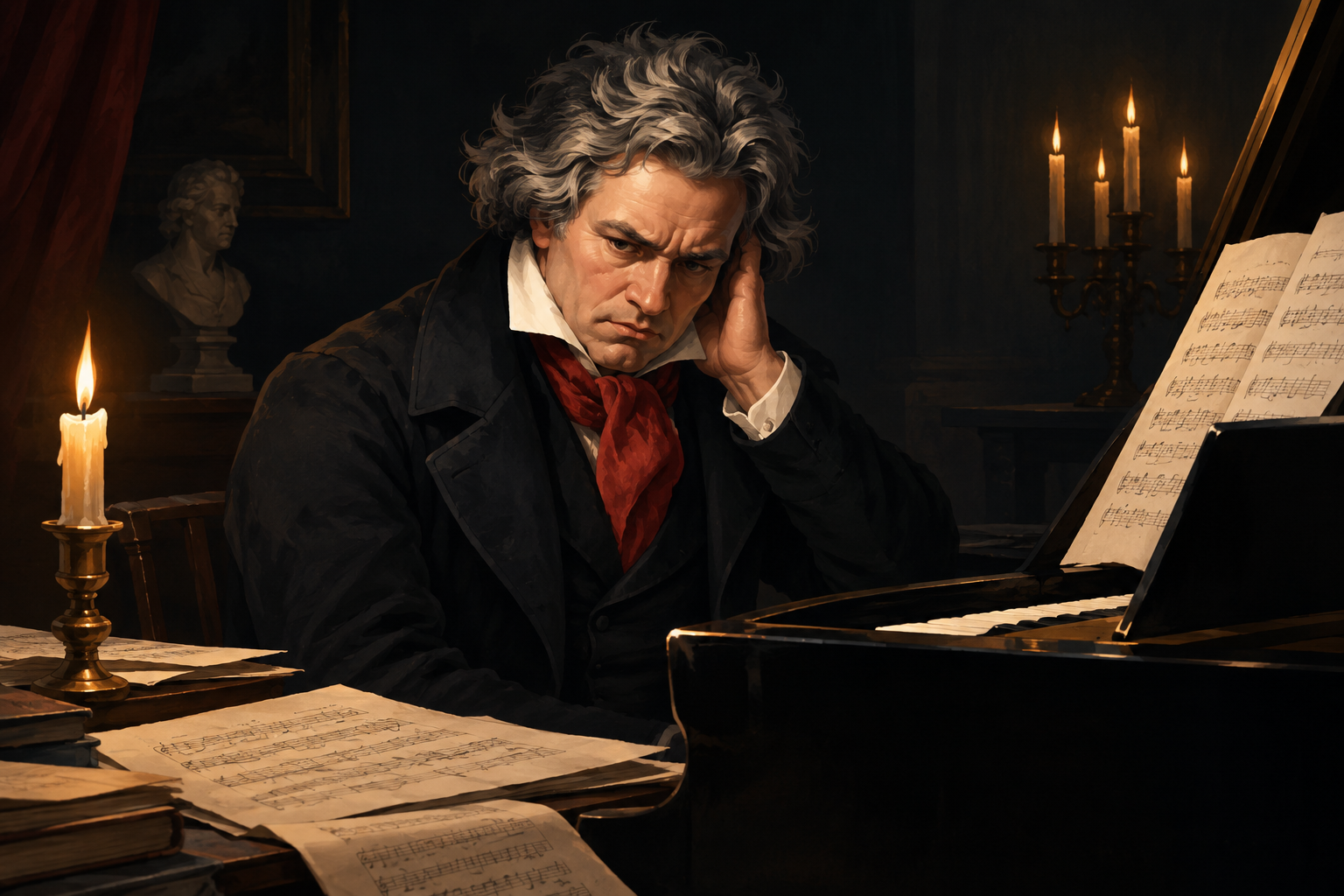
Yes, Beethoven was deaf. His hearing began to fail in his late twenties, around 1798, and by about 1818 he could no longer follow conversation at all. He wrote some of his greatest music, including the Ninth Symphony, after he had lost almost all of his hearing.
When Beethoven Started Going Deaf
Ludwig van Beethoven was born in Bonn in December 1770 and moved to Vienna in 1792 to make his name as a pianist. A few years later, while still in his twenties, he noticed that something was wrong with his ears.
He kept it secret for several years. A deaf composer sounds like a contradiction, and a deaf piano virtuoso would have lost his income. He finally confessed in letters to two close friends in 1801: the physician Franz Wegeler and the violinist Karl Amenda.
The letter to Wegeler gives a clear picture of the symptoms. Beethoven described a constant humming and buzzing in his ears, which we would now call tinnitus. He could not hear the high notes of instruments or voices from a distance in the theater. Speech reached him as sound, but he couldn’t make out the words. He also found loud noise painful. If someone shouted, he said, he could not bear it.
Audiologists recognize that pattern today. When you lose sensitivity to soft sounds, loud sounds can still feel uncomfortably loud. The ear has a narrower comfortable range.
The Heiligenstadt Testament
In October 1802, on the advice of his doctor, Beethoven spent months in Heiligenstadt, then a quiet village outside Vienna. There he wrote a long letter to his brothers Carl and Johann. It was never sent. It was found among his papers after his death and is now called the Heiligenstadt Testament.
It is a painful document. Beethoven describes pulling away from company because he could not bear people noticing that he could not hear. He describes standing beside a companion who heard a distant flute or a shepherd singing when he heard nothing. He admits he came close to ending his life. Only his art held him back, he wrote. He could not leave the world until he had brought out everything he felt was in him.
He went back to Vienna and into the most productive stretch of his life. The “heroic” middle period followed, including the Third Symphony (Eroica), the Fifth, the Violin Concerto and the opera Fidelio.
How His Hearing Got Worse Over Time
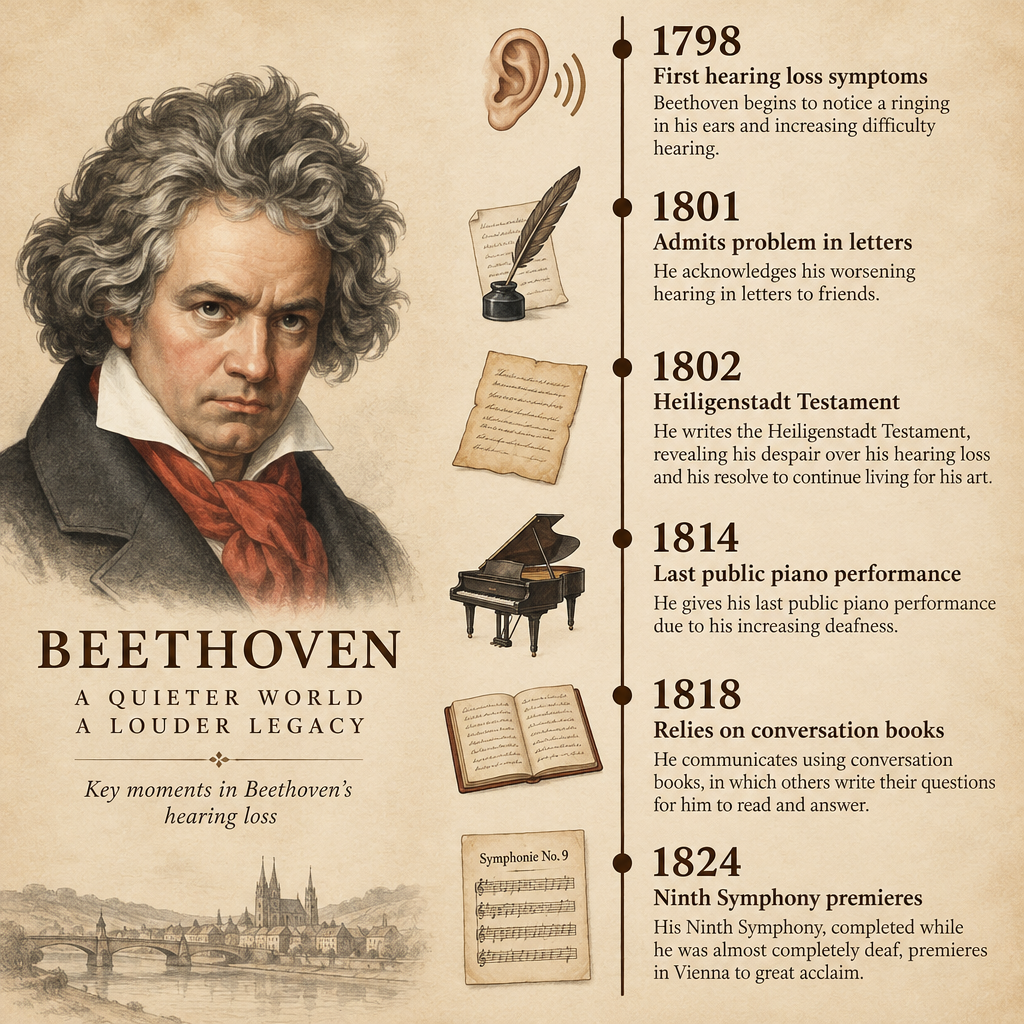
Beethoven’s deafness came on gradually over about 20 years.
| Year | Age (approx.) | What happened |
|---|---|---|
| c. 1798 | 27 | First signs of hearing loss and tinnitus |
| 1801 | 30 | Admits the problem in letters to Wegeler and Amenda |
| 1802 | 31 | Writes the Heiligenstadt Testament |
| c. 1813–1814 | 42–43 | Uses ear trumpets made by Johann Nepomuk Mälzel |
| 1814 | 43 | Struggles in one of his last public piano performances |
| 1818 | 47 | Begins relying on written conversation books |
| 1824 | 53 | Ninth Symphony premieres in Vienna |
| 1827 | 56 | Dies in Vienna in March |
Performing went first. The composer Louis Spohr heard him rehearse the “Archduke” Trio in 1814. He wrote that the playing was harsh and uneven, too loud in some places and inaudible in others. After that, Beethoven largely stopped appearing as a pianist. Conducting lasted a little longer, but it also became impossible.
How Beethoven Kept Composing
You don’t need working ears to write music down. Beethoven had trained since childhood, and he could hear a score in his head the way a skilled reader hears a sentence without saying it aloud. Musicians call this inner hearing. He had decades of sound stored in memory, and he could imagine how a chord or orchestral color would sound before anyone played it.
He also used every tool available to him:
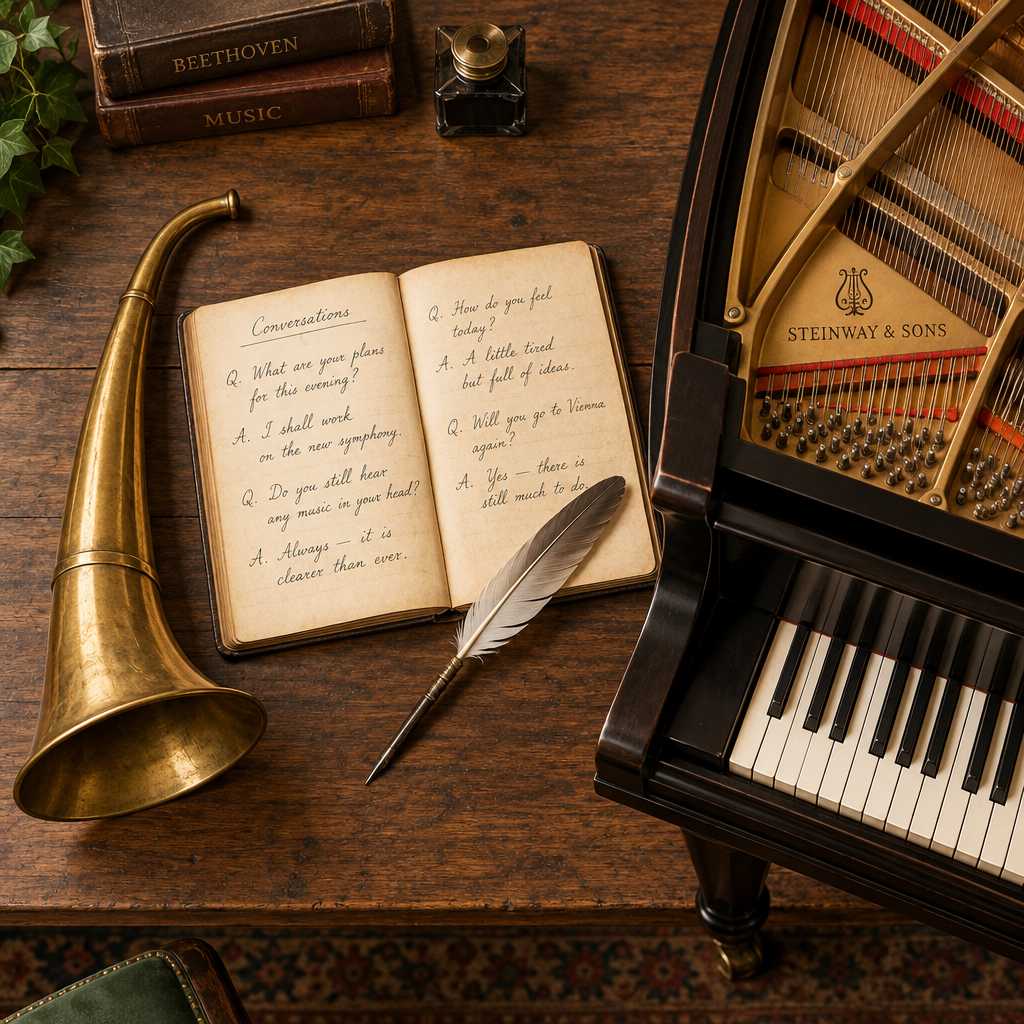
- Ear trumpets. Mälzel, the inventor best known for the metronome, built him several brass ear trumpets. A few survive at the Beethoven-Haus museum in Bonn. They helped for a while, then stopped being enough.
- Louder pianos. In 1818 the London maker Broadwood sent him a piano, and the Viennese builder Conrad Graf later lent him an instrument with four strings per note for extra volume. A sound-reflecting cover is said to have been fitted over it.
- Vibration. A story often told about Beethoven says he held a rod between his teeth and pressed it against the piano to feel the sound through his jawbone. That is bone conduction, the same principle used in some modern headphones and hearing devices. The story is plausible but secondhand, so treat the details with caution.
- Conversation books. From around 1818, visitors wrote their side of the conversation in notebooks, and Beethoven usually answered aloud. Over a hundred of these books survive. They are a remarkable record of daily life, although his secretary Anton Schindler later destroyed some and added fake entries to others.
The conversation books were an early version of something many deaf and hard of hearing people use today. Live closed captioning and text relay services such as telecommunications relay service do the same job of turning speech into something you can read.
Did Deafness Change His Music?
It did, and researchers have tried to measure it. A 2011 study in the BMJ analyzed the notes in Beethoven’s string quartets across his career. As his hearing worsened in his middle years, he used fewer high notes, which were the frequencies he had the most trouble hearing. In the late quartets, written when he was almost completely deaf, the high notes came back. The authors suggested that once he could no longer hear anything, he relied entirely on his inner ear and stopped writing around his damaged hearing.
The late works are often described as the most inward and experimental music he wrote. They include the Hammerklavier Sonata, the Missa Solemnis, the Ninth Symphony and the late string quartets, including the Grosse Fuge. You can argue about cause and effect, but isolation from the sounding world clearly didn’t make his music simpler.
The Ninth Symphony Premiere
The Ninth Symphony premiered at Vienna’s Kärntnertortheater on May 7, 1824. Beethoven stood on stage beside the official conductor, Michael Umlauf, and indicated the tempos. The musicians had reportedly been told to follow Umlauf.
The most famous story from that night comes at the end. Beethoven was still facing the orchestra, out of step with the music or simply unaware it had finished. The contralto soloist Caroline Unger turned him around so he could see the audience applauding. Many accounts say people waved hats and handkerchiefs so he could see the ovation he couldn’t hear.
The “Ode to Joy” finale, a setting of Friedrich Schiller’s poem, became one of the most recognized pieces of music in the world. Beethoven never heard it performed.
What Caused Beethoven’s Deafness?
Nobody knows for sure. Theories have included otosclerosis (abnormal bone growth in the middle ear), Paget’s disease of bone, typhus, autoimmune disease, syphilis and lead poisoning. The autopsy in 1827 recorded shrunken auditory nerves and a badly damaged liver. That fits nerve-related hearing loss but doesn’t identify a cause.
DNA testing has added real evidence. A 2023 study in Current Biology sequenced authenticated locks of his hair. It found a genetic risk for liver disease and signs of hepatitis B infection, but no clear genetic cause for his deafness. The same team showed that one famous lock, long used to support the lead theory, actually came from a woman.
A 2024 follow-up in Clinical Chemistry tested other authenticated locks and found lead at dozens of times the normal level. The researchers said lead exposure could have contributed to his hearing loss and other illnesses. Possible sources included wine sweetened with lead compounds and lead-glazed tableware. They did not claim lead alone explains everything. The honest answer remains that his deafness probably had more than one cause.
Other Deaf Musicians After Beethoven
Beethoven is the most famous deaf composer, but he isn’t the only musician to keep working with hearing loss.
- Bedřich Smetana lost his hearing at 50. In his String Quartet No. 1, “From My Life,” a long, high-pitched violin note depicts the tinnitus that came before his deafness.
- Gabriel Fauré struggled with hearing loss and distorted pitch in his final decades and kept composing.
- Evelyn Glennie, the Scottish percussionist, has been profoundly deaf since childhood and plays barefoot to feel vibrations through the floor.
- Mandy Harvey, an American singer who lost her hearing at 18, also performs barefoot to sense pitch and rhythm. She reached the finals of America’s Got Talent in 2017.
Hearing tip
If you play or listen to loud music regularly, musicians’ earplugs such as Loop earplugs reduce volume without muffling sound the way foam plugs do.
What Beethoven’s Symptoms Would Mean Today
Beethoven’s early complaints were ringing in the ears, trouble hearing high pitches, and speech that sounded loud but unclear. Many people describe the same thing to an audiologist today. The difference is that you now have options he never had: a proper hearing test, prescription and over-the-counter hearing aids, cochlear implants for severe loss, and captioning on almost every screen.
See a professional
If your hearing drops suddenly in one or both ears, treat it as an emergency and get medical care the same day. Ongoing tinnitus or gradually muffled hearing deserves a visit to an audiologist or doctor.
FAQ
At what age did Beethoven go deaf?
His symptoms began around age 27, in about 1798. His hearing declined over roughly 20 years, and he was essentially deaf by his late forties.
Was Beethoven completely deaf when he wrote the Ninth Symphony?
He was profoundly deaf by then. He composed the Ninth mainly between 1822 and 1824, relying on inner hearing and decades of musical training.
Could Beethoven hear anything at the end of his life?
Accounts suggest he could still sense some very loud sounds and vibrations, but he could not follow speech or music. That is why visitors wrote in his conversation books.
Did Beethoven use sign language?
No. Beethoven relied on written notes, lip reading and his own speech, which he kept throughout his life.
Is Beethoven the only famous deaf composer?
No. Bedřich Smetana and Gabriel Fauré also composed with serious hearing loss, and performers such as Evelyn Glennie and Mandy Harvey work as deaf musicians today.