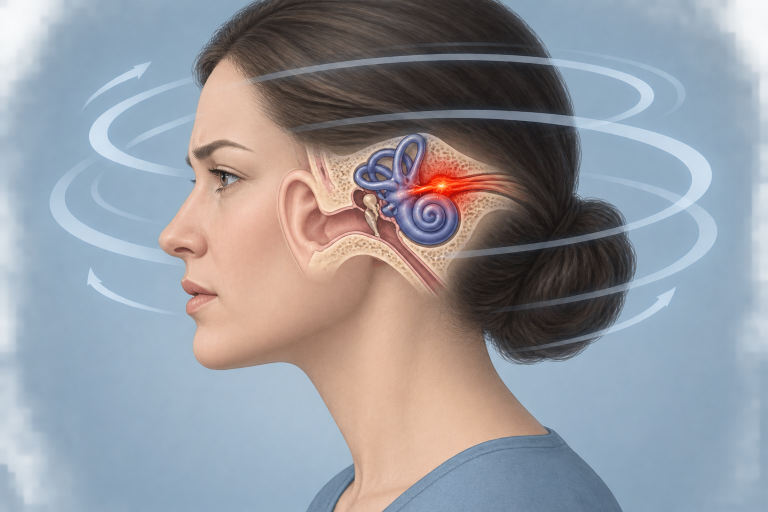
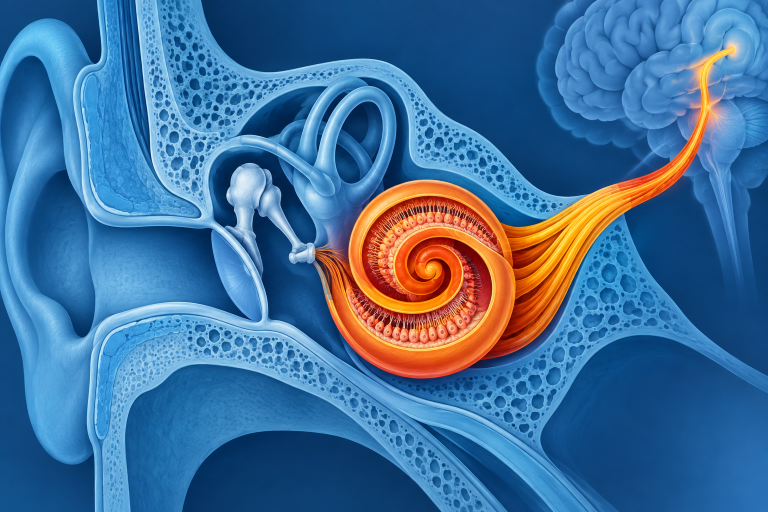
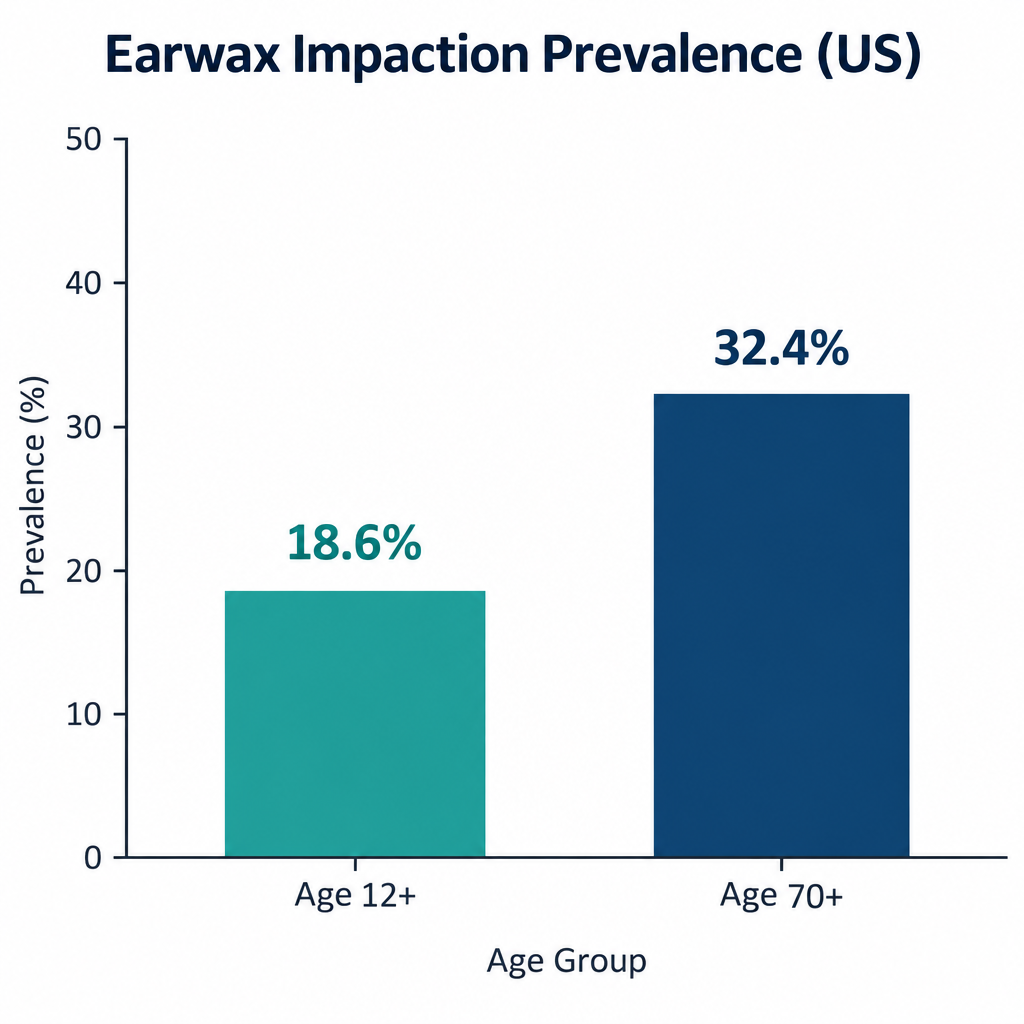
Nearly one in five Americans aged 12 and older has impacted earwax. Among people 70 and older, it is almost one in three. That makes earwax one of the most common causes of hearing loss that can be reversed. For most people, safe earwax removal means a few days of softening drops, then a gentle rinse if your eardrum is intact, or a quick professional clean if it is not.
Worth remembering
- Ears clean themselves. Treat wax only when it causes symptoms or blocks an ear exam.
- Soften wax with drops (oil, sodium bicarbonate, carbamide peroxide, even water) before you rinse or book removal.
- Skip home removal if you have a perforated eardrum, ear tubes, past ear surgery, diabetes, an infection or ear pain.
- In the US, primary care, retail clinics, urgent care, audiologists and ENTs all remove wax. Microsuction usually means an audiologist or an ENT.
- Hearing aid and earbud users get impacted wax more often. Check for wax before you blame your hearing or buy an OTC hearing aid.
Fact-checked
We checked these key facts against the sources named, on November 23, 2026:
- Most people only need drops for 3 to 5 days (source: pmc.ncbi.nlm.nih.gov)
- Going straight to microsuction would cost $100 to $300 on its own (source: health.costhelper.com)
- Microsuction at an audiology or ENT office runs about $100 to $300 a session (source: health.costhelper.com)
- In the US, expect about $40 to $110 without insurance at a primary care office (source: biologyinsights.com)
- That is higher than the 10% to 12% estimated from the earlier 1999 to 2002 NHANES cycle (source: pubmed.ncbi.nlm.nih.gov)
Earwax removal: the 30-second answer
Most ears never need cleaning. If yours feels blocked, use softening drops twice a day for 3 to 5 days. Then rinse gently with body-temperature water from a bulb syringe, but only if you know your eardrum is intact. If that doesn’t work, or you have pain, bleeding, discharge, dizziness or sudden hearing loss, see a clinician for irrigation, curette removal or microsuction.
The guidelines behind this advice
Two clinical guidelines set the standard, and they agree on the basics. In the US, the reference is the Clinical Practice Guideline (Update): Earwax (Cerumen Impaction) from the American Academy of Otolaryngology-Head and Neck Surgery Foundation (AAO-HNSF). It was published in January 2017 as a supplement to the journal Otolaryngology-Head and Neck Surgery, replaced the 2008 version and covers patients older than 6 months. It is still the current version in November 2026, and the American Academy of Pediatrics endorses it. The American Academy of Family Physicians (AAFP) published a plain summary of it in American Family Physician in August 2017.
In the UK, the National Institute for Health and Care Excellence (NICE) covers wax removal in guideline NG98, Hearing loss in adults: assessment and management, published on 21 June 2018 and updated on 2 October 2023.
The shared message is simple. Soften the wax, remove it only when it causes problems, and never use candles or swabs.
Do you actually have impacted earwax?
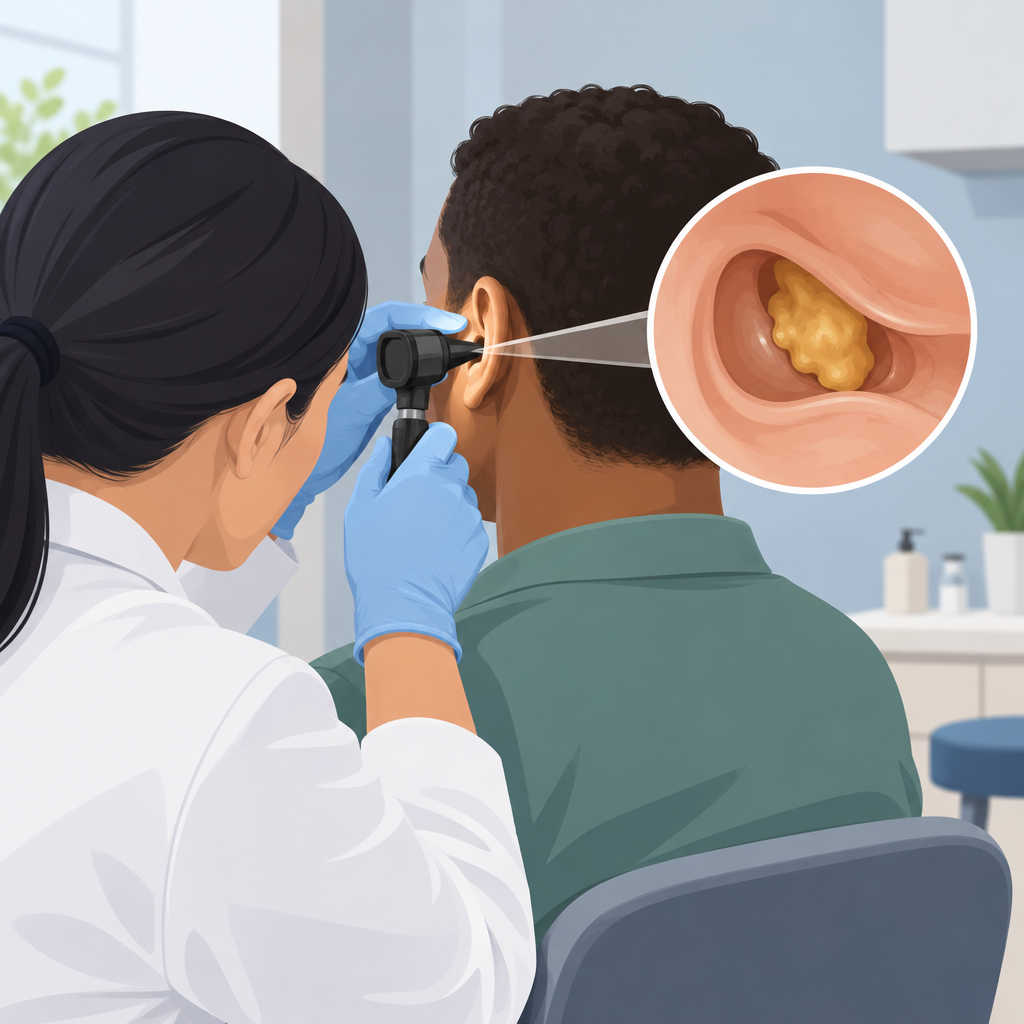
Wax counts as “impacted” when a clinician can see it with an otoscope and it either causes symptoms or blocks a needed look at your ear. That is the AAO-HNSF definition, as summarised by the AAFP. Having some wax in your ear is not a problem.
Earwax (cerumen) is made in the outer third of the ear canal. It traps dust, keeps the skin moist and helps protect against infection. The canal skin grows slowly outward, a bit like a conveyor belt. Jaw movement from talking and chewing helps carry old wax to the opening, where it dries and falls out.
Impaction happens when that conveyor belt is blocked or overloaded. Swabs push wax back in. Hearing aids and earplugs block the exit. Some people simply make more wax, or have narrow or hairy canals.
Symptoms of a wax blockage
A blockage usually builds slowly but seems to arrive all at once, often after a shower or a swim, when the wax swells.
Common signs include:
- Muffled or reduced hearing in one or both ears
- A full or plugged feeling
- Ringing or buzzing (tinnitus)
- Itching inside the canal
- Earache or discomfort
- Dizziness or a sense of imbalance
- A dry cough, triggered by a nerve in the ear canal
- In hearing aid users, whistling (feedback) or a sudden drop in volume
These symptoms overlap with infections, fluid behind the eardrum and inner ear problems. That’s why the guideline tells clinicians to confirm the wax has cleared after treatment, and to look for another cause if symptoms continue.
Who gets impaction most
Impaction happens at every age, but older adults, hearing aid wearers and people in care homes get it far more often.
The largest recent estimate comes from Tolan and colleagues, who analysed National Health and Nutrition Examination Survey (NHANES) data from 2005 to 2016 for 14,230 people. Their study, published in Laryngoscope Investigative Otolaryngology in April 2024, found impaction in 18.6% of US people aged 12 and older and 32.4% of those aged 70 and older. That is higher than the 10% to 12% estimated from the earlier 1999 to 2002 NHANES cycle. Separately, the otolaryngology association has estimated that about 12 million people a year see health workers for excess earwax, and about 8 million of them need it removed.
| Group | Why risk is higher | What the sources report |
|---|---|---|
| Adults 70 and older | Wax gets drier and canal hairs coarser with age | 32.4% have impaction (NHANES 2005 to 2016, published 2024) |
| Nursing home residents | Many can’t report symptoms, and checks get missed | Up to two-thirds may have impaction (2017 guideline, cited by KFF Health News) |
| Hearing aid wearers | Domes and molds block the natural exit | Higher risk, and guideline allows removal even without symptoms |
| Long-hours earbud or earplug users | In-canal tips act like a cork | Same mechanism as hearing aids |
| People with narrow, curved or hairy canals, or habitual swab users | Wax can’t travel out, or gets pushed back | Recognised risk factors in the guideline |
| People with intellectual disabilities | Symptoms may go unreported | Rates up to three times higher in children with significant cognitive disabilities (AAO-HNS) |
| Young children | Small canals, can’t describe symptoms | Covered in their own section below |
Did you know?
According to the 2024 NHANES analysis in Laryngoscope Investigative Otolaryngology, almost one in three Americans aged 70 and older has earwax impaction. A clinician can usually clear it in a single visit.
Earwax and hearing loss: check for wax first
Impacted wax causes conductive hearing loss: sound can’t reach the eardrum properly. Once the wax is cleared, hearing usually returns to the person’s normal level.
That matters if you, or a parent, have noticed hearing getting worse. Ask a clinician to look in your ears before you assume it’s age-related loss, before a hearing test, and before buying hearing aids.
If hearing is still reduced once the canal is clear, the cause lies deeper. Sensorineural hearing loss, for example, involves the inner ear or hearing nerve and needs an audiologist’s assessment.
Earwax in children
Children make wax for the same protective reasons adults do, and most need no cleaning beyond washing the outer ear at bath time. Summaries of the AAO-HNSF guideline put excess or impacted wax at about 1 in 10 children. A pediatric ENT bulletin from the AAO-HNS reports rates up to three times higher in children with significant cognitive disabilities.
Signs to watch for differ by age. Older children can tell you their ear feels plugged, itchy or sore, or that sounds are muffled. Infants and toddlers can’t, so ear tugging, rubbing or poor response to sound may be the only clues. The AAFP summary notes that young children are at higher risk of impaction and often can’t report symptoms, so clinicians should check for wax when they examine them.
What parents should and shouldn’t do:
- No swabs, fingers or tools in the canal. The Nationwide Children’s data below show swabs send about 34 US children a day to emergency departments, and children under 4 have the highest injury rate.
- No ear candles or “home remedies”. Nemours KidsHealth advises against them, and candling has not been shown to be safe or effective.
- Ask the pediatrician before using drops. This is essential if your child has ear tubes, a past perforation, ear pain, discharge or fever, and for children who won’t keep still. If the pediatrician agrees, a short course of a softening drop is a reasonable first step for an older child with symptoms and healthy ears.
- Don’t irrigate a child’s ear at home unless a clinician has told you to and shown you how.
At the visit, the clinician looks in with an otoscope and, if wax is the problem, removes it by scooping with a curette, lifting it with fine instruments, suctioning it, or flushing with warm water. A parent may need to hold a young child still. Very hard or deep wax sometimes needs drops at home first and a second visit. A child who can’t tolerate removal, or whose ears need it often, may be referred to a pediatric ENT.
Stop: when you should NOT remove earwax at home
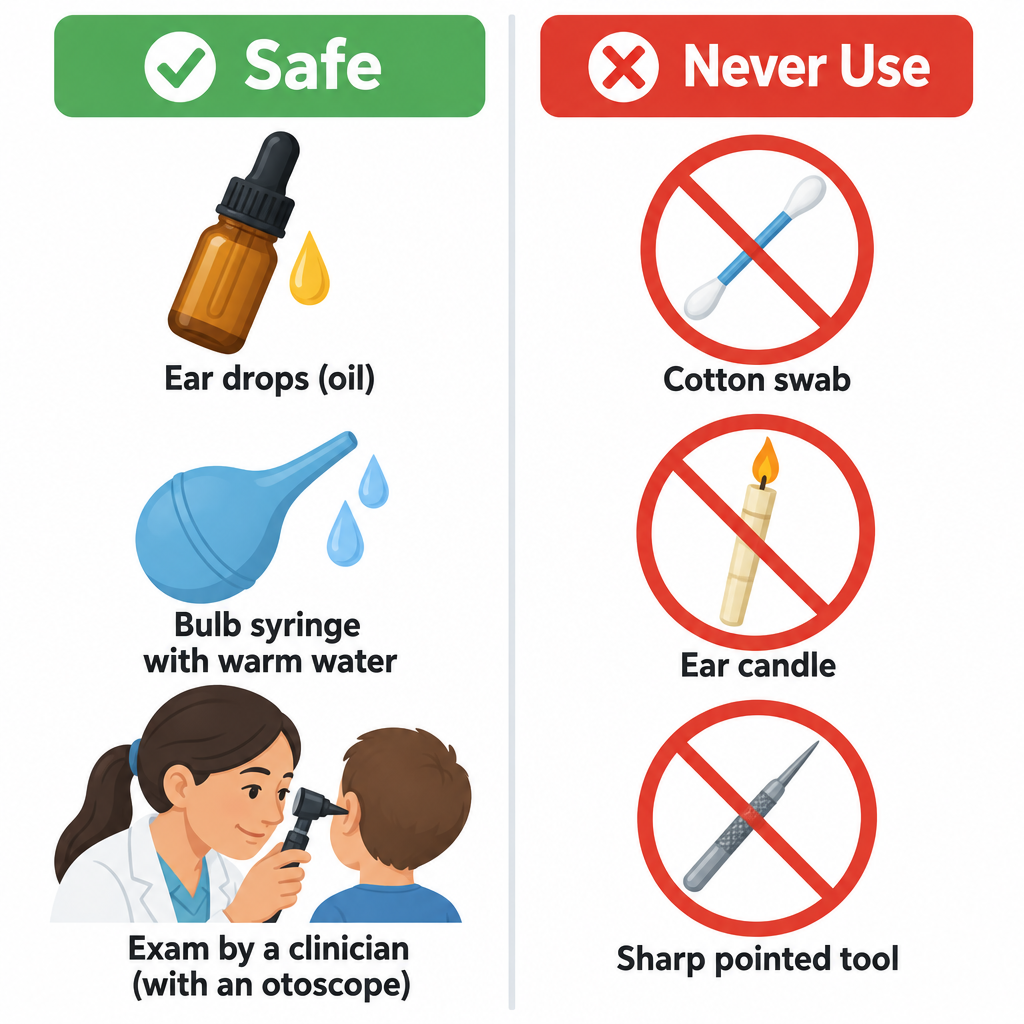
Don’t use drops or irrigation if you have a perforated eardrum, ear tubes, past ear surgery, an active infection, ear pain, bleeding or sudden hearing loss. The same applies to diabetes or a weakened immune system. In all these cases, a clinician should look first. NICE NG98 specifically advises against irrigation for anyone with current ear problems such as a perforation, an ear infection or ear dermatitis.
| Symptom or history | Why it matters | What to do |
|---|---|---|
| Sudden hearing loss (hours to a few days) | Can be sudden sensorineural loss, which needs treatment quickly | Seek same-day care. Treat it as an emergency |
| Perforated eardrum, now or in the past | Liquid can enter the middle ear and cause infection or dizziness | No drops or irrigation. See a clinician |
| Ear tubes (grommets) or past ear surgery | The ear’s structure has changed, so irrigation can cause harm | Professional removal only |
| Discharge, ear pain or fever | Suggests infection, such as swimmer’s ear or a middle ear infection | See a primary care clinician or urgent care |
| Blood from the ear | Possible canal injury or perforation | Stop all home methods and get checked |
| Vertigo or severe dizziness | May be an inner ear problem, not wax | Get a medical assessment |
| Diabetes or weakened immunity | Canal infections can become serious | Ask a clinician before any home removal |
| Children | Small canals are easy to injure | Ask a pediatrician first (see above) |
| Hearing in only one ear | Any injury could leave you without usable hearing | Choose professional removal |
See a professional
Sudden hearing loss in one or both ears is a medical emergency. Get same-day care. Don’t try drops or rinses and wait to see what happens.
How to remove earwax safely at home, step by step
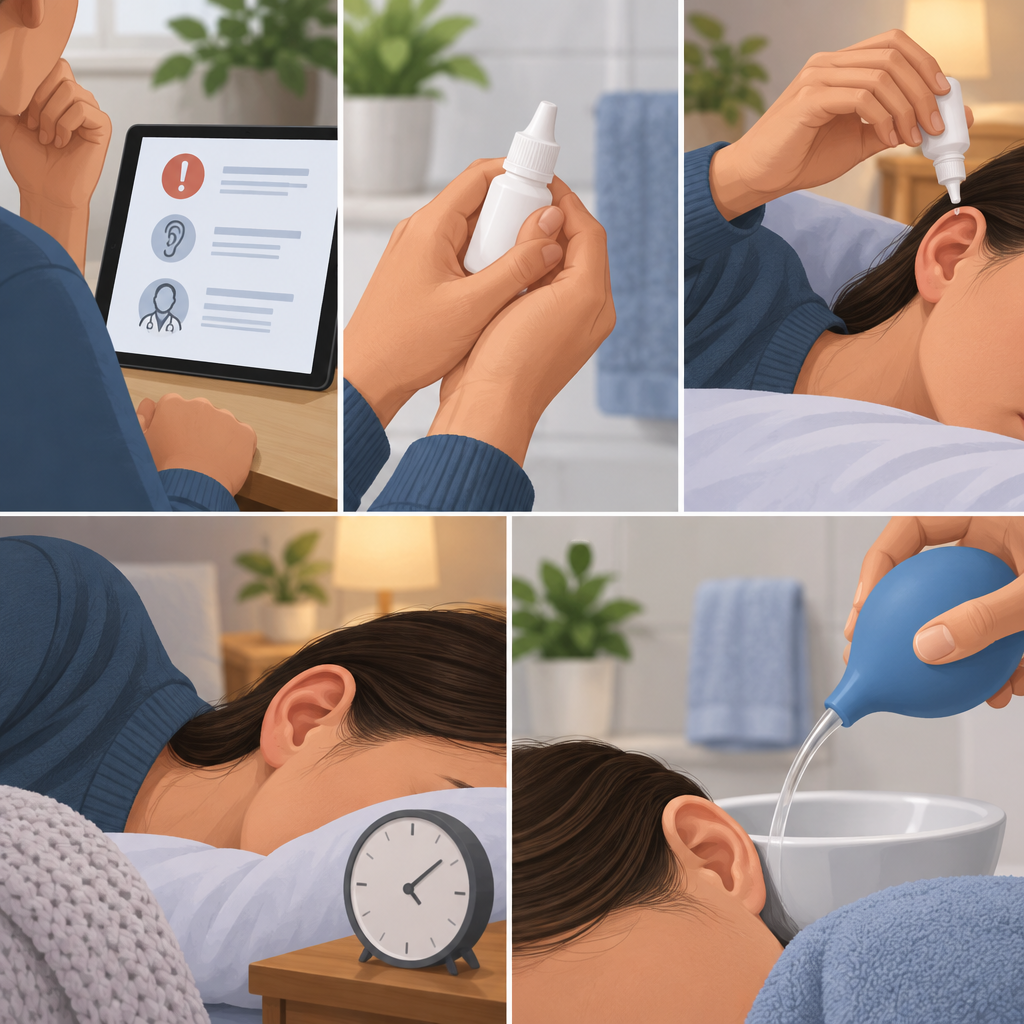
Safe home removal has two stages: soften, then rinse. Most people only need drops for 3 to 5 days. The rinse is optional and only suits people with a healthy, intact eardrum.
Setup steps
- Check the red-flag table above. If any row applies, stop and book a clinician.
- Warm the drop bottle in your hand for a few minutes so the liquid is close to body temperature.
- Lie on your side with the blocked ear facing up. Gently pull the outer ear up and back to straighten the canal.
- Put in the number of drops your product directs (usually 2 to 3 for oils, 5 to 10 for Debrox).
- Stay lying down for about 5 minutes so the drops can soak in. A cotton ball at the opening can catch any overflow.
- Repeat twice a day for 3 to 5 days, or as long as your product’s label allows.
- If needed, rinse once with body-temperature water from a bulb syringe (steps below).
- If you still feel blocked after a full course, book professional removal instead of starting another course.
Softening drops compared
The AAO-HNSF guideline found no clear evidence that any one type of drop works better than another. It also counts plain water or saline as a valid softener. Choose whatever is gentle on your skin and easy for you to use.
| Drop type | Example | How often / how many days | Notes |
|---|---|---|---|
| Olive or almond oil | Pharmacy olive oil ear drops | Twice daily for 3 to 5 days (NHS guidance) | Gentle. Softens and lubricates. Avoid almond oil if you have a nut allergy |
| Mineral oil | Plain mineral or baby oil | A few drops once or twice daily for several days | Cheap and bland. Works slowly |
| Sodium bicarbonate | Sodium bicarbonate ear drops (5%) | Twice daily for 3 to 5 days. May need 2 to 3 courses (NHS) | Breaks wax down. Can sting dry or sensitive canals |
| Carbamide peroxide | Debrox (6.5%) in the US, Otex in the UK | Debrox: 5 to 10 drops, twice daily, up to 4 days | Fizzes as it releases oxygen. Can irritate. Don’t use with a perforation |
| Water or saline | Warm tap water or sterile saline | Just before a rinse or a clinic visit | Counts as a softener under the AAO-HNSF guideline |
Hearing tip
Soften first, even if you plan to book microsuction. Many clinics ask you to use drops for a few days beforehand, because soft wax comes out faster and more comfortably.
Choosing an earwax removal kit
The best kit for most adults with healthy eardrums is the simplest one: softening drops plus a rubber bulb syringe. It matches the soften-then-rinse sequence in the AAO-HNSF guideline. Pricier irrigation systems add pressure and complexity. Camera and spiral kits add risk.
The four kit types below are ranked by two criteria, weighted equally: how closely each fits the guideline’s recommended methods, and the safety evidence covered later in this article. Prices are a sample of US retail listings in November 2026 and change often.
| Kit type | What’s included | Guideline fit | Who should avoid it | Approx. US price |
|---|---|---|---|---|
| Drops plus bulb syringe (for example, Debrox Earwax Removal Kit) | 0.5 fl oz of 6.5% carbamide peroxide drops and a soft rubber bulb | Best fit: softener, then gentle irrigation | Anyone in the red-flag table | About $8 to $15 |
| Drops only (Debrox drops, olive oil or sodium bicarbonate drops) | A bottle of softening drops | Good fit: softening alone often helps, then a clinic visit if needed | Perforation, ear tubes, infection | About $7 and up |
| Wash bottle or electric irrigation systems (for example, Wax-Rx Ear Wash System) | A spray bottle or powered flusher, tips and a catch basin | Irrigation is an accepted method, but stronger flow means less margin for error | Anyone in the red-flag table, plus people who get dizzy easily | About $16 to $35 |
| Camera scope and spiral tool kits | A Wi-Fi otoscope camera with scoops, spoons or twist tips | Poor fit: Harvard Health advises against home tools placed in the canal | Everyone, for removal | About $11 to $60 |
Note: the HSA store lists the Debrox kit as HSA/FSA eligible. If you have one of those accounts, check before you pay out of pocket.
Irrigating with a bulb syringe
A bulb syringe lets you flush softened wax out with a gentle stream of water. Use it only if your eardrum is intact and none of the red flags apply.
- Fill a bowl with water at body temperature. Test it on your inner wrist. It should feel neither warm nor cool.
- Squeeze the bulb and draw up the water.
- Lean over a sink with the treated ear tilted slightly down. Pull the outer ear up and back.
- Place the tip just inside the canal opening, never deep, and aim it gently at the top of the canal.
- Squeeze slowly. The water should run back out on its own.
- Repeat a few times, then tilt your head so the ear can drain. Dry the outer ear with a towel.
Stop at once if you feel pain, get dizzy or notice blood. Water that’s too cold or too hot can set off vertigo, which is why temperature matters so much.
Hearing tip
Warm both the drops and the rinse water to body temperature. Even mildly cold liquid against the eardrum can make the room spin for a minute or two.
Why your ear may feel more blocked after drops
Drops soften wax by making it swell and break apart. For a day or two, that swollen plug can fill more of the canal, so your hearing may seem worse before it improves.
This is a common reason people give up early or reach for a swab. If it happens to you, finish the course, then rinse or book removal. Don’t start digging.
Still blocked after two weeks of Debrox?
Stop and book professional removal. The Debrox label limits use to a few days for a reason, and extending a course rarely fixes what the first few days didn’t. Two weeks of twice-daily drops without relief means the plug is too hard or deep for drops alone, or that something other than wax is causing your symptoms. Suction or curette removal at an audiology or ENT office answers both questions in one visit, because the clinician can see the canal directly.
How to get rid of earwax fast (and why “fast” carries risk)
The fastest safe route is a professional appointment. Microsuction or irrigation of softened wax often takes minutes.
At home, “fast” methods mean pushing objects into the canal or rinsing hard. That is exactly how canals get scratched and eardrums get punctured. A few days of drops is slow, but it is the low-risk option.
Methods to avoid, and the evidence behind each
Cotton swabs, ear candles, hairpins and similar objects cause measurable injuries, and the evidence against them is strong. Camera-tipped scopes and spiral tools haven’t been shown to be safe for home use either.
Cotton swabs
Swabs push most wax deeper, packing it against the eardrum. They also scratch the thin skin of the canal.
Researchers at Nationwide Children’s Hospital, in a team including pediatric otolaryngologist Dr. Kris Jatana, analysed data from the National Electronic Injury Surveillance System (NEISS), which the US Consumer Product Safety Commission runs. Their study, published in The Journal of Pediatrics in May 2017, estimated that 263,000 US children under 18 were treated in emergency departments for cotton-tip applicator ear injuries from 1990 to 2010. That works out to about 12,500 a year, or 34 a day.
- 73% of injuries happened during ear cleaning.
- 77% happened while the child was using the swab alone. Parents were holding it in 16% of cases.
- 25% were perforated eardrums.
- Children aged 3 and under had the highest injury rate.
Injuries fell by more than a quarter between 2001 and 2010, but more than 12,000 children were still treated in 2010 alone. The authors’ conclusion was blunt: ear canals don’t need cleaning at home, and swabs shouldn’t be used for it. Adults get these injuries too, most often when someone bumps an arm mid-swab.
Did you know?
Nationwide Children’s Hospital found, in a 2017 Journal of Pediatrics study, that cotton swabs sent about 34 US children a day to emergency departments from 1990 to 2010. In 77% of cases, the child was using the swab without help.
Ear candles
Ear candling has no proven benefit and causes burns. The AAO-HNSF guideline tells clinicians to recommend against it.
In February 2010, the US Food and Drug Administration (FDA) warned that ear candles can cause serious injuries even when used as directed. These include burns to the face, ear canal, eardrum and middle ear, and punctured eardrums. Some people needed outpatient surgery after dripping candle wax blocked the canal. The FDA said there is no valid scientific evidence of benefit, and it sent warning letters to three large manufacturers. That 2010 warning remains the agency’s most recent consumer statement on candles. Health Canada has also warned consumers against candling.
Camera ear cleaners and “smart” scopes
Adding a camera to an ear pick doesn’t make it safe. Harvard Health Publishing advises against home earwax removal tools, including tiny cameras, scoopers and vacuums placed in the ear. It also says there’s no need to clean inside your ears unless you have a blockage.
The problem is depth and control. A phone screen gives you a fish-eye view with no real sense of distance. The scoop or tip can still scratch the canal, push wax inward or touch the eardrum. A marketplace listing also tells you nothing about whether the device has been reviewed as a medical device.
If you just want to look, a camera can show you there’s wax. It shouldn’t be the tool you use to remove it.
Spiral and twist tools
Twist-in spiral tips are sold as gentler alternatives to swabs. There’s no good evidence that they’re safe or that they work. Anything you rotate inside the canal can still pack wax deeper or injure the skin, so treat these tools the same way you would a swab.
Methods ranked by evidence and safety
This table weighs each method on two things: what the AAO-HNSF 2017 guideline and NICE NG98 say, and the type of harm reported in published sources. Methods with low risk and guideline support rank highest.
| Method | Where | Guideline stance (AAO-HNSF / NICE) | Main risk | Who should avoid | Typical time |
|---|---|---|---|---|---|
| Softening drops | Home | Recommended option. No drop type proven best | Irritation. Temporary fullness | Perforation, tubes, infection | 3 to 5 days |
| Microsuction | Audiology or ENT offices, some mobile services | Widely used. NICE says comparative evidence is limited | Noise, brief dizziness, rare canal trauma | Very anxious patients may prefer other options | About 10 to 30 minutes |
| Manual removal (curette, forceps) | Clinic, under direct view | Recommended option | Canal scratch or bleeding | People who can’t keep still | Minutes |
| Clinic irrigation | Primary care, retail clinic or urgent care | Recommended option. NICE: not with perforation, infection or dermatitis | Infection, dizziness, rare perforation | Perforation, tubes, ear surgery, diabetes | About 10 to 20 minutes |
| Home bulb-syringe rinse | Home | Irrigation is an accepted option when the eardrum is intact | Dizziness. Harm if the eardrum is not intact | Anyone in the red-flag table | A few minutes |
| Camera scopes, spiral tools | Home | Not recommended (Harvard Health) | Wax pushed deeper, scratches, eardrum injury | Everyone | Avoid entirely |
| Cotton swabs, hairpins | Home | Advised against | Wax pushed deeper, perforation | Everyone | Avoid entirely |
| Ear candles | Home or spa | Clinicians should recommend against (AAO-HNSF). FDA warning | Burns, perforation, blockage | Everyone | Avoid entirely |
Professional earwax removal: what each method involves
Clinicians use three main methods: irrigation, manual removal with instruments, and microsuction. All three work well. Which one you get depends on your ear’s history, the clinic’s equipment and what you find comfortable. NICE says the evidence comparing microsuction with irrigation is limited, and lists the clinical and cost-effectiveness of that comparison as a formal research recommendation under NG98.
Irrigation
A nurse or doctor flushes the canal with a controlled stream of body-temperature water, usually from an electronic irrigator. You hold a basin under your ear, and the wax comes out with the water. NICE advises against old-style manual metal syringes.
Irrigation suits people with an intact eardrum and no history of ear surgery. It’s widely available in US primary care and retail clinics. It’s usually not suitable if you have a perforation, ear tubes, an active infection or diabetes.
Manual removal (curette, forceps)
The clinician looks directly into your ear with a light or microscope. They lift the wax out with a small curette (a loop or spoon), a hook or fine forceps. It’s quick and dry, which makes it a good option when water is off-limits.
The main risk is a small scratch to the canal skin, which is why a little bleeding sometimes follows.
Is bleeding after manual removal normal?
A few spots of blood after a clinician has used a curette or forceps usually come from a shallow canal scratch, and these tend to heal within days. Keep water out of the ear and leave it alone in the meantime. Ongoing bleeding, pain, discharge or hearing that’s worse than before the visit are reasons to call the clinic back the same day.
Microsuction
The clinician uses a microscope, loupes or an endoscope to see into the canal, and a thin suction tube to vacuum out the wax. It’s loud, a bit like a small vacuum cleaner right next to your ear. Some people feel briefly dizzy or cold. No water goes into the ear, so microsuction is often chosen for people with a past perforation or ear surgery.
Expect a session measured in minutes, with the noise as the main discomfort. Because impacted wax causes conductive hearing loss, hearing usually comes back as soon as the plug is out. If it doesn’t, ask the clinician to check for another cause before you leave.
Is getting earwax removed good? Benefits and risks
Removing impacted wax is worthwhile. It can restore hearing, ease fullness and tinnitus, and allow a proper ear exam or hearing aid fitting.
Removing wax that isn’t causing problems has no benefit, and every method carries a small risk. The AAO-HNSF guideline says clinicians shouldn’t routinely treat wax that isn’t causing symptoms unless it blocks an exam. Hearing aid users are one exception, where clinicians may decide to remove wax anyway.
Where to get earwax removal in the US
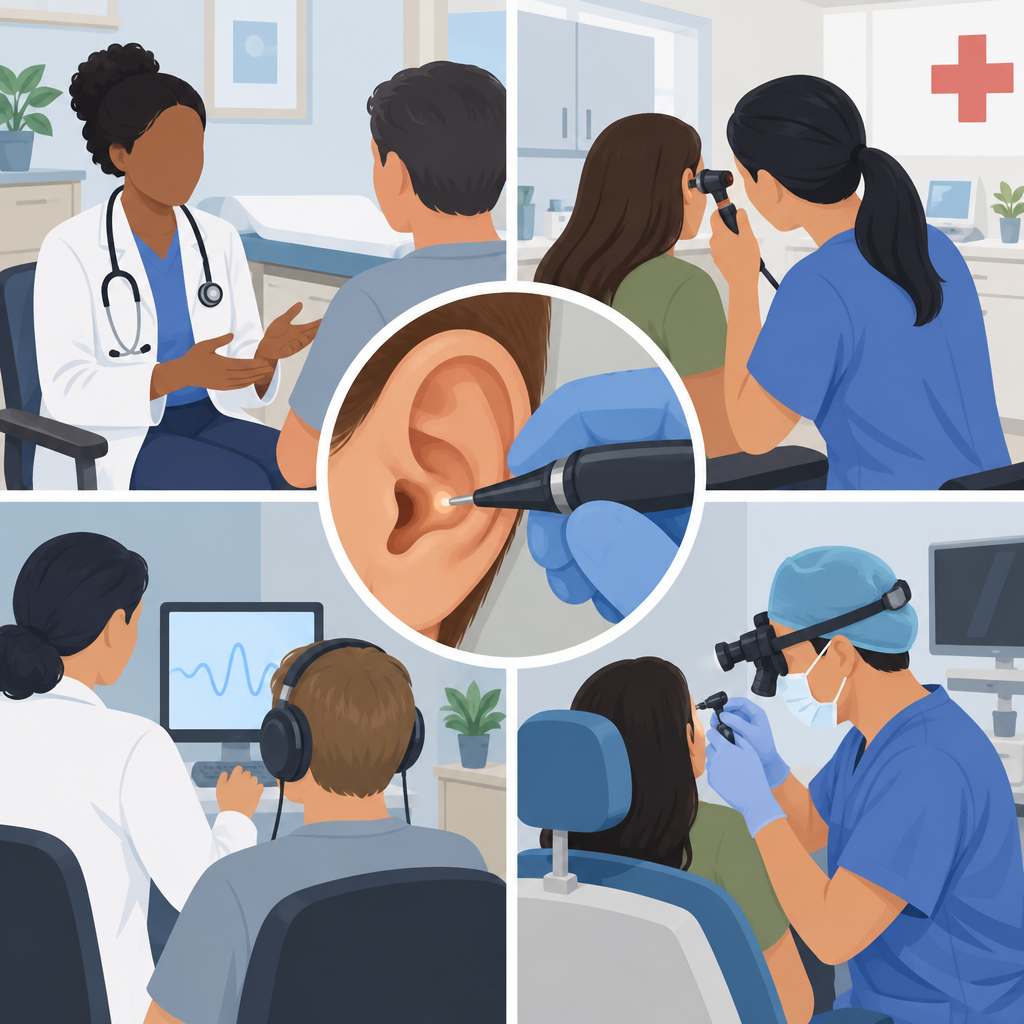
Most US adults can get impacted wax removed at a primary care office, a retail clinic, an urgent care center, an audiology practice or an ENT office. Start with primary care or a retail clinic for simple blockages. Go to an audiologist or ENT for microsuction, or if you have a perforation, ear tubes, past ear surgery, or wax that keeps coming back.
| Provider type | What it typically offers | Insurance | Choose it when |
|---|---|---|---|
| Primary care office | Irrigation or curette removal, plus a look for infection | Usually covered when wax is impacted and documented | You have a regular doctor and a simple blockage |
| Retail clinic (such as CVS MinuteClinic) | Otoscope check, then manual removal or a warm-water flush. A second visit is sometimes needed | MinuteClinic says it accepts most insurance. Costs vary | You want a walk-in visit without a referral |
| Urgent care center | Irrigation or manual removal, plus a check for infection | Usually billed like any urgent care visit | Symptoms are bothering you now, or you also have pain or discharge |
| Audiologist | Curette removal or microsuction, often with a hearing check or hearing aid service | Varies. Medicare does not separately pay audiologists for wax removal (per ASHA) | You wear hearing aids, need a hearing test, or want microsuction |
| ENT (otolaryngologist) | Microscope-guided microsuction and instrument removal, including for complex ears | Usually covered as specialist care. A referral may be needed | You have a perforation, ear tubes, past surgery, or blockages that keep returning |
| Mobile ear-care service | Microsuction at home or in a care facility | Often cash-pay | Someone is housebound or lives in a nursing home |
Provider directories and what to search for
Four directories cover almost every option, and each works best with a specific search. Match the tool to the type of care you need, then confirm the removal method by phone before you book.
| Tool | Run by | What to search for | Check before booking |
|---|---|---|---|
| ASHA ProFind | American Speech-Language-Hearing Association | Your ZIP code, profession set to audiologist | ASHA doesn’t verify listed services, so ask whether they do cerumen removal or microsuction. ASHA’s line is 800-638-8255 |
| Find an ENT | ENThealth.org, the AAO-HNS patient website | Your city or ZIP, then look for otology or general otolaryngology | Whether the practice offers microsuction and needs a referral |
| MinuteClinic clinic locator | CVS Health | Your ZIP, filtered to ear wax removal | Not every location offers the service |
| Your insurer’s provider search | Your health plan | Primary care, urgent care, audiology or ENT, in network | Your copay or deductible for each setting |
In a general search engine, specific phrases work better than broad ones. Try “audiologist microsuction” or “ENT cerumen removal” followed by your ZIP code, or “mobile earwax removal” plus your county if someone can’t travel. Add “self-pay price” if you’re uninsured, since some practices publish cash rates.
When you call, ask whether they remove wax by irrigation, curette or microsuction, and whether you should start drops beforehand. If your ear feels blocked and none of the red flags apply, book a primary care or retail clinic visit this week. If you have ear tubes, a past perforation or hearing aids, book an audiologist or ENT instead.
Earwax removal cost in 2026
In the US, professional earwax removal costs roughly $40 to $110 without insurance at a primary care office. Microsuction at an audiology or ENT office runs about $100 to $300 a session. The prices below were checked in November 2026. They vary by city, clinic, and whether you need one ear or both done.
| Setting | Self-pay range | Source | Notes |
|---|---|---|---|
| Primary care office or clinic | $40 to $110 | CostHelper Health estimate, current page | Usually irrigation or curette |
| Audiology clinic or ENT microsuction | About $100 to $250 | Hearing Aid Cost Guide, 2026 earwax removal cost guide | Microscope-guided suction |
| ENT practice, McLean, VA | $150 to $300 per session | Practice’s own pricing page | Self-pay microsuction |
| Cash-pay clinic, Huntersville, NC | $135 clinic visit | Mobile ENT NC FAQ page, 2026 | Standard microsuction |
| Mobile service, Huntersville, NC | $200 home visit | Mobile ENT NC FAQ page, 2026 | Useful for people who are housebound |
A worked example
Say you’re uninsured, one ear is blocked, and you have no red flags. A week of olive oil or Debrox costs under $15. If that clears it, you’re done. If it doesn’t, a primary care or retail clinic flush adds roughly $40 to $110, for a total under about $125. Going straight to microsuction would cost $100 to $300 on its own. Paying more makes sense if you have a past perforation, ear tubes or hearing aids, because microsuction keeps water out of the ear and specialists can handle complex canals.
With and without insurance
Insurance usually covers removal of impacted wax that a clinician documents as medically necessary. It usually doesn’t cover routine cleaning of wax that isn’t causing problems.
Original Medicare covers removal of impacted wax when a physician bills for it. According to ASHA’s Medicare billing guidance, CMS does not separately reimburse audiologists for cerumen removal. That means a Medicare patient seeing an audiologist may be asked to sign a notice and pay out of pocket.
Some commercial plans do pay audiologists. Copays and deductibles still apply.
When you book, ask:
- Which method will you use, and does the price cover both ears?
- Is there a fee if no wax is found?
- Should I use drops beforehand, and for how many days?
- Will you bill my plan for removal of impacted wax, and what will I owe?
Does Boots do earwax removal? (UK readers)
Yes. Boots Hearingcare charges £60 for professional earwax removal. That price covers an ear health check, microsuction and a free hearing health check, according to its page updated on 4 March 2026.
Other high-street chains, including Specsavers and Superdrug, also run paid wax removal appointments, so compare current fees when you book. Many GP practices no longer offer wax removal on the NHS. Ask your practice what’s available before you pay privately.
Earwax for hearing aid and earbud users
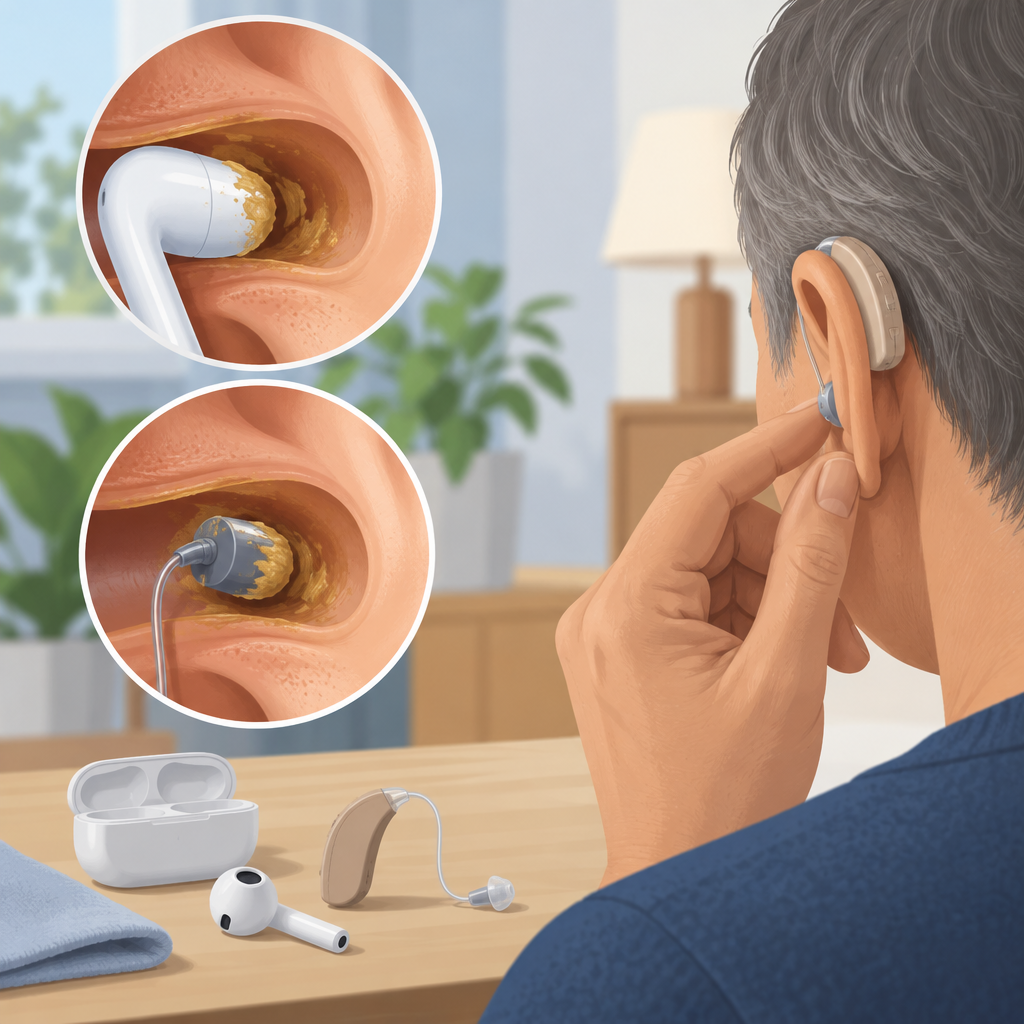
Anything that sits in your ear canal for hours slows the natural outward flow of wax and collects wax on its own surfaces. Hearing aid users get impacted wax more often, and a blocked receiver can make a working hearing aid sound broken.
Hearing aids (OTC and prescription)
Domes, custom molds and receiver-in-canal speakers all sit where wax is moving toward the exit. Over time, wax builds up on the device and in the canal, causing three typical problems:
- Muffled or weak sound. Wax clogs the wax guard or the receiver opening.
- Whistling (feedback). Sound bounces off a wax plug and back into the microphone.
- A “dead” hearing aid. A fully clogged wax filter can block sound completely, even with a charged battery.
Wax guards (also called wax filters or wax traps) are small replaceable screens that keep wax out of the receiver. Examples include Phonak’s CeruShield Disk and Oticon’s ProWax miniFit.
Phonak’s support guidance is to check the filter regularly. Replace it when it looks dirty, or when volume or sound quality drops. A UK hearing aid supplier suggests changing guards weekly if you make a lot of wax, and every 2 to 4 weeks if you make a moderate amount. Use the tool and guards made for your model. Different brands aren’t always interchangeable.
A daily routine helps:
- Each morning, wipe domes or molds with a dry cloth or a wipe made for hearing aids. Never use alcohol unless the manufacturer allows it.
- Brush the sound outlet with the small brush from your kit, holding the aid so the outlet points down and debris falls out.
- Look at the wax guard. If it’s discoloured or blocked, change it.
- Replace domes on the schedule your audiologist gives you, or sooner if they stiffen or tear.
- If the aid still sounds weak after a new guard, the wax may be in your ear rather than on the device. Get your ears checked.
What if hearing aid domes keep trapping wax?
Give your canals time without the aids, and put ear checks on a schedule. Taking the aids out overnight lets the canal air out and lets wax move toward the opening. If you still need professional cleaning often, ask your audiologist about a maintenance plan, or whether a different dome style or a custom mold would sit better. AAFP guidance notes that people who keep getting impacted wax can use drops regularly or have a clinician clean their ears every 6 to 12 months.
Hearing tip
If your hearing aid suddenly sounds weak or starts whistling, change the wax guard first. If that doesn’t fix it, the wax is probably in your ear canal, and it’s time to book a check.
Earbuds and in-ear headphones
In-ear earbuds work like a cork. They can push wax back in and stop it from leaving. This matters more now that earbuds have hearing features. Apple’s AirPods Pro 2 and AirPods Pro 3 support Apple’s Hearing Test and Hearing Aid feature, and wax on the tips or in the canal can muffle sound and may skew a self-test result.
Good habits:
- Wipe silicone tips regularly, following the manufacturer’s cleaning instructions, and let them dry fully.
- Check the speaker mesh for wax and clear it with a dry, soft brush.
- Take breaks from long listening sessions, and don’t sleep in earbuds every night.
- Don’t share tips, and replace torn or stiff ones.
- If one earbud suddenly sounds quieter, check both the earbud and your ear.
Before you buy an OTC hearing aid: rule out wax
The FDA’s over-the-counter hearing aid category is for adults 18 and older with perceived mild to moderate hearing loss. Under FDA rules, OTC hearing aid labels must list “red flag” conditions that should send you to a doctor first. Visible wax buildup or a foreign object in the ear is one of them.
If your hearing has become muffled recently, have your ears checked first. Clearing wax costs less than a pair of hearing aids, and an aid fitted over a wax plug won’t work as it should.
Blood in earwax: what it means
A small streak of blood in earwax usually comes from a scratch in the canal skin, often from a fingernail, swab or tool. Bleeding with pain, a sudden drop in hearing, discharge or dizziness can mean a perforated eardrum or an infection. In that case, you need to be seen.
| What you notice | Likely cause | What to do |
|---|---|---|
| Spot of blood after scratching or swabbing, no pain, hearing unchanged | Shallow canal scratch | Stop putting anything in the ear and keep it dry. Get checked if it isn’t better in a few days |
| Blood with sharp pain, sudden muffled hearing or ringing | Possible perforated eardrum | No drops or water. See a clinician soon |
| Blood mixed with yellow or green discharge, fever, swelling | Possible infection, such as swimmer’s ear or a middle ear infection | See a primary care clinician or urgent care |
| Blood after a head injury | Possible skull or inner ear injury | Emergency care |
| Spots after a clinician removed wax | Minor scratch from instruments | Usually settles. Call the clinic if it continues |
A typical scenario: wax feels loose and seems to shift, so you reach for a swab and see blood on the tip. With only a little blood, no pain and normal hearing, a canal scratch is the most likely cause. Stop swabbing and keep water out. Pain, reduced hearing, discharge or bleeding that continues should be checked. Most perforated eardrums heal on their own, but a clinician should confirm the diagnosis and advise you.
Preventing buildup
The best prevention is to keep things out of your ears. Wipe only the outer ear with a cloth, and let the canal clean itself.
If you find yourself blocked every few months, a regular softening routine works better than emergency digging. That fits the pattern AAFP describes, where regular drops or a professional clean every 6 to 12 months can stop wax from building into a full blockage. Agree the routine with your clinician, since drops used too often can irritate the canal.
Practical habits:
- Hands off. No swabs, hairpins or twist tools in the canal.
- Regular softening if you’re prone to wax, using a routine your clinician agrees with.
- Earbud discipline. Clean the tips and take breaks.
- Hearing aid care. Wipe daily, change guards when needed, and see your audiologist routinely.
- Children. Wash the outer ear at bath time and leave the canal alone.
- Older adults and care homes. Ask for an ear check whenever hearing, behaviour or communication seems worse.
Families with a relative in a nursing home should ask staff directly about ear checks. Impacted wax is common there and easy to miss. It makes conversation harder for people who already find it difficult, including people with dementia. Others can’t easily report symptoms either, including some Deaf and hard of hearing people who use hearing aids or cochlear implant processors, and people with intellectual disabilities. For them, it’s worth requesting a quick otoscope check at routine appointments.
If tinnitus continues after the wax is cleared, see an audiologist. Some people find a white noise machine helps them sleep while they wait for an assessment.
Your next step
Match the next step to your situation. If your ear feels blocked and no red flag applies, start drops tonight and give them 3 to 5 days. If that doesn’t clear it, book a primary care or retail clinic visit. If any red flag applies, or you wear hearing aids, skip the drops and book a clinician, choosing an audiologist or ENT when you need microsuction. And if hearing is still dull once the canal is clear, book a proper hearing test, because wax is no longer the explanation.
FAQ
How do you get rid of earwax fast?
The fastest safe option is professional microsuction, irrigation or curette removal, which usually takes minutes. Nothing fast is safe at home. A few days of drops followed by a gentle rinse is the low-risk route.
How do I find a clinic that removes earwax?
In the US, primary care offices, retail clinics such as CVS MinuteClinic, urgent care centers, audiologists and ENT offices all remove wax. Use ASHA ProFind to find an audiologist, ENThealth.org’s “Find an ENT” tool for an ENT, the MinuteClinic locator for walk-in care, or your insurer’s provider search for in-network options. Confirm the removal method when you call.
What is the best earwax removal kit?
For adults with healthy eardrums, a kit with softening drops and a rubber bulb syringe, such as the Debrox Earwax Removal Kit, fits the guideline best. US listings in November 2026 put it at about $8 to $15. Skip camera and spiral tool kits for removal.
Should I use earwax drops on my child?
Ask your pediatrician first, especially if your child has ear tubes, ear pain, discharge or fever. Most children’s wax needs no treatment. When removal is needed, a clinician can scoop, suction or flush it in the office.
What could be causing blood in my earwax?
Usually a small scratch in the ear canal from a nail, swab or tool. Blood with pain, sudden muffled hearing, discharge or fever can mean a perforated eardrum or an infection. See a clinician if you have any of those.
Do Boots Chemists do ear wax removal?
Yes. Boots Hearingcare offers microsuction for £60, including an ear health check and a free hearing health check, according to its page updated in March 2026. Other UK chains also offer paid appointments.
Is getting earwax removed good?
It’s worth doing when wax causes symptoms or blocks an exam, because hearing usually improves straight away. Removing wax that isn’t causing problems has no benefit and carries a small risk, so guidelines advise against routine removal.
How much does earwax removal cost?
In the US, expect about $40 to $110 without insurance at a primary care office. Microsuction at an audiology or ENT office runs about $100 to $300 a session (checked November 2026). In the UK, Boots charges £60.
Does insurance or Medicare cover earwax removal?
Many plans cover medically necessary removal of impacted wax. Original Medicare pays when a physician bills for it. According to ASHA, CMS doesn’t separately reimburse audiologists for it. Routine cleaning of wax that isn’t impacted is usually not covered.
Is microsuction better than ear irrigation?
Neither has been proven better overall, and NICE says the evidence comparing them is limited. Microsuction keeps water out of the ear, so it’s usually preferred if you have a past perforation, ear tubes or ear surgery.
Does hydrogen peroxide or Debrox remove earwax?
Debrox (6.5% carbamide peroxide) softens and breaks up wax, but it doesn’t remove a hard plug by itself. You may still need a rinse or professional removal. The guideline found no type of drop clearly better than the others, including plain water.
Is olive oil safe for earwax?
For most people with an intact eardrum, yes. NHS guidance suggests olive oil drops twice a day for 3 to 5 days. Olive oil alone sometimes clears soft wax. More often it softens the wax enough for a rinse or clinic removal.
Are camera earwax removal tools safe?
Harvard Health Publishing advises against home earwax tools, including camera scopes. The camera shows you the wax, but you can still scratch the canal, push wax deeper or injure the eardrum. Use one to look, if at all, and leave removal to drops or a clinician.
About this article
- Fact-checked by Lorraine Ostrowski against the sources listed below before publication.
- Published
Sources (8)
- Clinical Practice Guideline (Update): Earwax (Cerumen Impaction) – AAO-HNSF 2017 (pubmed.ncbi.nlm.nih.gov)
- AAFP: Cerumen Impaction guideline summary (aafp.org)
- Prevalence of cerumen impaction, NHANES 2005-2016 (pubmed.ncbi.nlm.nih.gov)
- KFF Health News: Earwax poses unrecognized risk in long-term care (kffhealthnews.org)
- Nationwide Children's Hospital: Cotton tip applicators sending 34 kids to the ED each day (nationwidechildrens.org)
- FDA: Don't Get Burned: Stay Away From Ear Candles (drugs.com)
- CostHelper: Ear Wax Removal Cost (health.costhelper.com)
- Hearing Aid Cost Guide: Ear wax removal cost (hearingaidcostguide.com)