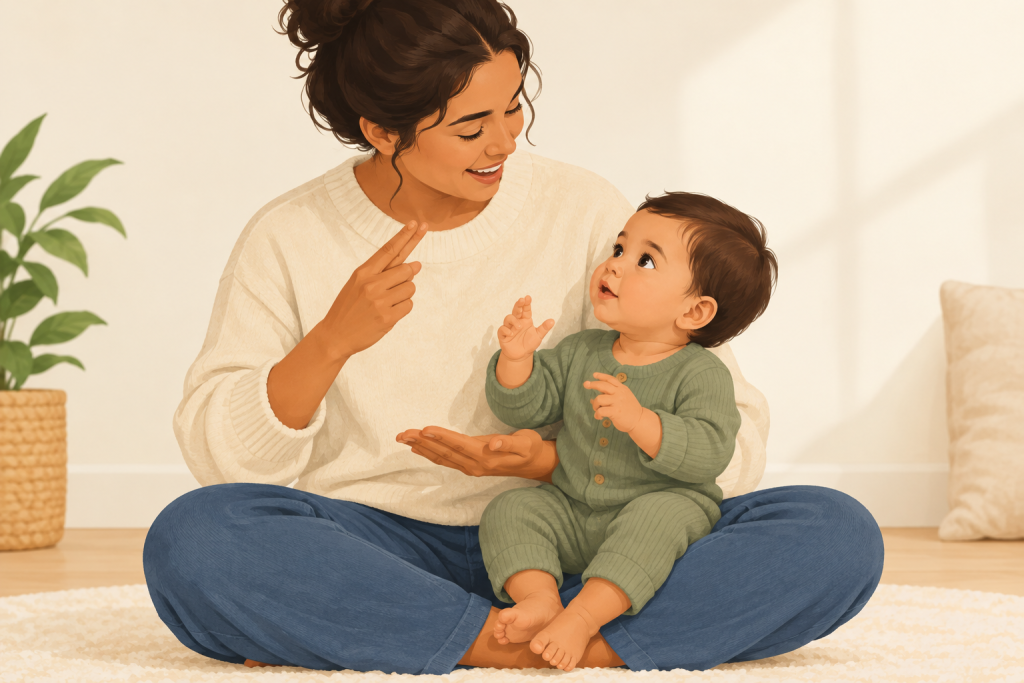
Baby sign language means using simple signs, ideally borrowed from American Sign Language (ASL), alongside your spoken words so your baby can tell you “milk,” “more” or “all done” before they can say them. You can start showing signs from birth, but most babies don’t sign back until about 8 months or later, and only after a couple of months of you signing the same few words every day. This guide covers the first signs to teach, how to make each one, a weekly routine, and what the research actually says about the benefits.
Worth remembering
- Start with three real ASL signs (milk, more, all done) at mealtimes, and say the word every time you sign.
- Expect roughly two months of steady signing before your baby signs back. Some babies take until after their first birthday.
- The best studies, a 2013 randomized trial and a 2026 study of 1,348 children, found no vocabulary boost, and no harm either.
- The benefit that holds up is how closely you learn to read your baby’s cues.
- If your baby doesn’t react to sounds or voices, that’s a question for a hearing test, not for more signing.
Fact-checked
We checked these key facts against the sources named, on November 26, 2026:
- The widely repeated “12-point IQ boost” comes from a 2000 conference presentation, not a peer-reviewed journal paper (source: doi.org)
- You can start showing signs from birth, but most babies don’t sign back until about 8 months or later, and only after a couple of months of you signing the same few words every day (source: healthychildren.org)
- A 2025 Government Accountability Office report, GAO-25-106978, found the EHDI program connects deaf and hard-of-hearing infants to services but said action is needed to improve access (source: gao.gov)
- Critics, including developmental psychologist Kathy Hirsh-Pasek, pointed to possible selection bias and the lack of a definitive published paper (source: apa.org)
- The Baby Signs program, which grew out of research by psychologists Linda Acredolo and Susan Goodwyn, started by encouraging parents to use simple gestures, some of them invented (source: babysigns.com)
Baby sign language in 60 seconds
Baby sign language is a short list of hand signs you use alongside speech during daily routines. You give your baby a way to point to an idea before their mouth can form the word.
Here are the basics:
- What you teach: Single-word signs taken from ASL, such as MILK, MORE, EAT, ALL DONE and HELP.
- When to start: Any time from birth. Most parents get the best return from starting between 4 and 8 months, when babies are watching hands closely.
- When babies sign back: Pediatricians writing for the American Academy of Pediatrics’ HealthyChildren.org say basic signs can help from about 8 to 9 months. Pathways.org says a baby may start signing after about two months of consistent signing.
- What research shows: No proven gain in speech or IQ, no evidence of harm, and a real improvement in how parents respond to their baby’s nonverbal signals.
Baby sign language vs. ASL: what you’re actually teaching
Baby sign language is key-word signing: you sign one important word in a spoken English sentence. American Sign Language is a complete language with its own grammar, facial grammar and word order. If you say “Do you want more milk?” and sign MORE and MILK, you’re doing baby sign. You aren’t speaking ASL.
That difference matters less than you might think at first. Head Start’s early childhood guidance for teachers says that skipping ASL grammar is fine when the goal is basic communication with infants and toddlers. Head Start also describes ASL as one of the earliest ways young children can express themselves.
Are baby signs real ASL?
Most popular baby signs are real ASL signs, or close to them. Commercial programs vary, though. The Baby Signs program, which grew out of research by psychologists Linda Acredolo and Susan Goodwyn, started by encouraging parents to use simple gestures, some of them invented. Sites such as BabySignLanguage.com and the Signing Time video series mostly use ASL vocabulary.
Before you buy a book or flashcards, check that the signs match an ASL dictionary. Some products simplify signs so much that they no longer match what a Deaf adult would recognize.
Should you make up your own signs?
You can, but real ASL is the better investment. A made-up “home sign” only works inside your family. An ASL sign works with Deaf relatives and neighbors, with daycare staff who already sign, and with your child’s future ASL classes if they keep going. It also respects a language that Deaf communities built over two centuries. If you’d like that background, our explainer on the meaning of ASL covers how American Sign Language began.
The exception is your baby’s own version of a sign, which is welcome. When your baby claps for “more,” you accept it and keep modeling the correct sign. That’s different from you inventing new signs.
When to start, and when your baby will sign back
You can sign from birth, but don’t expect a sign back until your baby has the motor control and memory to copy you. That’s usually somewhere between 8 and 12 months, and sometimes later. Starting early isn’t wasted time. It’s practice for you, and it makes signing a habit before your baby is ready to join in.
| Age | What you do | What baby may do | Source/notes |
|---|---|---|---|
| 0-3 months | Talk constantly; sign MILK before feeds if you like | Watches faces, quiets or startles to sounds | Modeling only; no response expected |
| 4-6 months | Sign 2-3 words at the same routine every day | Watches your hands, reaches, babbles | Good time to make signing a habit |
| 6-9 months | Keep the same signs; hold and exaggerate them | Waves, points, first rough sign attempts | Pathways.org: about 2 months of steady signing before a response |
| 9-12 months | Add one new sign each time one “sticks” | Uses MORE, MILK or ALL DONE in rough form | HealthyChildren.org: basic signs help from about 8-9 months |
| 12-18 months | Expand to people, animals, feelings | Combines signs with first words | Some babies only start signing now |
| 18-24 months | Keep saying the word with every sign | Words gradually replace signs | Signs often drop off on their own |
Can babies sign at 3 months?
No, not in any meaningful sense. A 3-month-old may open and close their hands, which can look like MILK, but that’s normal hand movement. Signing to a 3-month-old is fine. You’re building your own habit, and your baby will see the signs again and again in context.
What if my baby is 12 months and still isn’t signing?
That’s common and not a sign that you did something wrong. One parent asked in a forum: “We’ve been signing since 5 weeks and she only just started signing back at a little over a year. Did we do it wrong?” No. Head Start notes it can take a few months before a baby signs back, and babies who start late often pick up several signs at once.
What deserves a closer look is the bigger picture. A 12-month-old who doesn’t point, wave, respond to their name or react to sounds should be checked by your pediatrician. That’s about development or hearing, not signing.
How to teach baby sign language in 7 steps
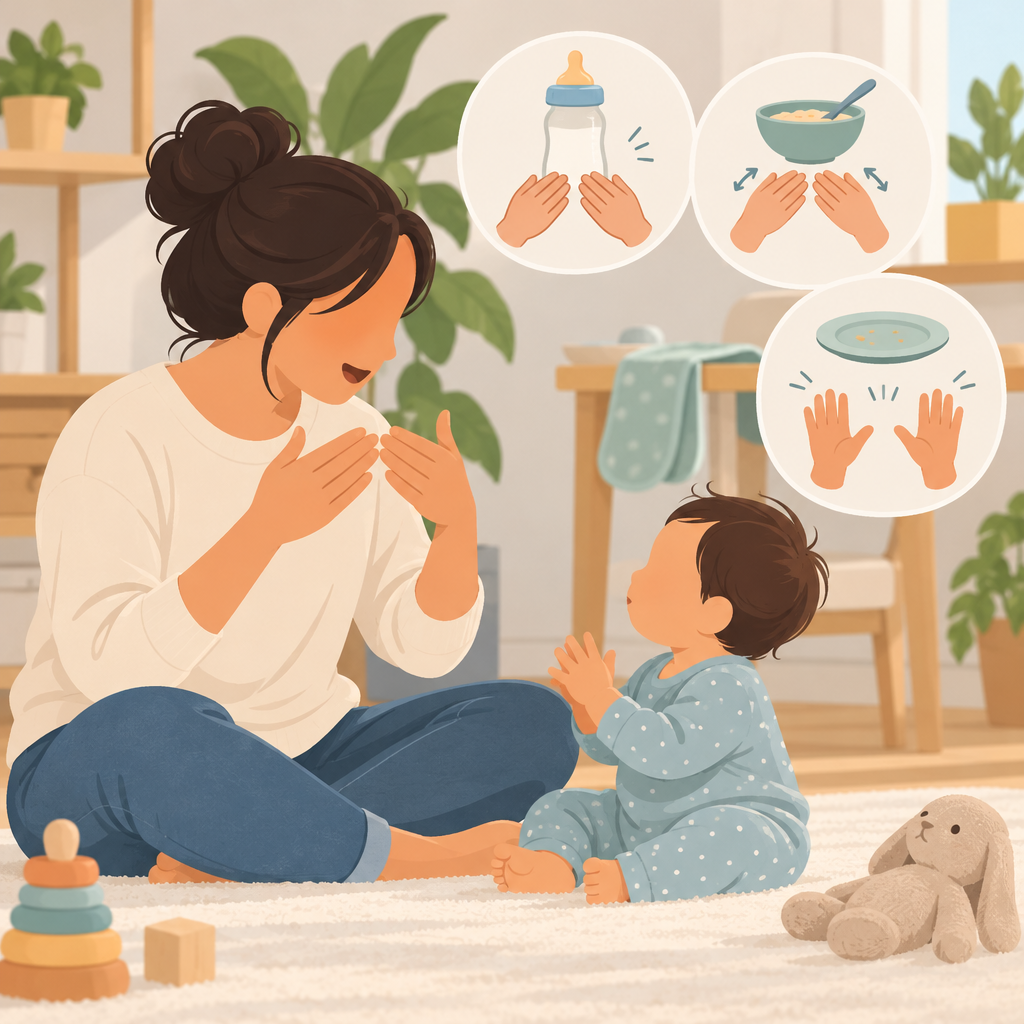
The method is simple: get your baby’s attention, say the word, make the sign, and do it at the same moment every day. Consistency matters far more than how many signs you know.
Setup steps
- Get eye contact before you sign.
- Say the word out loud as you make the sign.
- Tie each sign to a routine: MILK before feeds, ALL DONE after meals.
- Start with 2 or 3 signs only.
- Exaggerate the sign and hold it a beat longer than feels natural.
- Respond right away to your baby’s version of a sign.
- Get every caregiver using the same signs.
Getting eye contact
Head Start lists gaining and keeping eye contact as the first step. A sign your baby doesn’t see doesn’t count. Hold the spoon or bottle next to your face, gently tap your baby’s arm, or sign inside their line of sight while they’re in the high chair.
Hearing tip
When your hands are full, sign on your baby’s body or right in front of their face. For milk, sign just before you offer the bottle or breast, so the sign comes before the reward.
How many signs to start with
One parent asked: “Should I do more than 2 or 3 signs at a time, or will she get confused?” Two or three is the right number to start. Babies won’t be harmed by more, but you’ll be less consistent, and consistency is what teaches the sign. Add a new sign once your baby uses one of the first ones back.
Shaping your baby’s “baby version” of a sign
Babies rarely make a perfect sign. MORE often comes out as clapping, MILK as a loose open-and-close of one hand, and ALL DONE as a single wave. Treat the attempt as real communication: respond right away (“More! You want more banana”), then show the correct sign again. Correcting or moving their hands into position usually puts them off.
Getting daycare and grandparents on board
Signs stick faster when everyone uses them. Print the chart below for the fridge and the diaper bag. Ask daycare staff which signs they already use. Many infant rooms use MORE, ALL DONE and EAT, and Head Start programs are encouraged to sign with infants. If a grandparent makes a sign slightly differently, agree on one version rather than teaching two.
The first 25 signs to teach, with how-to descriptions
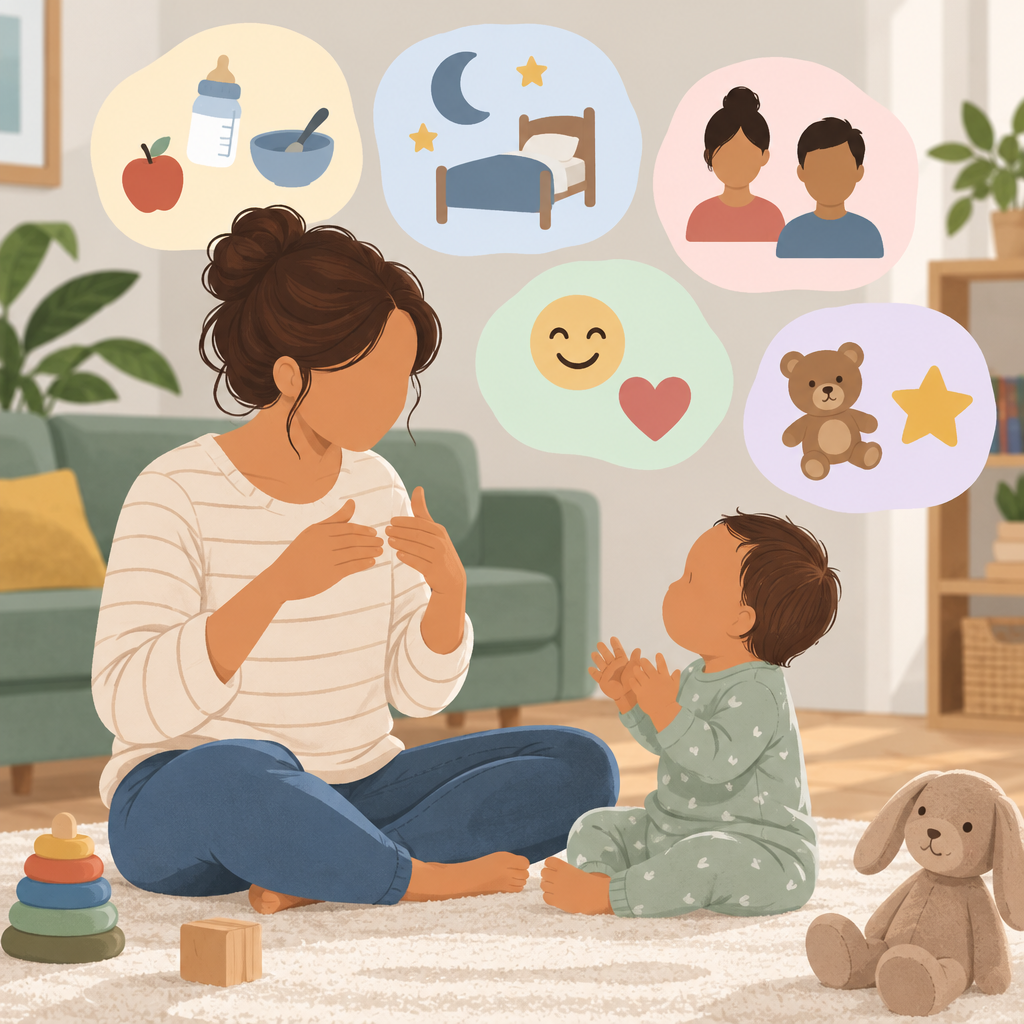
Start with the needs group, then add routines, people, feelings and fun words as your baby shows interest. Each description below follows the ASL form: handshape, where you make it, and the movement.
Milk, more and all done: the starter three
These three come up several times a day, which is why they’re the most common first signs.
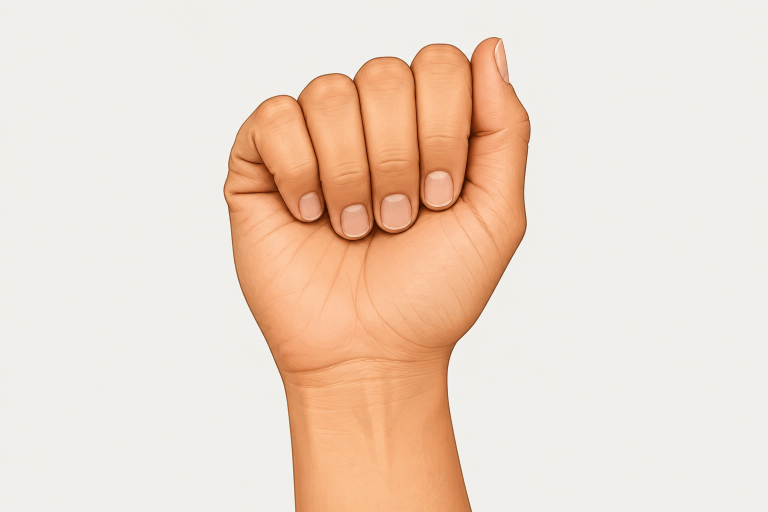
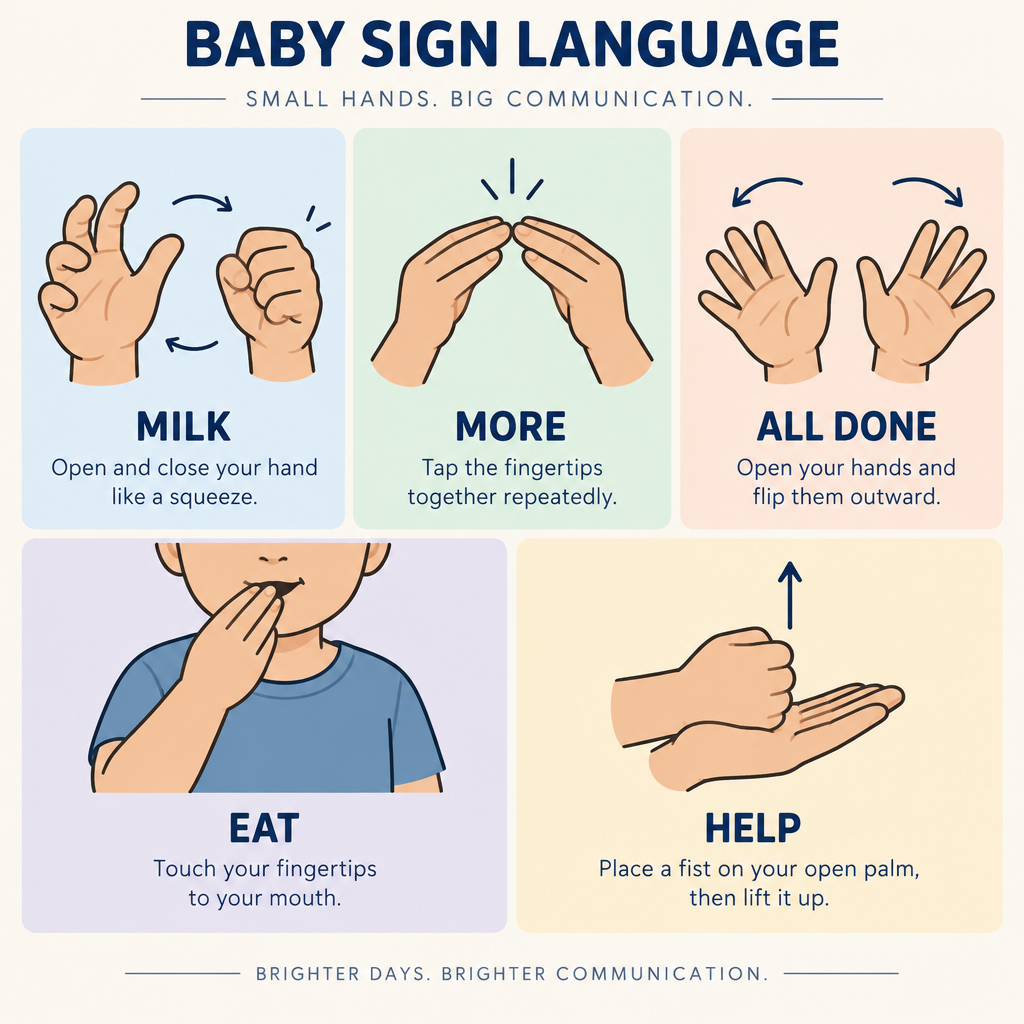
- MILK: Hold one hand in a loose fist at chest height and squeeze it open and closed a few times, like milking a cow.
- MORE: Bunch the fingertips of each hand together into a flat “O” shape, then tap the fingertips of both hands together a few times in front of your body.
- ALL DONE (ASL FINISH): Hold both hands up, fingers spread, palms facing you, then twist your wrists so your palms turn outward. Repeat once or twice.
Hearing tip
Always say the word out loud as you sign it. Signs go alongside speech and never replace it, which is also the condition the AAP’s HealthyChildren.org puts on signing.
Hungry vs. eat
These two look different and mean different things, so it helps to know both.
- EAT: Bunch your fingertips into a flat “O” and tap them to your lips, as if putting food in your mouth.
- HUNGRY: Make a “C” shape with one hand, palm facing you, and draw it down from your upper chest toward your stomach.
Use EAT at the table (“Time to eat”). Use HUNGRY when you’re asking about a need (“Are you hungry?”). Most babies use EAT first because they see it at every meal.
Up and help
- UP: Point your index finger toward the ceiling and move your hand upward. Many babies simply raise both arms, and that’s a perfectly clear baby version.
- HELP: Make a thumbs-up with one hand and rest it on the flat, upturned palm of your other hand, then lift both hands together.
The remaining needs and routine signs
- WATER: Make a “W” with your index, middle and ring fingers and tap your index finger to your chin twice.
- SLEEP: Hold an open hand in front of your face and draw it down while your fingers close, as if your face is falling asleep. Close your eyes as you do it.
- DIAPER: At both hips, tap your index and middle fingers down onto your thumbs twice, like pins closing.
- POTTY: Make a “T” handshape (thumb tucked between your index and middle fingers) and shake it side to side.
- BATH: Make fists and rub them up and down on your chest, as if scrubbing.
People
- MOMMY: Spread the fingers of one hand and tap your thumb on your chin.
- DADDY: Same handshape, with your thumb tapping your forehead.
- GRANDMA: Start with MOMMY at your chin, then move your hand forward in two small arcs.
- GRANDPA: Start with DADDY at your forehead, then make the same two forward arcs.
Feelings, including “I love you” in sign language
- HURT: Point both index fingers toward each other and twist or jab them lightly, near the spot that hurts.
- HAPPY: Brush a flat hand upward on your chest in small circles.
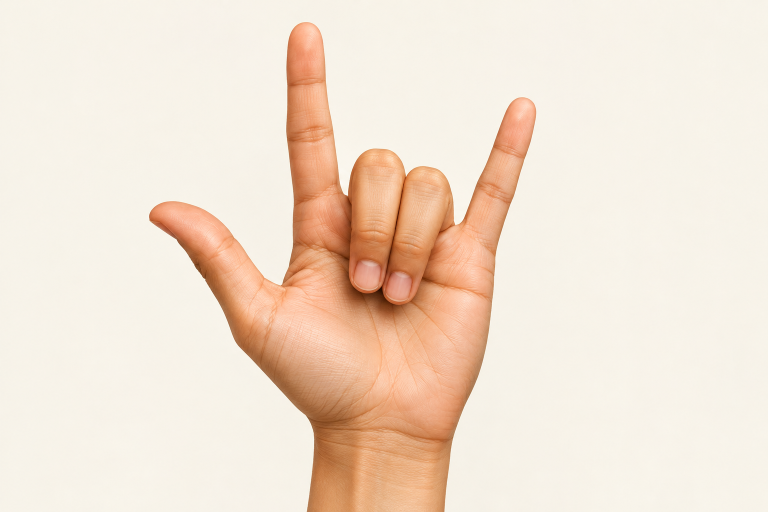
- I LOVE YOU: Raise one hand, palm facing out, with your thumb, index finger and little finger extended and your middle and ring fingers folded down. This ILY handshape combines the ASL letters I, L and Y. Our guide on how to sign I love you covers variations and where the sign came from.
Fun words
- DOG: Pat your thigh, then snap your fingers, like calling a dog.
- CAT: Pinch your thumb and index finger near your cheek and pull outward, tracing whiskers.
- BIRD: At your mouth, open and close your index finger and thumb like a beak.
- BOOK: Press your palms together, then open them like a book.
- PLAY: Make “Y” handshapes (thumb and little finger out) with both hands and twist them back and forth at the wrists.
- AGAIN: Hold one hand flat, palm up. Bend the fingers of your other hand and arc it over so the fingertips land on your flat palm.
Once your toddler has these, polite words make a good next step. Our guide to thank you in sign language covers one of the easiest.
Printable baby sign language chart
This chart covers the ten signs most families use first. Print this section and keep a copy on the fridge and one in the daycare bag.
| Sign | When to use it | How to make it | Common baby version |
|---|---|---|---|
| Milk | Right before bottle or breastfeed | Squeeze a fist open and closed | Opening and closing one hand |
| More | Mid-meal, during games, tickles | Tap bunched fingertips of both hands together | Clapping, or one finger poking a palm |
| All done | End of meals, bath, play | Palms toward you, twist outward | A single wave or arm flap |
| Eat | Sitting down to meals | Bunched fingertips tap your lips | Hand to mouth |
| Hungry | Asking about a need | “C” hand moves down chest to stomach | Patting the tummy |
| Water | Offering a cup | “W” taps chin | Patting the chin |
| Help | Stuck toy, shoes, climbing | Thumbs-up on flat palm, lift both | Patting own chest or hand |
| Up | Before you pick baby up | Index finger points up and rises | Both arms raised |
| Sleep | Naps and bedtime | Open hand draws down over face, closing | Hand over face, eyes closed |
| Diaper | Before changes | Fingers tap thumbs at both hips | Patting hips or belly |
Does baby sign language actually work? What the research says
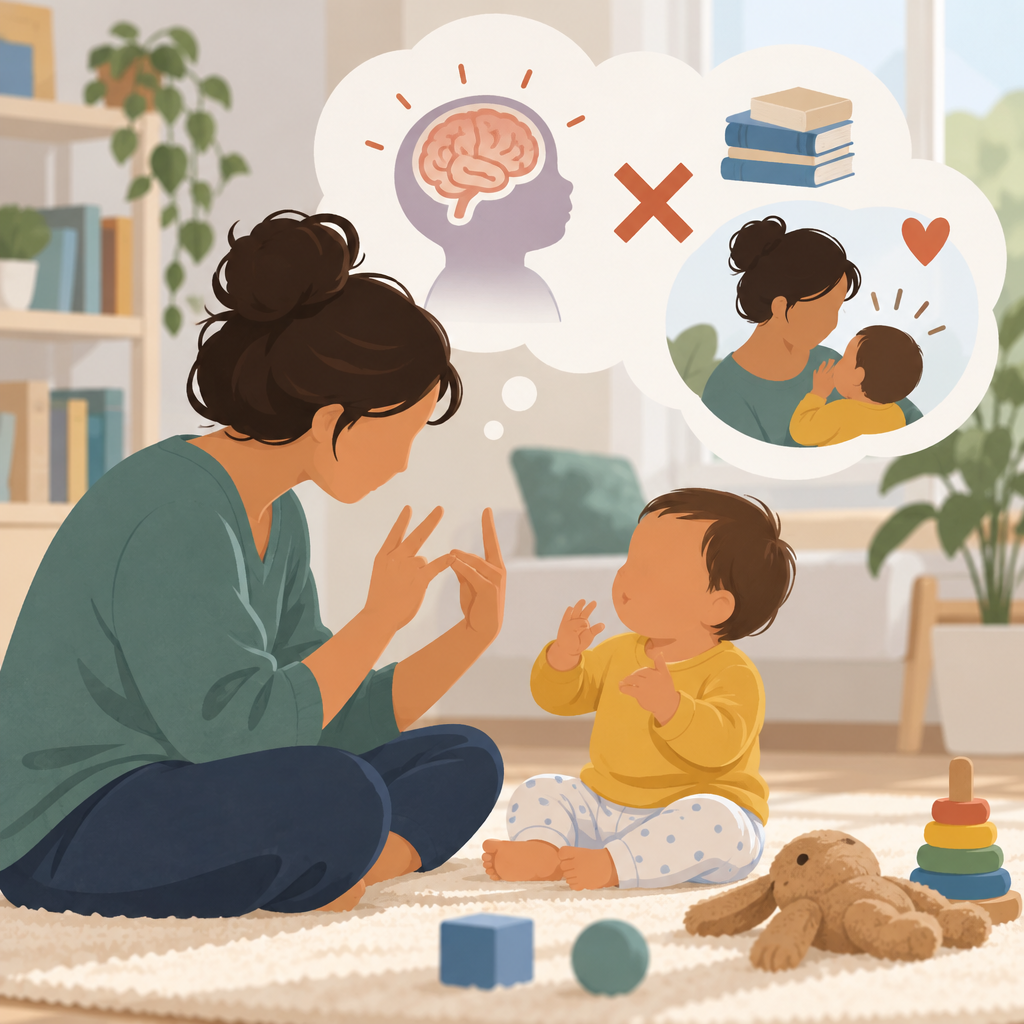
Baby sign doesn’t make babies talk earlier or raise their IQ, as far as the best evidence shows. It also doesn’t hurt. The strongest finding is about parents: signing seems to make you watch your baby more closely.
| Claim | Study/source | Year | Sample | Finding | Verdict |
|---|---|---|---|---|---|
| Signing raises IQ by about 12 points | Acredolo & Goodwyn, International Conference on Infant Studies, Brighton | 2000 | Follow-up of earlier study group | Conference presentation, no definitive published paper | Not supported |
| Signing speeds up language | Kirk, Howlett, Pine & Fletcher, Child Development 84(2) | 2013 | 40 infants, 8-20 months | No language advantage for signing babies | Not supported |
| Signing improves communication | J. Cyne Johnston, systematic review, First Language | 2014 | Review of published studies | Unclear benefit; no evidence of interference | Unproven, harmless |
| Signing grows vocabulary | Bertussi, Ravanas & Dautriche, First Language | 2026 | 1,348 French children, 10-28 months | Weak to no effect on vocabulary or caregiver behavior | Not supported, no harm |
| Baby sign websites reflect the evidence | Nelson et al. review of baby sign sites | 2012 | 33 websites | Only 8 cited empirical research; 90% of citations were opinion pieces | Treat marketing with caution |
Where the “12-point IQ” claim comes from
The figure you’ll see on sales pages traces back to “The long-term impact of symbolic gesturing during infancy on IQ at age 8,” a presentation by Linda Acredolo and Susan Goodwyn at the International Conference on Infant Studies in Brighton in 2000. Critics, including developmental psychologist Kathy Hirsh-Pasek, pointed to possible selection bias and the lack of a definitive published paper. A 2016 briefing from Lucid, the ESRC International Centre for Language and Communicative Development, said the IQ follow-up has numerous methodological problems and that there’s no adequate evidence baby sign raises IQ.
Did you know?
The widely repeated “12-point IQ boost” comes from a 2000 conference presentation, not a peer-reviewed journal paper. According to the 2016 Lucid briefing, there is no adequate evidence that baby sign raises IQ.
The 2026 study of 1,348 children
The largest study so far, by Bertussi, Ravanas and Dautriche, was published online in First Language on 21 January 2026. It compared 723 French hearing children who had been exposed to baby sign with 625 who hadn’t, aged 10 to 28 months. Once the researchers accounted for family socioeconomic status and everyday parent-child activities such as reading, baby sign showed weak to no effect on vocabulary or on how caregivers behaved. It didn’t harm vocabulary either. That control matters: families who sign also tend to read, talk and play more, which can make signing look more powerful than it is.
Will signing delay my baby’s speech?
No. Johnston’s 2014 review found no evidence that baby sign interferes with typical development, and the 2026 study found no harm to vocabulary. HealthyChildren.org’s guidance is that signing won’t get in the way of learning to talk as long as it doesn’t replace speaking. Say the word every time.
The benefits that do hold up
Elizabeth Kirk’s 2013 randomized controlled trial, run with colleagues at the University of Hertfordshire, found that babies learned the gestures but didn’t learn the matching words any faster. Their mothers changed, though. Mothers in the signing groups became more responsive to their babies’ nonverbal cues and encouraged more independent action.
So, was baby sign actually worth it, or is it just marketing? It’s worth it if you value a few months of easier mealtimes, less guessing, and a habit of watching your baby closely. It isn’t worth paying for a program that promises a smarter child or earlier talking. The free version works just as well.
Troubleshooting: common baby-signing problems
Most problems come from babies over-using their first useful sign, which is normal. The fix is nearly always the same: answer the need you think they mean, say the right word, and model the right sign.
- “She’s signing ‘more’ for everything now, including milk and all done.” MORE gets results, so babies over-use it. Respond to what you think they mean, then name and sign it: “Milk? You want milk,” with the MILK sign. Over-extension like this happens with spoken first words too.
- “My baby uses ‘all done’ for all done, more AND milk. Is that normal?” Yes. Make the signs look and feel different by tying each one to one moment only: MILK before a feed, MORE mid-meal while holding the food, ALL DONE as you lift the tray away.
- “My breastfed baby never uses the milk sign; she just nurses.” That’s common. Nursing already communicates the need, so the sign adds little for her. Keep signing MILK for a bottle or cup, or move on to EAT, WATER and MORE, which she’ll find more useful.
- Different caregivers, different signs. Agree on one version of each sign and share the chart. Mixed signals slow babies down more than late starts do.
- You’ve lost motivation. Cut back to the three signs you use at meals. Three steady signs do more than twenty used now and then.
Hearing tip
Add a new sign only once your baby has used one back. It keeps the list manageable for you and gives your baby an early success to build on.
When it’s a hearing question, not a signing question
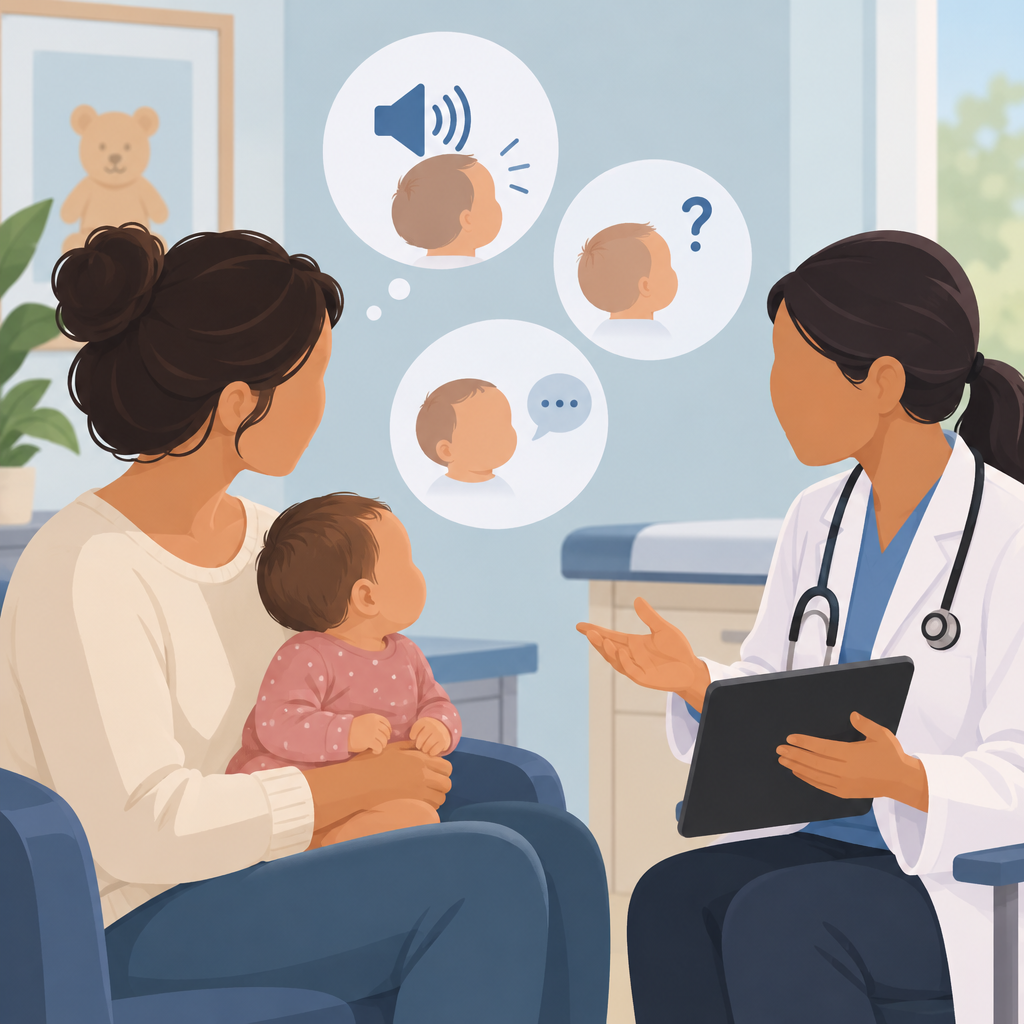
If your baby doesn’t startle at loud sounds, doesn’t turn toward your voice, or babbles less over time, call your pediatrician and ask for a hearing evaluation. Signing more won’t fix any of that. Copdaz Hearing doesn’t offer local services, so your pediatrician or a pediatric audiologist is the right first call.
US newborn hearing screening is run through the CDC’s Early Hearing Detection and Intervention (EHDI) program. It catches most babies at birth, but follow-up is where families fall through the gaps.
| Metric (2022 births) | Figure | Source |
|---|---|---|
| Births screened for hearing | 98.1% (3,547,774 of 3,616,776) | CDC EHDI summary |
| No documented screening | 1.9% | CDC EHDI summary |
| Did not pass the screen | 1.8% of screened infants | CDC EHDI summary |
| Identified deaf or hard of hearing | 6,272 infants (1.7 per 1,000) | CDC EHDI summary |
| Non-pass infants diagnosed before 3 months | 39.9% | CDC EHDI summary |
| Bilateral loss (where known) | 58% (3,408 of 6,026) | CDC EHDI summary |
| Enrolled in early intervention | 60.3% | CDC EHDI summary |
These 2022 figures are the latest CDC national summary. The EHDI benchmark is screening by 1 month, diagnosis by 3 months and early intervention by 6 months. If your baby got a “refer” result or missed the screen, a full diagnostic test should happen by 3 months.
See a professional
A missed or “refer” newborn screen, no reaction to loud sounds, or babbling that fades all need a hearing evaluation with your pediatrician or a pediatric audiologist. A sudden change in how your child responds to sound is urgent: call your doctor the same day.
If your baby is deaf or hard of hearing: ASL as a first language
For a deaf or hard-of-hearing baby, ASL can be a full first language with its own grammar, and much more than a bridge to speech. Families often combine ASL with hearing aids or cochlear implants and spoken language. An audiologist and your early intervention team can lay out the options. Starting language early, in any form, is what matters most.
Early intervention and what the numbers show
IDEA Part C early intervention offers services to eligible babies and toddlers, but only 60.3% of identified infants born in 2022 were enrolled, and 39.7% had no documented services. A 2025 Government Accountability Office report, GAO-25-106978, found the EHDI program connects deaf and hard-of-hearing infants to services but said action is needed to improve access. If your baby is identified, ask directly for a Part C referral.
Did you know?
About 1.7 of every 1,000 US babies born in 2022 were identified as deaf or hard of hearing, according to the CDC. Only 39.9% of babies who didn’t pass the newborn screen were diagnosed by 3 months.
Moving from signs to words: when to stop
You don’t need to stop. For most hearing babies, signs fade on their own as words arrive, usually between 18 months and 2½ years. Your child will say “milk” and stop bothering with the sign because speaking is faster.
Keep saying the word every time you sign, and repeat your toddler’s word back to them clearly. Some families decide to keep going and learn ASL as a second language together. If that appeals to you, the sign language alphabet is a natural next step, since fingerspelling unlocks names and new words.
Best free resources, books and apps
You don’t need a paid program to teach baby sign language. A good video dictionary and a printed chart are enough.
- ASL video dictionaries: Lifeprint (ASL University) and Handspeak show each sign on video, which beats still pictures for movement. Head Start’s ASL guidance also points families to video sign resources.
- Ready DLL App: A free Head Start app for teachers and caregivers. Head Start says it includes 23 ASL words and phrases for everyday communication with young children.
- Signing Time: A long-running ASL video series for children, now offered through a subscription app. Its signs are ASL-based.
- Books and flashcards: Before you buy, check a few signs against a video dictionary. Choose anything that matches ASL and skip products built around invented gestures or IQ claims.
Your next step is small: tonight at dinner, sign MORE before the second spoonful and ALL DONE as the tray comes off. Do that every day for the next two months, and your baby will have a fair chance to answer you.
FAQ
When should a baby start sign language?
You can start signing from birth. Many families start between 4 and 8 months. Babies usually sign back from about 8 to 9 months, after roughly two months of consistent signing.
What is “I love you” in baby sign language?
It’s the same as the ASL ILY sign. Hold your palm out with your thumb, index finger and little finger extended, and your middle and ring fingers folded down.
Can babies sign at 3 months?
No. At 3 months, babies lack the motor control to make signs on purpose. You can still model signs at that age to build the habit.
How do I teach my baby sign language?
Get eye contact, say the word as you sign it, and use the sign at the same routine every day. Start with two or three signs and respond to any attempt right away.
What is the baby sign for milk?
Make a fist and squeeze it open and closed a few times, like milking a cow. Sign it just before each feed.
How do you sign “more” to a baby?
Bunch the fingertips of both hands into flat “O” shapes and tap them together a few times. Many babies clap as their version, and you can accept that.
What is the sign for hungry vs. eat?
EAT is bunched fingertips tapping your lips. HUNGRY is a “C” hand moving down from your chest to your stomach. EAT is easier for babies and usually comes first.
How do you sign “up” in baby sign language?
Point your index finger up and raise your hand. Raising both arms is a natural baby version and works fine.
Does baby sign language delay speech?
No. A 2014 systematic review and a 2026 study of 1,348 children found no harm to language development, as long as you keep talking while you sign.
Is baby sign language the same as ASL?
Not quite. Baby sign uses individual ASL signs alongside spoken English. ASL is a full language with its own grammar. Using real ASL signs means your effort carries over if your family keeps learning.
We started at 4 months. When will he sign back?
Most babies who start that early sign back somewhere between 8 and 12 months. Some wait until after their first birthday and then pick up several signs quickly.
Is it okay to make up our own signs, or should we use real ASL?
Use real ASL where you can. Your baby’s own rough version of a sign is fine, but ASL signs work with daycare, Deaf relatives and anyone else who signs.
About this article
- Fact-checked by Lorraine Ostrowski against the sources listed below before publication.
- Published
Sources (8)
- Bertussi, Ravanas & Dautriche, First Language (2026): large-scale evaluation of baby sign (doi.org)
- First Language: baby sign and vocabulary development (journals.sagepub.com)
- Kirk et al. (2013) To sign or not to sign? Child Development (eprints.whiterose.ac.uk)
- Kirk et al. (2013), University of Hertfordshire repository (uhra.herts.ac.uk)
- Johnston (2014) systematic review of baby sign, First Language (journals.sagepub.com)
- Info-CHILDES discussion of the Acredolo & Goodwyn IQ claim (2007) (listserv.linguistlist.org)
- Lucid briefing on baby sign (May 2016) (lucid.ac.uk)
- The Conversation: Sifting the fact from fiction about baby sign language (theconversation.com)