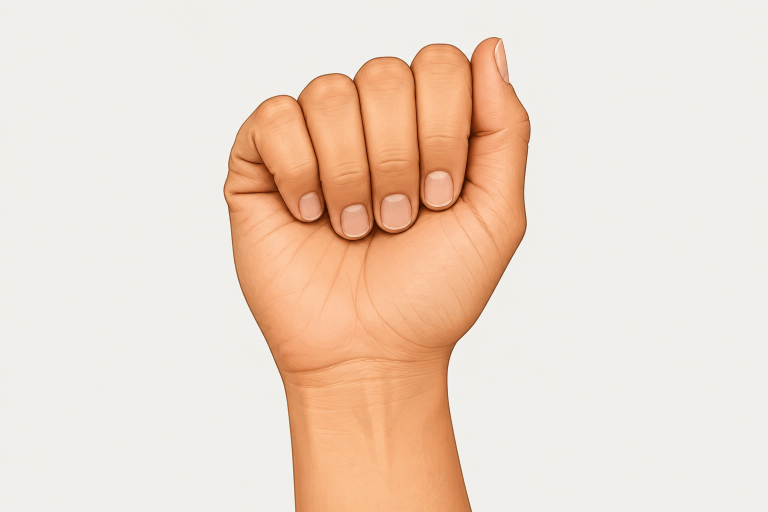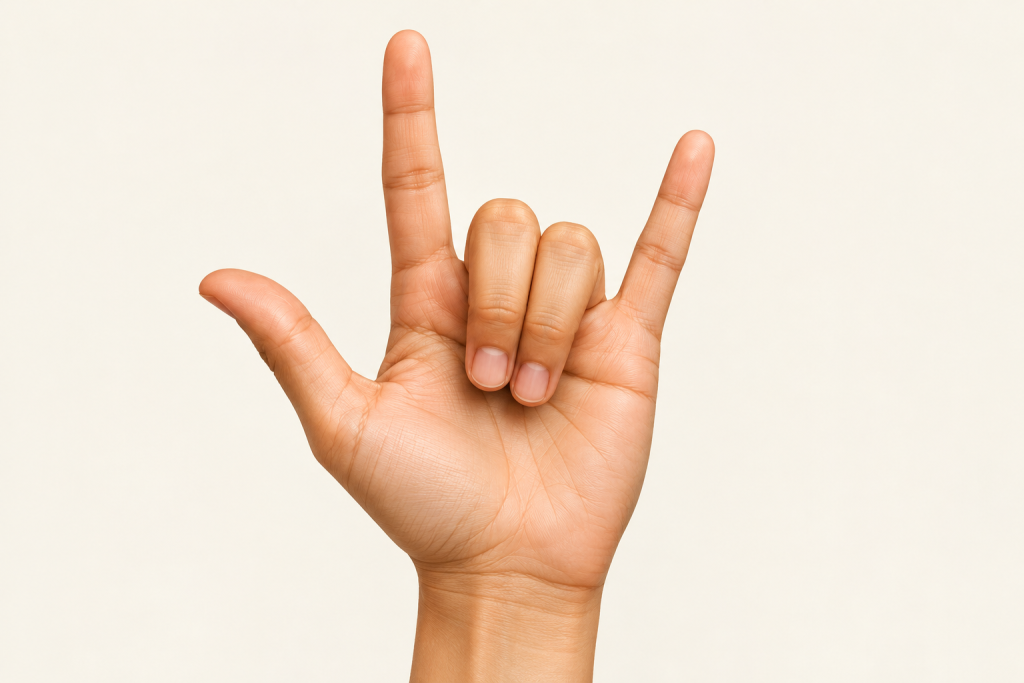
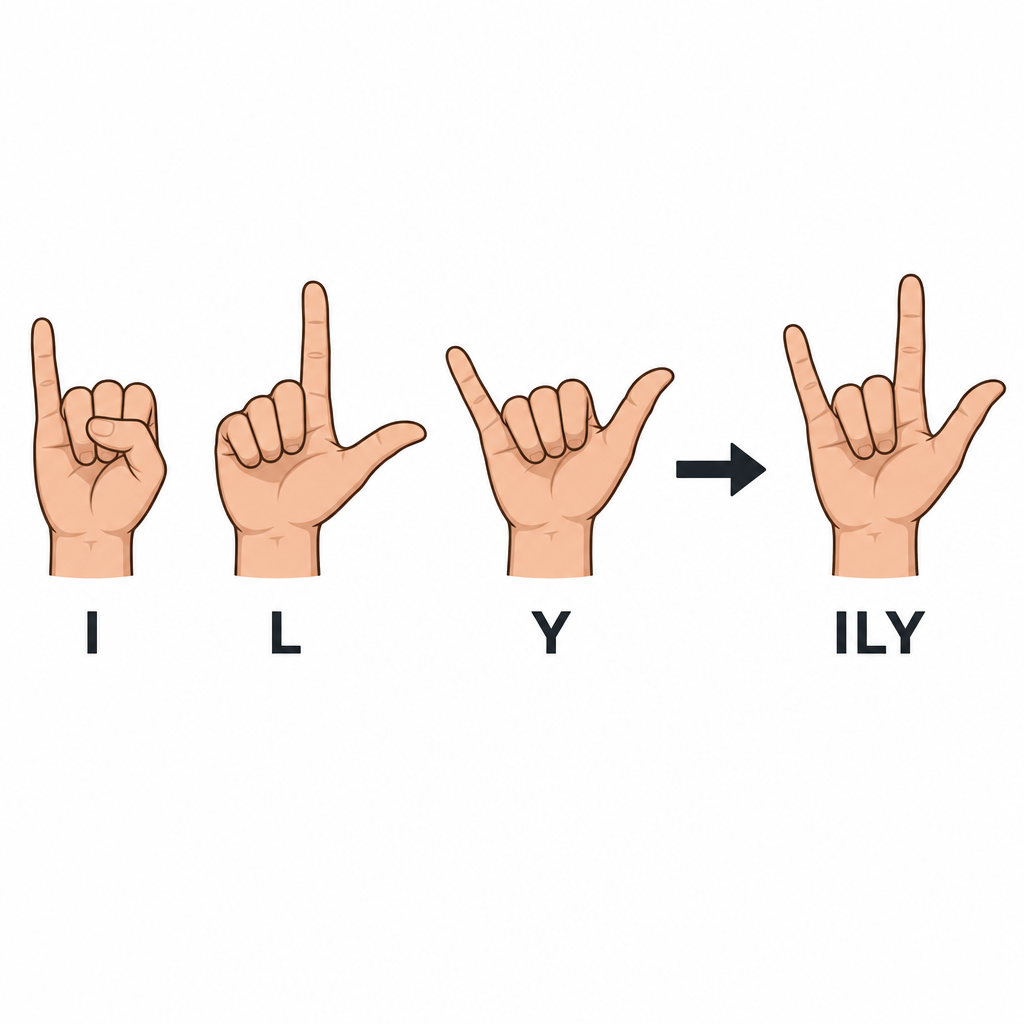
To sign “I love you” in American Sign Language (ASL), raise your thumb, index finger and pinky while folding your middle and ring fingers down to your palm. Face your palm toward the person and hold it up with your dominant hand. That single handshape, called the ILY sign, merges the fingerspelled letters I, L and Y into one gesture.
Last checked: November 26, 2026.
Worth remembering
- ILY is one handshape: thumb, index and pinky up, middle and ring fingers down, palm out.
- The thumb decides the meaning. Without it, the sign stops reading as “I love you.”
- ILY is casual and suits friends, family, groups and goodbyes. For romance, many signers use I + LOVE + YOU.
- “I really love you” crosses the index and middle fingers, according to Lifeprint.
- Sign languages aren’t universal. British, Japanese and Korean Sign Language each have their own signs.
How to sign “I love you” in ASL (quick answer)
Make an “L” with your thumb and index finger, lift your pinky, and keep your middle and ring fingers against your palm. Turn your palm toward the person and hold the hand up at about chest or shoulder height. Lingvano’s ASL guide describes the same shape and says to use your writing hand.
Step-by-step handshape
Making the ILY handshape
- Raise your dominant hand to about shoulder height, fingers relaxed.
- Fold your middle and ring fingers down until they touch your palm.
- Extend your index finger straight up and your thumb straight out to the side, forming an “L”.
- Lift your pinky straight up so it stands parallel to your index finger.
- Turn your palm to face the person you’re signing to, and hold the shape steady.
Done right, you have three points showing (thumb, index, pinky) and two fingers folded. From the front, someone sees your palm with the thumb sticking out sideways.
Palm direction and movement
Your palm faces the person you mean. You can hold the sign still, or give it a small side-to-side shake for warmth. When you sign to someone across a room, lift it a bit higher so it clears heads and furniture.
Signing tip
Point your palm at the person you mean. For a group, sweep the hand slowly across everyone in an arc.
Which hand to use
Use your dominant hand, the one you write with. Left-handed signers use the left hand, and that’s correct ASL, not a mirror-image error. Switching hands from one sign to the next makes your signing harder to read, so pick one and stay with it.
Why the handshape means I-L-Y
ILY works because it stacks three letters from the ASL manual alphabet into a single shape. Lifeprint, the ASL resource run by Dr. Bill Vicars, explains the sign as a blend of the fingerspelled I, L and Y.
| Letter | Handshape on its own | What it adds to ILY |
|---|---|---|
| I | Fist with only the pinky raised | The raised pinky |
| L | Index up, thumb out, other fingers folded | The raised index and the extended thumb |
| Y | Thumb and pinky out, other three fingers folded | The thumb and pinky together |
| ILY | Thumb, index and pinky up; middle and ring folded | All three letters at once |
Look at the overlap. The pinky belongs to both I and Y, and the thumb belongs to both L and Y. Only the middle and ring fingers appear in none of them, so those two stay down. Practising I, L and Y slowly on their own, the way you’d learn the sign language alphabet, makes the combined shape feel natural fast.
Common mistakes: ILY vs. rock on vs. shaka
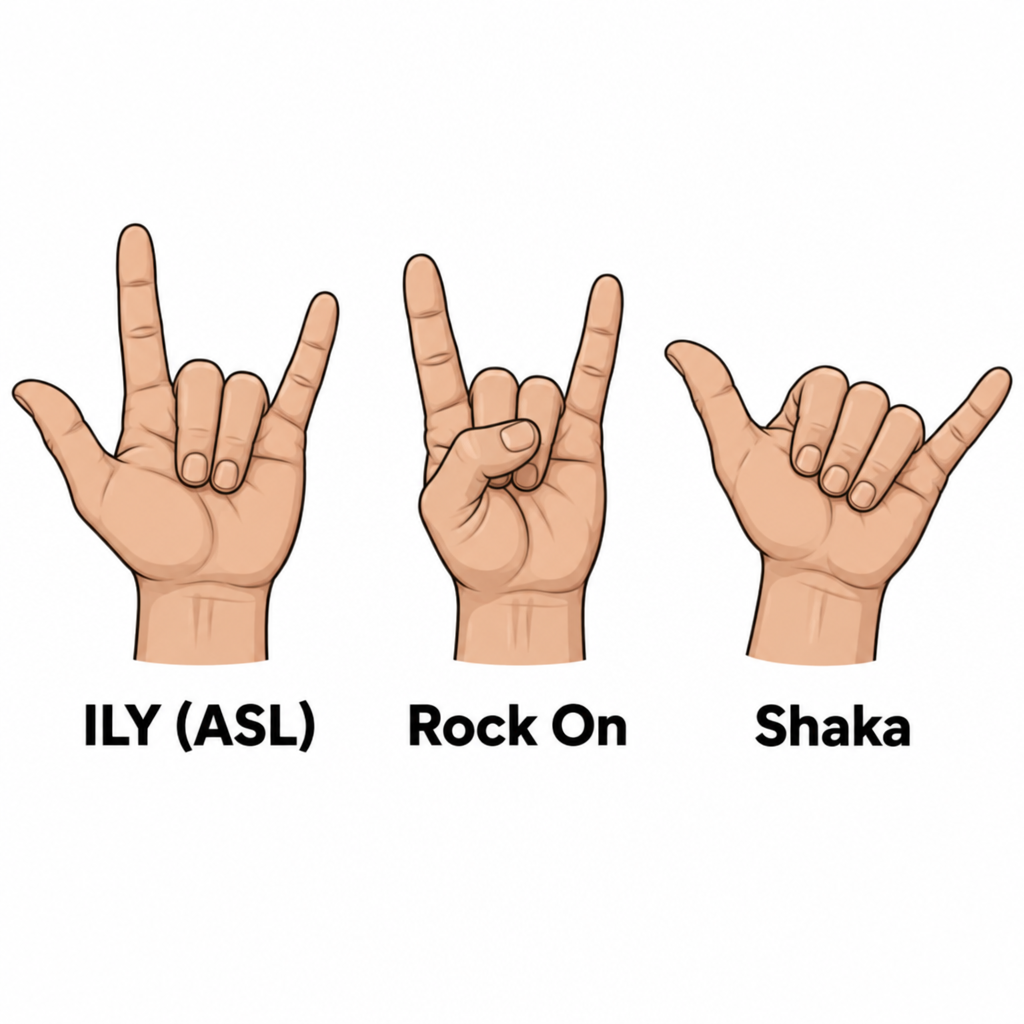
The thumb is the deciding finger. Signing Savvy states that the thumb must be present for the sign to mean I LOVE YOU, and it notes that people often confuse ILY with the Hawaiian shaka.
| Gesture | Fingers extended | Thumb | Meaning | Where it’s used |
|---|---|---|---|---|
| ILY (ASL) | Index and pinky | Extended out to the side | I love you | ASL, Deaf community, widely recognized elsewhere |
| Rock “horns” | Index and pinky | Tucked over the middle and ring fingers | Rock on, heavy metal | Concerts, popularized by Ronnie James Dio |
| Shaka / hang loose | Pinky only | Extended | Relax, hello, thanks | Hawaii, surf culture |
| ASL letter Y | Pinky only | Extended | The letter Y | Fingerspelling |
| “I really love you” | Index and middle crossed, plus pinky | Extended | I really love you | ASL (Lifeprint) |
The thumb rule: why “rock on” isn’t ILY
The rock horns look close, but the thumb clamps the middle and ring fingers down instead of sticking out, so the gesture won’t carry “I love you.” Check your thumb before anything else. It’s easy to miss in photos, where it can hide behind the fingers at certain angles.
Shaka (hang loose)
The shaka matches the ASL letter Y: thumb and pinky out, index folded. Add the index finger and it becomes ILY.
Did you know?
In June 2017, KISS bassist Gene Simmons filed a USPTO trademark application for a gesture with the “thumb extended perpendicular.” Outlets including NME pointed out that this is the ASL “I love you” sign, not the rock horns. IPWatchdog reports he abandoned the application on June 20, 2017, 11 days after filing.
When to use ILY, and when to sign the full phrase
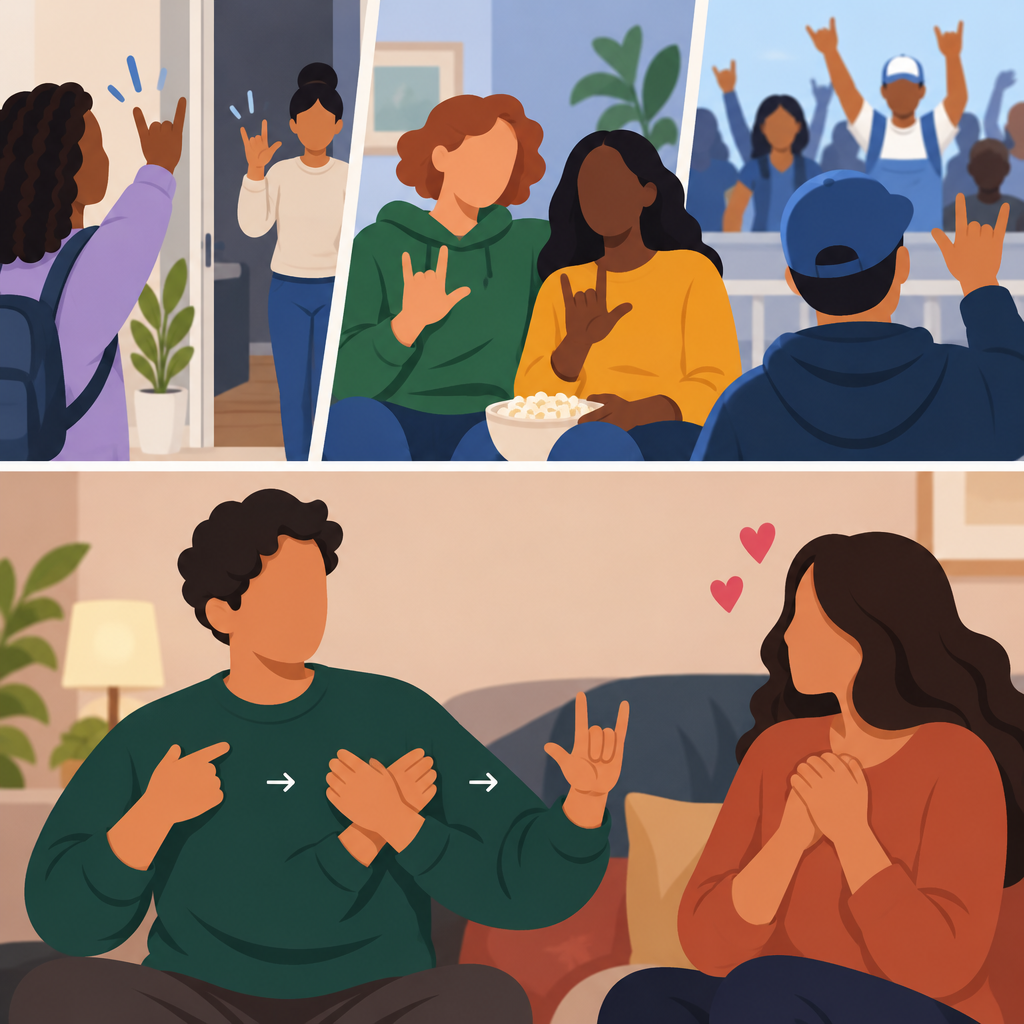
Use ILY for friendly, casual affection: goodbyes, thanks, cheering someone on, or a wave across a crowd. For a romantic or serious “I love you,” many signers use the three signs I + LOVE + YOU. Lifeprint’s Dr. Bill Vicars calls ILY less formal than the crossed-arms LOVE sign.
| Phrase | How to sign it | Register | Best for |
|---|---|---|---|
| ILY | One handshape, palm toward the person | Informal | Friends, family, goodbyes, texts |
| I LOVE YOU (three signs) | Point to self, cross fists on chest, point to the person | Sincere, personal | Partners, serious moments |
| I love you all | ILY swept across the group | Informal | Audiences, classrooms, families |
| I love you too | ILY signed back, or a nod plus ILY | Informal | Replies |
| I really love you | ILY with index and middle crossed | Informal, emphatic | Playful emphasis |
ILY as goodbye and thanks
ILY works as a warm sign-off at the end of a visit or video call. Wiktionary’s ASL entry describes it as usually meaning platonic love and often aimed at a large group of acquaintances. That fits, since Deaf performers and speakers often flash it to a room. When you want to thank someone directly, ASL has its own sign, covered in our guide to thank you in sign language.
Romantic “I love you” in ASL
Sign the three words separately:
- I: point your index finger at the center of your chest.
- LOVE: make two fists, cross them at the wrists and press them against your chest over your heart.
- YOU: point your index finger at the person.
Your face carries much of the meaning. A soft expression, steady eye contact and a slower pace show you mean it. In ASL, facial expression is part of the grammar, not decoration.
Signing tip
For a romantic moment, sign I + LOVE + YOU with a warm expression and keep ILY for goodbyes and texts.
“I love you all” and “I love you too”
For a group, hold ILY with your palm out and move it slowly in an arc across the people you mean. That’s how you’d sign “I love you all” to a class or family. For “I love you too,” the simplest reply is to sign ILY back, usually with a smile or nod. Signers also add a sign for “same” or “too,” but signing ILY back is the reply everyone understands.
Variations: “I really love you,” “I love you forever” and more
You can make ILY stronger by changing the handshape, the movement or your expression. Each one changes how strong the message reads.
I really love you
Cross your index and middle fingers while keeping your thumb and pinky out. Dr. Bill Vicars on Lifeprint says this crossed version means “I really love you,” with the crossed fingers standing in for the letter R. It’s playful and well known among signers.
I love you forever
ASL has a separate sign for FOREVER, so sign ILY or I + LOVE + YOU, then add FOREVER. In a common version, the index finger draws a small circle near the side of the head, then the hand moves forward into a Y shape. Regional versions exist, so compare a dictionary video from Lifeprint or Signing Savvy before you rely on it.
I love you so much
ASL usually shows intensity through movement and the face rather than an extra word. Hold ILY longer, push it toward the person with a little tension, and widen your eyes or nod. With the three-sign phrase, squeeze the crossed fists tighter against your chest.
Signing “I love you” with babies and toddlers
ILY is one of the easiest signs to share with a baby. You can sign it at the same moments every day, such as bedtime, daycare drop-off and goodbyes. Many baby-sign programs borrow ASL signs and sometimes simplify them, so check that the version you learn matches the ASL sign above.
Expect rough attempts. Small hands often lift all the fingers, or just the pinky, before they can fold the middle two. Treat any attempt as communication and keep signing the full, correct shape back. If your baby is Deaf or hard of hearing, full ASL from fluent signers matters far more than a handful of baby signs. Talk to your child’s audiologist and early-intervention team about ASL access.
See a professional
If a baby doesn’t react to sounds, or an older child or adult loses hearing suddenly, see a doctor or audiologist promptly. Sudden hearing loss is a medical emergency.
Nearby signs people mix up: sorry, please and love
Several common ASL signs happen on the chest, and the handshape tells them apart. Signing Savvy lists PLEASE and SORRY as a “close but not the same” pair. Both circle on the chest, but SORRY uses a closed A-handshape fist and PLEASE uses an open flat hand.
| Sign | Handshape | Movement | Meaning |
|---|---|---|---|
| SORRY | Closed fist, thumb alongside (A) | Circles on the chest | I’m sorry, apology |
| PLEASE | Flat open hand (B) | Circles on the chest | Please, polite request |
| LOVE | Two fists, wrists crossed | Pressed against the chest, held | Love, affection |
| I / ME | Index finger | Points to or touches the chest | I, me |
How to sign “I’m sorry”
Make a fist with your dominant hand, thumb resting along the side. Place it on your chest and rub it in small circles. A sincere expression matters as much as the hand.
What rubbing your chest means
Circling your hand on your chest usually means PLEASE (flat hand) or SORRY (fist). If someone circles a fist and looks apologetic, they’re saying sorry. If the hand is open and they look hopeful, they’re asking please.
Is ILY the same in other sign languages?
No. Sign languages aren’t universal. British Sign Language (BSL), Japanese Sign Language (JSL) and Korean Sign Language (KSL) are separate languages with their own vocabularies. Many Deaf people abroad recognize the ASL ILY sign, but in their own language it may not be the usual way to say “I love you.”
British Sign Language
BSL uses a two-handed fingerspelling alphabet, so the I-L-Y letter logic doesn’t carry over. BSL has its own sign for love. BSL SignBank, a dictionary project linked to University College London, and British Deaf organizations are good places to check it.
Japanese and Korean
JSL and KSL developed separately from ASL and have their own signs for love and affection. For those, use a national sign-language dictionary or a Deaf association in that country rather than a gesture you saw online. If you’re signing to a Deaf person from another country, ILY will often be understood, but asking how they say it in their language is the more respectful move.
A short history of the ILY sign
The ILY sign is usually traced to deaf schoolchildren in the US in the early 1900s. It reached mainstream audiences in the 1970s and went digital in 2017. Treat the early date as attributed rather than proven.
| Year | Event | Source |
|---|---|---|
| 1905 (attributed) | Origin among deaf schoolchildren combining I, L and Y | Wikipedia, citing Jack Gannon’s Deaf Heritage |
| 1971-1977 | Records of the I Love You Foundation | Gallaudet University Archives |
| 1977 | Jimmy Carter reportedly flashes ILY to deaf spectators at his inauguration parade | Wikipedia |
| 1976-1985 | Richard Dawson ends Family Feud episodes with ILY during his first run as host, giving it wide TV exposure | Wikipedia |
| June 2017 | Gene Simmons files a trademark for the thumb-out gesture, then drops it on June 20 | IPWatchdog, NME |
| 2017 | 🤟 approved in Unicode 10.0 and added to Emoji 5.0 | Unicode data via Codepoints.net, Emojipedia |
Gannon’s Deaf Heritage, a narrative history of Deaf America published by Gallaudet University Press, is the source Wikipedia gives for the 1905 date. Wikipedia’s own article flags that its inline citations are thin, so the date is best read as “reported by a respected Deaf historian.” According to Wikipedia, Carter learned the sign from deaf supporters in the Midwest. That story is also reported rather than firmly documented. For the wider background of the language, see our article on the meaning of ASL and how American Sign Language began.
The 🤟 emoji, GIFs and tattoos
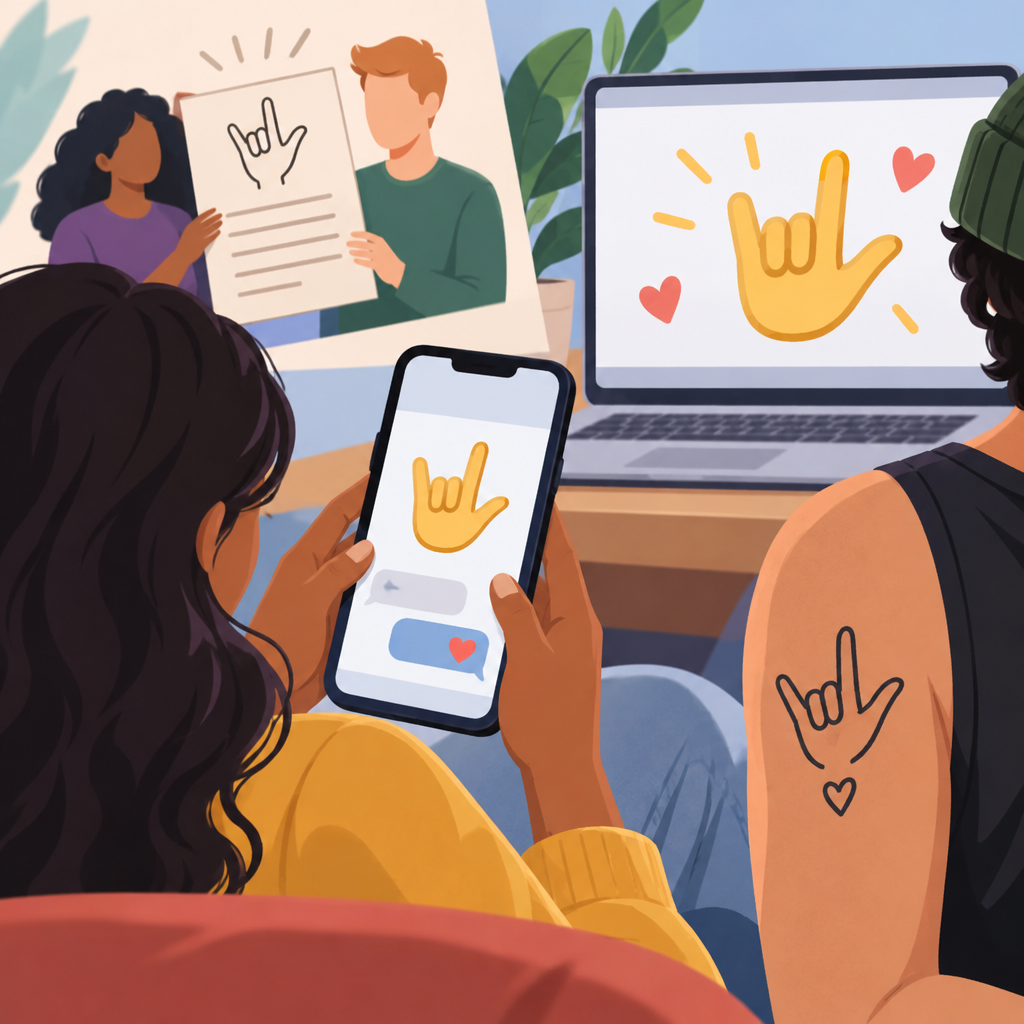
The 🤟 emoji is the ILY sign, and its official Unicode name says so outright. Codepoints.net lists U+1F91F as “I LOVE YOU HAND SIGN,” added in Unicode 10.0 in 2017. Emojipedia notes it joined Emoji 5.0 the same year, and its Unicode CLDR short name is “love-you gesture.”
Did you know?
According to Dictionary.com, the 🤟 emoji came about after a petition by two people, one of them Western Oregon University professor C.M. Hall.
To type it, search “love you” or “love-you gesture” in your phone’s emoji keyboard. It supports the five standard skin-tone modifiers, which you pick by long-pressing the emoji. Designs differ between Apple, Google, Samsung and others, and some show the thumb at a more natural angle than others.
Tattoo and photo checklist
- Thumb visible: without the thumb it reads as horns.
- Palm facing out: that’s how the person receiving the sign sees it.
- Not mirrored: front cameras often flip images, which puts the thumb on the wrong side for a right-handed reference.
- Real reference: work from a photo of a fluent signer, not an emoji, since emoji art varies by platform.
- Middle and ring fingers clearly folded: half-folded fingers blur in ink and in small photos.
Signing tip
Before you post a selfie or take it to a tattoo artist, flip the image so it matches what a viewer would see facing you.
For a tattoo, both views work. The palm-out view is how a viewer sees the sign, and the back-of-hand view is how you see your own hand. Choose one on purpose and check that the thumb points the right way for that view.
Etiquette: can hearing people use ILY?
Yes. Hearing people are welcome to use ILY, and Deaf people generally like seeing it used correctly. CHC Hearing describes ILY as a sign for anyone you share a connection with, and as a symbol of Deaf identity, pride and visibility. That weight is a reason to sign it well, not a reason to avoid it.
Opinions do differ. Lifeprint’s Dr. Bill Vicars calls ILY a “cute” bit of signing that doesn’t come up much in everyday Deaf conversation. CHC Hearing stresses its cultural meaning. Both are true: it’s casual, and it also matters to people.
Using ILY with a Deaf girlfriend or boyfriend isn’t weird. Notice how your partner uses it and ask what they prefer. Some couples keep ILY for goodbyes and sign I + LOVE + YOU for bigger moments. When hearing friends assume ILY is romantic, you can explain it’s closer to “love you, see you” or “love you all,” the way you’d say it to a cousin.
If you want to use more than one sign, learn some real ASL from Deaf teachers. That respects the language more than a single gesture. Varieties such as Black American Sign Language show how much ASL varies across the community.
Can’t fold your fingers? Adapting the sign
If arthritis, injury or limited dexterity keeps your middle and ring fingers from folding all the way, aim to keep the shape readable rather than perfect. Signers adapt handshapes all the time, and context fills in a lot.
- Rest the fingers lightly: curl the middle and ring fingers as far as is comfortable. A partial curl still reads as ILY if the thumb, index and pinky stand out.
- Use the thumb only if you must: holding the folded fingers down with the thumb takes the thumb out of the sign. It then looks like horns, so add context such as a smile or the three-sign phrase.
- Use the other hand: if your dominant hand hurts, sign with the other one, or press the fingers down gently with it.
- Switch to I + LOVE + YOU: pointing and crossed fists ask much less of your fingers.
See a professional
If folding your fingers causes pain, numbness or swelling, see a doctor or hand therapist instead of forcing the shape.
Related signs to learn next
These signs come up in the same moments as ILY: greetings, goodbyes, thanks and apologies. Learn them as a set.
- Hello: a flat hand starting near the forehead and moving outward, like a small salute.
- Thank you: flat-hand fingertips at the chin, moving forward toward the person.
- Sorry: a fist circling on the chest, covered above.
- Please: a flat hand circling on the chest, covered above.
- Love: fists crossed at the wrists over the heart.
- Goodbye: an open hand waving, or folding the fingers down and up.
- The ASL alphabet: the letters I, L and Y are the foundation of ILY itself.
FAQ
How do you sign “I love you” in sign language?
In ASL, raise your thumb, index finger and pinky, fold your middle and ring fingers, and face your palm toward the person, as in the five steps above.
What is “j love you” in sign language?
There’s no “J love you” sign. It’s almost always a typo for “I love you.” In the ASL alphabet, J is the pinky tracing a J shape in the air, which has nothing to do with ILY.
Do Deaf people actually use the ILY sign?
Yes, mostly for goodbyes, greetings to crowds and photos. Lifeprint notes it isn’t used heavily in everyday conversation, where a full signed sentence is more common.
Does “ILY” in a text mean the same as the sign?
Yes. ILY is the standard texting abbreviation for “I love you,” and the 🤟 emoji is its visual match, so a text, the emoji and the sign all carry the same casual, affectionate meaning.
Your next step
The thumb is the detail to get right first. Practise I, L and Y one at a time in front of a mirror, merge them, and check that your thumb sticks out to the side. Once ILY feels natural, learn I + LOVE + YOU as well, so you have a casual version and a serious one.
About this article
- Fact-checked by Lorraine Ostrowski against the sources listed below before publication.
- Published
Sources (8)
- Lifeprint: I Love You in ASL (lifeprint.com)
- Lifeprint: ILY discussion (Dr. Bill Vicars) (lifeprint.com)
- Lingvano: I Love You in Sign Language (lingvano.com)
- ILY sign (Wikipedia via Wikiwand) (wikiwand.com)
- ILY sign – Wikipedia (en.wikipedia.org)
- Gallaudet University Archives: I Love You Foundation, 1971-1977 (gallaudet.edu)
- Deaf Heritage (Gallaudet University Press via Project MUSE) (muse.jhu.edu)
- Emojipedia: Love-You Gesture (emojipedia.org)