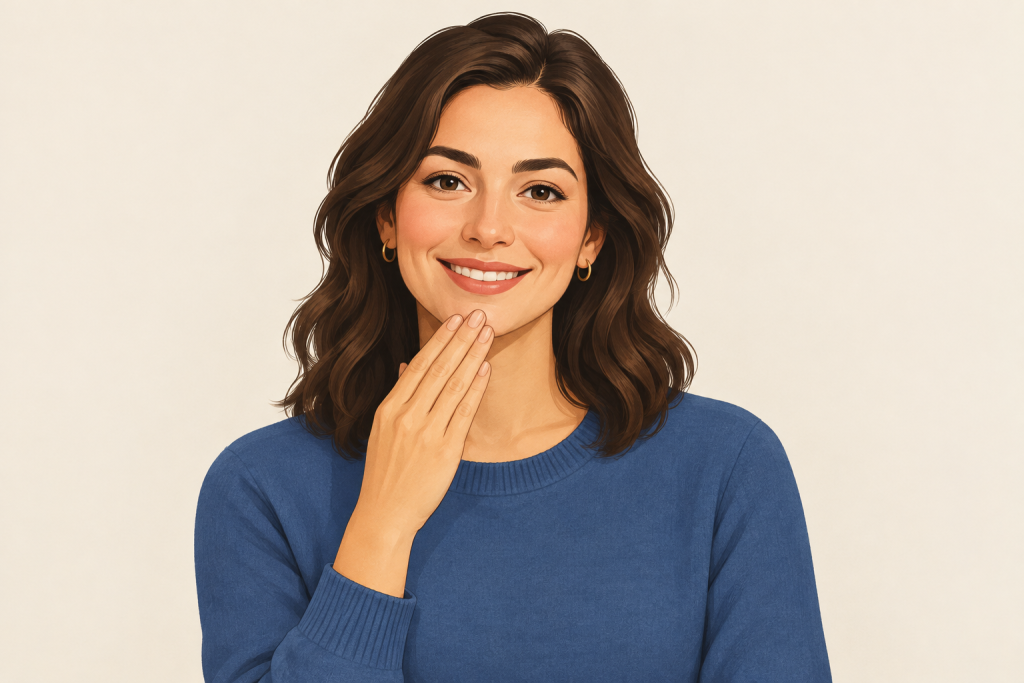
To sign thank you in American Sign Language (ASL), put the fingertips of your flat dominant hand at your chin or lips, palm toward you. Then move the hand forward and slightly down toward the person until your palm faces up, and smile while you do it. This page breaks that movement into its parts, shows the variants, and separates it from the signs it gets confused with. Last checked November 2026.
Worth remembering
- THANK-YOU is one flat hand moving from your chin or lips out toward the person you are thanking.
- Two hands means “thank you very much” and also works for thanking a group.
- Your smile is part of the sign, not decoration.
- A vertical hand means THANK-YOU. A horizontal hand drifts toward GOOD.
- ASL is not universal: British Sign Language (BSL) and others have their own vocabulary.
Fact-checked
We checked these key facts against the sources named, on November 24, 2026:
- It had about 108,000 enrollments, up 0.8% from 2016, and 44 more institutions offered ASL than in 2016 (source: mla.org)
- The Essentials of Linguistics textbook (2nd edition, published through eCampusOntario) uses THANK-YOU as its worked example of an open-B sign (source: ecampusontario.pressbooks.pub)
- The Modern Language Association’s Fall 2021 census, published in November 2023, ranked ASL as the third most-studied language other than English at US colleges (source: mla.org)
How to sign “thank you” in ASL (quick answer)
THANK-YOU in ASL takes one hand and about one second. Many learners remember it as a gentle blown kiss, made a little lower and without the kiss.
Signing THANK-YOU
- Hold your dominant hand flat, fingers together, thumb resting alongside (the open-B handshape).
- Touch your fingertips lightly to your chin or just below your lips, palm facing you.
- Move your hand forward and slightly down toward the person you are thanking.
- Finish with your palm facing up, and smile or nod while you sign.
Signing Savvy describes the sign as using only the dominant hand and says it is similar to blowing someone a kiss. Baby Sign Language‘s dictionary adds a useful correction: the sign sits a bit lower than a real blown kiss.
This is the ASL sign used in the United States and much of Canada. If you are signing in the UK or Australia, check the local sign language first (more on that below).
The THANK-YOU sign, broken down
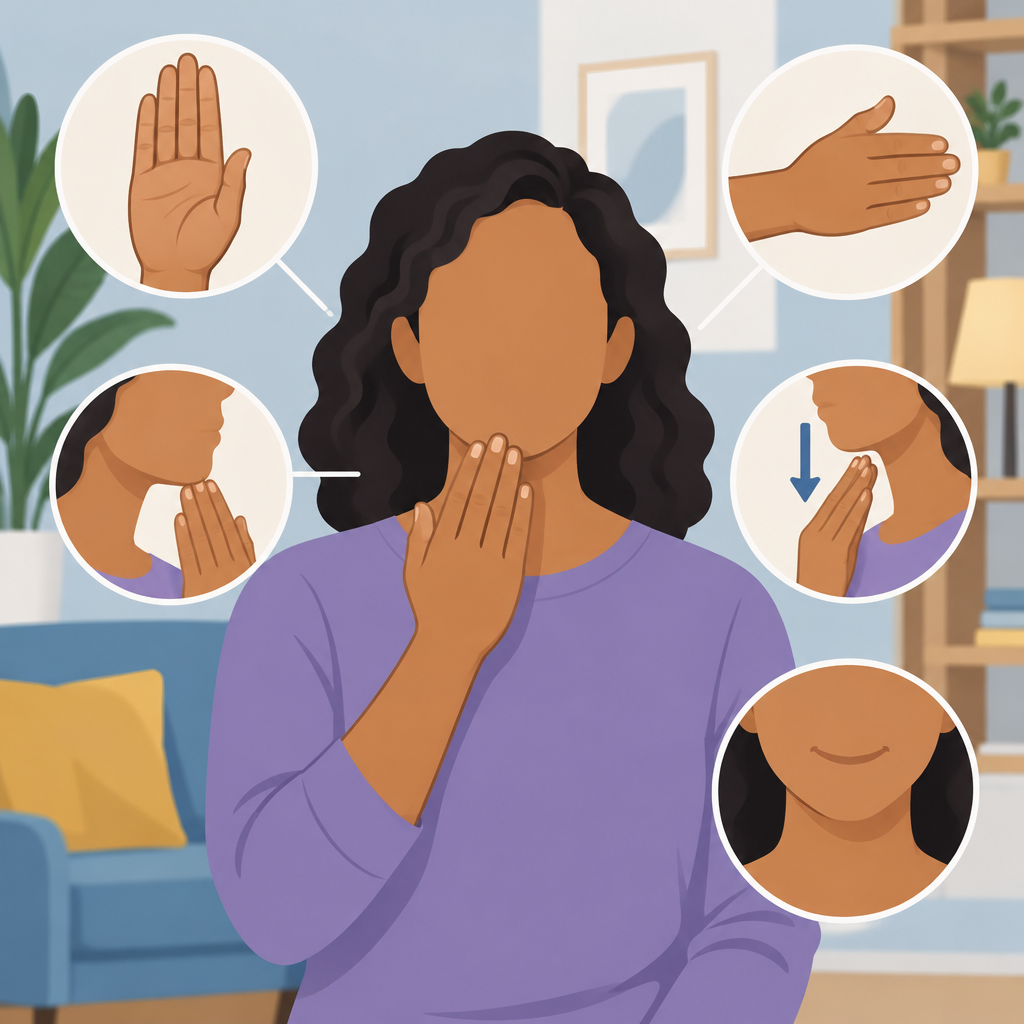
Signs are described by their parameters: handshape, location, palm orientation, movement and non-manual markers such as facial expression. Get those five right and your THANK-YOU will be clear to any ASL signer.
| Parameter | What to do | Common mistake |
|---|---|---|
| Handshape | Flat open-B hand, fingers together | Spread fingers or a loose, curled hand |
| Location | Fingertips at the chin or just below the lips | Starting at the cheek or the nose |
| Palm orientation | Palm toward you at the start, palm up at the end | Ending palm-down |
| Movement | One smooth arc forward and down toward the person | Moving sideways or straight down |
| Facial expression | Warm smile, a slight nod | A blank face, which reads as flat or insincere |
Handshape: flat (open-B) hand
The handshape is the open-B: fingers straight and together, thumb tucked along the side of the hand. The Essentials of Linguistics textbook (2nd edition, published through eCampusOntario) uses THANK-YOU as its worked example of an open-B sign.
If you already know the sign language alphabet, this is the fingerspelled letter B with the thumb relaxed alongside instead of folded across the palm.
Location: chin or lips? What the sources say
Both are accepted, and no fluent signer will misread either one. The difference is real but small, and sources really do disagree.
- Lifeprint (ASL University, Dr. Bill Vicars) says to start with your fingers near your lips.
- Essentials of Linguistics describes the sign as starting on the chin.
- Signing Savvy’s look-alike article has the hand starting at the chin and moving forward and down, “like a bow.”
Did you know?
Lifeprint’s entry for GOOD records a Deaf employee insisting that GOOD comes off the lips and THANK-YOU off the chin. A Deaf instructor quoted on the same page says GOOD made from the chin still means GOOD.
The practical answer: start at the chin or the lower lip, touch lightly, and focus on the movement. That matters more than which spot your fingertips land on.
Movement: toward the person, ending palm-up
The movement is directional. Lifeprint says to move your hand toward the person you are thanking, and the linguistics textbook describes the path moving outward into neutral signing space as your elbow straightens.
So if your friend is on your left, the sign travels a little to the left. Pointing it at empty space looks like you are thanking nobody in particular.
Hearing tip
End with your palm facing up toward the person. A sign that stops palm-down or drifts sideways looks unclear.
Facial expression is part of the sign
In ASL your face carries grammar and tone. Lifeprint tells you to smile a bit while signing THANK-YOU.
A deadpan THANK-YOU is a bit like a spoken “thanks” in a flat monotone. It is understood, but it lands as reluctant. A nod, a real smile and eye contact make the sign warm.
Thank you very much, thanks a lot, and thanking a group
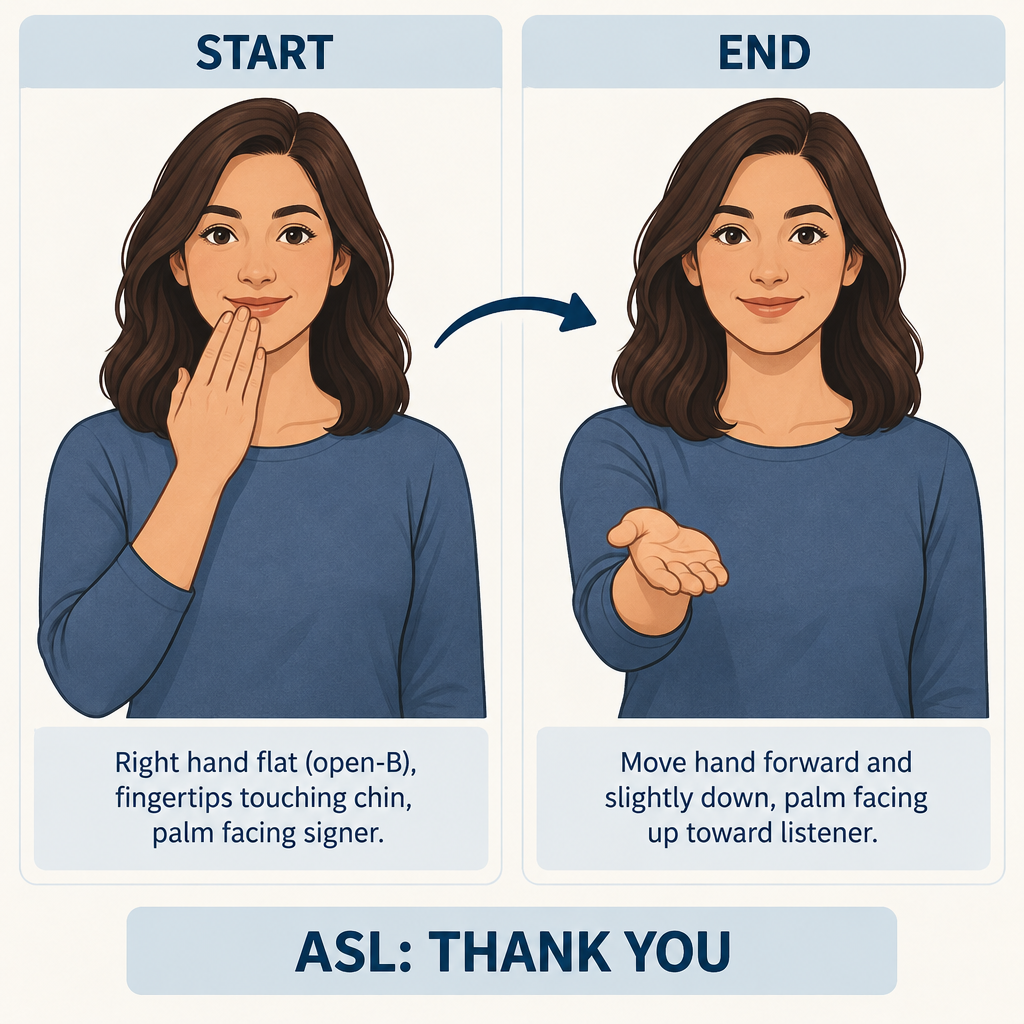
ASL shows degree through the hands and the face, not extra words. The main tool is a second hand.
| English | ASL form | When to use |
|---|---|---|
| Thank you / thanks | One-handed THANK-YOU | Everyday thanks: a held door, a coffee order |
| Thank you very much | Two-handed THANK-YOU | Real gratitude, a favour, a gift |
| Thanks a lot / so much | Two hands, bigger movement, stronger smile or nod | Enthusiastic thanks |
| Thank you, everyone | Two hands sweeping out toward the group | A class, an audience, a team |
| Very thankful | Two hands moving up and down together twice | Expressing gratefulness as a feeling |
Two-handed THANK-YOU
According to Lifeprint, using two hands for THANK-YOU means you are “very” grateful. Both open-B hands start at the chin or lips and move out together.
You can add emphasis by making the movement a little larger and slower and letting your expression show more feeling. Avoid repeating the one-handed sign over and over, which reads more like nervous fidgeting than emphasis.
Thanking a group or an audience
Signing THANK-YOU with both hands also works when you are thanking several people at once. Lead Academy’s guide notes that the two-handed form adds emphasis and suits a large group.
For an audience, let both hands travel outward and sweep slightly across the room. That way the direction includes everyone.
Thank you for coming / for your help (combining signs)
ASL often puts the topic first and the thanks after. A common pattern is the reason, then THANK-YOU directed at the person.
For “thank you for helping,” you would sign HELP and then THANK-YOU toward the person who helped. For “thank you for coming,” sign COME and then THANK-YOU. Word order in ASL follows its own grammar, not English, which is part of why the meaning of ASL as a separate language matters to learners.
Signs that look like “thank you” and how not to mix them up
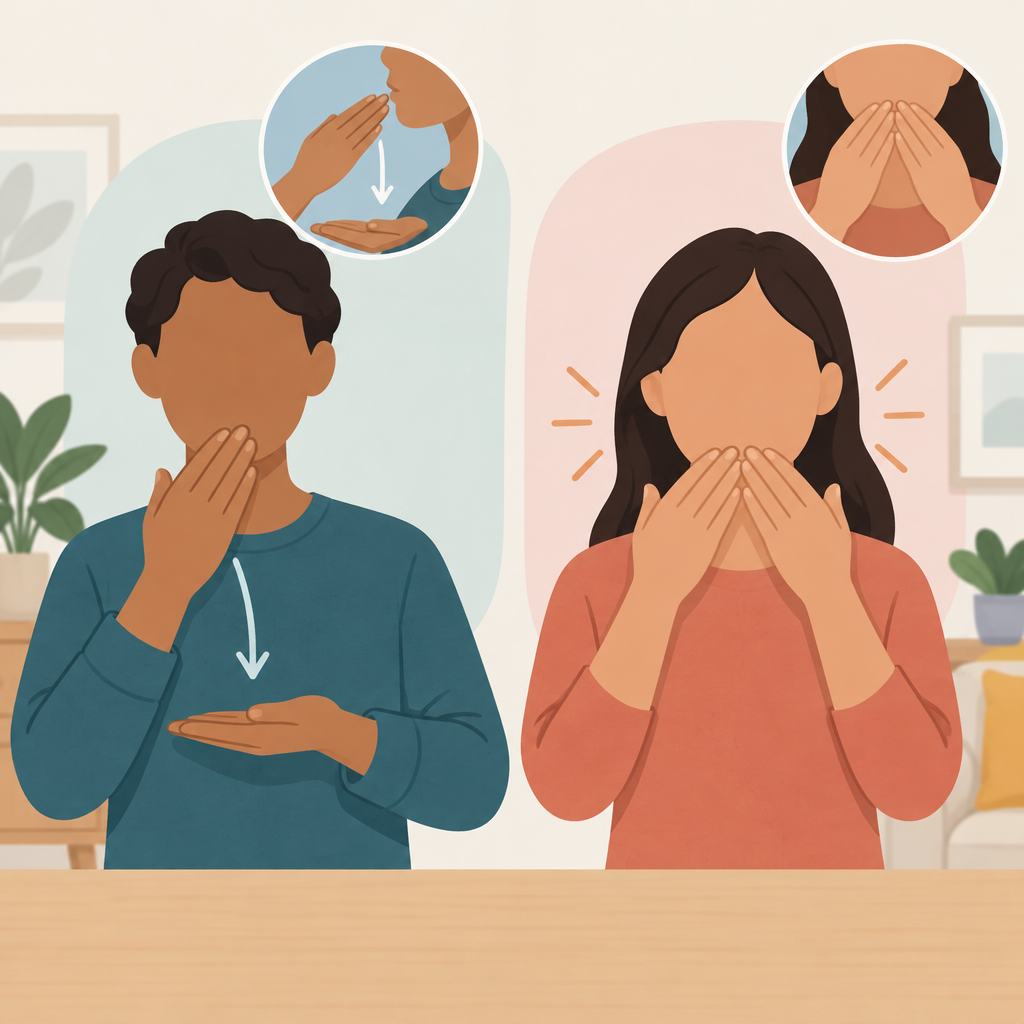
Most confusion comes from a handful of signs that share the open-B hand or the mouth area. One cue usually tells them apart.
| Sign | Hands | Start/end location | Key difference from THANK-YOU | Source |
|---|---|---|---|---|
| GOOD | One or two | Lips or chin, then down onto the other palm | Hand turns horizontal and often lands on the non-dominant palm | Lifeprint, Baby Sign Language |
| VERY THANKFUL | Two | Mouth area, hands move up and down twice | Two hands, repeated movement | Signing Savvy |
| THANKSGIVING | Two (common form) | Chin area outward | Two hands; regional variants exist | Signing Savvy |
| KISS | One | Fingertips touch the lips, then the cheek | Second contact on the cheek, no forward path | General ASL dictionaries |
| A real blown kiss | One | Lips, then flung away | Higher on the face, with a pucker | Baby Sign Language |
THANK-YOU vs GOOD
These two are nearly twins, and Lifeprint warns about it directly. GOOD typically starts at the mouth and comes down to rest on the palm of your non-dominant hand.
Baby Sign Language points out that if you skip the resting palm, GOOD looks like THANK-YOU. Its rule of thumb: the THANK-YOU hand is vertical, the GOOD hand is horizontal.
That also answers a common family question: “My kid’s sign for thank you looks like ‘good’, which is right?” Young children often blend the two. Context usually makes the meaning obvious, and gently modelling the vertical hand will sort it out over time.
Hearing tip
Keep your fingers together and your hand vertical as it leaves your chin. A hand that flattens out horizontally starts to look like GOOD.
THANK-YOU vs THANKFUL and THANKSGIVING
Signing Savvy’s “Signs That Are Close… But Not the Same” article covers these three together. All use the open-B handshape. THANK-YOU uses one hand, while VERY THANKFUL and THANKSGIVING use two.
VERY THANKFUL has a repeated up-and-down movement with both hands, which Signing Savvy says resembles blowing kisses. Lifeprint adds that THANK-YOU itself can express gratitude, and a more formal two-handed movement is one way to separate the ideas.
THANKSGIVING has more than one form depending on region and signer. If you are signing it for a classroom or holiday card video, watch a dictionary video rather than guessing.
The mistake beginners worry about most
The fear usually comes in two versions: “Is it rude if my thank you looks like blowing a kiss?” and “Can I accidentally sign something offensive?”
On the kiss question, no. Deaf signers see THANK-YOU every day and read it from context. Keep the sign at chin level, skip the pucker, and move forward toward the person.
On the offensive question, the gesture people half-remember is the chin flick, where the back of the fingers brushes forward from under the jaw. It is an insult in Italy and parts of Europe. THANK-YOU is the opposite: the fingertips touch, the palm faces you, and the hand opens out with a smile. Do it with a flat, open hand and you cannot drift into it.
How Deaf signers reply: “you’re welcome” in ASL
There is no single, direct ASL translation of “you’re welcome.” Ava’s ASL guide says this, and adds that reply signs vary by region and by person.
That answers the reader question “Is there even a sign for you’re welcome or do Deaf people just nod?” Often, yes, the reply is a nod and a smile. That is a complete, polite answer in ASL.
Other common replies include signing THANK-YOU back to the person, or a casual sign meaning something like “sure” or “it’s fine.” Which one you see depends on the person, the region and how formal the moment is.
If someone thanks you and you do not know a reply sign, a warm nod and eye contact is correct. No apology needed.
Related polite signs: please and sorry
Two other signs come up in the same breath as THANK-YOU, and Signing Savvy treats them as a look-alike pair.
- PLEASE: flat open-B hand on your chest, moving in a circle.
- SORRY: fist (A handshape) on your chest, moving in a circle.
Same location, same circle. The handshape is the only difference, so check your hand before you apologise by accident.
“Thank you” in other sign languages
Sign languages are not universal. Each Deaf community has its own language, with its own vocabulary and grammar. ASL itself has variants too, including Black American Sign Language, which has its own history and features.
ASL vs BSL
British Sign Language is a separate language from ASL, not a dialect of it. Kids’ explainers comparing the two list “thank you” among the signs that differ.
The BSL forms also sit near the mouth and chin, so they can look familiar to an ASL signer. Some UK beginner materials say BSL signers often use the same or a very similar sign for please and thank you, told apart by mouthing the English word. That comes from community teaching guides, so check it against a BSL source.
For the exact form, watch the video entry for “thanks” in the British-sign.co.uk BSL dictionary, or ask a BSL user. Australia uses Auslan, which is related to BSL, and the official Auslan Signbank lists its thanks sign with video.
Baby sign and Signing Time versions
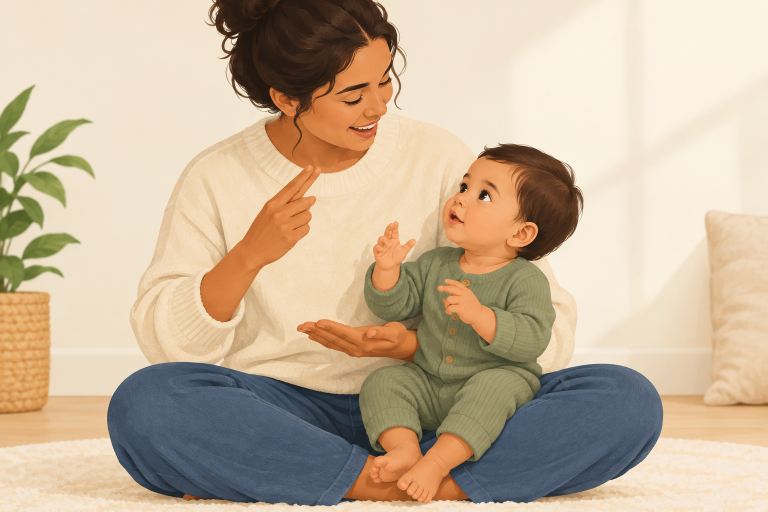
Baby sign language programmes generally teach the ASL THANK-YOU sign, sometimes simplified. The Baby Sign Language dictionary uses the same flat hand from the chin moving forward. Children’s video series such as Signing Time also teach ASL vocabulary.
Toddlers’ versions are often sloppy, with a hand that pats the mouth or waves outward. That is normal motor development, not a different sign.
Etiquette: thanking a Deaf person or an interpreter
Sign or speak to the Deaf person directly, and look at them, not at the interpreter. ASL interpreters relay what is said. They are not the person you are talking to.
Hearing tip
When an interpreter is present, sign THANK-YOU to the Deaf person and keep eye contact with them. You can thank the interpreter separately afterwards.
Will one sign be weird or patronising?
No. A single, sincere THANK-YOU to a Deaf cashier or barista is usually received as the courtesy it is. Many Deaf people appreciate hearing people who learn even the basics.
What does land badly is putting on a show: big exaggerated signs, speaking very slowly while signing, or assuming the person cannot read or lipread. Sign it once, smile and move on, the same as you would say “thanks.”
Pair it with text or captions
If you need to say more than “thank you,” type it on your phone. Text works well, and in group settings live captioning apps such as Ava help hard of hearing people follow along. Knowing the closed captioning vs subtitles difference also helps when you share video with Deaf friends.
See a professional
If a family member’s hearing drops suddenly, often in one ear, treat it as an emergency and get them to a doctor the same day. For gradual changes, book a hearing test with an audiologist.
Practise and get feedback for free
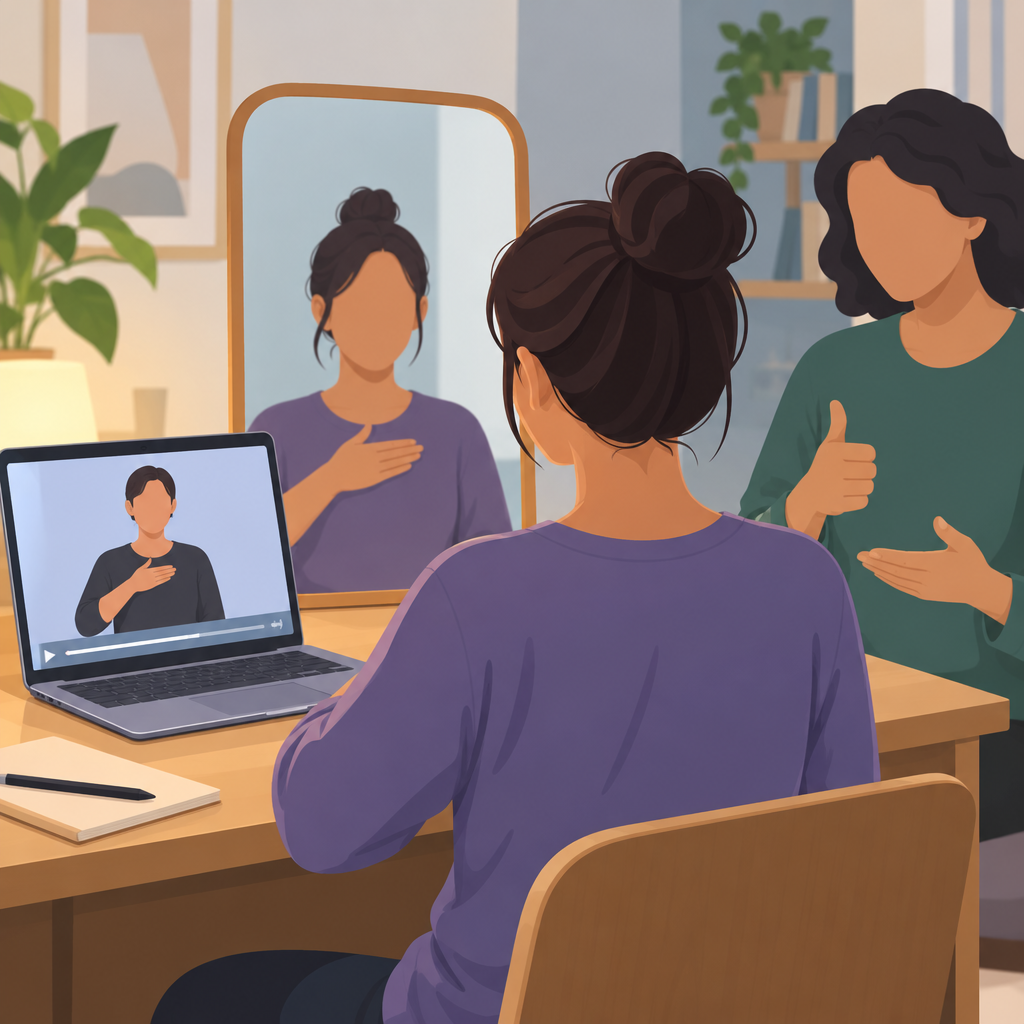
Watching a video, copying it in a mirror and then getting feedback is the fastest route to a clean THANK-YOU. These are the free options with the strongest track record.
| Resource | Format | Feedback? | Notes |
|---|---|---|---|
| Lifeprint / ASL University | Written lessons, photos, video | No | Run by Dr. Bill Vicars; detailed notes on variants and disagreements |
| Signing Savvy | Video dictionary and articles | No | Clear look-alike comparisons; some features need a paid membership |
| NVIDIA Signs | Web platform with a 3D avatar | Yes, via webcam | Built with the American Society for Deaf Children and Hello Monday |
| Baby Sign Language dictionary | Illustrated entries | No | Plain explanations for parents |
| Local Deaf events and ASL classes | In person | Yes, from people | The best feedback available |
NVIDIA launched Signs in February 2025 with the American Society for Deaf Children and the creative agency Hello Monday. It launched with 100 signs and aims to grow to 1,000. An AI tool analyses your webcam footage and gives feedback on your signing.
Its limits are worth knowing. At launch NVIDIA said Signs tracks hand movements and finger positions but not facial expressions or head movement. So it cannot tell you whether your THANK-YOU looks warm. It also needs webcam access.
That is the honest counter-argument to any app. Software can check your handshape. Deaf signers and other fluent signers can tell you whether you look natural, and classes or community events give you that.
Why learning even one ASL sign matters
Plenty of people want to learn ASL. The question of how many people use it has a much less certain answer.
The Modern Language Association’s Fall 2021 census, published in November 2023, ranked ASL as the third most-studied language other than English at US colleges. It had about 108,000 enrollments, up 0.8% from 2016, and 44 more institutions offered ASL than in 2016. That is the latest complete MLA census; Fall 2024 results had not been released when this page was checked.
Did you know?
According to Inside Higher Ed’s report on the MLA census, overall college enrollment in languages other than English fell 16.6% from fall 2016 to fall 2021, while ASL grew slightly.
How many people use ASL is much less certain. A 2006 paper in Sign Language Studies by Ross Mitchell, Travas Young, Bellamie Bachleda and Michael Karchmer found that every data-based estimate traces back to a single study from the early 1970s, and nobody routinely collects data on ASL use.
A commonly cited figure is about 500,000 ASL users in the US, but the basis for that estimate and its definition of ASL use are limited. Published estimates have ranged from 100,000 to 15 million. Treat any precise figure with caution.
The takeaway: your THANK-YOU will be seen by a large, real community. Start there, then learn PLEASE, SORRY and the alphabet next.
FAQ
How do you sign thank you in ASL?
Place the fingertips of your flat dominant hand at your chin or lips, palm facing you. Move it forward and slightly down toward the person until your palm faces up, and smile.
Is the thank you sign one hand or two?
One hand is the standard form. Two hands means “thank you very much” and also works for thanking a group.
How do you sign thank you very much in sign language?
In ASL, sign THANK-YOU with both hands at once, starting at the chin and moving out toward the person. A slightly larger movement and a stronger expression add emphasis.
Does thank you in sign language start at the chin or the lips?
Either is accepted. Lifeprint describes starting near the lips, while Signing Savvy and the Essentials of Linguistics textbook describe the chin. Touch lightly and focus on the outward movement.
What’s the difference between thank you and good in ASL?
THANK-YOU keeps the hand vertical and moves it toward the person. GOOD turns the hand horizontal and usually lands it on your other palm.
How do you say you’re welcome in sign language?
ASL has no single direct equivalent. A nod and smile is common and polite. Some signers sign THANK-YOU back or use a casual “sure” or “fine” style sign, and this varies by region.
Is thank you the same in British Sign Language?
No. BSL is a separate language with its own vocabulary, even though its thank-you sign also sits near the mouth. Watch a BSL video dictionary such as British-sign.co.uk before using it in the UK.
How do you sign thank you to a group?
Use the two-handed THANK-YOU and let your hands sweep outward across the group, so the direction includes everyone.
How do you sign thank you in baby sign language?
Most baby sign programmes use the ASL sign: a flat hand from the chin moving forward. A toddler’s version that pats the mouth is a normal early attempt.
Is the thank you sign the same as blowing a kiss?
They look alike, which makes the kiss a handy memory aid. THANK-YOU sits lower, at the chin, with no pucker, and it opens out toward the person palm-up.
About this article
- Fact-checked by Lorraine Ostrowski against the sources listed below before publication.
- Published
Sources (8)
- Lifeprint: The sign for thank you (lifeprint.com)
- Lifeprint: American Sign Language GOOD (lifeprint.com)
- Lifeprint: American Sign Language gratitude (lifeprint.com)
- Essentials of Linguistics, 2nd ed.: Describing Signs (ecampusontario.pressbooks.pub)
- Signing Savvy: Signing Thank You (signingsavvy.com)
- Signing Savvy: Signs That Are Close… But Not the Same: Thanksgiving (signingsavvy.com)
- Baby Sign Language Dictionary: Thank You (babysignlanguage.com)
- Ava: You're welcome in ASL (ava.me)