There are two ways to sign “ABC” in American Sign Language (ASL). You can fingerspell the letters A, B and C with one hand, or you can use the sign for the alphabet itself. Below you’ll find both, plus a written description of every letter from A to Z, the letters people confuse most, and a practice plan for reading fingerspelling as well as forming it.
Worth remembering
- The ASL manual alphabet uses one hand, held steady near your shoulder with the palm mostly facing out.
- Only J and Z move. The other 24 letters are held still.
- 26 letters come from 22 handshapes, so K/P, G/Q, H/U and I/J differ only in direction or movement.
- Reading fingerspelling is much harder than producing it. Practice both from the first week.
- British, Australian and New Zealand signers use a two-handed alphabet, so check which chart you are looking at.
Fact-checked
We checked these key facts against the sources named, on November 24, 2026:
- The NIDCD reports that 9 out of 10 children born deaf have hearing parents (source: nidcd.nih.gov)
- Over the same period, total language programs fell from 11,734 in 2016 to 10,773 (source: insidehighered.com)
- In 1817 they co-founded the school in Hartford, Connecticut, now the American School for the Deaf (source: asd-1817.org)
- In 1620, Juan Pablo Bonet published a one-handed manual alphabet in Spain for teaching deaf students (source: en.wikipedia.org)
- ASL first passed German to become the third most enrolled language in US colleges in the Modern Language Association (MLA) 2013 survey (source: insidehighered.com)
The ASL alphabet at a glance
The American manual alphabet gives each English letter one handshape, made with one hand. According to Lifeprint (ASL University, run by Dr. Bill Vicars), the alphabet is built from 22 handshapes. Held in certain positions or moved in certain ways, those shapes cover all 26 letters. Two letters, J and Z, trace a shape in the air. Every other letter stays still.
The letter tables further down are plain text, so screen readers can read them aloud and they print cleanly on one or two pages. Line them up against Lifeprint’s photo chart when you want a visual check.
How to hold your hand
Use your dominant hand only. Hold it at about shoulder height, a little to the side of your face, with the palm mostly facing the person you’re talking to. Keep your elbow relaxed and low.
This position does three things:
- It keeps your mouth and face visible, and both carry meaning in ASL.
- It gives your hand a fixed “screen,” so the person watching doesn’t have to track it around.
- It stops you from tiring your shoulder during long words.
A few letters break the “palm out” rule. C and O face sideways. G and H point sideways. P and Q point down. Those exceptions are where most of the chart confusion comes from.
Hearing tip
Fingerspell with your dominant hand only and keep it still beside your face, palm out. If you can see your hand drifting across your mouth in a mirror, move it out to the side.
How to sign each letter A to Z
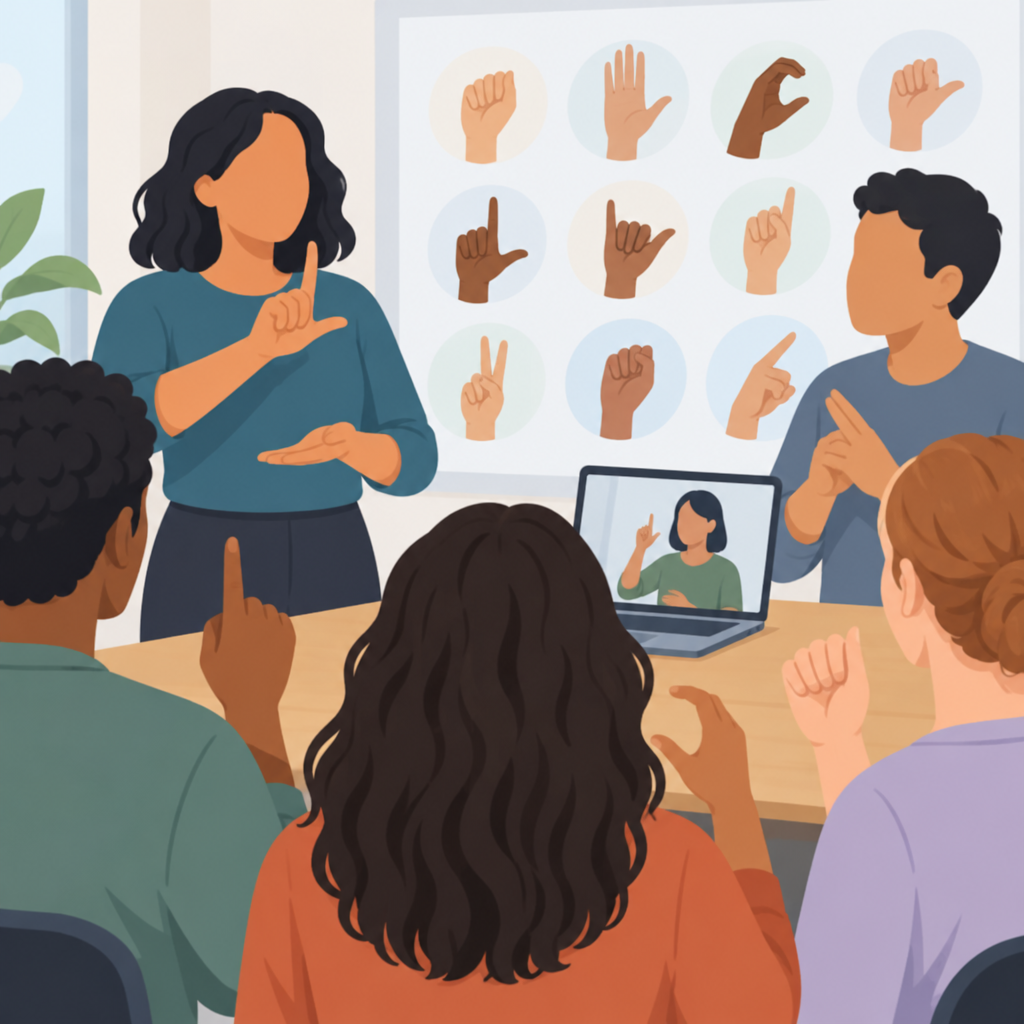
Every letter below is described for a right-handed signer. If you’re left-handed, mirror everything. Lifeprint points out that if you asked a hundred Deaf people to show you the alphabet, you’d see dozens of correct variations. So treat these as standard forms, not the only acceptable ones.
A to F
| Letter | Handshape (plain language) | Palm faces | Movement? | Common mistake |
|---|---|---|---|---|
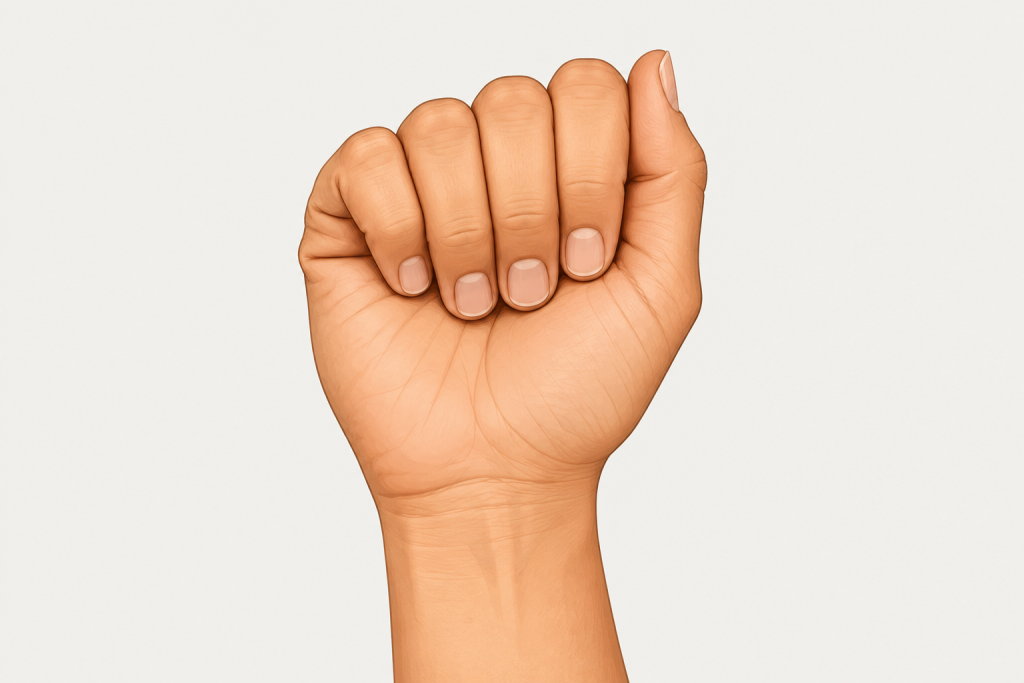
| A | Closed fist, thumb straight up against the side of the index finger | Out | No | Wrapping the thumb across the front, which makes S |
| B | Four fingers straight up and together, thumb folded across the palm | Out | No | Leaving the thumb sticking out to the side |
| C | Fingers and thumb curved into a C, like holding a can | Sideways (to your left) | No | Facing the palm out, which flattens the C |
| D | Index finger up; middle, ring and little fingers curve down to touch the thumb tip | Out | No | Leaving a gap so it looks like a loose 1 |
| E | Fingertips bent down to rest on the thumb, which is tucked across the palm | Out | No | Making a tight fist, which looks like S or A |
| F | Thumb and index fingertip touch in a circle; other three fingers up and spread | Out | No | Squeezing the three fingers together |
G to L
| Letter | Handshape (plain language) | Palm faces | Movement? | Common mistake |
|---|---|---|---|---|
| G | Index finger and thumb stick out parallel, other fingers closed | In, toward you; hand points sideways | No | Pointing up, which looks like L or D |
| H | Index and middle fingers extended together, thumb holds the others down | In; fingers point sideways | No | Pointing up, which makes U |
| I | Fist with the little finger straight up, thumb over the curled fingers | Out | No | Thumb poking out, which drifts toward Y |
| J | I handshape; the little finger traces a J | Starts out, ends facing you | Yes | Moving the whole arm instead of twisting the wrist |
| K | Index up, middle finger angled forward, thumb tip touching the middle finger between them | Out/sideways | No | Spreading the fingers like V with no thumb contact |
| L | Index finger up, thumb out to the side, forming an L | Out | No | Curving the index finger |
M to R
| Letter | Handshape (plain language) | Palm faces | Movement? | Common mistake |
|---|---|---|---|---|
| M | Thumb tucked under the index, middle and ring fingers, which fold over it | Out | No | Tucking under only two fingers, which makes N |
| N | Thumb tucked under the index and middle fingers | Out | No | Tucking under three fingers, which makes M |
| O | All fingertips curve to meet the thumb tip in an O | Sideways | No | Leaving a gap so it reads as C |
| P | K handshape turned so the middle finger points down | Down | No | Keeping it upright, which stays K |
| Q | G handshape turned so the index and thumb point down | Down | No | Pointing sideways, which stays G |
| R | Index and middle fingers crossed, middle in front | Out | No | Fingers side by side, which makes U |
S to X
| Letter | Handshape (plain language) | Palm faces | Movement? | Common mistake |
|---|---|---|---|---|
| S | Closed fist, thumb wrapped across the front of the fingers | Out | No | Thumb up the side, which makes A |
| T | Fist with the thumb tip poking up between the index and middle fingers | Out | No | Gripping too tightly; skilled signers keep it loose |
| U | Index and middle fingers straight up and together | Out | No | Fingers drifting apart into V |
| V | Index and middle fingers up and spread | Out | No | Fingers too close, reading as U |
| W | Index, middle and ring fingers up and spread; thumb holds the little finger | Out | No | Letting the little finger pop up |
| X | Index finger hooked like a crook; other fingers in a fist | Sideways/out | No | Index straight, which reads as D or 1 |
Y and Z
| Letter | Handshape (plain language) | Palm faces | Movement? | Common mistake |
|---|---|---|---|---|
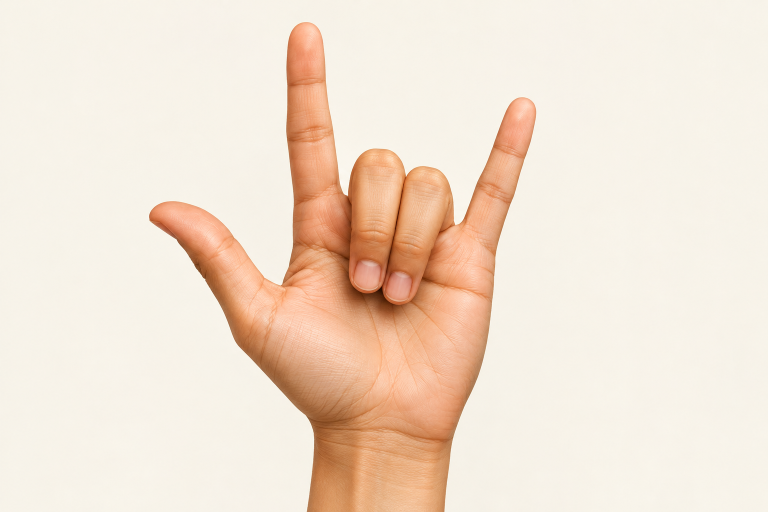
| Y | Thumb and little finger out, the middle three fingers closed | Out | No | Adding the index finger, which makes the “I love you” handshape |
| Z | Index finger extended; it draws a Z in the air | Out | Yes | Drawing a huge Z with the whole arm |
Did you know?
According to Lifeprint, the ASL alphabet has 26 letters but only 22 handshapes. K and P, for example, are the same shape. The only difference is which way the hand points.
The letters that move: J and Z
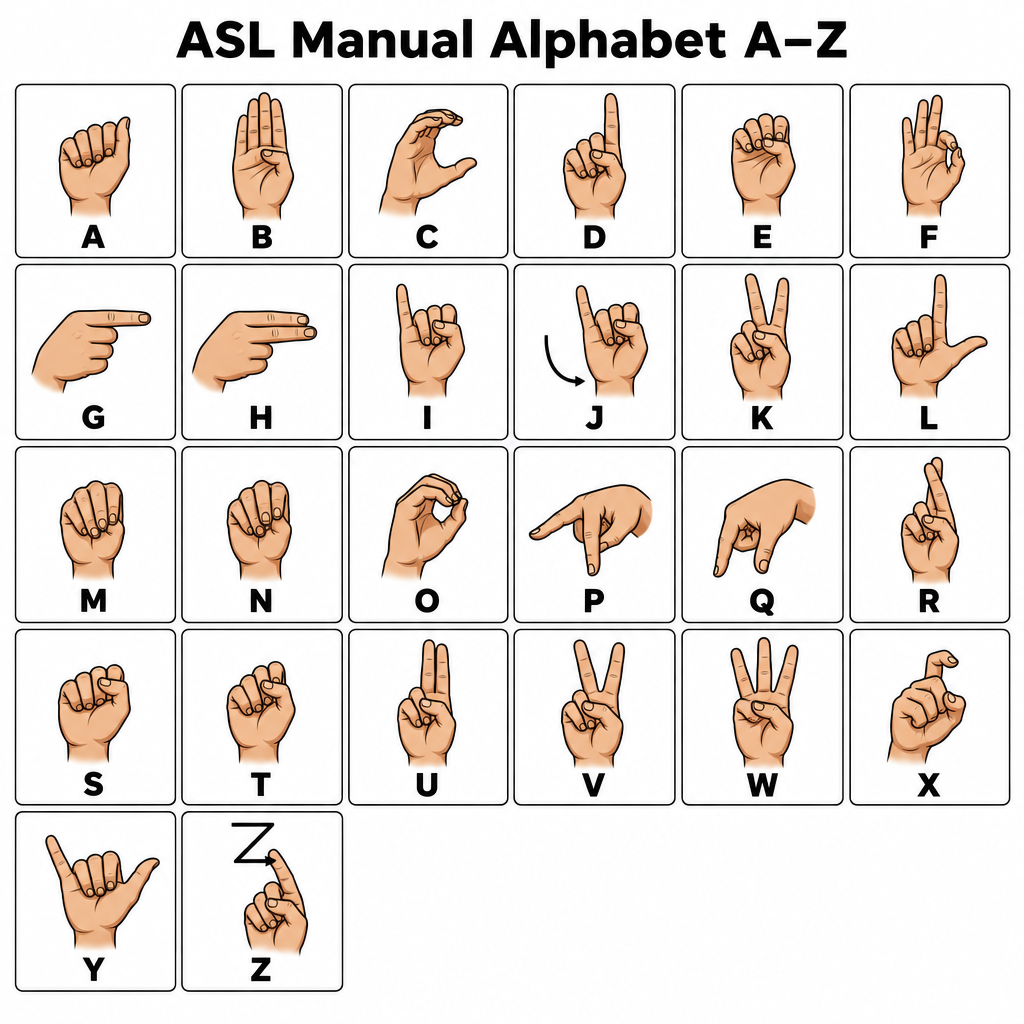
J and Z are the only moving letters in the ASL alphabet. J uses the I handshape and the little finger traces a J. Z uses an extended index finger to draw a Z. Both movements are small and come from the wrist, not the shoulder.
To sign J:
- Make I: a fist with the little finger up and the palm facing out.
- Twist your wrist so the little finger dips down and curves toward you, like the hook of a printed J.
- Finish with your palm facing you. The movement takes about as long as one held letter.
To sign Z:
- Extend your index finger with the other fingers closed and the palm facing out.
- Draw a Z: across, then diagonally down and back, then across again.
- Keep the Z about the size of your face or smaller.
If you’re left-handed
Left-handed signers mirror the whole alphabet, including the movements. Your J hooks the other way and your Z is drawn as a mirror image of a right-hander’s. That’s correct. Don’t switch to your right hand to “get it right.” Pick one dominant hand and stay with it.
Letters beginners mix up (and how to tell them apart)
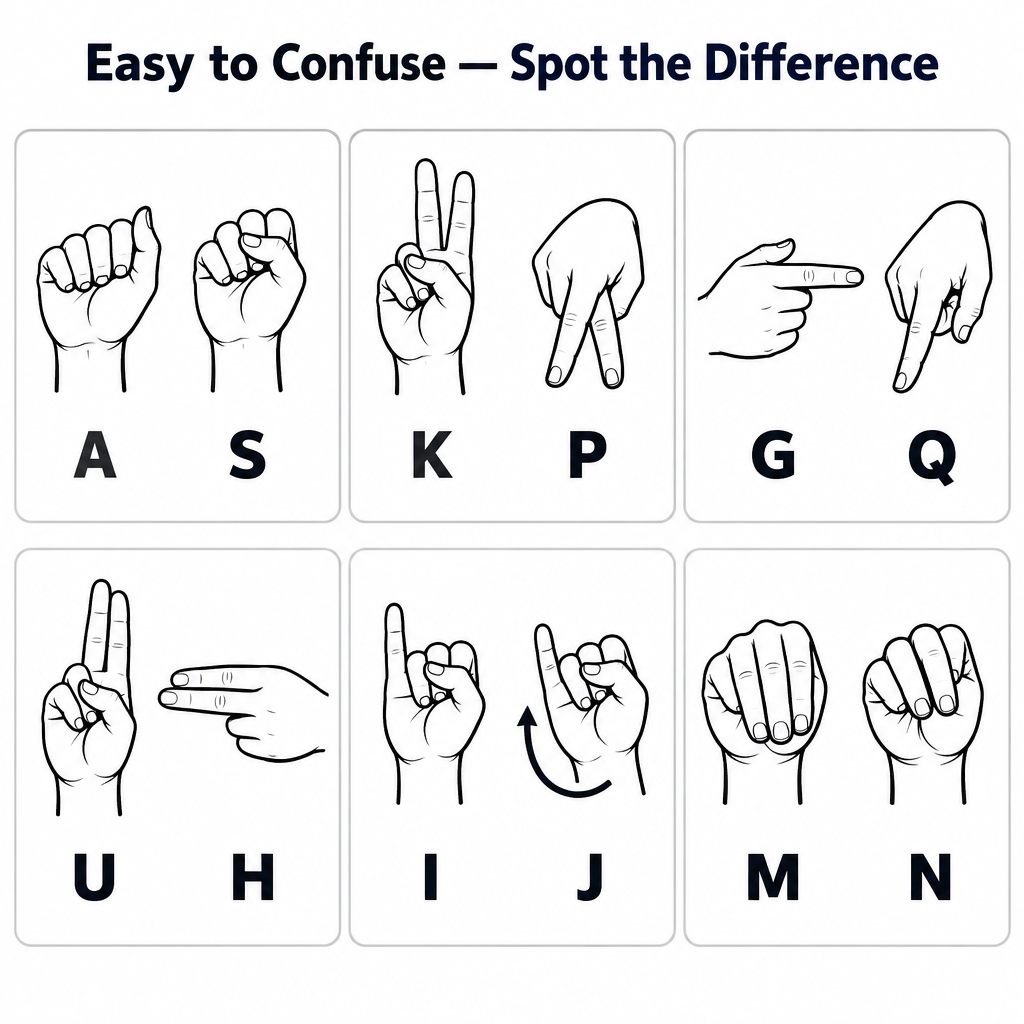
Most mix-ups come from two places. Some letters share one shape and differ only in direction. Others are closed-fist shapes that differ only in where the thumb sits. If your K and P look the same, you’re probably fine on the handshape. What’s missing is the turn of the wrist.
Same shape, different direction: G/Q, K/P, H/U, I/J
| Pair | What’s the same | What’s different | Quick check |
|---|---|---|---|
| G / Q | Index and thumb parallel | G points sideways; Q points down | Can you see the floor past your fingertips? Then it’s Q |
| K / P | Index, middle and thumb in a K | K points up; P points down | Middle finger aimed at the ground means P |
| H / U | Two fingers extended together | H points sideways; U points up | Fingers parallel to the floor means H |
| I / J | Little finger up | J adds a wrist twist that traces the letter | No movement means I |
The fist letters: A, S, T, M, N, E
These six all start from a closed or nearly closed hand. The thumb is what tells them apart:
- A: thumb up along the side of the fist.
- S: thumb across the front of the fingers.
- T: thumb between the index and middle fingers.
- N: thumb under two fingers.
- M: thumb under three fingers.
- E: fingertips curled down onto a tucked thumb, with the nails showing.
For the M/N question, count the fingers draped over the thumb. Three humps make M and two make N. The person watching sees knuckles, so make them visible rather than burying the thumb.
R vs U vs V, D vs F, C vs O
- R, U and V all use the index and middle fingers. R crosses them, U holds them together and V spreads them.
- D and F both make a circle. In D the index finger stands up and the other fingers form the circle. In F the index finger and thumb touch to form the circle and the other three fingers stand up.
- C and O differ in handshape as well as closure. C is curved and open, while O brings the fingertips toward the thumb to form a closed shape.
The ASL sign for “ABC” and “alphabet”
You don’t need a separate dictionary sign to talk about “the ABCs.” Lifeprint describes the usual ways: fingerspell A-B-C and then add the sign FINGERSPELL, or fingerspell A-B-C, sign THROUGH and fingerspell Z, which gives you “A through Z.” FINGERSPELL is usually made with the dominant hand palm down while the fingers flutter and the hand moves sideways. Context does the rest. If you’re talking about a child learning letters, A-B-C alone is often clear.
So “ABC in sign language” can mean either of two things:
- Fingerspelling the letters A, B and C: a fist with the thumb up, then a flat hand with the thumb folded in, then a curved C.
- Referring to the alphabet as a topic: A-B-C plus FINGERSPELL, or the “A through Z” phrasing.
How fingerspelling is actually used in ASL

Fingerspelling borrows English words into ASL. It isn’t ASL itself. Signers use it for names, places, brand names, titles and English words with no settled sign. Knowing the alphabet doesn’t mean you can sign, in the same way that knowing how to spell doesn’t mean you can hold a conversation.
The NIDCD (National Institute on Deafness and Other Communication Disorders) describes ASL as a complete, natural language with its own grammar, separate from English. That grammar uses space, movement, facial expression and handshape together. Our piece on the meaning of ASL covers this in more depth. Many fluent signers fingerspell often, but in a sentence the spelled word sits inside ASL grammar.
Fingerspelling etiquette
Clear fingerspelling follows a few habits, and Deaf signers notice when they’re missing:
- Don’t bounce. Keep the hand in one spot. Pushing the hand forward on every letter makes the word hard to read.
- Don’t say each letter aloud. If you mouth anything, mouth the whole word.
- Pause between words. Hold the last letter for a beat, or drop the hand briefly, before the next word.
- Handle double letters smoothly. For the LL in “balloon,” slide the hand slightly sideways or do a small repeat instead of rebuilding the letter.
- Choose clarity over speed. A steady, even pace beats a fast blur. Speed comes from fluency over time.
- Ask for a sign. Once a name or term has been spelled, Deaf people will often show you its sign. Use it after that.
Hearing tip
For a double letter, such as the OO in “book” or the EE in “Lee,” make a small sideways slide of the same handshape. Making the letter twice from scratch looks like two separate letters.
Why chart letters look different at speed
If Deaf signers’ letters look different from your chart, you didn’t learn it wrong. Charts show the shapes slowly, one at a time. Lifeprint notes that skilled signers don’t bend or wrap their fingers for M, N and T as tightly as alphabet charts show. At real speed, letters blend into each other. The hand moves through the word’s shape instead of stopping hard on each letter.
Did you know?
Lifeprint’s lessons point out that real fingerspelling looks noticeably looser than a poster. Fluent signers soften letters like M, N and T, so reading real people means learning shapes in motion.
How to read fingerspelling (the hard part)
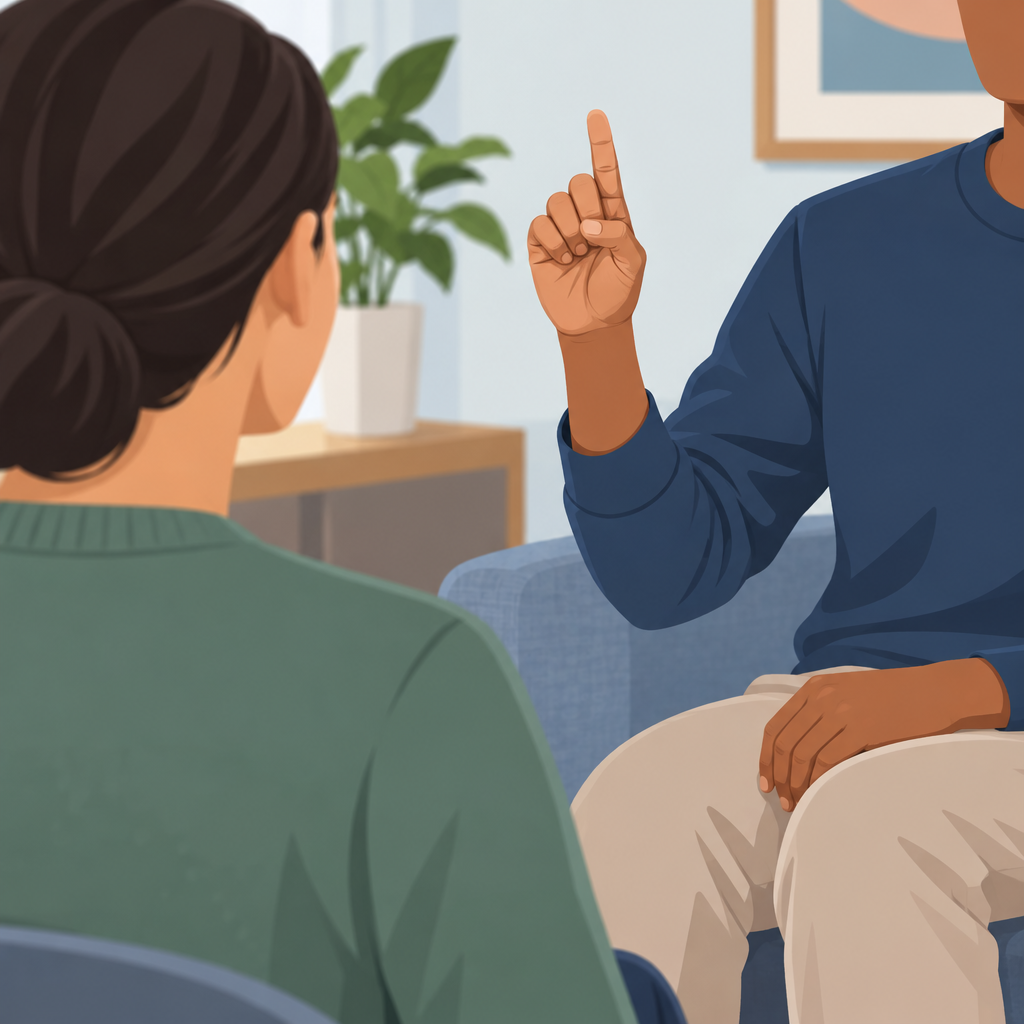
Struggling to hold the word in your head while it’s being spelled is completely normal. Almost every learner hits it. Reading fingerspelling is a separate skill from producing it. Many people can spell quickly but can’t read anyone else, because they’ve only ever practiced their own hand.
What works, based on guidance from Signing Savvy and Lifeprint:
- Look straight at the hand. Signing Savvy notes that learners usually can’t read fingerspelling in peripheral vision at first. Fluent signers watch the face and catch the hand at the edge of view. You’ll get there, but early on you need to look directly at it.
- Catch the first letter. Signing Savvy calls this key. The first letter, plus the length and context, narrows the word fast.
- Read the shape, not the letters. Don’t sound out each letter in your head. Try to see the word’s overall movement, the way you read “the” without spelling it.
- Don’t panic in the middle. You lose the word partway through because you’re still decoding letter three while letter six goes by. Let missed letters go and aim for the overall shape.
- Ask again. Asking someone to spell it again is normal and polite.
A 10-minute daily practice plan
- Minutes 1 to 2: Spell A to Z slowly in front of a mirror and check the fist letters and orientation pairs.
- Minutes 3 to 4: Spell your own name, family names and your street, five times each, at an even pace.
- Minutes 5 to 8: Watch real-speed fingerspelling (Lifeprint’s practice pages or a Deaf creator’s videos) and write down the first letter and length of each word before guessing.
- Minutes 9 to 10: Spell three-letter words (cat, dog, sun) with no bounce, holding the last letter before starting the next.
Spend at least half your time reading, not forming.
Hearing tip
When you watch practice videos, note just the first letter and how long the word is before you guess. That habit trains your eyes to read the overall word instead of stalling on each letter.
Practice tools and apps, and their limits
Checked November 2026.
| Tool | Type | Practice focus | Camera feedback | Cost note |
|---|---|---|---|---|
| Lifeprint / ASL University | Website lessons by Dr. Bill Vicars | Forming and reading | No | Free lessons |
| Signing Savvy | Online dictionary and articles | Reading tips, sign lookup | No | Free articles; some tools need a membership |
| Fingerspelling.xyz | Browser game by Hello Monday with the American Society for Deaf Children | Forming letters and words | Yes, webcam hand tracking | Free; built for desktop |
| Signs (signs-ai.com) | Web platform by NVIDIA, the American Society for Deaf Children and Hello Monday | Forming signs with a 3D avatar | Yes, webcam | Free |
Hello Monday says Fingerspelling.xyz doesn’t store or send webcam data. Camera tools are good at one thing: telling you whether your handshape matches the model. They can’t teach you to read other people. NVIDIA has also said Signs currently tracks hand movements and finger positions only, with facial expressions and regional variation planned for later. Use these tools to check your form, and use real Deaf signers on video or in classes for reading skill.
ASL alphabet vs other sign language alphabets
Sign language alphabets aren’t universal. ASL uses a one-handed alphabet. British Sign Language (BSL), Auslan (Australia) and New Zealand Sign Language (NZSL) use a two-handed one. The SAGE Deaf Studies Encyclopedia groups those three as the BANZSL family. It also notes that ASL, French Sign Language (LSF) and German Sign Language use one-handed alphabets.
| Feature | ASL | BSL / Auslan / NZSL |
|---|---|---|
| Hands used | One | Two |
| Vowels | Distinct handshapes | Shown by touching fingertips of the non-dominant hand |
| Related to | LSF (French Sign Language) | Each other (BANZSL family) |
| Moving letters | J and Z | Several letters involve contact and movement between hands |
| Mutual understanding | Separate language | NIDCD notes that Americans who know ASL may not understand BSL |
This matters when you search. Image results for “sign language alphabet” often mix ASL and BSL charts. If a chart shows two hands touching, it’s not ASL. Our guide to the sign language alphabet covers the letter-by-letter differences.
Where the ASL alphabet came from
The American manual alphabet came from France. In 1620, Juan Pablo Bonet published a one-handed manual alphabet in Spain for teaching deaf students. In Paris, Abbé Charles-Michel de l’Épée’s school used a one-handed alphabet for French. Laurent Clerc studied at that Paris school and later taught there.
Thomas Hopkins Gallaudet traveled to Europe looking for teaching methods and brought Clerc back to the United States. In 1817 they co-founded the school in Hartford, Connecticut, now the American School for the Deaf. Kentucky’s Commission on the Deaf and Hard of Hearing says the manual alphabet Gallaudet brought from France is essentially the one still used today. Gallaudet University in Washington, DC, is named for him. ASL itself grew from LSF mixed with signing already used in American Deaf communities, and it kept developing regionally. One example is Black American Sign Language, which has its own history in the Deaf community.
Interest keeps growing. ASL first passed German to become the third most enrolled language in US colleges in the Modern Language Association (MLA) 2013 survey. In the MLA’s fall 2021 census, ASL was one of only three of the top 15 languages whose enrollment rose, alongside Korean and Biblical Hebrew. Over the same period, total language programs fell from 11,734 in 2016 to 10,773.
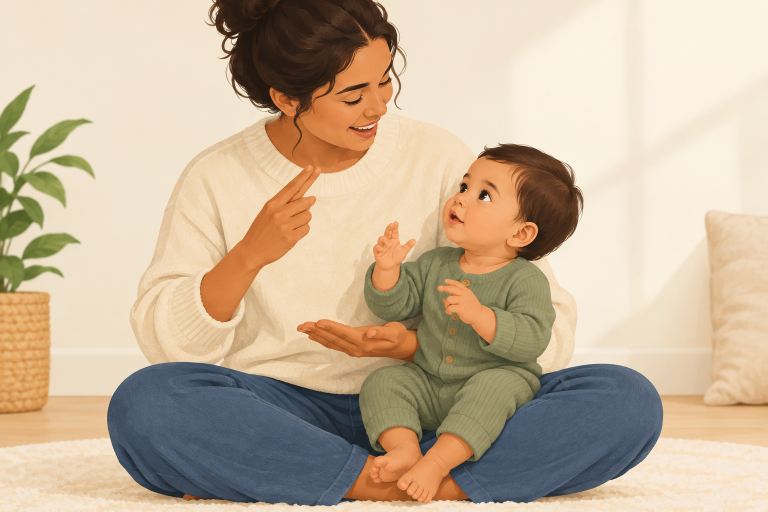
Teaching the ASL alphabet to kids and families
The NIDCD reports that 9 out of 10 children born deaf have hearing parents. For many of those families, the alphabet is the first piece of ASL they learn. It helps, but keep it in proportion. A deaf child needs full access to language, which can come through a fully accessible signed or spoken language. ASL is one language option, and spelling alone is not enough.
Family-friendly ways to practice:
- Start with names. Each family member learns to spell their own name and everyone else’s.
- Play the A-to-Z challenge. Time each person spelling the whole alphabet cleanly. Clean letters count, speed second.
- Play first-letter guess. One person spells a word from a category (animals, foods) and everyone races to name it.
- Spell road signs and cereal boxes. Brand names are real fingerspelling material.
See a professional
If you think your child or you may have hearing loss, book a hearing evaluation with an audiologist. Sudden hearing loss in one or both ears is a medical emergency, so see a doctor the same day.
FAQ
How do you sign ABC in sign language?
In ASL, fingerspell A (a fist with the thumb up the side), B (a flat hand with the thumb folded across the palm) and C (a curved C shape facing sideways). To mean “the alphabet,” Lifeprint describes adding the sign FINGERSPELL after A-B-C, or spelling “A through Z.”
How do you sign the alphabet in ASL?
Use your dominant hand at shoulder height, palm mostly out, and form each of the 26 handshapes in order. Only J and Z move. The rest are held still and flow from one to the next without bouncing.
Which ASL letters move?
Only J and Z. J traces a J with the little finger using the I handshape. Z traces a Z with the index finger.
How do you sign J and Z in ASL?
For J, make I and twist your wrist so the little finger hooks down and toward you. For Z, point your index finger and draw a small Z in the air. Left-handers mirror both.
Is the sign language alphabet the same in every country?
No. ASL, LSF and German Sign Language use one-handed alphabets. BSL, Auslan and NZSL use a two-handed alphabet. Even one-handed alphabets differ between countries.
What’s the difference between the ASL and BSL alphabets?
ASL uses one hand and a distinct handshape per letter. BSL uses two hands, and the vowels are made by touching the fingertips of the non-dominant hand. They belong to separate languages.
Should I fingerspell with my left or right hand?
Use your dominant hand. Left-handed signers mirror everything, including J and Z. Stay consistent, because switching hands mid-conversation makes you harder to read.
Which way is my palm supposed to face?
Mostly toward the person you’re talking to. The exceptions are C and O (sideways), G and H (palm in, pointing sideways), and P and Q (pointing down).
How long does it take to learn the ASL alphabet?
Many learners can form all 26 letters within a few days of short practice. Reading real-speed fingerspelling takes much longer, usually months of regular watching. That’s the skill to plan for.
Is fingerspelling the same as sign language?
No. Fingerspelling is a way to borrow English words into ASL. ASL is a full language with its own grammar, and most of it is signs, not spelled words.
What’s the difference between M and N in ASL?
M tucks the thumb under three fingers (index, middle and ring). N tucks it under two (index and middle). Count the knuckles folded over the thumb.
My K and P look the same. Am I doing it wrong?
Your handshape is probably correct, since K and P share one shape. Point the middle finger up for K and turn your wrist so it points down for P.
I learned the alphabet from a chart, but Deaf people’s letters look different. Did I learn it wrong?
No. Lifeprint notes that skilled signers form letters like M, N and T more loosely than charts show, and many valid variations exist. Keep your chart forms, then copy fluent signers’ looser shapes as your speed grows.
Once you can spell your own name cleanly, start reading other people. Choose one real-speed fingerspelling video a day and try to catch the first letter and the word length before you guess. That one habit does more for real conversations than another week of drilling the chart.
About this article
- Fact-checked by Lorraine Ostrowski against the sources listed below before publication.
- Published
Sources (8)
- Lifeprint: Fingerspelling handshapes (lifeprint.com)
- Lifeprint: ASL alphabet ABC chart (lifeprint.com)
- Lifeprint: American Sign Language Handshapes (lifeprint.com)
- Lifeprint: ABCs sign (lifeprint.com)
- Lifeprint: Fingerspelling (lifeprint.com)
- ASL alphabet (Wikipedia) (en.wikipedia.org)
- NIDCD: American Sign Language (nidcd.nih.gov)
- SAGE Deaf Studies Encyclopedia: Two-handed fingerspelling (sk.sagepub.com)